Entries for March 2015
Here’s The Economist’s obituary of Lee Kuan Yew, the founder of Singapore.
Among a number of 20th-century luminaries asked by the Wall Street Journal in 1999 to pick the most influential invention of the millennium, he alone shunned the printing press, electricity, the internal combustion engine and the internet and chose the air-conditioner. He explained that, before air-con, people living in the tropics were at a disadvantage because the heat and humidity damaged the quality of their work.
Martin Scorsese is reportedly set to direct a biopic on Mike Tyson with Jamie Foxx in the title role. Tyson has compiled a video of each of his 44 knockouts and wants his fans’ help in choosing his top 10 for Foxx to study.
The top 10 from this video are definite contenders.
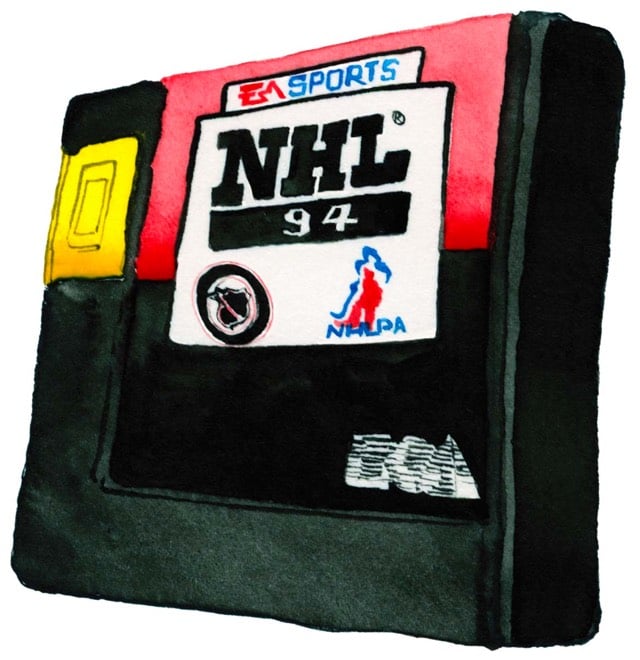
Blake Harris, the author of Console Wars, has written a piece on how NHL ‘94 came to be. For those unaware, NHL ‘94 is one of the greatest sports video games ever created. This is the sort of attention to detail that made it so great:
For example, it could emulate the ambience of a game day NHL arena by including the proper organ music. The problem, though, was that each team’s organist played different songs. ‘That’s not a problem, actually,’ explained Dieter Ruehle, the organist for the San Jose Sharks (and previously for the Los Angeles Kings), ‘I can do that.’ True to his word, Ruehle provided EA with organ music for every team; and he didn’t just provide all of their songs, but also noted which music was blasted during power plays, which tunes were used to celebrate goals, and all the other inside info needed to make each arena feel like home. Ruehle was so diligent about getting it right and capturing that home crowd essence, that during a recording session at EA’s sound studio he asked:
‘The woman who plays the organ for the Washington Capitals has arthritis; would you like me to play the songs how they are meant to be played, or the way that she plays them because of her condition?’
‘Definitely the way she plays it!’ Brook answered, after a laugh.
I think I might have to bust out the Genesis this week. Anyone wanna come over?
Finland is planning on phasing out teaching by subject (math, geography, etc.) and replace it with a teaching-by-topic approach.
Subject-specific lessons — an hour of history in the morning, an hour of geography in the afternoon - are already being phased out for 16-year-olds in the city’s upper schools. They are being replaced by what the Finns call “phenomenon” teaching — or teaching by topic. For instance, a teenager studying a vocational course might take “cafeteria services” lessons, which would include elements of maths, languages (to help serve foreign customers), writing skills and communication skills.
More academic pupils would be taught cross-subject topics such as the European Union — which would merge elements of economics, history (of the countries involved), languages and geography.
As a generalist, wannabe polymath, and obvious fan of a scattershot approach to knowledge gathering & dissemination, I approve. (via qz)
Update: From the Finnish National Board of Education: Subject teaching in Finnish schools is not being abolished.
The news that Finland is abolishing teaching separate subjects has recently hit the headlines world-wide. Subject teaching is not being abolished although the new core curriculum for basic education will bring about some changes in 2016.
(via @adamcreen)

Ok, Pluto fans. They evicted Pluto from our solar system’s planetary pantheon, but a NASA mission launched in 2006 is nearing the dwarf planet with its cameras. We’ll soon have photos of Pluto that are much more high resolution than we currently have, which means scientists will need names for all the new geographic features. The Our Pluto site has been set up to help suggest and vote on names for these features. Naming themes include historic explorers, travelers to the underworld, and scientists and engineers. Go vote! (via slate)
I am a total sucker for great wave photography. Like these photos from Ray Collins.



Prints are available of Collins’ photos and many of them have been collected into a coffee table book called Found at Sea. (via @naveen)
New Every Frame a Painting! In this installment, Tony Zhou shows how Akira Kurosawa used movement in his films to terrific effect.
From the cool devices in our hands, to the software on our screens, to the smooth stylings of Jony Ive’s Apple product video voiceovers, it’s clear this is the era of design. Since design has touched and changed so many parts of our lives, isn’t it time that we redesigned death? The chief creative officer at one of the top design firms in the world thinks it is:
With just a little attention, it seemed — a few metaphorical mirrors affixed to our gurneys at just the right angle — he might be able to refract some of the horror and hopelessness of death into more transcendent feelings of awe and wonder and beauty.
From Jon Mooallem in California Sunday Magazine: Death, Redesigned. (I like where you’re going with the embalming and the eternal darkness, I just think it could pop a little more.)

I had a great time guest-blogging here this week! Thanks so much to Jason and to everyone who read, some of the smartest, most interesting readers I’ve found online. It was really a thrill. It was like being Krang inside the exosuit, but in a good way.
When Jason originally put out the call on Twitter for a guest blogger, he tweeted, “It’s a paid gig or you can do it for the lolz and we’ll donate the fee to a charity of your choosing.” So we’re donating the money to Girls Write Now, a terrific New York City-based non-profit that pairs talented at-risk teen girls with professional writer mentors to create the next generation of great women writers.
You can find me online here or on Twitter.
Update (from Jason): Thanks, Susannah! It’s been great having you here. I just dropped your fee into the coffers of Girls Write Now. If some of you would like to do the same, you can donate here; it’ll only take you a couple minutes.
And since Susannah was too courteous to promote her recently published short story, The Tumor, I’ll do it.

You may have seen artist Clayton Cubitt’s NSFW Hysterical Literature project. On YouTube, the videos have been viewed nearly 50 million times. The recipe is simple: a woman, a book, and a Hitachi Magic Wand. In the latest installment, Janet, who’s in her early sixties, reads Ralph Waldo Emerson. It’s a lovely meditation on women, sexuality, and age. The project is also on view at MASS MoCA’s Bibliothecaphilia show.
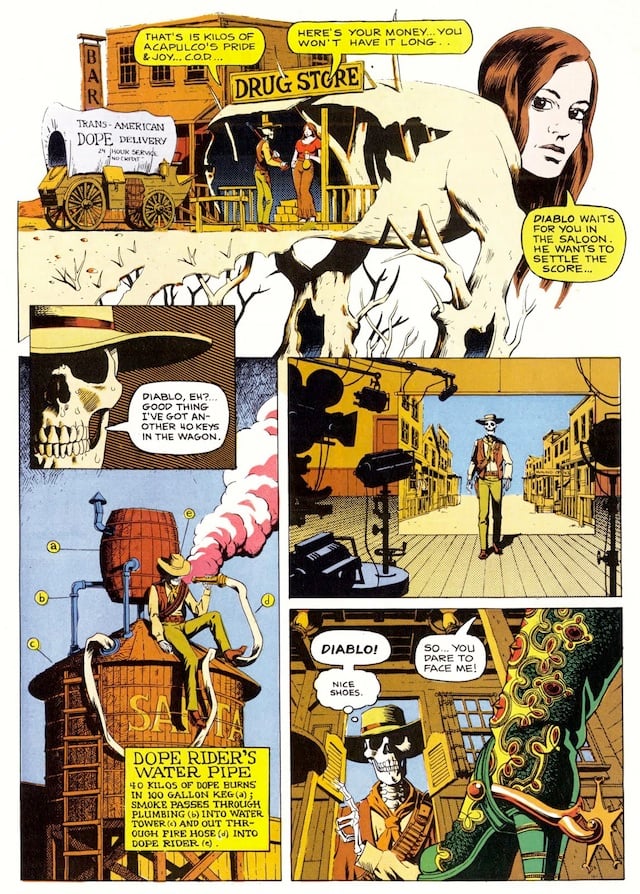
Since I wasn’t a High Times reader in 1975, I missed the debut of Dope Rider, a totally trippy, startlingly surrealistic comic strip starring a Wild West skeleton and created by Paul Kirchner. Thankfully, Kirchner has uploaded the entire Dope Rider oeuvre and shared the back story on what may be one of the comic world’s stranger strips. The psychedelic comic features dope trading, Hells Angels references, and lines like, “The best things about being high is the view.”
(via Gawker)

A thought-provoking post from Laurie Frick: “Will a Data-Selfie Boost Your Immune System?”
In the future I imagine human data portraits manifested from reams of personal tracking data gathered invisibly as we move thru the day. Genuine data-selfies. We are so close to gathering every possible morsel of data about us, imagine what could be possible once you owned every bit of data gathered about you. After some thought, I decided it’s more than just seeing personal data and abstract patterns of you. It’s about what these patterns will tell us about ourselves. Data collected about us will unfold a personal narrative and story to reveal a hidden part of us we are trained to ignore, a way to know ourselves and anticipate what comes next. Perhaps seeing the abstract patterns and rhythms of your self-tracking data is a short-cut to mindfulness. A quick and dirty way to boost your immune system, the benefits of meditation and self-reflection without much effort.
Frick makes art out of data. She also made an app called FRICKbits that empowers you to turn your data into art.
I really love this video featuring the opening and closing shots of fifty-five movies presented side-by-side, “First and Final Frames.” Created by Jacob T. Swinney.
My favorites: “Tree of Life,” “Raging Bull,” “Melancholia.”
Update: Swinney has released a second installment of First and Final Frames.
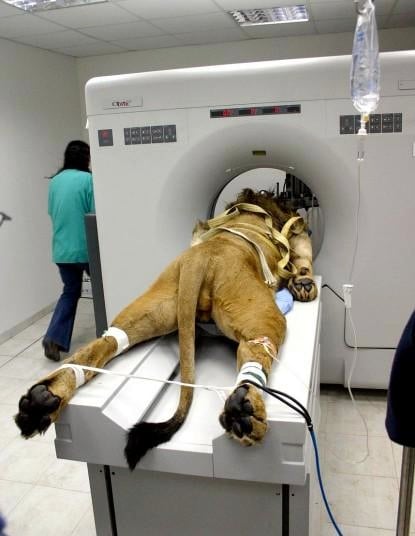
Apparently, this is what it looks like when a lion is getting a CAT scan.
(via Amanda Macias)
The “Mad Max: Fury Road” international trailer features fire and blood, colorful explosions, and Charlize Theron screaming. What a lovely day, indeed. BRB, I gotta go get in line.
(via This Isn’t Happiness)
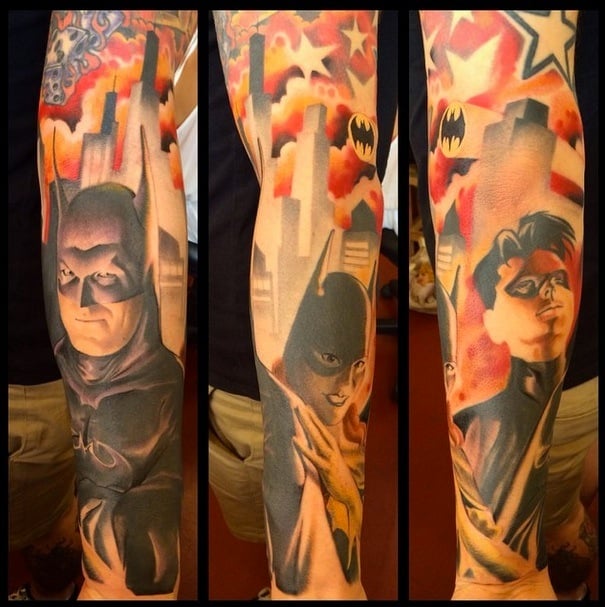
Leslie Rice (whose work you see here) is a second-generation tattoo artist who’s been tattooing for twenty years, and here’s the number one thing he’s learned: “Women are tougher than men.”
“Women and men have a very different approach to traumatic things like getting tattoos. Women are far more willing to accept it and go with the flow, whereas men will try and fight it, so you end up in this horrible situation where men end up vomiting and passing out and falling on the floor, and the women don’t tend to do that.”
(via Needles and Sins)
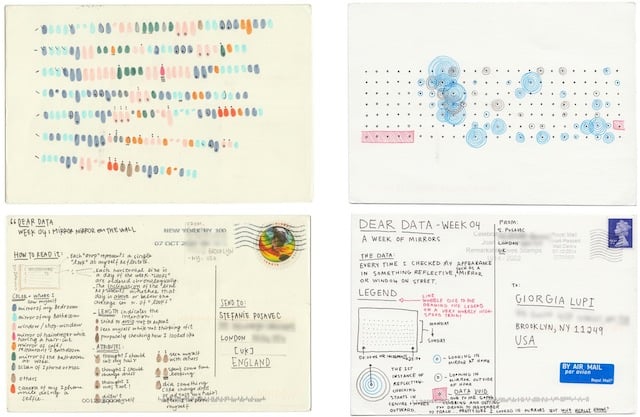
Giorgia Lupi, who lives in New York, and Stefanie Posavec, who lives in London, are engaged in a long-distance, postcard-based data exchange in order to get to know each other better: “Dear Data.” They’ve only met in person twice, and they’re both interested in data, so they’re sending each other postcard drawings of data about their day-to-day lives.
Each week we collect and measure a particular type of data about our lives, use this data to make a drawing on a postcard-sized sheet of paper, and then drop the postcard in an English “postbox” (Stefanie) or an American “mailbox” (Giorgia)!
Eventually, the postcard arrives at the other person’s address with all the scuff marks of its journey over the ocean: a type of “slow data” transmission.
By creating and sending the data visualizations using analogue instead of digital means, we are really just doing what artists have done for ages, which is sketch and try to capture the essence of the life happening around them. However, as we are sketching life in the modern digital age, life also includes everything that is counted, computed, and measured.
We are trying to capture the life unfolding around us, but instead we are capturing this life through sketching the hidden patterns found within our data.
The data appears on the front of the postcard, and a key explaining how to read the data appears on the back of the postcard. (via Coudal)
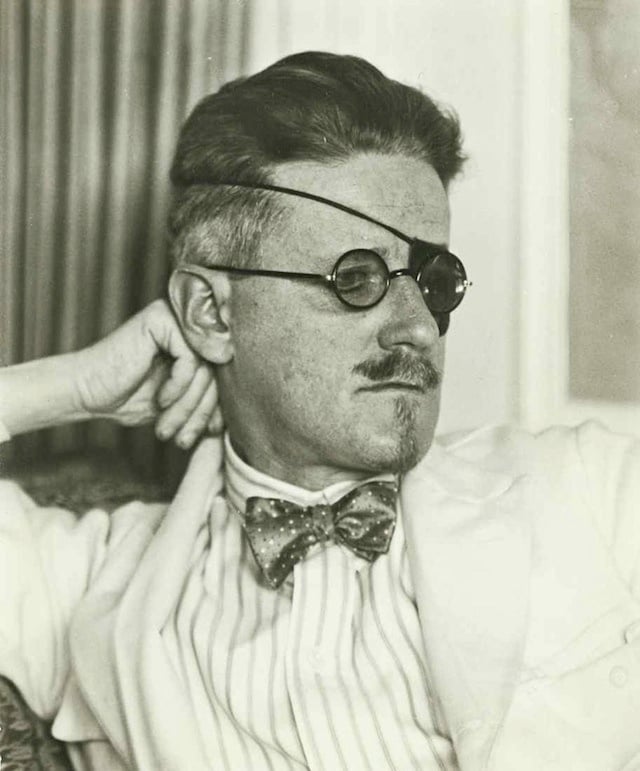
James Joyce is the greatest writer the world has ever known. Arguably! He didn’t even bother confining himself to the known language. He created words of his own.
A few highlights from “17 Words Invented by James Joyce”:
Bababadalgharaghtakamminarronnkonnbronntonnerronntuonnthunnt-rovarrhounawnskawntoohoohoordenenthurnuk. This is Joyce’s most famous word creation. It’s from Finnegans Wake, and it’s supposed to sound like a thunderclap. Which it does. If you can figure out how to pronounce it.
Peloothered. This means you’re drunk. Someone calls you this in Ireland, and you know you’re blotto.
Smilesmirk. Girls on Instagram have basically perfected this one.
Update: Ryan Goodlett advises: “I’ve found after a handful of languages that Icelandic sounds the best.” Agreed! And Kevin Krebs suggests: “you’ll want to follow @FW_WOTD.” Michael Schwartz says: “You might want to try james Joyce or Kool Keith.” I got six out of ten. How embarrassing.
This is a donk.
It can be yours for $65,000.

This guy turned recovered Federal HST pistol bullets into a Valentine’s Day gift for his girlfriend.
I started out with a box of Federal 9x19mm HST 147gr pistol ammunition. This was a box of 50 rounds purchased at the Gun Bunker in Shrewsbury PA for $35 plus tax. I fired 6 of these cartridges into a 30” tall trash can filled with water. I did this from an elevated firing position, striking the water perfectly perpendicular. I used a Beretta 92FS Inox pistol with a 5” barrel, and a Freedom Armory Machine Works Grenadier 45 suppressor (as to not alarm the neighbors). This caused the hollowpoints to expend nearly perfectly, with nothing to deform them before they were fully decelerated by the water. One of the six did not expand, and was discarded. A firearm with a significantly longer or shorter barrel would have probably affected the expansion. I was about 10 feet above the trash can, but I still managed to get splashed from this.
An Hermes Birkin bag costs between $10,000 and $150,000, and women of a certain income bracket who own Birkin bags are putting their babies in them.
There are babies in blue Birkin bags, babies in green Birkin bags, babies in patterned Birkin bags, babies in unknown original color Birkin bags, and babies in bougainvillea ostrich Birkin bags.
This woman made her daughter a Birkin bag Halloween costume.
Who started the Baby-in-a-Birkin trend?
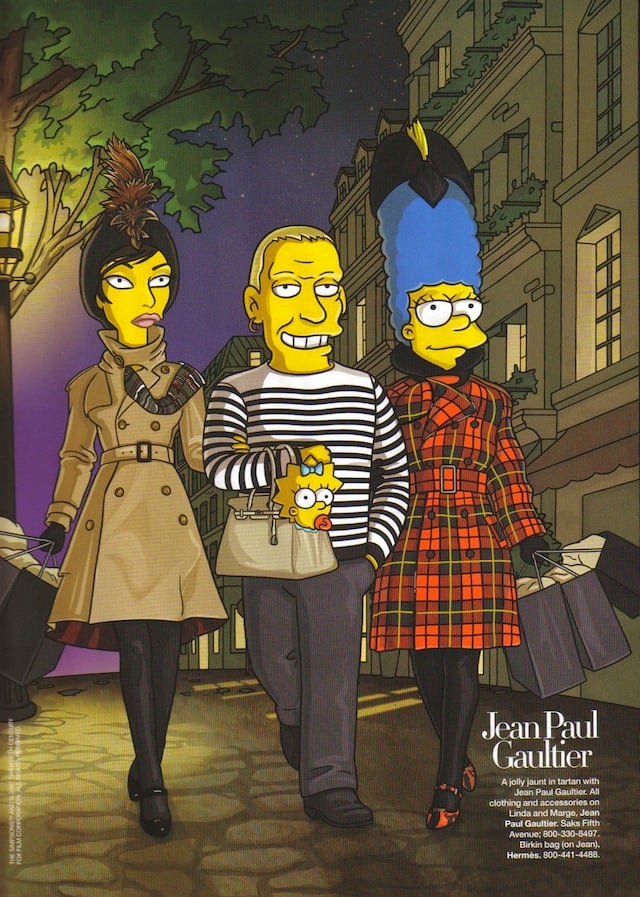
It appears Maggie Simpson is the culprit.
Have you always dreamed of owning the home where Tony Montana married Elvira Hancock? The “Scarface” estate known as El Fureidis can be yours for only $34M.

But many of the classic features of the mansion are still in place: an 18-foot-high central dome adorned with 24-karat gold leaf in the Byzantine-style alcove, as well as a formal dining room ceiling depicting a scene of Alexander the Great conquering Persepolis in 330 B.C. (also designed with 24-karat gold leaf).
NB: The house isn’t in Coral Gables, FL. It’s in Montecito, CA.
Here’s a relatively exhaustive exploration of “Scarface” shooting locations, including the elevator scene and the chainsaw scene. (via Damon Brown)

Motherboard has an interesting story about how women who lose limbs are finding prosthetic devices are made for men: “Man Hands.”
When Jen Lacey gets her toes done, she does both feet, even though one of them is made of rubber. “I always paint my toenails,” she says, “because it’s cute, and I want to be as regular as possible.” But for a long time, even with the painted toes, her prosthetic foot looked ridiculous. The rubber foot shell she had was wide, big and ugly. “I called it a sasquatch foot,” she jokes. “It’s an ugly man foot.”
Part of the problem is that most prosthetic devices are designed by men and most prosthetists are men.
There are a few reasons for all this male-centric design. The history of prosthetics is, in large part, a history of war. One of the earliest written records of a prosthetic device comes from the Rigveda, an ancient sacred text from India. Ironically, that amputee is a woman—the warrior queen Vishpala loses her leg in battle and is fitted with a replacement so she can return and fight again. But after that, the history of prosthetics is nearly entirely a history of men—Roman generals, knights, soldiers, dukes.
Every year, 30 percent of those undergoing an amputation are women. In other words, it’s the 70 percent that’s male that drives the market.
Copyranter says this is the best St. Patrick’s Day ad ever made.
See also: Mouth Eyes, Madonna’s “Bedtime Story,” and “Born with Three Mouths.”
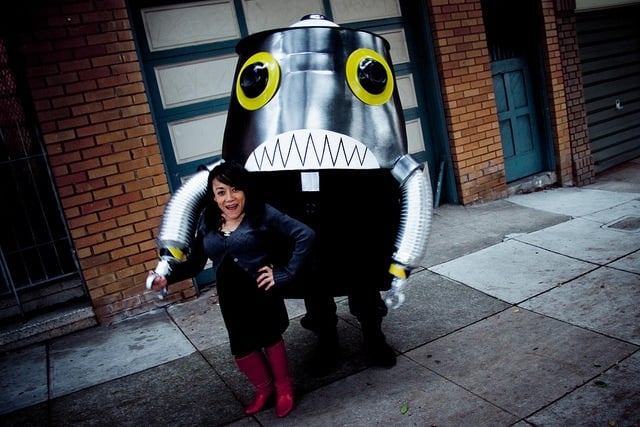
I, for one, welcome our new ROBOPRIEST overlords. I found ROBOPRIEST on artist Josh Ellingson’s website. The robot costume-for-two was intended to perform wedding ceremonies and is the brainchild of Ellingson and Selene Luna, a 3’10” performance artist. It speaks in a robot voice, has flashing eyes, and the interior of its hatch is decorated with dirty pictures.
The idea of ROBOPRIEST started as a joke on Twitter between me and Selene Luna, an actress friend of mine in Los Angeles. We were trying to come up with funny ideas to collaborate on wedding services.The joke then turned into reality when Selene asked me to build ROBOPRIEST for her one woman show, “Sweating the Small Stuff” in San Francisco. The costume consisted mostly of cardboard and foam rubber with a skeleton of plastic hula hoops. The “eyes” are speakers equipped with voice-activated electro-luminescent wire. The audio for ROBOTPRIEST’s voice and various sound-effects were created by sound designer, Jim Coursey.
Its components include children’s toy claws, silver lame, ductwork, an iPod, and a harness that enables Luna to operate the costume from inside while riding piggyback on Ellingson.
Selene pilots ROBOPRIEST from a harness attached to my back. The harness is called The Piggyback Rider and is really just a backpack strap with a bar that runs along the bottom. This allowed Selene to comfortably stand on my back and easily hop off if needed. The top of ROBOPRIEST is equipped with a hatch from which Selene can address her minions. The inside of the hatch is decorated with a collage of nudie magazine clippings (NSFW), something that I thought appropriate for the insides of a repressed robot’s head at the time, although it may just have been all the hot-glue fumes getting to me.
Ellingson’s site has sound clips and a video of ROBOPRIEST announcing himself, and there are lots of photos on Flickr showing the build process.
The New York Times would like to tell you how to keep your hair during chemo.
Hair loss is one of the most obvious side effects of cancer treatment. Now, a growing number of breast cancer patients are freezing their scalps as a way to preserve their hair during chemotherapy.
The hair-saving treatment, widely used in Europe, requires a specialized frozen cap worn tightly on the head before, during and for a couple hours after a chemotherapy session. The method can be time consuming, expensive and uncomfortable, but numerous women swear by the results.
I was vaguely aware of this option when I was getting ready to undergo the chemo in early 2012. I recall researching it, but I never looked into it seriously. I wonder how the experience would’ve been different had I not emerged from it looking like this:
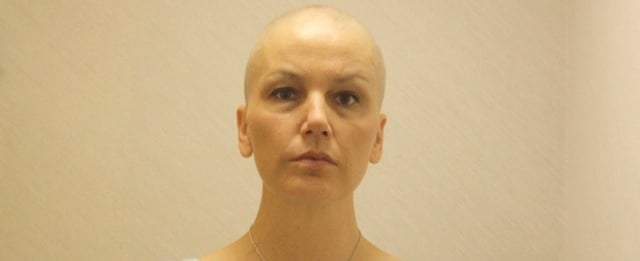
Clearly, I wasn’t a happy camper.
When I was originally diagnosed with early-stage breast cancer in November of 2011, we didn’t know whether or not I would have to do chemotherapy. But after I had surgery, we knew that I would. Previously, I’d thought, Hey, what’s a little hair? Of course, when you’re told you’re going to go bald, that’s another story. I cried. Not because I was going to lose my hair, but because I would lose my hair and then everyone would know.
I went wig shopping, but I never bought one. The American Cancer Society sent me a hideous free brunette wig that showed up one day in a brown envelope in the mail, and I stuck it in a drawer. I didn’t wrap a scarf around my head like Elizabeth Taylor. Sometimes, I wore my husband’s USMC baseball hat. More often than not, I walked around exposed: I was six-two, I was bald, and I was angry. I felt humiliated, but I did it anyway. I hated that I was sick, yet I was hellbent on refusing to hide the fact that I was. I startled people, and eventually it dawned on me that I wasn’t me anymore, I was The Sick Person, and what everyone saw when they saw me was the looming specter of human frailty.
As far as chemo, it seemed like enough to go through it — the port in the chest, the needle in the hole, the free fall of the drugs — without freezing my head at the same time. But that was me. The cancer fled. My hair grew back. That was that.
These Shylights are amazing. Kinetic ceiling lights that resemble blooming flowers, unfurling parachutes, descending ghosts.
The concept is based on nyctinasty, the process by which flowers open and close due to light or temperature changes.
“We wanted to find this exact moment, where the difference is in an object, when it is dead or when it starts to become alive.”
(via This Isn’t Happiness)
If you’ve seen “American Psycho,” you’ll likely remember the scene where Patrick Bateman and his peers pull out their business cards like Old West gunfighters pulled out their firearms. Now you can have Bateman’s card — “That’s bone. And the lettering is something called Silian Rail.” — in the form of an iPhone case.
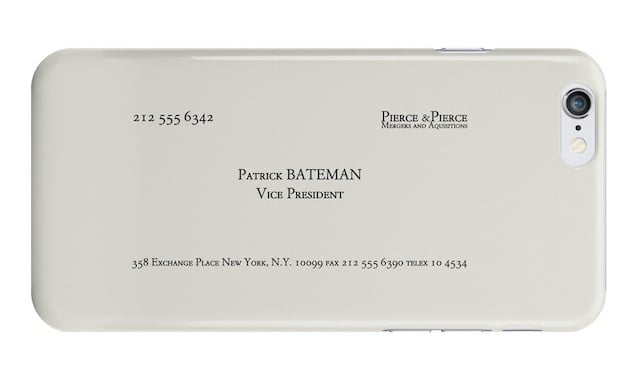
As for Silian Rail, according to IMDb:
This is not a real font, the name was invented by Bret Easton Ellis for the novel. In the film, the actual font seen on the business card is Garamond Classico SC.
You can watch the full scene here. (via The Cut)
A week ago, Paul Kalanithi, who was 37, died from lung cancer. He had recently finished his neurosurgery residency at Stanford and was a father to an infant daughter.
He was also a writer. If you haven’t read his “How Long Have I Got Left?” or “Before I Go,” you should.
In this video, he talks about how time changes as you face your mortality. “Clocks are now kind of irrelevant to me,” he says. “Time, where it used to have kind of a linear progression feel to it, now feels more like a space.”
This Garden of Eden-themed serpent rug by Fornasetti belongs in a bedroom.
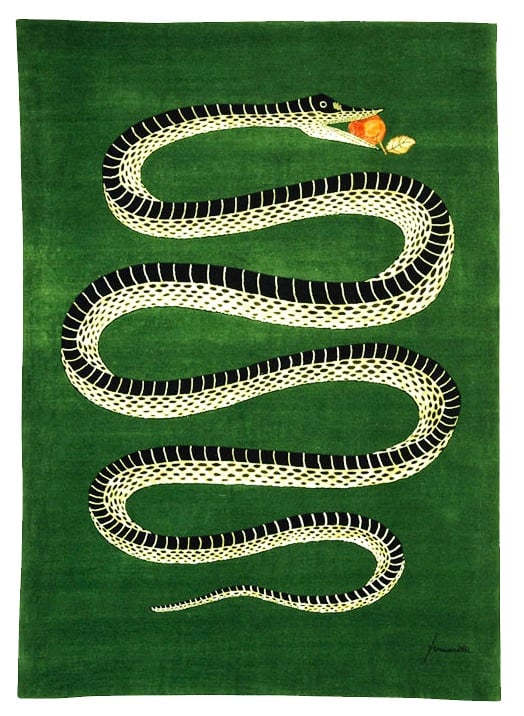
The Wall Street Journal explores “The Cult of Fornasetti.”
Newer posts
Older posts





Socials & More