Entries for May 2013
A group of researchers in Oregon have successfully cloned human embryos. No, really:
The researchers, at Oregon Health and Science University, took skin cells from a baby with a genetic disease and fused them with donated human eggs to create human embryos that were genetically identical to the 8-month-old. They then extracted stem cells from those embryos.
The embryo-creation technique is essentially the same as that used to create Dolly the sheep and the many cloned animals that have followed. In those cases, the embryos were implanted in the wombs of surrogate mothers.
These embryos won’t work for producing clones humans…they are being used to harvest stem cells.
The Oregon researchers, who published a paper on their work in the journal Cell, say their goal is what has been called therapeutic cloning: making embryonic stem cells that are genetically identical to a particular patient.
Embryonic stem cells can turn into any type of cell in the body, like heart cells, muscles or neurons. That raises the hope that one day the cells will be turned into replacement tissue or even replacement organs to treat a host of diseases.
There are a lot of outdoor movies showing in NYC this summer: here’s a listing of the whats, wheres, and whens. Movies include The Goonies, Jaws, Duck Soup, Moonrise Kingdom, Grease, and Blade Runner.
The New Yorker introduces their Strongbox, a way to anonymously send files to editors at the magazine.
Strongbox is a simple thing in its conception: in one sense, it’s just an extension of the mailing address we printed in small type on the inside cover of the first issue of the magazine, in 1925, later joined by a phone number (in 1928-it was BRyant 6300) and e-mail address (in 1998). Readers and sources have long sent documents to the magazine and its reporters, from letters of complaint to classified papers. (Joshua Rothman has written about that history and the magazine’s record of investigative journalism.) But, over the years, it’s also become easier to trace the senders, even when they don’t want to be found. Strongbox addresses that; as it’s set up, even we won’t be able to figure out where files sent to us come from. If anyone asks us, we won’t be able to tell them.
Strongbox is based on DeadDrop, an open source app built by Aaron Swartz.
The audio of a complete broadcast day from radio station WJSV in Washington, D.C. The day in question is September 21, 1939. A partial listing of the schedule:
12:30 Road of Life (soap)
12:45 This Day Is Ours (soap)
1:00 Sunshine Report (news)
1:15 The Life & Love of Dr. Susan (soap)
1:30 Your Family and Mine (soap)
1:45 News
2:00 President Roosevelt’s Address to Congress (speech)
2:40 Premier Edouard Daladier
3:00 Address Commentary (news)
3:15 The Career of Alice Blair (soap)
3:30 News (news)
3:42 Rhythm & Romance
3:45 Scattergood Baines
4:00 Baseball: Cleveland Indians at Washington Senators (sports)
5:15 The World Dances (music)
5:30 News (news)
5:45 Sports News (news)
6:00 Amos and Andy (comedy)
(via @ftrain)
Angelina Jolie had a preventive double mastectomy orig. from May 14, 2013
* Q: Wha? A: These previously published entries have been updated with new information in the last 24 hours. You can find past updates here.
Two controls, one bouncing stick, uneven terrain that eventually falls out from under you, get the stick as far to the right as you can. Harder than it sounds. I got 107.04 on, like, my 2,341st try. (Cheat code: you can get pretty far just by holding ‘A’ down.) Also fun: seeing how far to the left you can get…I couldn’t get much past -48.
How appropriate that at the height of the Cold War, in which the United States was attempting to spend the Soviet Union into collapse (a task at which they eventually succeeded), the Soviets cloned the buggiest, most inconsistant part of the US space program.

Called Buran (Russian for blizzard or snowstorm), the program was launched by the Kremlin as a reaction to NASA’s space shuttle and an attempt to gain an edge in space against the backdrop of Ronald Reagan’s “Star Wars” Strategic Defense Initiative. It was also an attempt to fulfill the Soviet Union’s dream of reusable spacecraft and payloads, ideas that predated the American space program.
A massive effort began. Over a million and a half people worked on the multi-billion dollar project, while researchers developed new, elaborate schemes for Russian space exploration. Among other tasks, Russian scientists hoped that the Buran would be able to carry the space station back to Earth, and — the reported reason for its inception — to allow the USSR to carry out military attacks from space.
And from Maciej Ceglowski’s epic takedown of the Shuttle program, this little tidbit:
The Soviet Shuttle, the Buran (snowstorm) was an aerodynamic clone of the American orbiter, but incorporated many original features that had been considered and rejected for the American program, such as all-liquid rocket boosters, jet engines, ejection seats and an unmanned flight capability. You know you’re in trouble when the Russians are adding safety features to your design.
(via @Mike_FTW)
In this morning’s NY Times, Angelina Jolie writes about her decision to have a preventive double mastectomy to hopefully ward off cancer.
My mother fought cancer for almost a decade and died at 56. She held out long enough to meet the first of her grandchildren and to hold them in her arms. But my other children will never have the chance to know her and experience how loving and gracious she was.
We often speak of “Mommy’s mommy,” and I find myself trying to explain the illness that took her away from us. They have asked if the same could happen to me. I have always told them not to worry, but the truth is I carry a “faulty” gene, BRCA1, which sharply increases my risk of developing breast cancer and ovarian cancer.
It happens that just last night I read about the BRCA-1 gene in Siddhartha Mukhergee’s excellent biography of cancer, The Emperor of All Maladies. This part is right near the end of the book:
Like cancer prevention, cancer screening will also be reinvigorated by the molecular understanding of cancer. Indeed, it has already been. The discovery of the BRCA genes for breast cancer epitomizes the integration of cancer screening and cancer genetics. In the mid-1990s, building on the prior decade’s advances, researchers isolated two related genes, BRCA-1 and BRCA-2, that vastly increase the risk of developing breast cancer. A woman with an inherited mutation in BRCA-1 has a 50 to 80 percent chance of developing breast cancer in her lifetime (the gene also increases the risk for ovarian cancer), about three to five times the normal risk. Today, testing for this gene mutation has been integrated into prevention efforts. Women found positive for a mutation in the two genes are screened more intensively using more sensitive imaging techniques such as breast MRI. Women with BRCA mutations might choose to take the drug tamoxifen to prevent breast cancer, a strategy shown effective in clinical trials. Or, perhaps most radically, women with BRCA mutations might choose a prophylactic mastectomy of both breasts and ovaries before cancer develops, another strategy that dramatically decreases the chances of developing breast cancer.
Radical is an understatement…what a tough and brave decision to make. Again from the book, I liked this woman’s take on it:
An Israeli woman with a BRCA-1 mutation who chose this strategy after developing cancer in one breast told me that at least part of her choice was symbolic. “I am rejecting cancer from my body,” she said. “My breasts had become no more to me than a site for my cancer. They were of no more use to me. They harmed my body, my survival. I went to the surgeon and asked him to remove them.”
The genetic testing company 23andme screens for three common types of mutation in the BRCA1 or BRCA2 genes:
Five to 10 percent of breast cancers occur in women with a genetic predisposition for the disease, usually due to mutations in either the BRCA1 or BRCA2 genes. These mutations greatly increase not only the risk for breast cancer in women, but also the risk for ovarian cancer in women as well as prostate and breast cancer among men. Hundreds of cancer-associated BRCA1 and BRCA2 mutations have been documented, but three specific BRCA mutations are worthy of note because they are responsible for a substantial fraction of hereditary breast cancers and ovarian cancers among women with Ashkenazi Jewish ancestry. The three mutations have also been found in individuals not known to have Ashkenazi Jewish ancestry, but such cases are rare.
23andme testing kits are only $99.
Update: Two things. First, and I hope this isn’t actually necessary because you are all intelligent people who can read things and make up your own minds, but let me just state for the official record that you should never never never never NEVER take medical advice, inferred or otherwise, from celebrities or bloggers. Come on, seriously. If you’re concerned, go see a doctor.
Two: I have no idea what the $99 23andme test covers with regard to BRCA1 and BRCA2 gene mutations beyond what the company states. The most comprehensive test for BRCA1 and BRCA2 mutations was developed by a company called Myriad Genetics and costs about $3000. Myriad has patented the genes, a decision that has been sharply criticized and is currently being decided by the Supreme Court.
But many doctors, patients and scientists aren’t happy with the situation.
Some are offended by the very notion that a private company can own a patent based on a gene that was invented not by researchers in a lab but by Mother Nature. Every single cell in every single person has copies of the BRCA1 and BRCA2 genes.
Myriad officials say they deserves the patent because they invested a great deal of money to figure out the sequence and develop “synthetic molecules” based on that sequence that can be used to test the variants in a patient.
“We think it is right for a company to be able to own its discoveries, earn back its investment, and make a reasonable profit,” the company wrote on its blog.
I do know the 23andme test covers something related to the BRCA1 and BRCA2 mutations…a friend of a friend did the 23andme test, tested positive for the BRCA1 mutation, and decided to have a preventive double mastectomy after consulting her doctor and further tests. (thx, mark, allison, and ★spavis)
1927 color film of London orig. from May 13, 2013
* Q: Wha? A: These previously published entries have been updated with new information in the last 24 hours. You can find past updates here.
The headline (How Bing Crosby and the Nazis Helped to Create Silicon Valley) glistens with Mashable-grade hyperbole, but watch as Paul Ford deftly and convincingly connects crooner Bing Crosby with a Nazi invention that helped power the invention of Silicon Valley.
Fast-forward into the mid-nineteen-forties. The Second World War had just ended. Americans were picking over the technological remains of German industry. One of the things they discovered was magnetic tape; the Nazis had been using tape recording to broadcast propaganda across time zones. It was a remarkable invention. Previous sound-recording technologies had used wax cylinders or discs, or delicate wires. But magnetic tape was remarkably fungible: it could be recorded over, cut and spliced together. Plus it sounded better.
Radio shows, however, were supposed to be live. Radio inherited its forms from vaudeville, from variety shows, and it was assumed that the artifice of pre-recording would diminish the audience’s connection, at great risk to the sponsors. Crosby-a master of artifice-didn’t buy that, according to “Bing Crosby: Crooner of the Century,” by Richard Grudens. In 1946 he used his industry power-by then he was on top, one of the world’s richest, most famous and intensely beloved celebrities-to step away from live broadcast by choosing a sponsor and network that would let him use large, wax discs. “Philco Radio Hour” d’ebuted in 1946 on ABC, at thirty-thousand dollars a week. Bob Hope was his first guest.
In August of 2012, mathematician Shinichi Mochizuki posted a series of four papers online that purported to prove the ABC Conjecture, “a famed, beguilingly simple number theory problem that had stumped mathematicians for decades”. Then, nothing. Or nearly nothing.
The problem, as many mathematicians were discovering when they flocked to Mochizuki’s website, was that the proof was impossible to read. The first paper, entitled “Inter-universal Teichmuller Theory I: Construction of Hodge Theaters,” starts out by stating that the goal is “to establish an arithmetic version of Teichmuller theory for number fields equipped with an elliptic curve…by applying the theory of semi-graphs of anabelioids, Frobenioids, the etale theta function, and log-shells.”
This is not just gibberish to the average layman. It was gibberish to the math community as well.
“Looking at it, you feel a bit like you might be reading a paper from the future, or from outer space,” wrote Ellenberg on his blog.
But seeming jibberish by a genius might just be solid mathematics, but Mochizuki isn’t doing much to help other mathematicians confirm or refute his assertions. Which raises an interesting point: mathematics isn’t all just logic and truth…there’s a social element to it as well.
“You don’t get to say you’ve proved something if you haven’t explained it,” she says. “A proof is a social construct. If the community doesn’t understand it, you haven’t done your job.”
(via @dunstan)
Claude Friese-Greene shot these scenes in color around London in 1927.
(thx, rob)
Update: This footage was taken from the British Film Institute’s YouTube channel and it turns out there’s tons of color footage Friese-Greene shot around Britain in the 1920s. Like farm laborers in Devon in 1924, a busking family in Scotland in 1926, the docks in Cardiff in 1926, and much more. (via @magnakai)
Perfect for a slow Friday afternoon. Have a good weekend everyone.
According to science, you can achieve the results of a long run and a visit to weight room by doing “12 exercises deploying only body weight, a chair and a wall.” And the whole thing only takes seven minutes.
“There’s very good evidence” that high-intensity interval training provides “many of the fitness benefits of prolonged endurance training but in much less time,” says Chris Jordan, the director of exercise physiology at the Human Performance Institute in Orlando, Fla., and co-author of the new article.
Update: The Times has published a more demanding (and rewarding?) version of the 7-minute workout.
Interval programs based on cycling, walking and running come with a downside, however: They improve overall fitness and health but do little to improve muscular strength other than in the legs. By contrast, the New Scientific 7-Minute Workout does more than build the large, obvious muscles that most of us can name-check, as Mr. Verstegen puts it — the quads and glutes, for example; its exercises also engage smaller, often overlooked muscles in the back, abdomen, shoulders and hips that, when neglected and weak, contribute to back, neck and knee pain.
Hamilton Nolan, who notes the Times is “not a fitness organization”, has a few suggestions for better 7-minute workouts.
Do air squats as long as you can until your leg freezes and you topple to the ground. Then get in pushup position and do as many pushups as you can until seven minutes have passed.
A nice short analysis by filmmaker Steven Benedict of the themes expressed and techniques used by Steven Spielberg in his films.
Stanley Kubrick: A Life in Pictures is a documentary released in 2001 about Stanley Kubrick. Narrated by Tom Cruise, the film was directed by his long-time assistant Jan Harlan and features interviews of many actors from Kubrick’s films as well as other noted directors like Spielberg and Scorsese. The entire thing is available on YouTube:
You can also rent/buy on Amazon or rent/buy on iTunes.
Working with the USGS, NASA, and Time, Google has built a viewer for satellite image time lapses. Among the images are those of the deforestation of the Amazon rainforest, the retreat of an Alaskan glacier, and the growth of Dubai. You can also refocus the map on any other area you want. More info here and here’s the extensive Time feature.
The quick progress of the US space program in the 1960s and 70s and the science fiction of the 70s and 80s seemed to point towards humans living permanently in space. What happened?
Ironically, our actual experiments in space living have largely reinforced this stark perspective. Real life in space is often cramped, unpleasant and even pointless. Some years back, I visited Star City near Moscow, the training centre for cosmonauts since Gagarin, where I had a chance to clamber inside a full-scale training mock-up of the Mir space station. The experience was more like residing inside a computer terminal than one of O’Neill’s cylindrical islands, so proximate and abundant were tubes, wires, levers, buttons and unnameable gadgets.
More disorienting was the placement of controls and conveniences: because space was limited, these were distributed throughout the station without reference to Earthly gravity, thus making use of ‘ceilings’ as sleeping quarters, walls for toilet cubicles and virtually any other surface for any other activity. One could get used to such things (and you’d have to be a true cynic to tire of the view outside your window). But it’s a far, far cry from strolling the wide corridors of the Starship Enterprise.
They promised us life in space, flying cars, and jetpacks but all we got were pocket-sized rectangles containing all human knowledge. FAIL.
Some interesting data about how protected bike lanes in NYC dramatically increased retail sales of local businesses.
A new study from the New York Department of Transportation shows that streets that safely accommodate bicycle and pedestrian travel are especially good at boosting small businesses, even in a recession.
NYC DOT found that protected bikeways had a significant positive impact on local business strength. After the construction of a protected bicycle lane on 9th Avenue, local businesses saw a 49% increase in retail sales. In comparison, local businesses throughout Manhattan only saw a 3% increase in retail sales.
And that’s just one of the many tidbits from a NYC DOT report released last November (right around the time of Hurricane Sandy, which is probably why no one noticed at the time); read the whole report here:
Among them: “retail sales increased a whopping 172% after the city converted an underused parking area in Brooklyn into a pedestrian plaza”, and traffic calming in the Bronx decreased speeding by ~30% and pedestrian crashes by 67%. (via @lhl)
This is like CSI for geography dorks: you’re plopped into a random location on Google Street View and you have to guess where in the world you are. So much fun…you get to say “wait, zoom in, enhance, whoa, back up” to yourself while playing. My top score is 14103…what’d you get? p.s. Using Google in another tab is cheating! (thx, nick)
Since 861 AD, almost 35,000 meteorites were recorded hitting the Earth but only 1,045 were actually seen falling. This animated infographic is a good way to visualize the data. Bolides is the perfect domain name. (via @DavidGrann)
This is amazing: Alan Taylor rounds up some homemade inventions from China, including DIY submarines, giant motorcycles, home-built robots, and can’t-possibly-fly airplanes. I can’t pick a favorite, but this homemade welding mask is outstanding:

Ok, and this giant motorcycle:

Oh, and this rickshaw-pulling robot:
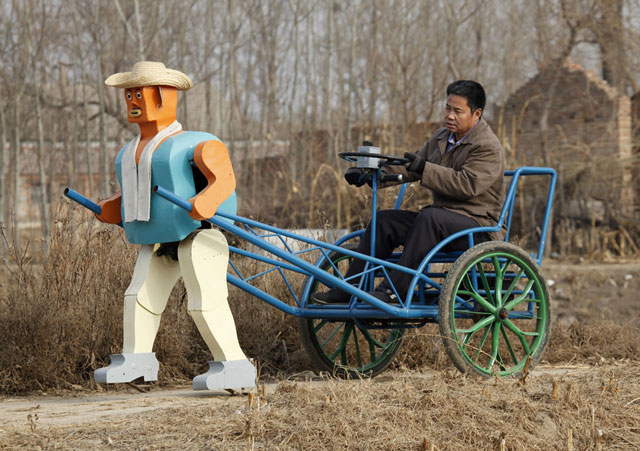
And, and, and… (via @faketv)
Is this a photo of Billy the Kid, Doc Holliday, Jesse James? orig. from May 08, 2013
Under pressure orig. from May 08, 2013
Steven Soderbergh: The state of cinema orig. from May 07, 2013
* Q: Wha? A: These previously published entries have been updated with new information in the last 24 hours. You can find past updates here.
Marine scientist Cassandra Brooks narrates a time lapse video of her two-month journey on an Antarctic icebreaker. High points: the ice ramming at 2:35 and the fishing penguins at the end.
Brooks blogged her journey for National Geographic. If you want to fall down the rabbit hole of how icebreakers are designed and how they differ from usual ships, Wikipedia is a good place to start.
For a ship to be considered an icebreaker, it requires three traits most normal ships lack: a strengthened hull, an ice-clearing shape, and the power to push through sea ice.
This is purported to be a photo of (from l to r) Billy the Kid, Doc Holliday, Jesse James, and Charlie Bowdre.
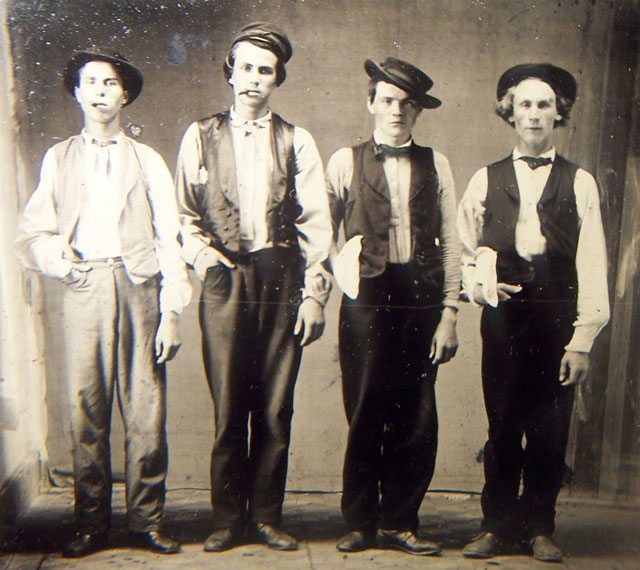
The story goes that the photo was taken in 1879 in Las Vegas, New Mexico, at a time when each of the men may have been in town. It’s entirely plausible that these men all met and posed for a photo, but as there doesn’t appear to be any provenance for particular photo, we’re left with trying to ID the long-dead from the very few authenticated photos that exist. So…maybe? But probably not? (via if charlie parker were a gunslinger…)
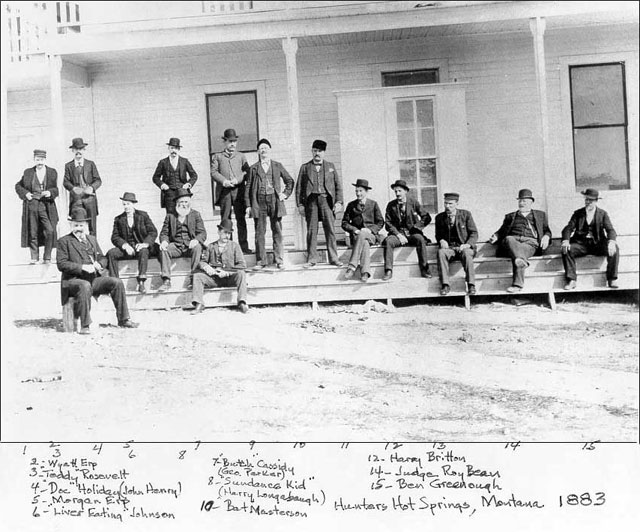
Update: Ah, here’s an even better photo that’s almost certainly mislabeled, purportedly featuring Wyatt Erp, Teddy Roosevelt, Doc Holliday, Bat Masterson, Butch Cassidy, and the Sundance Kid:
Contrast both of these photos with this (very real and accurately labeled) group photo of participants at the 1927 Solvay International Conference on Electrons and Photons:
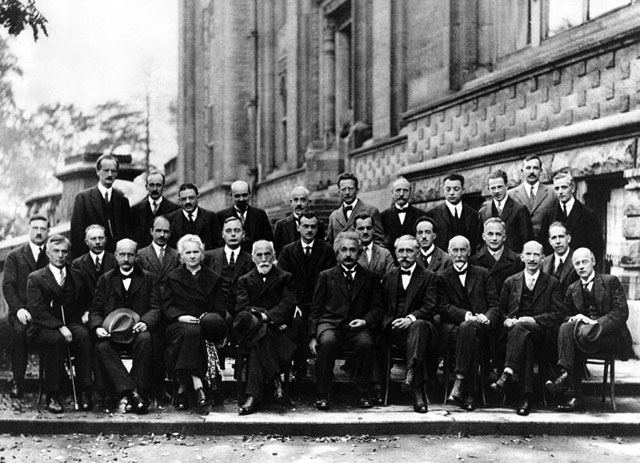
Among those pictured are Albert Einstein, Marie Curie, Neils Bohr, Paul Dirac, Max Planck, Erwin Schrödinger, Wolfgang Pauli, Werner Heisenberg, Arthur Compton, and Hendrik Lorentz. (thx, mike)
Damn! Watch this railroad tanker car instantly implode:
I couldn’t find too much information on the source of this clip, but it appears to be part of a safety training video on the perils of improperly steam cleaning tanker cars. In the clip, the tanker car is filled with steam and the safety valves are disabled. The steam cools, then condenses, the pressure inside drops, and the pressure difference is big enough to crumple that huge railcar like a napkin.
Update: See also “sun kink”, when railroad tracks buckle in intense heat:
An explanation of the effect can be found here. (thx, will)
The national rates of gun violence and homicide in the US have fallen significantly in past 20 years, but most people are unaware. From a recently released Pew Research report:
Nearly all the decline in the firearm homicide rate took place in the 1990s; the downward trend stopped in 2001 and resumed slowly in 2007. The victimization rate for other gun crimes plunged in the 1990s, then declined more slowly from 2000 to 2008. The rate appears to be higher in 2011 compared with 2008, but the increase is not statistically significant. Violent non-fatal crime victimization overall also dropped in the 1990s before declining more slowly from 2000 to 2010, then ticked up in 2011.
Despite national attention to the issue of firearm violence, most Americans are unaware that gun crime is lower today than it was two decades ago. According to a new Pew Research Center survey, today 56% of Americans believe gun crime is higher than 20 years ago and only 12% think it is lower.
The whys behind the drop in gun violence (and in crime in general) are more difficult to come by:
There is consensus that demographics played some role: The outsized post-World War II baby boom, which produced a large number of people in the high-crime ages of 15 to 20 in the 1960s and 1970s, helped drive crime up in those years.
A review by the National Academy of Sciences of factors driving recent crime trends (Blumstein and Rosenfeld, 2008) cited a decline in rates in the early 1980s as the young boomers got older, then a flare-up by mid-decade in conjunction with a rising street market for crack cocaine, especially in big cities. It noted recruitment of a younger cohort of drug seller with greater willingness to use guns. By the early 1990s, crack markets withered in part because of lessened demand, and the vibrant national economy made it easier for even low-skilled young people to find jobs rather than get involved in crime.
At the same time, a rising number of people ages 30 and older were incarcerated, due in part to stricter laws, which helped restrain violence among this age group. It is less clear, researchers say, that innovative policing strategies and police crackdowns on use of guns by younger adults played a significant role in reducing crime.
(via hacker news)
Taking a page from Orwell, officials in Chengdu, China endeavored to prevent recent protests by moving the weekend and scheduling security exercises at the same time and place as the scheduled protest.
As text messages circulated calling for another protest, authorities decided to fiddle with the calendar: For many, Saturday became a workday, and the day of rest was moved to Monday, May 6. So as Saturday dawned, schoolchildren straggled reluctantly back to class, and employees at government-run work units discovered the day was taken up by urgent meetings.
See also how Georgia ended the country’s drug problem:
But the more radical steps involved brutalizing the addicts themselves. Saakashvili mandated as aggressive a drug policy as any country has attempted since Mao Zedong threatened to execute all Chinese opium fiends and “cured” about five million of them overnight. If you think New York’s stop-and-frisk rule is invasive, try Georgia’s: Cops can stop anyone at any time for no reason and force him to urinate into a cup. Fifty-three thousand people were stopped on the street in 2007, or about one in 20 of the young men in Georgia. About a third of those passed dirty urine; first-offenders were levied a fine of several hundred dollars. One more dirty test amounted to a criminal offense.
“There was such an unprecedented drug war,” Otiashvili says. “What was going on-and still goes on-in Georgia doesn’t happen anywhere. No country puts people in the prison for a positive urine test.”
(via @tylercowen)
Former Supreme Court Justice Sandra Day O’Connor now admits that taking on the Bush vs Gore case in 2000 was probably a mistake.
“It took the case and decided it at a time when it was still a big election issue,” O’Connor said during a talk with the Chicago Tribune’s Editorial Board on Friday. “Maybe the court should have said, ‘We’re not going to take it, goodbye.’”
The case, she said, “stirred up the public” and “gave the court a less than perfect reputation.”
“Obviously the court did reach a decision and thought it had to reach a decision,” she said. “It turned out the election authorities in Florida hadn’t done a real good job there and kind of messed it up. And probably the Supreme Court added to the problem at the end of the day.”
[Hair tearing-out noise]
At the recent San Francisco Internation Film Festival, Steven Soderbergh gave a keynote about the current state of cinema. It is worth reading if you enjoy movies or are engaged in any sort of creative work.
But before we talk about movies we should talk about art in general, if that’s possible. Given all the incredible suffering in the world I wonder, what is art for, really? If the collected works of Shakespeare can’t prevent genocide then really, what is it for? Shouldn’t we be spending the time and resources alleviating suffering and helping other people instead of going to the movies and plays and art installations? When we did Ocean’s Thirteen the casino set used $60,000 of electricity every week. How do you justify that? Do you justify that by saying, the people who could’ve had that electricity are going to watch the movie for two hours and be entertained - except they probably can’t, because they don’t have any electricity, because we used it. Then I think, what about all the resources spent on all the pieces of entertainment? What about the carbon footprint of getting me here? Then I think, why are you even thinking that way and worrying about how many miles per gallon my car gets, when we have NASCAR, and monster truck pulls on TV? So what I finally decided was, art is simply inevitable. It was on the wall of a cave in France 30,000 years ago, and it’s because we are a species that’s driven by narrative. Art is storytelling, and we need to tell stories to pass along ideas and information, and to try and make sense out of all this chaos. And sometimes when you get a really good artist and a compelling story, you can almost achieve that thing that’s impossible which is entering the consciousness of another human being - literally seeing the world the way they see it. Then, if you have a really good piece of art and a really good artist, you are altered in some way, and so the experience is transformative and in the minute you’re experiencing that piece of art, you’re not alone. You’re connected to the arts. So I feel like that can’t be too bad.
Update: If you prefer to watch the speech, have at it:
(via @MikeShefferNJ)
NYC is set to introduce their bike-share program at the end of the month. I think it’s a great idea and am interested to follow how it does in practice. Many have objected to the share program even before it starts (reminding me of the smoking ban protests, ultimately much ado about nothing) but Sommer Mathis does an admirable job heading them off.
Claim #3: The stations are too ugly for historic neighborhoods, and Citibank’s sponsorship is too crassly commercial.
These are just some of the claims behind a series of lawsuits that are already in the works, brought by specific building owners who argue that docking stations don’t belong next to their beautiful buildings. They’re also worried that delivery truck access may be impeded by the presence of some stations. The lawsuits are being filed within the context of additional complaints that neighbors feel they weren’t consulted on the location of some stations, despite the city’s department of transportation having held nearly 400 meetings on station locations with community boards and other neighborhood groups. This is a classic NIMBY reaction, and by far the easiest one the city could have predicted. The idea that bike-share infrastructure is somehow uglier or more commercial than any other element of New York’s streetscape is easy enough to debunk. But the truth is, one of the best things about the design of the Alta bike-share stations is how easy they are to install and, if need be, later remove. It’s entirely possible that small problems with the specific locations of some stations will become apparent after the program launches, and they’ll need to be moved around the corner or across the street to better serve users. This has happened here in Washington, D.C., and it’ll happen for sure in New York. But that’s all part of the bike-share roll-out process. If there’s a legitimate problem with the location of a single station, that can actually be fixed within in a matter of hours or at worst, a day or two.
Our neighborhood newspaper went full-NIMBY about the bike-share this week and hit all the major points addressed in this article, including the ridiculous “bike racks are taking valuable parking spots” one. (via @jmseabrook)
Adam Davidson on the asinine and broken food truck/cart system in NYC. This short paragraph not only explains what’s wrong with the food cart biz in NYC but also with American politics in general:
Economically speaking, the problem is a standard one, known as the J-curve, which represents a downslope on a graph followed by a steep rise. Some sensible changes to the current food-vendor system may have long-term benefits for everyone, but the immediate impact could spell short-term losses for those who now profit from the system. A small group of New Yorkers — particularly owners of commissaries and physical restaurants — are highly motivated to lobby politicians not to change things. And most of the potential beneficiaries don’t realize they’re missing out. Many of the rest of us would love to have more varied food trucks, but we don’t care enough to pressure the City Council.
(via @tylercowen)
PepsiCo is dropping Lil Wayne as a Mountain Dew spokesman because of “vulgar lyrics” referring to Emmett Till after the Till family put pressure on the beverage giant. What lyrics? Because of its ridiculous policy against including bad words in such an august publication, the NY Times doesn’t even say what the lyrics are! Which makes the entire article worthless from a journalistic perspective. The lyrics are the entire story…without them, it’s just a bunch of press release bullshit. FYI, because we are all adults here (and your kids already know the lyrics), here are the lyrics in question courtesy of Rap Genius:
Pop a lot of pain pills
Bout to put rims on my skateboard wheels
Beat that pussy up like Emmett Till
Yeah….
Two cell phones ringin’ at the same time
That’s your ho, callin’ from two different phones
Tell that bitch “leave me the fuck alone!”
See, you fuck her wrong, and I fuck her long
I got a love-hate relationship with Molly
I’d rather pop an ollie, and my dick is a trolly
Boy, I’ll bury you like Halle
How can people even discuss the artistic merit and/or offensiveness of the lyrics if you can’t print them? The Times should either simply publish whatever it is they are talking about or not run the story at all. (via @bdeskin, who has been giving the Times shit about their profanity policy on Twitter)
In this series of illustrations created for a British TV show, historical figures are depicted as they might look today. Shakespeare becomes a Williamsburg hipster, Henry VIII is Richard Branson-esque, and Elizabeth I is a cross between Tina Brown and Tilda Swinton.
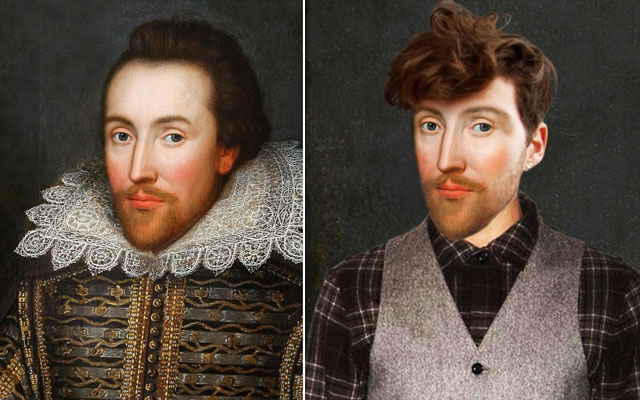
(via @DavidGrann)
An amazing bit of camouflage from the orchid mantis:

Seeing it move around is eerie. See also the bee orchid. (via @faketv)
Heather Dewey-Hagborg collects hair, chewed gum, and smoked cigarettes, pulls the DNA out of them, and uses the genetic information to produce models of what the people who used those items might have looked like.
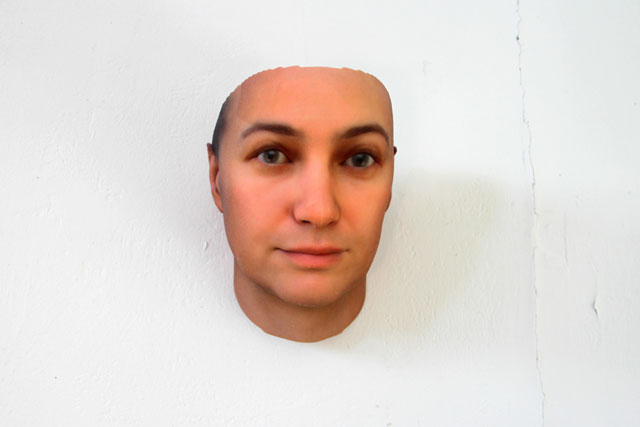
From this sequence, Dewey-Hagborg gathers information about the person’s ancestry, gender, eye color, propensity to be overweight and other traits related to facial morphology, such as the space between one’s eyes. “I have a list of about 40 or 50 different traits that I have either successfully analyzed or I am in the process of working on right now,” she says.
Dewey-Hagborg then enters these parameters into a computer program to create a 3D model of the person’s face.” Ancestry gives you most of the generic picture of what someone is going to tend to look like. Then, the other traits point towards modifications on that kind of generic portrait,” she explains. The artist ultimately sends a file of the 3D model to a 3D printer on the campus of her alma mater, New York University, so that it can be transformed into sculpture.
There are lots of reviews of Google Glass out there, but my favorite is Luke Wroblewski’s concise and measured take.
My own audio: Glass has a bone transducer that amplifies audio only you can hear. In practice, it’s imperfect. But the potential is clear.
Social interactions: I forced myself to wear Glass even if I felt uneasy about it, which was in a lot of places. I was downright nervous to have them on in airport security and the casino floor. But even when ordering a coffee at Starbucks, I felt like I was doing something wrong.
vintage post from May 2013
· gift link
The Peregrine Falcon is the world’s fastest animal;1 it can reach speeds of more than 240 mph during dives. It uses that speed to kill other birds in mid-air. Here’s a video of a Peregrine diving and killing a duck, shot with a camera mounted on the falcon’s back.
It’s cool watching her fly around, but the exciting part starts right around 2:45. The acceleration is incredible. The same bird does a longer and faster dive in this video (at ~0:55):
Here’s what the Peregrine’s dive looks like from an observer’s point-of-view:
Our family had a lively discussion about Peregrine Falcons around the dinner table a couple of weeks ago…I can’t wait to show the kids these videos when I get home tonight. (via @DavidGrann)
All of Jerry’s best girls orig. from May 03, 2013
* Q: Wha? A: These previously published entries have been updated with new information in the last 24 hours. You can find past updates here.
A list of the northernmost, southernmost, easternmost and westernmost cities/towns/villages in all 50 US states.
Vermont — Northernmost: Derby Line. Southernmost: Vernon (specifically South Vernon area). Easternmost: Beecher Falls. Westernmost: Chimney Point.
California — Northernmost: Tulelake (note: Fairport is more northerly but is considered a “former settlement”) Southernmost: San Diego (San Ysidro District). Easternmost: Parker Dam. Westernmost: Ferndale.
New York — Northernmost: Rouses Point. Southernmost: Staten Island-New York City (Tottenville Neighborhood) Easternmost: Montauk. Westernmost: Findley Lake.
(via @jessamyn)
Photographer Richard Prince took photographs of the 57 girlfriends Jerry Seinfeld had on the show and turned it in to the below composite.

See also Jason Salavon’s work. (via @sippey)
Update: Max points out I may have misread the article and these 57 girlfriends are not necessarily Jerry’s only. Supporting this is Sarah Silverman’s inclusion in the composite even though she’s was a love interest of Kramer’s.
Many Russian cars are outfitted with dashboard cameras to protect drivers against insurance fraud. These cameras have caught all sorts of crazy happenings — car accidents, low-flying jets, insurance scam attempts, meteors, and plane crashes
— leading many to believe that Russia is a place where crazy shit pretty much happens constantly.
But Russia’s dash cams have also captured many more tender moments — people hopping out of their cars to help old ladies across the street, looking after little kids who wandered into the street, pushing cars out of snowbanks, etc.
I love the hell out of this video. Russia, you’re alright. (via devour)
A list of the most New York episodes of Seinfeld.
4. “The Rye” (Season 7, Episode 11)
This episode’s titular breadstuff-which Jerry steals from an old lady who refuses to sell it to him, even for 50 bucks-supposedly comes from Schnitzer’s, a great New York bakery name if we’ve ever heard one. The real place was called Royale Kosher Bake Shop. Unfortunately, it’s now closed. A Jenny Craig branch stands in its place at 237 W. 72nd St. Also in this episode: Kramer leads Beef-a-Reno-fueled hansom cab rides through Central Park. His skills as a tour guide are questionable, though, as his historical “facts” are impressively inaccurate. For example, Frederick Law Olmsted and Calvert Vaux-not former New York Yankee Joe Pepitone-designed the park.
Already good, Seinfeld got 100 times better when I moved to NYC and got 10 more of the jokes per episode.
Basketball Hall of Famer and “secret nerd” Kareem Abdul-Jabbar shares a list of 20 things he wish he’d know when he was 30 years old.
18. Watch more TV. Yeah, you heard right, Little Kareem. It’s great that you always have your nose in history books. That’s made you more knowledgeable about your past and it has put the present in context. But pop culture is history in the making and watching some of the popular shows of each era reveals a lot about the average person, while history books often dwell on the powerful people.
Caroline Rothstein on how Kids came about and what happened to the young actors who starred in the film.
Two decades after a low-budget film turned Washington Square skaters into international celebrities, the kids from Kids struggle with lost lives, distant friendships, and the fine art of growing up.
In Lambert’s Cafe in Sikeston, MO, they just throw your bread to you from across the restaurant.
so my parents were gone for 2 days and I switched most of our family photos with pictures of steve buscemi…
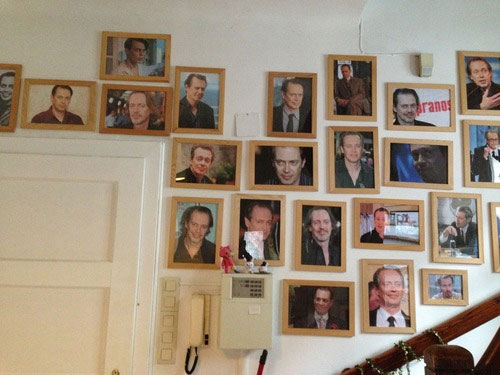
The one hanging in the fridge clinches it.
The Hangover Part III is out later in the month and the Hollywood Reporter has an oral history of the making of the first two movies.
HELMS: I was always the nervous Nelly about those jokes. Zach was going to get arrested for the baby thing.
PHILLIPS: Jerking the baby off at Caesars.
GALIFIANAKIS: I did it first with the doll that was just sitting there while we were setting up the shot. I showed Todd, and he goes, “Let’s go ask the parents if we can do that.” (Laughter.) I’m like, “No.”
PHILLIPS: I waited for the [baby’s] mom to go upstairs because the mom was a little bit more not into stuff like that. I go to the dad: “It would be funny if Zach pretends to do this. Would you have a problem with that?” And he literally goes: “[My wife is] going to be gone for a half-hour. Can you do it in the next half-hour?”
COOPER: “Can you jerk my kid off in a half-hour?” (Laughter.)
Newer posts
Older posts





Socials & More