kottke.org posts about video
According to an expert, France doesn’t have any of the large, old trees necessary to replace the burned wooden beams in the roof of the Notre Dame.
Bertrand de Feydeau, vice-president of preservation group Fondation du Patrimoine, told France Info radio that the wooden roof that went up in flames was built with beams more than 800 years ago from primal forests.
He says the cathedral’s roof cannot be rebuilt exactly as it was before the fire because “we don’t, at the moment, have trees on our territory of the size that were cut in the 13th century.”
This reminds me of one of my favorite stories about future planning (possibly apocryphal). As told by Stewart Brand in How Buildings Learn, the story goes:
New College, Oxford, is of rather late foundation, hence the name. It was founded around the late 14th century. It has, like other colleges, a great dining hall with big oak beams across the top. These might be two feet square and forty-five feet long.
A century ago, so I am told, some busy entomologist went up into the roof of the dining hall with a penknife and poked at the beams and found that they were full of beetles. This was reported to the College Council, who met in some dismay, because they had no idea where they would get beams of that calibre nowadays.
One of the Junior Fellows stuck his neck out and suggested that there might be some oak on College lands. These colleges are endowed with pieces of land scattered across the country. So they called in the College Forester, who of course had not been near the college itself for some years, and asked about oaks. And he pulled his forelock and said, “Well sirs, we was wonderin’ when you’d be askin’.”
Upon further inquiry it was discovered that when the College was founded, a grove of oaks has been planted to replace the beams in the dining hall when they became beetly, because oak beams always become beetly in the end. This plan had been passed down from one Forester to the next for five hundred years. “You don’t cut them oaks. Them’s for the College Hall.”
Hopefully the trees needed for rebuilding Notre Dame can be sourced elsewhere. Just as important, a more modern form of future planning was recently undertaken that should help greatly with the rebuild. In 2010, two men photographed and laser-scanned every inch of the Notre Dame, creating an incredibly detailed 3-D map of the building.
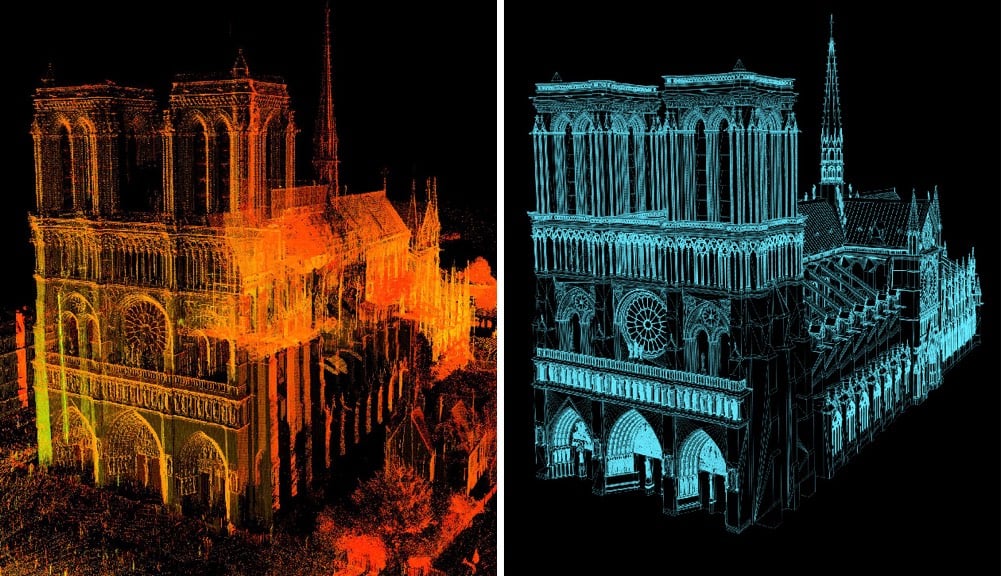
Now, with the building having sustained untold but very substantial damage, the data that Tallon and Blaer created could be an invaluable aid to whoever is charged with rebuilding the structure. Ochsendorf described the data as “essential for capturing [the structure] as built geometry.” (He added, however, that the cathedral, no matter what happens now, “is irreplaceable, of course.”)
Tallon and Blaer’s laser data consist of 1 billion data points, structured as “point clouds,” which software can render into images of the three-dimensional space. Stitch them together, inside and out, map the photographs onto the precise 3-D models, and you have a full digital re-creation of incredible detail and resolution.
“I saw this happening, and I had two thoughts,” Blaer told me of watching the cathedral engulfed in flames. “One thought was that I was kind of relieved that he didn’t actually have to see this happen. But on the other hand, he knew it so well and had so much information about how it’s constructed, he would have been so helpful in terms of rebuilding it.”
(thx, meg)
Update: According to this piece in Le Monde (as best as I can discern in Google Translate), French forests have both the quality and quantity of wood available to provide new beams for Notre Dame. (via @ramdyne)
Nuclear physicists hypothesize that when the cores of neutron stars are subject to enough pressure, the quarks that make up the core can turn from up and down quark varieties into strange quarks. As this Kurzgesagt video explains, this strange matter is particularly stable and if it were to escape from the core of the neutron star, it would convert any ordinary matter it came into contact with to more strange matter. If you hadn’t heard about this hypothesis before, you can read up on it in their list of sources for the video.
With a tweet at 3:20am this morning, Beyoncé announced her latest album, a 40-track live album of her acclaimed 2018 Coachella performance. You can listen to Homecoming right now on Spotify, Apple Music, Tidal, Amazon, YouTube, and Pandora.
The album is a complement to a Netflix film of the performance, also called Homecoming and also available today. Here’s the trailer for that:
After the Coachella performance last year, the NY Times’ music critic Jon Caramanica wrote:
Let’s just cut to the chase: There’s not likely to be a more meaningful, absorbing, forceful and radical performance by an American musician this year, or any year soon, than Beyoncé’s headlining set at the Coachella Valley Music and Arts Festival on Saturday night.
It was rich with history, potently political and visually grand. By turns uproarious, rowdy, and lush. A gobsmacking marvel of choreography and musical direction.
In the first episode of season two of Earworm, Estelle Caswell explains where the “Explicit Lyrics” sticker found on many of your favorite music albums came from. The story involves heavy metal, Prince, the rise of the religious right, the Satanic panic, Tipper Gore, and lots of amazing hair.
The very public discussion around the advisory label involved the Parents Music Resource Center (PMRC), a group led by the wives of Washington politicians, and a few musicians including Frank Zappa, Dee Snider, and John Denver.
While the PMRC’s involvement was allegedly sparked by some raunchy lyrics from Prince’s 1984 album Purple Rain, the debate over rock lyrics had been infiltrating American culture and politics for a decade. The driving force behind that debate was the rise of heavy metal, a genre that saw explosive popularity with the launch of MTV in 1981, and the growing influence of the religious right, who saw rock music as a powerful threat to Christianity.
One of the main sources for the video is Eric Nuzum’s book, Parental Advisory: Music Censorship in America.
Monotype has introduced a new version of the Helvetica typeface called Helvetica Now.
Helvetica Now is a new chapter in the story of perhaps the best-known typeface of all time. Available in three optical sizes-Micro, Text, and Display-every character in Helvetica Now has been redrawn and refit; with a variety of useful alternates added. It has everything we love about Helvetica and everything we need for typography today. This is not a revival. This is not a restoration.
This is a statement.
Typographer Erik Spiekermann says:
This is the typeface Max Miedinger and Eduard Hoffmann would have designed back in 1957 if they had known about offset printing, small screens, browsers, digital design tools and UI designers.
If you had access to the last ripe avocado in the world, what would you do with it?
Brix System is a collection of scaled-up Lego versions of computers, phones, and music machines made out of wood. This is super nerdy and I am here for it.
See also A Full-Scale Lego Supercar that Actually Drives.
Have you ever wondered how mapmakers made bird’s-eye-view maps before the invention of satellites or even hot air balloons? I have and was glad to find Phil Edwards’ video on the subject:
Leonardo da Vinci is justly famous for a lot of different things, but we’ve heard somewhat less about his mapmaking prowess than his painting or mechanical designs. His 1502 map of the Italian town of Imola is the oldest surviving example of an ichnographic (i.e. bird’s-eye-view) map of a place, a type of map that is ubiquitous today in the form of satellite imagery.
Most Renaissance maps are known for their fanciful inclusion of dragons, castles, and undulating mountainsides, and most of them show buildings in elevation, or the “oblique perspective.” But da Vinci’s sought to capture the proportions and relationships between land features more accurately, and he developed new technologies to do so. To make this map of Imola, he may have used the special hodometer and magnetic compass he’d already invented (he’d been fascinated by maps and optics for years). With careful measurements in hand, he drew every “street, plot of land, church, colonnade, gate and square, the whole encompassed by the moat,” writes the Renaissance historian Paul Strathern.
Here is Leonardo’s Imola map (cropped) compared with a contemporary satellite image:
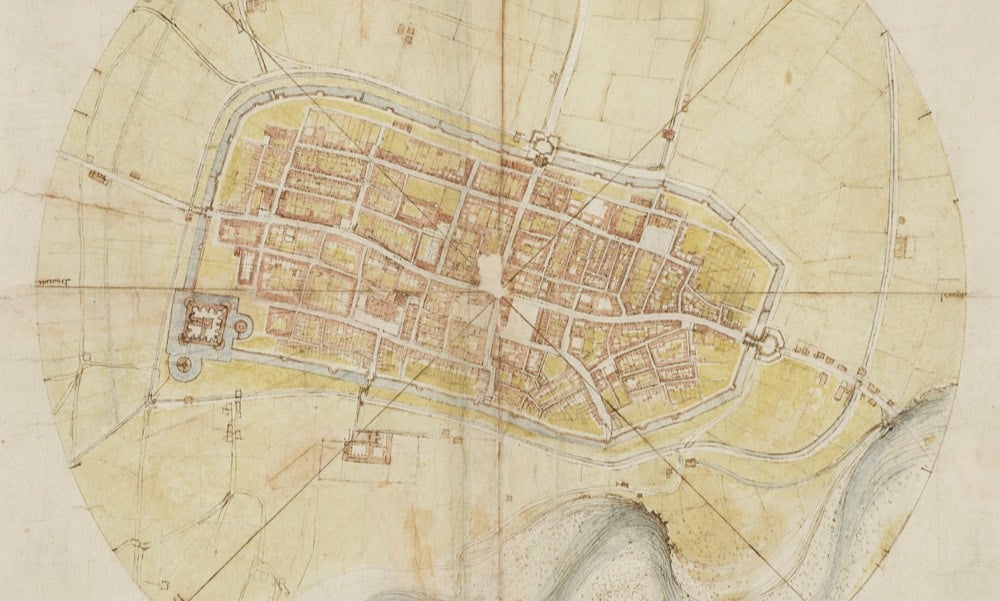
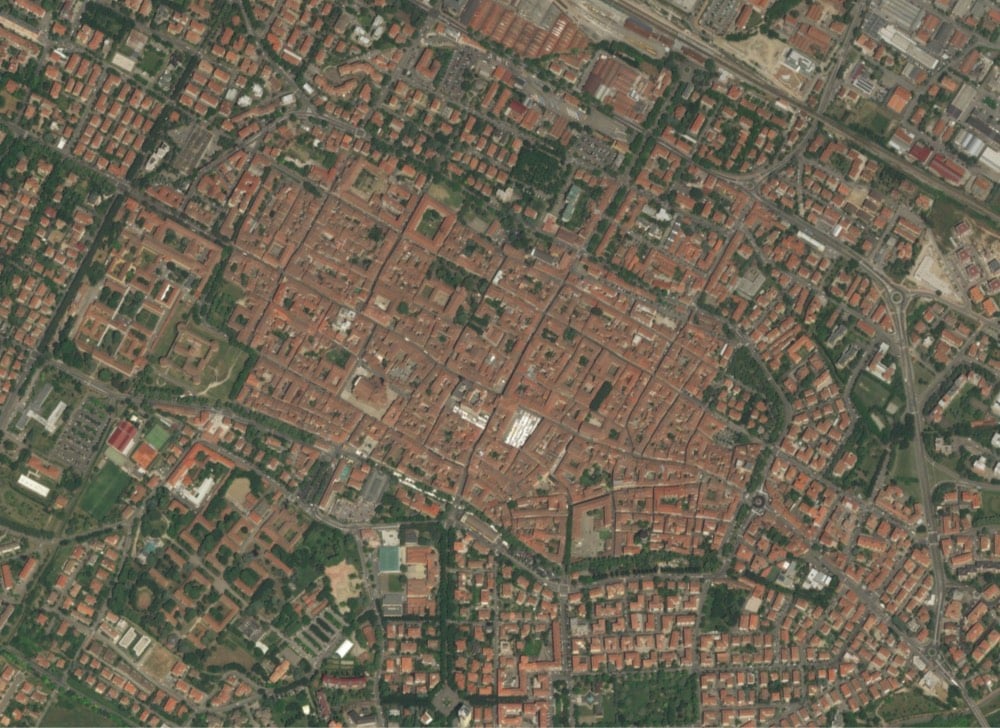
As Edwards notes in the video, Leonardo’s map is not strictly an illustration or drawing of a place but more of an infographic. We take this type of map for granted now, but 500 years ago, that shift was a genuine innovation.
Game of Thrones made its return to HBO last night and, surprise, someone died! According to this compilation video, over 174,000 people have died on the show in seven seasons. The sheer numbers and the fact that some of the deaths have been, shall we say, a little creative (even for a fantasy show) sometimes interfered with my ability to fully suspend my disbelief when watching. Take Khal Drogo killing Viserys Targaryen by pouring molten gold on his head in the first season:
That’s a pretty outlandish death, an over-the-top display of sadism for the benefit of a TV audience. Right? Well, I’ve been reading Peter Frankopan’s The Silk Roads: A New History of the World and I’ve discovered that Game of Thrones hews close to historical precedent when it comes to inventive murder.
According to some sources, after the Roman Emperor Valerian was captured in battle in the 3rd century, he was subjected to something much worse than a simple death at the hands of the Persian Emperor, Shapur I:
The Emperor Valerian was humiliated after being taken prisoner and held in “the abject form of slavery”: used as a human footstool for the Persian ruler “by bending his back to raise the king as he was about to mount his horse,” his body was eventually flayed “and his skin, stripped from the flesh, was dyed with vermilion, and placed in the temple of the gods of the barbarians, that the remembrance of a victory so signal might be perpetuated and that this spectacle might always be exhibited for our ambassadors.” He was stuffed so all could see the folly and shame of Rome.
Around the end of the 10th century, a leader of the Rus’ was ritually executed by Pecheneg steppe nomads:
The capture of the prince was gleefully celebrated, and his skull was lined with gold and kept as a victory trophy, to be used to celebrate ceremonial toasts.
In 1182, rising tension between the Byzantine Empire and the rising Italian city-states like Venice resulted in attacks against citizens of the city-states who were living in Constantinople:
Many were killed, including the representative of the Latin church, whose head was dragged through the city’s streets behind a dog.
The Mongols, under Genghis Khan and subsequent rulers, used brutality as a tool to shock and awe local populations into peaceful submission, making examples of those who resisted their advances:
Nīshāpūr was one of the locations that suffered total devastation. Every living being — from women, children and the elderly to livestock and domestic animals — was butchered as the order was given that not even dogs or cats should be left alive. All the corpses were piled up in a series of enormous pyramids as gruesome warnings of the consequences of standing up to the Mongols.
It was a very effective technique:
In 1241, the Mongols struck into the heart of Europe, splitting their forces into two, with one spur attacking Poland and the other heading for the plains of Hungary. Panic spread through the entire continent, especially after a large army led by the King of Poland and the Duke of Silesia was destroyed, and the head of the latter paraded on the end of a lance, together with nine sacks filled with “the ears of the dead.”
When the Mongols conquered Baghdad in 1258, they moved through the city “like hungry falcons attacking a flight of doves, or like raging wolves attacking sheep,”
The city’s inhabitants were dragged through the streets and alleys, like toys, “each of them becoming a plaything.” The Caliph al-Mustaʿṣim was captured, rolled up in fabric and trampled to death by horses. It was a highly symbolic moment that showed who held real power in the world.
And finally, if there was any remaining doubt that George R.R. Martin modelled the Dothraki on the Mongols and Khal Drogo on Genghis Khan, consider the death of Inalchuq, a 13th-century Persian governor:
Stories such as that of a high-ranking official who was ordered into the presence of a newly arrived Mongol warlord and had molten gold poured into his eyes and ears became widely known — as was the fact that this murder was accompanied by the announcement that this was fitting punishment for a man “whose disgraceful behaviour, barbarous acts and previous cruelties deserved the condemnation of all.”
Perhaps Game of Thrones doesn’t seem so fantastical after all…
Eggs are an extremely versatile food. They taste great alone, make super sauces (including the much maligned mayonnaise, which I love), and can dress up leftovers into a whole other meal — just put an egg on it.
In this video, Bon Appétit editor Amiel Stanek explores almost 60 different ways to cook an egg, from over easy to coddled to grilled to something called “blowtorched egg” (not great). Be sure to catch the Rollie egg cooker in action at ~20:50…yucko. In general, the classic cooking methods beat newer techniques in terms of taste, texture, and convenience.
See also Every Way to Cook a Chicken Breast, Kenji’s guide on making perfect hard-boiled eggs, and How to Make Perfect Soft-Scrambled Eggs.
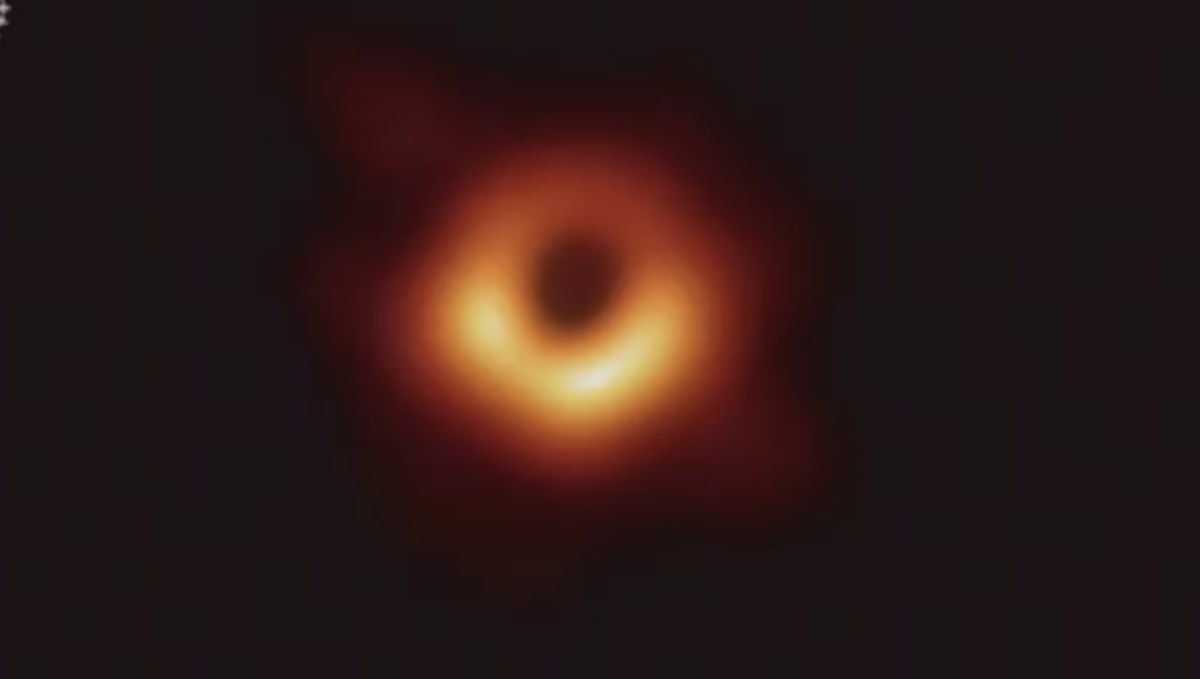
Ok, this is pretty cool. We have the first photo of a supermassive black hole, from imagery taken two years ago of the elliptical galaxy M87 (in the constellation Virgo) by the Event Horizon Telescope project. The EHT team is a group of 200 scientist that has been working on this project for two decades. The image was created using data captured from radio telescopes from Hawaii to the South Pole and beyond using very long baseline interferometry.
The image, of a lopsided ring of light surrounding a dark circle deep in the heart of the galaxy known as Messier 87, some 55 million light-years away from here, resembled the Eye of Sauron, a reminder yet again of the power and malevolence of nature. It is a smoke ring framing a one-way portal to eternity.
Now is a good time to (re)read Jonathan Lethem’s early novel, the absurdist physics love story As She Climbed Across the Table.
Update: Vox’s Joss Fong has a good 6-minute video that explains how the photo was taken:
And this video by Veritasium is even more meaty (and this one too):
Ben Burtt was the sound designer for the original Star Wars trilogy and was responsible for coming up with many of the movies’ iconic sounds, including the lightsaber and Darth Vader’s breathing.1 In this video, Burtt talks at length about how two dozens sounds from Star Wars were developed.
The base sound for the blaster shots came from a piece of metal hitting the guy-wire of a radio tower — I have always loved the noise that high-tension cables make. And I never noticed that Vader’s use of the force was accompanied by a rumbling sound. Anyway, this is a 45-minute masterclass in scrappy sound design.
See also: how the Millennium Falcon hyperdrive malfunction noise was made, exploring the sound design of Star Wars, and This Happy Dog Sounds Like a TIE Fighter.
Joining Carl’s Jr. and White Castle, Burger King is adding a tastes-like-beef veggie burger to their menu.
This week, Burger King is introducing a version of its iconic Whopper sandwich filled with a vegetarian patty from the start-up Impossible Foods.
The Impossible Whopper, as it will be known, is the biggest validation — and expansion opportunity — for a young industry that is looking to mimic and replace meat with plant-based alternatives.
The roll-out will start in the chain’s St. Louis restaurants and then proceed nationwide if all goes well. Here’s a commercial in which hardcore BK fans can’t tell the Impossible Whopper from their beloved beef version:
As an increasingly conflicted omnivore, I would be perfectly happy if all low- to mid-end burgers were replaced by veggie clones — I don’t care that the Quarter Pounder I eat once every three months is beef…I just want it to taste like a Quarter Pounder — and then high-end burgers (the ones where you can tell the difference and you eat only rarely) were made from humanely raised beef for which consumers pay an appropriate price that accurately reflects the true-cost accounting of their production. A meat burger that costs a dollar is just being paid for in other ways by someone or something else.
For his series of documentary short films, States of America, Brad Barber is profiling one person from each of the 50 US states.
In the United States, you might be born one place, go to school or work in another, then pack it up and move somewhere else for a thousand different reasons of choice or circumstance. You might have been born in another country. What is it that ties us to these places and makes us adopt them as our home? How does our state affect who we are and how we identify ourselves? What makes us from there?
For Wisconsin, Barber profiled Xong Xiong, a member of the Hmong community whose parents moved there from a refugee camp in Thailand.
Xong was born in a Hmong refugee camp in Thailand but moved to Wisconsin as a child after her family couldn’t safely return to Laos following the Vietnam War. There she grew up as part of a large influx of twice dislocated Hmong refugees who were not always welcomed with open arms in the small city of La Crosse. Despite her experiences with racism, poor integration, and detachment from her own culture, Xong is determined to help the younger generation born in America stay connected.
Xiong lives not too far from where I grew up as a kid. The subject of the Vermont short film lives pretty close to where I am now:
Here’s a trailer for the series. (thx johan)
John Boswell has made a 10-minute time lapse video showing the history of the universe, from its formation 13.8 billion years ago up to the present. Each second of the video represents the passing of 22 million years. But don’t blink right near the end…you might miss the tiny fraction of a second that represents the entire history of humanity.
See also: Boswell’s Timelapse of the Future, a dramatized time lapse of possible events from now until the heat death of the universe many trillion trillion trillions of years from now.
Newer posts
Older posts




Socials & More