kottke.org posts about sports
Pro freestyle mountain bike rider Matt Jones wants to try a new trick, something no one has ever done before. In this video, you see him go through the entire process of bringing a new idea or invention into the world:
- The idea. It’s based on a previous trick but is more difficult; standing on the shoulders of giants. He suspects it’s possible, but doesn’t know for sure. Only one way to find out…
- The prototype. Jones takes a bike frame (no wheels, pedals, etc.) to the local swimming pool to do flips with it off the diving board. The price of failure is low, so it’s easy to try out all sorts of different things. The mad inventor is gawked at by the public but presses on.
- Visualization. Now that his body knows how it feels to perform the motion in the pool, he can perform the trick in his mind over and over again, syncing brain & body. He’s starting to believe.
- Trial and error. With the basics down, it’s time to tinker with all the different variables — over and over and over and over and over and over again. An airbag breaks his falls, enabling experimentation.
- Failure. You see Jones try this trick over and over again in the video and very few of them are successful — and I bet a lot more failure happened off camera. Hundreds of tries, hundreds of fails. This is the way.
- Self-doubt. The trial & error, failure, and self-doubt stages all overlap. You can see him struggling with this on top of the tower. He still believes but this trick is dangerous. Body and mind are battling hard.
- Success. It all comes together at last.
This was one of three new tricks that Jones wanted to do last year and you can see more of his progress and process with those in these three videos. (thx, matt)
The best Super Bowl halftime performance, by a comfortable margin, is Prince’s performance during Super Bowl XLI in 2007. Anil Dash has a great writeup that contextualizes the song choices and what it all meant to Prince.
Prince’s halftime show wasn’t just a fun diversion from a football game; it was a deeply personal statement on race, agency & artistry from an artist determined to cement his long-term legacy. And he did it on his own terms, as always.
Opening with the stomp-stomp-clap of Queen’s “We Will Rock You”, Prince went for crowd participation right from the start, with a nod to one of the biggest stadium anthems of all time — and notably, is one of the songs in the set that he never performed any time before or after. Indeed, though his 1992 song “3 Chains O’ Gold” was clearly a pastiche of the then-rejuvenated “Bohemian Rhapsody”, Prince had rarely, if ever, played any Queen covers at all in his thousands of live shows.
But with that arena-rock staple, Prince was signaling that he was going to win over a football crowd. He launched straight into “Let’s Go Crazy” at the top of the set. As one of the best album- and concert-opening songs of all time, this was a perfect choice. Different from any other Super Bowl performer before or since, Prince actually does a call-and-response section in the song, emphasizing that this is live, and connecting him explicitly to a timeless Black music tradition.
You can watch his entire performance here. But if you’ve seen it before and you’re strapped for time, check out the full-on mini-concert Prince performed at a Super Bowl press conference a few days before the game:
Incredible. I move that going forward all “this is more of a comment than a question” comments during conference Q&As are immediately cut off with blistering guitar riffs of Johnny B. Goode. Seconded?
Werner Herzog doesn’t know anything about skateboarding. But suspecting the director was a kindred spirit, Ian Michna interviewed Herzog for skate mag Jenkem. My favorite bit is when Michna asks Herzog if he shot a skateboarding video, what music would he choose as a soundtrack:
What comes to mind first and foremost would be Russian Orthodox church choirs, something that creates this kind of strange feeling of space and sacrality — so what you are doing is special, bordering the sacred.
(via @mathowie)
Inspired by rock climbers, Danny MacAskill visits the Isle of Skye with his mountain bike to find an impossibly steep route down the Dubh Slabs. He is so far back in the saddle on some of the steepest stuff. I know high-end mountain bike brakes are on hair-triggers, but good God I wonder what MacAskill’s grip strength is… (thx, jeffrey)
In this short film by Simon Perkins, Jon Wilson shares his story of how cancer left him with one leg and the perspective he’s gained by skinning up and then skiing down mountains.
Sometimes I forget I’m broken. I cover up my scars and plug my ears. Things go okay for a while, but then I start thinking I’m entitled to some artificial slice of happiness, and before I know it I’m climbing a ladder to nowhere. To get down again, and find my equilibrium, it helps to remember when I was so low. It also helps to remind myself that life is relatively good if I have the luxury to ski up a goddamn mountain.
Many of us are scared to be broken. I’m a high school teacher, and I see it in the kids around me every day. They’re conditioned by black mirrors and social media algorithms designed for “perfect offerings.” We tell them about the ills of brokenness, but not the power and wisdom in it. We talk about post-traumatic stress — not post-traumatic growth. Being broken is a pre-existing condition that is never expunged from our record. And while I would never wish it on anyone, I would never trade in my scars, even if it meant having my leg back.
Last night, Tony Hawk posted a video of himself doing a 720 at the age of 52 (a full 2 years beyond the Brimley/Cocoon Line).
Hawk says it’ll probably be his last one — he’s getting too old, his spin is slower, etc. In 2016, at the age of 48, Hawk hit his final 900:
There’s a way in which watching Hawk perform these tricks and watching, say, 11-year-old Gui Khury perform the world’s first 1080 is the same: they’re both attempting something they aren’t sure they can do at that moment. But Hawk has both the benefit and hindrance of wisdom to draw upon here. He knows he can do a 720 because he’s done probably hundreds of them before, but he’s also battling his body, self-doubt, and probably the tiny voice in the back of his head saying “why exactly do you need to do this, dumbass?” Hawk probably knows better than anyone that as you get older, the true battle in sports (and life) is not against others or the record book, it’s against yourself.
Update: On Twitter, @limitedmitch says: “If you want to feel desperately sad today, Tony Hawk has been sporadically doing tricks ‘for the last time ever’ on his Instagram”.
This look inside the world of professional tag — the court setup, the vocabulary, the strategy — by Phil Edwards was the perfect low-stakes thing I needed to watch today. If you’d like to know more after watching, you can check out the World Chase Tag site, including the rules and terminology of the game (which has too many trademarked terms for my taste) or some competition videos (this compilation of the best moves from the last world championships is probably a good place to start).
With the positive news about the Covid-19 vaccine trials, I assume many of you have started to think about the potential end of the pandemic — what we’ll do, where we’ll go, who we’ll see, and reckon with what’s changed and what’s been lost. I know I have. Alex Hutchinson has written an intriguing piece on what sports science might be able to tell us about the psychology of a situation like the pandemic, where the finish line is poorly defined, ever-changing, or even non-existent.
As it happens, there’s a whole subfield of sports science, at the intersection of physiology and psychology, that explores this terrain. It’s called teleoanticipation, a term coined in 1996 by German physiologist Hans-Volkhart Ulmer to describe how our knowledge of an eventual endpoint (or telos) influences the entirety of an experience. Using endurance sports as their medium, researchers in this subfield have probed what happens when you hide the finish line, surreptitiously move it or take it away entirely. For those of us tempted by promising vaccine updates to start fantasizing about an end to the pandemic, these researchers have some advice: don’t.
Instead, the key seems to be remaining in the moment instead of focusing on the goal.
It turns out that, if you ask yourself “Can I keep going?” rather than “Can I make it to the finish?” you’re far more likely to answer in the affirmative.
This squares with mindfulness practices from Buddhism and Stoicism but also reminds me of a motivational trick I first heard a few years ago: that you can do anything for 10 seconds — and then you just begin a new 10 seconds. Turns out that was popularized by Unbreakable Kimmy Schmidt. Good advice can come from anywhere.
This video is a lovely little rumination by Iancu Barbarasa “about collecting, cycling caps, art and design, personal connections and why it’s worth doing something for a long time, even if the benefits are not clear at first.”
Many think some people are special but usually those people just put a lot more time in it than others. This applies to sports, arts, almost everything. It’s worth doing something for a long time, even if the benefits are not always clear. Good surprising things come out of it. You also learn about yourself in the process.
His inspiration in doing the film was to “inform, delight, and inspire”:
I mentioned above Milton Glaser’s “inform and delight” definition of art. It’s brilliant, but I always felt something was still missing from it. So I’d say that art — and any creative’s work — should aim to “inform, delight and inspire”. Hopefully my film will inspire people to start something of their own, or share what they’re already doing with other people. That would bring joy to everyone, and there’s never too much of it.
You can check out Barbarasa’s cycling cap collection on Instagram. I have never been much of a collector, but my 22+ years of efforts on this site (collecting knowledge/links?) and my sharing of photos on Flickr/Instagram over the years definitely have resulted in some of the same benefits.
This is a video of world champion Grant Holloway doing the 110-meter hurdles that’s been modified to keep his head right in the middle of the video. While champion hurdlers don’t keep their heads as still as birds do when hunting, Holloway’s relative lack of motion is incredible.
In this view, you can clearly see how expert hurdlers don’t jump their whole bodies over the hurdle (like Super Mario or something) — it’s more that they just bring their lower bodies up over the hurdles while their heads & shoulders remain more or less the same height from the ground. There’s hardly any lateral motion either — very little wasted energy here.
Second-tier Scottish football club Inverness Caledonian Thistle doesn’t have a camera operator for matches at their stadium so the club uses an AI-controlled camera that’s programmed to follow the ball for their broadcasts. But in a recent match against Ayr United, the AI controller kept moving the camera off the ball to focus on the bald head of the linesman, making the match all but unwatchable. No fans allowed in the stadium either, so the broadcast was the only way to watch.
Watch as artistic cyclist Viola Brand does all sorts of seemingly impossible bike tricks that look like ballet, all while dodging a massive chandelier inside an ornate European castle.
See also bicycle acrobat Lilly Yokoi performing some similar tricks back in 1965.
Alan Kahn, aka the Speed Bag King and author of The Speed Bag Bible, can seemingly do anything with a boxing speed bag…like make music. Just watch this 45-second video of him getting warmed up on the bag and then performing a tiny virtuoso concert for a small group of amazed onlookers.
See also Kahn punch drumming the William Tell Overture. Again, this starts off slow but wait for the complex stuff to kick in over the course of the video. (via @austinkleon)
Four years to the day after Colin Kaepernick kneeled during the national anthem of an NFL preseason game to protest the oppression of Black people in the United States, the Milwaukee Bucks refused to play their NBA playoff game and set off an NBA-wide strike, as well as strikes by teams in the WNBA, MLB, and MLS. They were reacting to the attempted murder of Jacob Blake by a Kenosha police officer on Sunday and the subsequent inaction by officials to take any disiplinary action against the officer.
The shooting prompted numerous N.B.A. players and coaches to express frustration and anger that the various measures they have been taking for weeks to support the Black Lives Matter movement, such as kneeling during the national anthem and wearing jerseys bearing social justice messages, were having little impact. Some also began to question, as the Nets’ star guard Kyrie Irving did in June before the 2019-20 season resumed, whether providing entertainment through basketball was actually diverting public attention away from the broader social justice movement.
Fueled by that frustration, Milwaukee’s players stunned league officials by organizing Wednesday’s boycott, a walkout that had virtually no precedent in N.B.A. history.
Milwaukee’s George Hill gave a glimpse of the Bucks’ mind-set on Monday when he openly questioned whether the league’s return had successfully amplified the players’ messaging.
“We shouldn’t have even come to this damn place to be honest,” Hill said. “I think coming here just took all the focal points off what the issues are.”
Former NBA player Kenny Smith walked off the set of TNT’s Inside the NBA in solidarity with the players.
As a reminder, here’s what Kaepernick said after kneeling four years ago:
I am not going to stand up to show pride in a flag for a country that oppresses black people and people of color. To me, this is bigger than football and it would be selfish on my part to look the other way. There are bodies in the street and people getting paid leave and getting away with murder.
You can see why the players believe that little has been done to address this state of affairs — there’s definitely more awareness now, but substantive change is not happening.
Update: A previous version of this post referred to the players’ walkout as a boycott (following the Times’ language). While boycott is technically accurate, it is generally used to refer to consumers withholding their purchase power as a protest. Strike is a more exact word to use in a situation where workers are withholding their labor (even though the players are not demanding concessions from their employers), so I updated the post to reflect that. (thx, david)
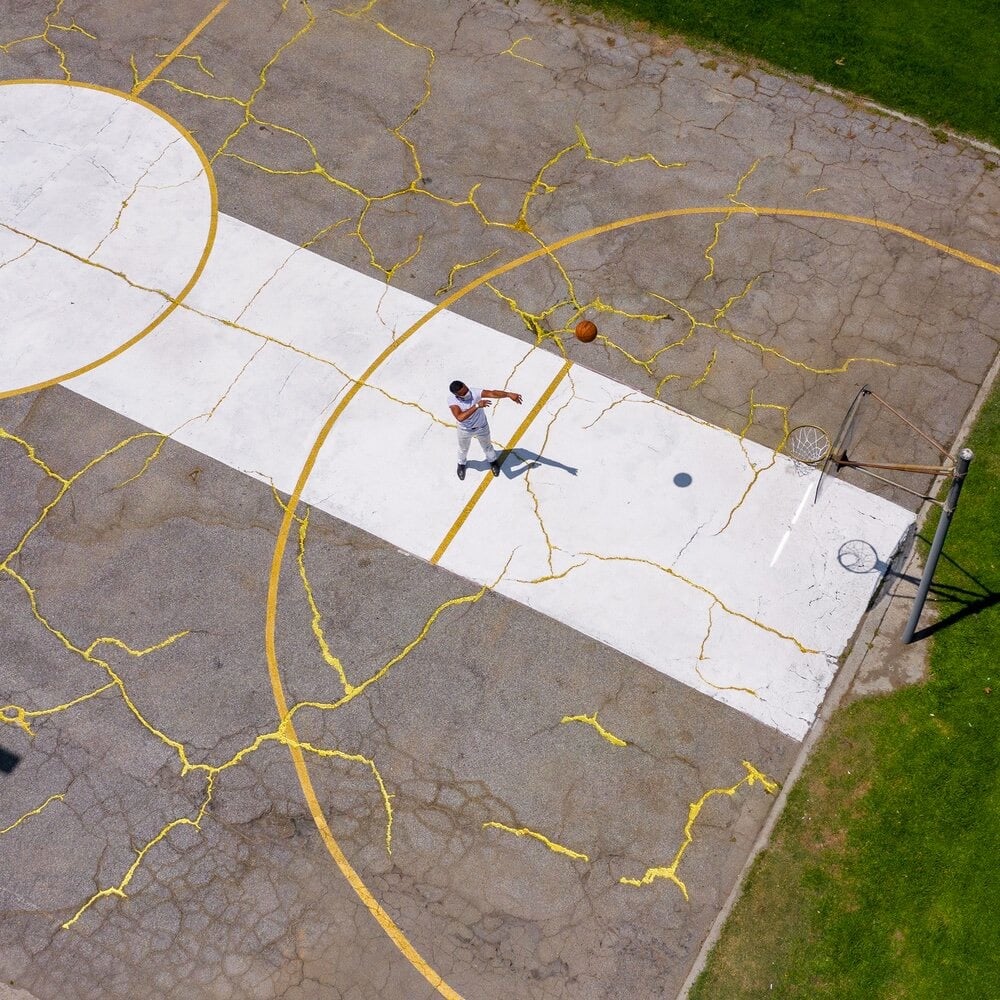
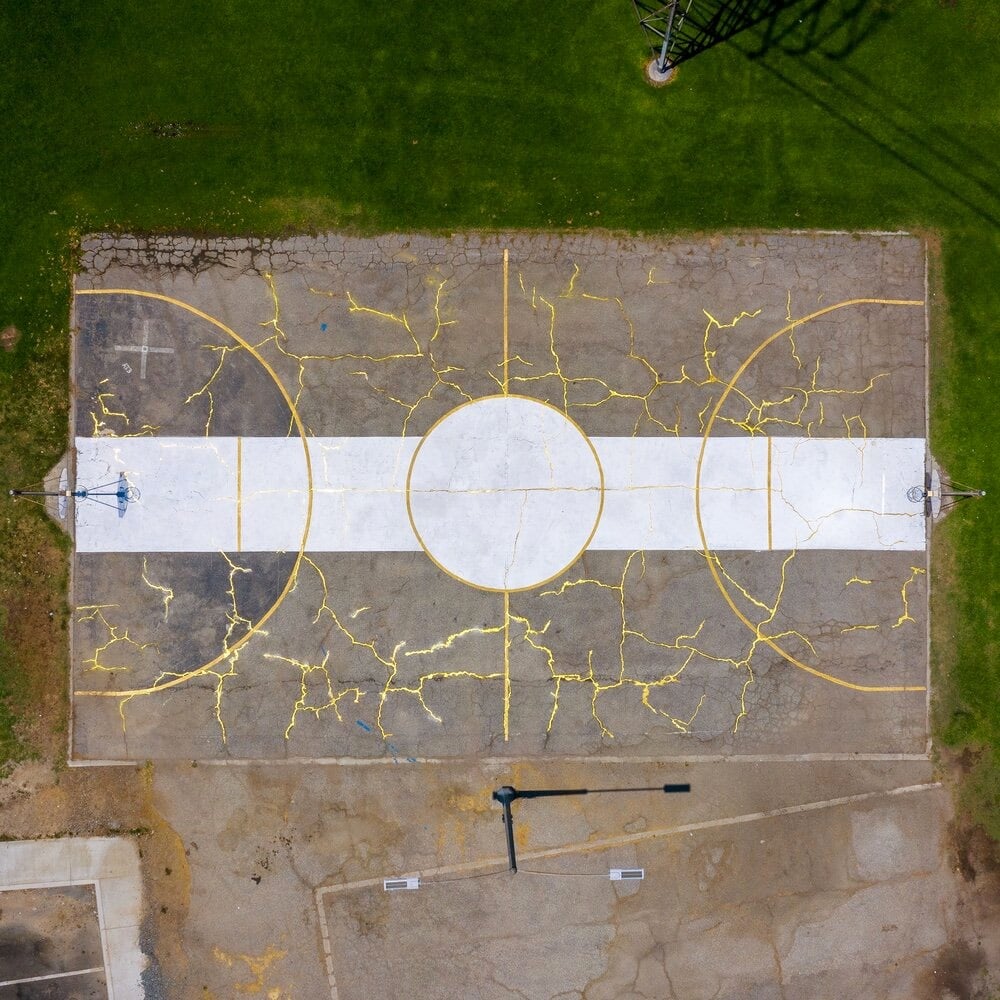
As part of his Literally Balling project, artist Victor Solomon fixed up a rundown basketball court, repairing the blacktop using the Japanese art of kintsugi. Traditionally, the kintsugi method involves repairing pottery with glue mixed with gold powder, which results in visible cracks, a reminder of the pottery’s past and what it’s been through. Says Solomon of the project:
With the heartbreaking beginning to 2020 and this weekend’s return of basketball — I’ve been thinking about the parallels between sport as a uniting platform to inspire healing and my ongoing experiments with the technique of Kintsugi that embellishes an objects repair with gold to celebrate it’s healing as formative part of the journey.
(via the kid should see this)
Newer posts
Older posts





Socials & More