kottke.org posts about science
Scientists confirm what every TV news network, conservative radio commentator, and blogger already knows: “Repeated exposure to one person’s viewpoint can have almost as much influence as exposure to shared opinions from multiple people. This finding shows that hearing an opinion multiple times increases the recipient’s sense of familiarity and in some cases gives a listener a false sense that an opinion is more widespread then it actually is.” (via snarkmarket)
A pair of articles on the Large Hadron Collider at CERN: A Giant Takes On Physics’ Biggest Questions and Crash Course. The LHC will hopefully provide the 1.21 gigawatts 7 trillion electron volts needed to uncover the Higgs boson, aka, The God Particle. “What we want is to reduce the world to objects that have no structure, that are points, that are as simple as we can imagine. And then build it up from there again.”
Room ceiling heights affect how people think. “When a person is in a space with a 10-foot ceiling, they will tend to think more freely, more abstractly. They might process more abstract connections between objects in a room, whereas a person in a room with an 8-foot ceiling will be more likely to focus on specifics.”
Global warming + evolution = species explosion!!!
Three of the candidates in the recent Republican presidential debate said they don’t believe in evolution: Colorado Representative Tom Tancredo, Kansas Senator Sam Brownback, and former Arkansas governor Mike Huckabee. Hard to believe that this is 2007 and not 1807. John McCain said he did believe in evolution but that “I also believe, when I hike the Grand Canyon and see it at sunset, that the hand of God is there also”.
Update: An earlier version of this post wrongly stated that Mitt Romney raised his hand when asked about disbelieving evolution…Tom Tancredo was the third person. (thx to several who wrote in about this)
While working on a particle accelerator, Anatoli Bugorski accidentally put his head into the proton stream. “The left half of Bugorski’s face swelled up beyond recognition, and over the next several days started peeling off, showing the path that the proton beam (moving near the speed of light) had burned through parts of his face, his bone, and the brain tissue underneath.” Some photos here. (via cyn-c)
The NY Times has an excerpt of the first chapter of The Black Swan by Nassim Taleb. Accompanying the excerpt is a review by Gregg Easterbrook. “History, he writes, proceeds by ‘jumps,’ controlled by ‘the tyranny of the singular, the accidental, the unseen and the unpredicted.’” Sounds like punctuated equilibrium.
A letter from the Paleoanthropology Division of the Smithsonian Institute: “We have given this specimen a careful and detailed examination, and regret to inform you that we disagree with your theory that it represents ‘conclusive proof of the presence of Early Man in Charleston County two million years ago.’ Rather, it appears that what you have found is the head of a Barbie doll, of the variety one of our staff, who has small children, believes to be the ‘Malibu Barbie.’”
Update: Not that there was any doubt that this isn’t a real letter, here’s the confirmation. (thx, sam & sheldon)
Humans are the animal world’s best distance runners…we can run long distances relatively fast without overheating. “Once humans start running, it only takes a bit more energy for us to run faster, Lieberman said. Other animals, on the other hand, expend a lot more energy as they speed up, particularly when they switch from a trot to a gallop, which most animals cannot maintain over long distances.” (via beebo)
I don’t know if this is the whole article or if the Discover site is just really bad at indicating that the rest of the article is for paying customers only, but either way, I want to read more on what happened to the hype about chaos theory.
Cities are often thought of as organisms or ecosystems, but the authors of a new study find that metaphor lacking. “The one thing that we know about organisms whether it be elephants or sharks or frogs, is that as they get large, they slow down. They use less energy, they don’t move as fast. That is a very important point for biological scaling. In the case of cities, it is actually the opposite. As cities get larger they create more wealth and they are more innovative at a faster rate. There is no counterpart to that in biology.”
How not to write a science book. “6. Avoid mentioning scientists or experiments. You’re a journalist, so it’s your job to explain things to people in ways they can understand. You always found science class difficult, and that class was taught by a scientist and involved experiments. Therefore no one can understand scientists and experiments.”
Microscopic auto-origami. Just add water! (And they fold right up.)
I love YouTube. This is a video clip of a chef pulling noodle dough, doubling it over 12 times until the noodles are unbelievably fine. The clip is from a 1987 PBS science show that I watched once when I was 14[1] and I’ve remembered it ever since as one of the simplest, coolest, and most concrete illustrations of mathematics I’ve ever seen. (via seriouseats)
[1] Ooh, watching science shows on PBS at 14….how popular was I in school?
There are some goldfish in Japan that live in a functioning deep fat fryer. The frying oil floats above the water where the fish live and as long as they don’t try jumping out of their layer, they’re fine. A nice side effect of this arrangement is that the fish keep the fryer clean, eating whatever food scraps fall from the fryer above. (via cyn-c)
Rare semi-identical twins born. “They are the result of two sperm cells fertilising a single egg, which then divided to form two embryos - and each sperm contributed genes to each child.”
Researchers looking into the science of happiness have found evidence that through kindness, gratitude, and optimism exercises, a person can increase their happiness level, much like physical exercise can increase physical fitness.
The Schmidt Sting Pain Index is a measure of how painful insect stings are. The Pepsis wasp rates a 4.0 and the pain is described as “blinding, fierce, shockingly electric. A running hair drier has been dropped into your bubble bath (if you get stung by one you might as well lie down and scream).” (via that’s how it happened)
Michael Pollan has some good advice for writing about nature and science. “So choose your first person deliberately. Too many newspaper first persons — and a lot of magazine first persons too — are written in the voice of the neutral feature-writer. They’re the voice of the Journalist. That is the least interesting first person you have. Nobody cares about journalists. They’re not normal people. So choose a first person that draws on a more normal side of your personality. And think about which one will help you tell the story. You’ll see that in very subtle ways it will shape your point of view and your tone and unlock interesting things.”
Thoughtful post on the extreme recency of recorded human history. We know very little about the people who lived before the invention of writing and collections of stories like the Bible, save for what we can glean from speechless skeletons, footprints, and other remains.
And look at how much is lost. Between the time of the couple fleeing across a field of volcanic ash and poor dead Lucy lies 400,000 years. If a Bible is a record of the struggle of a people for 2,000 years, we’d need 200 Bibles to tell us the tale of just this one obscure, remote branch of our lineage.
(thx, alexander)
An Intelligent Designer designs a cow. “How about we give it three, no eleven, no four stomachs! Four stomachs! For the efficient eating, of the grass. I am truly inspired! Don’t stop there. How’s this? This animal should urinate milk. From its groin, no less.”
Related to the men look at crotches post, here’s an eyetracking study that compares how artists look at a photo with the rest of us. “Non-artists spent significantly more time looking at [human bodies and faces in the photos] than artists.” (via snarkmarket)
17-year-old Mary Masterman built a spectrograph at home for $300, thousands of dollars less than they usually cost, earning her the top prize in the Intel Science Talent Search. Interestingly, 6 of the top 10 winners were women.
Among the many interesting things in Online Journalism Review’s article about using eyetracking to increase the effectiveness of news article design is this odd result:
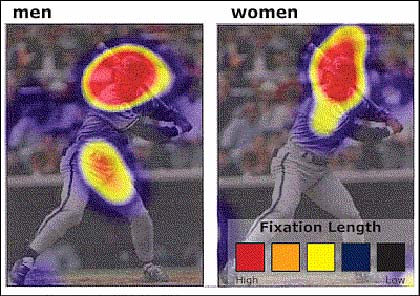
Although both men and women look at the image of George Brett when directed to find out information about his sport and position, men tend to focus on private anatomy as well as the face. For the women, the face is the only place they viewed. Coyne adds that this difference doesn’t just occur with images of people. Men tend to fixate more on areas of private anatomy on animals as well, as evidenced when users were directed to browse the American Kennel Club site.
That is absolutely fascinating. I’d love to hear an evolutionary biologist’s take on why that is.
I’m also heartened by the article’s first featured finding: that tighter writing, more white space, and jettisoning unnecessary imagery helps readers read faster and retain more of what they’ve read.
Newer posts
Older posts



Socials & More