kottke.org posts about real estate
Ann Ballentine bought an old candy factory building in Brooklyn in 1979. She filled it with working artists and became something of a fairy godmother to them all.
It entails someone who’s not as money driven, because you’re not gouging people for huge rents, and it requires being determined to do that over a long stretch of time.
This is a lovely little short film.
Slice of Life (trailer) is a feature-length documentary about the American Dream through the lens of former Pizza Huts that have been transformed into everything from bars to churches to candy stores to cannabis dispensaries. A woman who runs an LGBTQ+ church out of a former Pizza Hut says:
It’s the stained-glass windows that draw people and touch people, and I think really takes it out of the realm of a Pizza Hut. It’s the power of transformation. When things continue to transform, beauty can come from it, good things can come out of it.
You can rent or buy the film from their website.
I’ve written before about how Pizza Hut was a special place to visit when I was a kid:
Pizza Hut was the #1 eating-out destination for me as a kid. My family never ate out much, so even McDonald’s, Arby’s, or Hardee’s was a treat. But Pizza Hut was a whole different deal. Did I enjoy eating salad at home? No way. But I had to have the salad bar at Pizza Hut. Did I normally eat green peppers, onions, and black olives? Nope…but I would happily chow down on a supreme pizza at Pizza Hut.
This is a really interesting video about something called the gang-nail plate, a construction innovation that enabled larger roofs to be built on houses, removed the need for internal load-bearing walls, and made the process of construction cheaper & more efficient.
While it helped streamline building processes and cut costs, it also encouraged rapid housing expansion and larger, more resource-intensive homes. The result was an architectural shift that contributed to suburban sprawl, increased energy demands, and homes increasingly treated as commodities rather than unique, handcrafted spaces. These changes reverberated through building codes, real estate markets, and even family life, influencing how we interact with our homes and one another.
The story of gang-nail plate illustrates an inescapable reality of capitalist economics: companies tend not to pass cost savings from efficiency gains onto consumers…they just sell people more of it. And people mostly go along with it because who doesn’t want a bigger house for the same price as a smaller one 10 years ago or a 75” TV for far less than a 36” TV would have cost 8 years ago or a 1/4-lb burger for the same price as a regular burger a decade ago? (via @mariosundar.bsky.social)

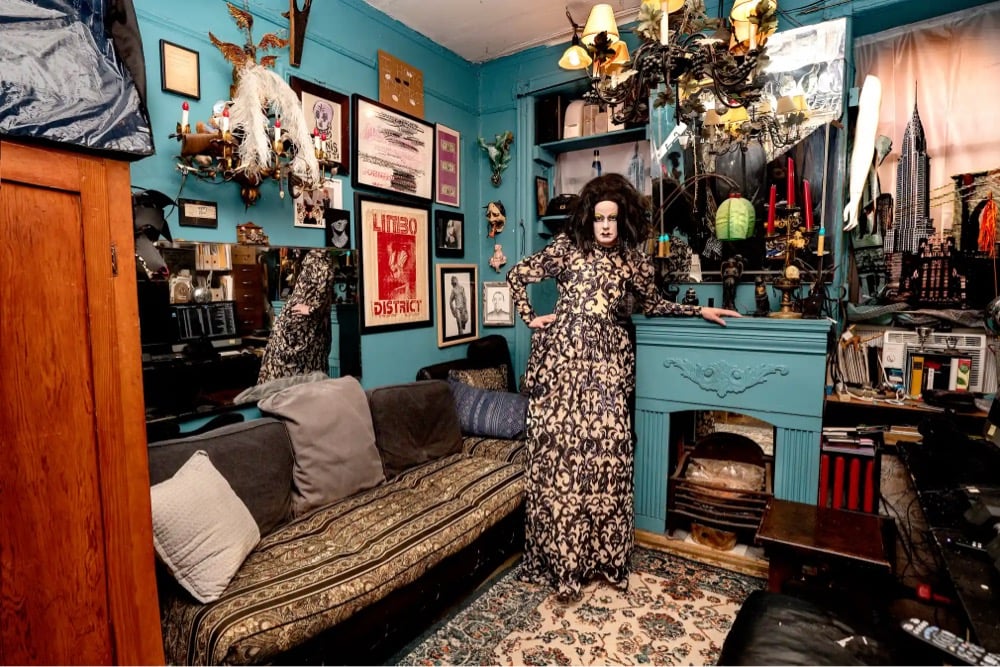
For her forthcoming book New Yorkers, photographer Sally Davies (Instagram) captured portraits of people inside their NYC apartments. I love the creativity of these living spaces, many in styles you just do not see in contemporary design magazines. You can preorder New Yorkers at Bookshop.org — it comes out April 1.


Posing as young apartment-hunting Hungarian billionaire, artist Andi Schmied was able to gain access to more than two dozen luxury apartments in Manhattan and photograph the views from them. The resulting project is called Private Views and you can see some of her photos in this portfolio. Christopher Bonanos interviewed Schmied about the project for Curbed. Regarding the banal sameness of rich people things:
Did you discover anything interesting about the apartments themselves?
They are all the same! I mean, really! For example, the layout of the apartments are essentially identical. You enter, and there’s a main view, always from the living room — in the case of Billionaires’ Row, everything’s facing the park. The second-best view is from the master bedroom, which is usually the corner. Then there’s the countertop, which usually a kitchen island in the middle, and there’s different types of marble but there’s always marble — Calacatta Tucci, or Noir St. Laurent, or Chinchilla Mink, and they always tell you, “It’s the best of the best,” from a hidden corner of the planet where they hand-selected the most incredible pieces. After five of these, it’s incredibly similar, all of them. Also they put a lot of emphasis on naming the designer.
The branding.
Yes. And there’s a big competition for amenities, who has the craziest amenities. Of course there’s the pool and all of that, but one of the newest things in the past two years in every single development is the golf-simulator room - it’s just the standard now.
Private Views is performance art as much as it is about photography and architecture. I love the details about how she conned her way into these buildings by using the eagerness of real estate brokers against them.
But after a while I realized that it absolutely doesn’t matter what I wear: From their point of view, you’ve passed the access, and you can do anything — anything is believable. For example, all the pictures were taken with a film camera, which is [gestures broadly] this big. I’d just ask, “Can I take some pictures for my husband?” which is a very obvious and normal thing to do. There were a few agents who noticed that it was a film camera, not a digital camera, and those who noticed asked, “Oh, wow, is it film?” And I’d always say something like, “Oh, my grandfather gave it to me — to record all the special moments in my life.” And they’d just put me in this box of “artsy billionaire,” and would start to talk to me about MoMA’s latest collection. So anything goes.
For a taste of the real estate banter, you can watch videos that Schmied recorded of her visits in a talk she gave early last year. Schmied is crowdfunding a book based on the project — you can back it here.
This week’s fun internet plaything has been the 3D virtual house tour of this three-bedroom house at 8800 Blue Lick Rd. in Louisville, KY. If you take the tour, you’ll quickly see why: from the standpoint of physics, the house doesn’t seem to make any sense. You think you’re in the basement and then head up some stairs to find yourself…still in the basement? It’s all very Inception crossed with the Winchester Mystery House with a side of How Buildings Learn.
So of course people turned it into a game: find the oddly located bathtub. They even started speedrunning it.
Resident internet meme sleuth Andy Baio called the owner of the house and got the scoop on the puzzling residence.
A larger question remained: what’s the deal with this place? Whoever owned it, they were too organized to be hoarders. The home appeared to double as the office and warehouse for an internet reseller business, but who sells a house crammed floor-to-ceiling with retail goods?
Internet sleuths unearthed several news articles from 2014, outlining how police discovered thousands of stolen items being sold online during a raid at the address, the result of a four-year investigation resulting in criminal charges for four family members living and working at the house.
But it didn’t add up. If they were convicted for organized crime, why was there still so much inventory in the house, with products released as recently as last year? Why is it still packed full while they’re trying to sell it? And what’s with the bathtub!?
I had questions, so I picked up the phone.
He also explains why the bathtub is no longer viewable in the 3D walkthrough.
In this video for NPR, Gene Demby summarizes the history of housing segregation in America and how it’s a factor for current differences in health (poorer), wealth (much less), education (underfunded), and policing (much more aggressive) for Black communities in US cities.
If you look at the way housing segregation works in America, you can see how things ended up this way. Once you see it, you won’t be able to unsee it.
When you’re talking about housing policy in America, Kimberly Jones’ Monopoly analogy starts to sound a lot less metaphorical and more literal: if Black people cannot buy houses or can only buy houses on certain streets, they will not be able to build wealth like others can.
For more on housing segregation, check out historian Richard Rothstein’s The Color of Law: A Forgotten History of How Our Government Segregated America. From a 2017 interview with Rothstein:
The federal government pursued two important policies in the mid-20th century that segregated metropolitan areas. One was the first civilian public housing program which frequently demolished integrated neighborhoods in order to create segregated public housing.
The second program that the federal government pursued was to subsidize the development of suburbs on a condition that they be only sold to white families and that the homes in those suburbs had deeds that prohibited resale to African-Americans. These two policies worked together to segregate metropolitan areas in ways that they otherwise would never have been segregated.
Rothstein talked about the book with Ta-Nehisi Coates during a conversation at Politics and Prose Bookstore.
Update: This is excellent: you can explore the maps created by the federal government’s Home Owners’ Loan Corporation at Mapping Inequality by the University of Richmond’s Digital Scholarship Lab.
These grades were a tool for redlining: making it difficult or impossible for people in certain areas to access mortgage financing and thus become homeowners. Redlining directed both public and private capital to native-born white families and away from African American and immigrant families. As homeownership was arguably the most significant means of intergenerational wealth building in the United States in the twentieth century, these redlining practices from eight decades ago had long-term effects in creating wealth inequalities that we still see today.
(via @masonadams)

For New York Apartment, an art project commissioned by The Whitney, artists Sam Lavigne and Tega Brain compiled actual NYC real estate listings into a listing for one mega apartment for sale.
Compiled from actual online real estate listings, the artwork collapses the high and low ends of the market, architectural periods and styles, and neighborhoods and affordability into a single space that cumulatively creates a portrait of New York’s living spaces and the real estate market. Like a standard real estate ad, the listing shows the price, number of bed- and bathrooms, and square footage, all of which are updated weekly based on the city’s aggregated real estate listings.
Take some time to explore the project — take the 3D virtual tour, scroll through all of the bathrooms & closets, peruse the apartment features, and take the video tour:
Do you crave brilliant sunshine and the peace Zen behind closed doors at home, and the bustle and excitement of the big city at your doorstep?
Do you dream of a Manhattan life?
Do you dream of Brooklyn living with Manhattan in reach?
Do you have a thing for top floor apartments?
Do you have vision?
Do you like light?
Do you love to cook?
Do you love to entertain?
Do you need lots of closet space?
Do you own or plan to buy a car?
Do you prefer simple shaker style wood cabinets with solid surface counters or custom lacquer cabinets paired with a travertine marble?
Do you want a home just steps to the beach?
Do you want Katz Deli, Russ and Daughters or maybe some Economy Candy?
Contact information for all of the brokers is listed on the site in case you’re interested.
In the 1850s, the well-heeled residents of Manhattan were convinced the city needed a grand park like the European capitals had. And so, a park located in the middle of the city was proposed, a Central Park, if you will. The only problem? There were people living in the park’s proposed location, including Seneca village, a small, integrated, predominately black neighborhood.
It’s a story that goes back to the 1820s, when that part of New York was largely open countryside. Soon it became home to about 1,600 people. Among them was a predominantly black community that bought up affordable plots to build homes, churches and a school. It became known as Seneca Village. And when Irish and German immigrants moved in, it became a rare example at the time of an integrated neighborhood.
See also ‘The City Needed Them Out’.
Since reading Gregory Shill’s writing about how heavily subsidized cars are in the United States, I’ve been on the lookout for different frameworks for thinking about America’s relationship to cars. I recently ran across a pair of interesting things about cars & housing. First, a refresher on what Shill had to say about how our nation’s laws have made cars all but mandatory:
Let’s begin at the state and local level. A key player in the story of automobile supremacy is single-family-only zoning, a shadow segregation regime that is now justifiably on the defensive for outlawing duplexes and apartments in huge swaths of the country. Through these and other land-use restrictions — laws that separate residential and commercial areas or require needlessly large yards — zoning rules scatter Americans across distances and highway-like roads that are impractical or dangerous to traverse on foot. The resulting densities are also too low to sustain high-frequency public transit.
Aaron Bady shared a few meaty pages from Nathanael Lauster’s The Death and Life of the Single-Family House: Lessons from Vancouver on Building a Livable City about houses being urban parasites and their symbiotic relationship with cars. Here’s an excerpt (italics mine):
Returning to the metaphor provided by the pine beetle and blue stain fungus, one parasite often works with another. In similar form, houses cultivate cars. Integrated through planning, they displace vastly more habitat than either could manage alone. Because houses consume space and tend to surround themselves with other houses, which also consume space, people often cannot walk to where they need to go. Because all that space results in a relatively low population density, it is also not very efficient to run public transit lines to areas with many houses. Low-density areas tend to end up with very few riders for what are often very expensive systems to maintain. In short, public transit loves density. The relationship between urban density and public transit use is exceptionally strong, with some suggestion of a cutoff — perhaps around twelve persons per acre (or about three thousand per square kilometer) — below which ridership drops off and expense per user makes transit impractical. By contrast, cars love the sprawl associated with houses and houses love cars back.
Houses cultivate cars. Cars love the sprawl associated with houses and houses love cars back. Lauster continues with the nature metaphor:
Altogether, house habitat displaces alternatives. The establishment of a Great House Reserve has protected house habitat even as it continues to expand in size. Agricultural and wild lands suffer in an immediate sense, as do the more urban habitats prevented from expanding beyond a constrained Urban Core. The house allies itself with the car at the same time as both contribute to global warming, potentially risking the displacement of everyone and everything. The house habitat excludes the poor. But even for those who can afford to live there, the Great House Reserve is a troublesome place to live. By its nature it leads to disengagement, contributes to inequality, and encourages a sedentary, unhealthy lifestyle.
And so on:
Houses are not just unaffordable for most people; they’re ultimately unaffordable for cities too. The fiscal situation of cities varies from place to place, but overall, houses tend to create a drain on municipal coffers. They are often taxed at lower rates than other properties, reflecting zoning restrictions on what could be built on single-family lots and how they can be used. But houses are more expensive to service on a per-unit basis, both in terms of the basic utilities infrastructure and, as previously noted, in terms of transit and transportation infrastructure. This could mean that my modestly wealthy neighbors and I, living in low-rises and town houses, end up supporting the very wealthy house owner nearby by paying more property tax relative to the amount of urban land and services we receive. The disparity becomes more notable as one crosses municipal boundaries into nearby house-dominated suburbs, where residents frequently enjoy the services (e.g., roads, commerce, employment opportunities) provided by the city without paying into the municipal tax base at all.
Josh Vredevoogd’s No Parking Here is about the poor parking policy in LA and leads with the statement: “Let’s build houses for people, not cars.”
For commercial buildings, it’s common to see a parking space required for every 100-200 sq ft. Meaning that parking is built at an almost 2:1 ratio to actual retail space, marginalizing the place that actually creates value and prioritizing temporary car storage. This inefficiency is carried into rent, groceries, meals, and overall raises the floor for cost of living.
Per City of LA code, a set of storefronts like above are illegal to build, instead they are required to be surrounded with empty pavement at the cost of walkability and comfort.
This forces people into driving. Parking requirements increase the density of cars but reduce the density of people. It also puts pressure on businesses by taking up useful real estate and replacing it with car storage.
Certainly a lot of food for thought here. See also Cars! What’s the Matter with Cars Today? and on a lighter note, What On Earth!, Kal Pindal’s Oscar-nominated short film about Martians visiting Earth and their observations about the dominant form of life here, the automobile.
Sarah Miller went looking for real estate in Miami, a place where the sea level could rise between one and three feet in the next 30 years. As she discovered, the real estate agents there have gotten good at deflecting buyers’ concerns about such matters.
I asked how the flooding was.
“There are pump stations everywhere, and the roads were raised,” he said. “So that’s all been fixed.”
“Fixed,” I said. “Wow. Amazing.”
I asked how the hurricanes were.
He said that because the hurricanes came from the tropics, from the south and this was the west side of Miami Beach, they were not that bad in this neighborhood. “Oh, right,” I said, as if that made any sense.
I asked him if he liked it here. “I love it,” he said. “It is one of the most thriving cities in the country, it’s growing rapidly.” He pointed to a row of buildings in a neighborhood called Edgewater that were all just three years old. “That skyline was all built in the last three years.”
Wow, I said, just in the last three years… “They’re not worried about sea level rise?”
“It’s definitely something the city is trying to combat. They are fighting it, by raising everything. But so far, it hasn’t been an issue.”
I couldn’t wait to steal this line, slightly altered. “I am afraid of dying, sure, but so far, it hasn’t been an issue.”
Later, I texted Kristina Hill, an associate professor of urban ecology at the University of California, Berkeley, whose main work is helping coastal communities adapt to climate change. I told her that a real estate agent had just told me hurricanes were weaker near Sunset Harbour, because it was in the east side of Miami, and hurricanes come from the south. She wrote back, “That’s ridiculous!”
The analysis of why Amsterdam and Miami are quite dissimilar when it comes to their respective responses to climate change is enlightening.
The Big Plan in the Netherlands depends on walls. Since Miami is built on limestone, which soaks up water like a sponge, walls are not very useful. In Miami, sea water will just go under a wall, like a salty ghost.
For more than 35 years, Dennis Hope has been selling land on the Moon. Hope registered a claim for the Moon in 1980 and, since the US government & the UN didn’t object, he figures he owns it (along with the other planets and moons in the solar system).
“I sent the United Nations a declaration of ownership detailing my intent to subdivide and sell the moon and have never heard back,” he says. “There is a loophole in the treaty — it does not apply to individuals.”
The US government had several years to contest such a claim. which they never did. Neither did the United Nations nor the Russian Government. This allowed Mr. Hope to take the next step and copyright his work with the US Copyright registry office. So, with his claim and Copyright Registration Certificate from the US Government in hand, Mr. Hope became what is probably the largest landowner on the planet today.
An acre-sized plot of the Moon is currently available for $24.99 and Hope says he has sold over a billion acres of his celestial properties to more than 6 million people, including to such moonsteaders as George H.W. Bush, Ronald Reagan, and Star Trek cast members.

Written and illustrated by Ariel Aberg-Riger, The City Needed Them Out tells the story of Seneca Village, a predominantly black NYC neighborhood destroyed in the 1850s to make way for Central Park. This article in the NY Times from July 9, 1856 expressed the city’s sentiment about the village and its inhabitants.

John Green shares delightful and interesting stories about 21 of the world’s most famous houses, including the Playboy Mansion, Winchester Mystery House, and Graceland.
Brendan O’Connor has sketched a short, poignant, four-dimensional map* of one of Manhattan’s most iconic streets, from the Hudson to the East River, and from 2001 to the present.
There is an idea of New York, and especially of Manhattan, as a place where the wealthy and the less wealthy (and even the not-at-all wealthy!) live in close proximity, even adjacent, to each other, and that this arrangement produces ambition in the latter to attain what the former has, and some amount of respect for the humanity of the latter in the former. This is not just incidental to life here, the thinking goes, but integral to it: Everyone, or almost everyone, suffers the city together.
The story of 14th Street both encapsulates this high-low fantasy and shows how it has been and continues to be erased in favor of something much more lucrative.
[The] High Line is a magnet for more than tourists’ money: According to a study conducted by the New York City Economic Development Corporation, before the park’s construction in 2003, the surrounding West Chelsea neighborhood—a mix of residential properties and light industrial businesses—were valued at eight percent below Manhattan’s overall median. In 2005, the city rezoned West Chelsea for luxury development, and, by 2011, residential property values appreciated beyond borough-wide values. “The park, which will eventually snake through more than twenty blocks, is destroying neighborhoods as it grows,” Jeremiah Moss wrote in the New York Times in 2012. “And it’s doing so by design. While the park began as a grass-roots endeavor—albeit a well-heeled one—it quickly became a tool for the Bloomberg administration’s creation of a new, upscale, corporatized stretch along the West Side.”
*Most street maps lie in at least two ways in order to fit two-dimensional constraints.
- They omit pitch and elevation. This is admittedly a bigger problem in cities like San Francisco than it is in most places, but the experience of walking along any street is shaped by its sloping uphill or downhill, its seat above or below.
- They eliminate the axis of time, which is relegated to real estate transaction documents and local folklore.
Related: The New York Times’ terrific “Reshaping New York” interactive map from 2013.
Older posts





Socials & More