


Snowflakes
And now, a poem from my daughter.

To play
play
Play
Yes play!
So if i have not made that clear,
I will make it clear.
Play!
Have a good weekend, everyone.

This site is made possible by member support. 💞
Big thanks to Arcustech for hosting the site and offering amazing tech support.
When you buy through links on kottke.org, I may earn an affiliate commission. Thanks for supporting the site!
kottke.org. home of fine hypertext products since 1998.
Beloved by 86.47% of the web.
And now, a poem from my daughter.
To play
play
Play
Yes play!
So if i have not made that clear,
I will make it clear.
Play!
Have a good weekend, everyone.
Filmmaker Jennifer Crandall has spent the past two years travelling all around Alabama, collecting short video vignettes of people’s lives — “Might we pull out our cameras to capture a few tiny moments from your life?” — and now she’s posting the videos on the Whitman, Alabama site.
I believe in listening and I believe in creating spaces intimate enough for voices to be heard. I believe in Alabama and her people. So I wanted to try to amplify her voices. To do this, a patchwork team of us set out and began to make a 52-part documentary film.
We crisscrossed the state, made acquaintances with strangers and asked: “Might we pull out our cameras to capture a few tiny moments from your life?”
And people said yes! (This still surprises me every time.)
And then we said: “There’s a catch. Can we do it while you read some poetry?”
I have to say, you Alabamians stepped up to the plate. You said, “Yes, I believe that’d still be all right.”
Each of her 52 subjects recites a verse from Walt Whitman’s poem Song of Myself. Why Whitman and not a poem by a southern poet?
I like the idea of cheekily co-opting the work of a dead white Yankee and re-envisioning it through contemporary Southern voices. I think we’ve found a neat way of mixing DNA here by joining these voices with Whitman’s. We’ve taken Whitman up on his offer to be co-creators, co-authors, of “Song of Myself.”
The Sullivan family read verse 16:
Some people just hit you in the heart. I was at Yen Restaurant in Mobile, looking for a hit of comfort food—Vietnamese food — and Cathy, Samantha and Brandon walked in.
Samantha reminded me of myself — half-Asian, half-white, sort of a tomboy. I approached them. Immediately they were open and warm. I asked Cathy if they might want to read for the project.
She said sure. No hesitation. She appreciated art and music. Samantha did, too. Cathy stenciled boats for a living. Samantha wanted to be an illustrator or graphic designer someday.
Sometimes if people think something isn’t going to look good to other people, they won’t let you see it, let alone film it. But Cathy threw open the doors in full welcome.
Spend some time with the project, meet some of your fellow Americans you might not know that well. (via @alainabrowne)
Update: Jia Tolentino interviewed Crandall about the project for the New Yorker.
The first time Crandall read “Song of Myself,” it was 1990, and she was sixteen, standing in a bookstore in McLean, Virginia, having just moved back to the United States. Because of her father’s job, with U.S.A.I.D., she had spent most of her childhood in Bangladesh, Haiti, and Pakistan. “My mom is Chinese, from Vietnam, and my dad’s a white dude from Denver, and at that moment I just felt that I did not understand America,” she said. She pulled a paperback anthology of poetry off the shelf, and Whitman stuck out right away. “Though I wouldn’t have articulated it then, what I responded to was this idea that everyone embodies diversity, not just the country. That many people are negotiating multiple social contracts, the way I’d been doing since I was born.”
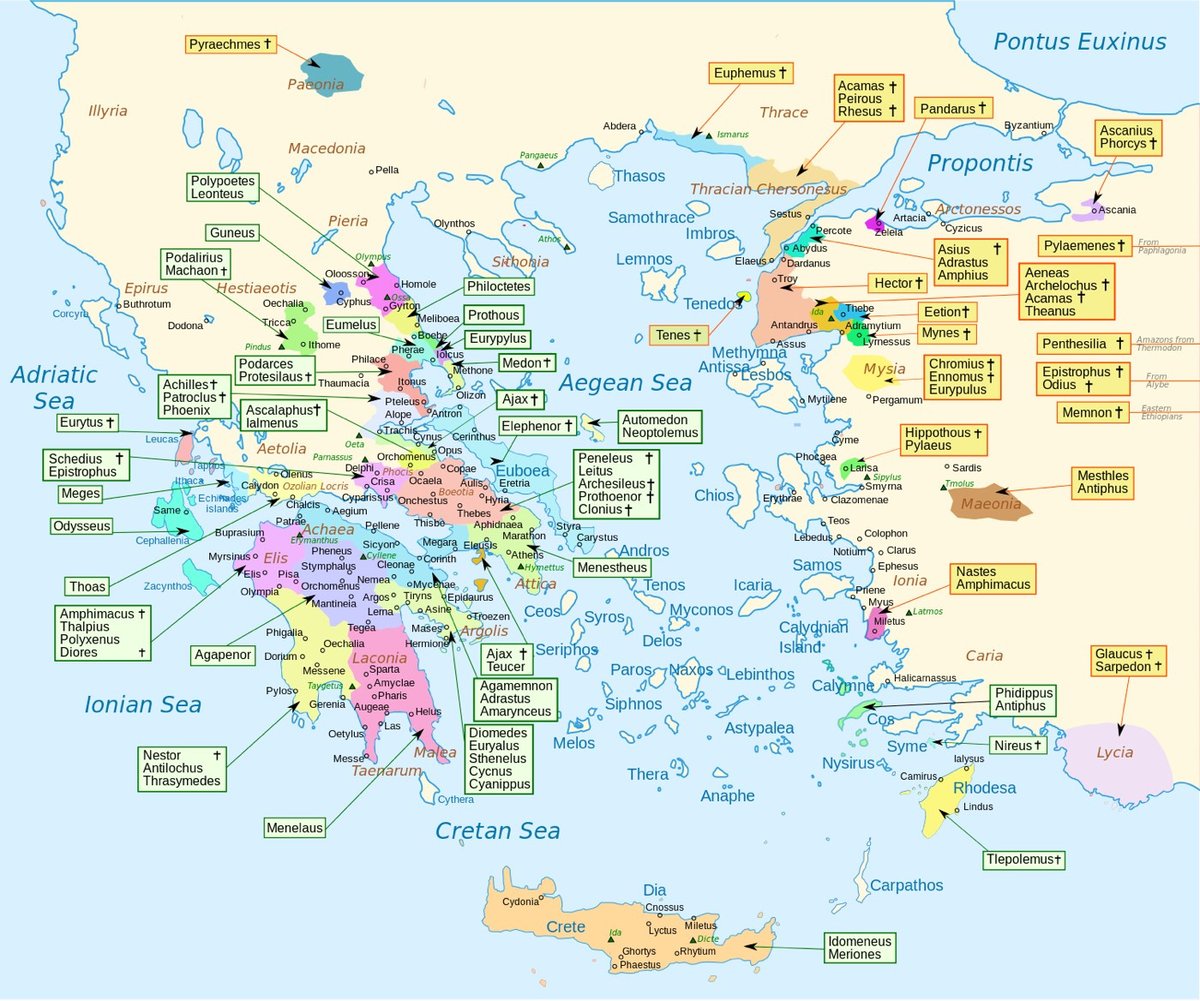
This is a map showing where all of the characters originated in Homer’s epic poem The Iliad. I know Greece is small by today’s standards, but it was surprising to me how geographically widespread the hometowns of the characters were. The Iliad is set sometime in the 11th or 12th century BC, about 400 years before Homer lived. I wonder if that level of mobility was accurate for the time or if Homer simply populated his poem with folks from all over Greece as a way of making listeners from many areas feel connected to the story — sort of the “hello, Cleveland!” of its time. (thx, adriana)
Update: I’ve gotten lots of feedback saying that not every character is represented in this map (particularly the women) and that some of the locations and hometowns are incorrect. Seems like Wikipedia might need to take a second look at it.
Update: The map was made using the Catalogue of Ships, a list of Achaean ships that sailed to Troy, and the Trojan Catalogue, a list of battle contingents that fought for Troy. That’s why it’s incomplete. An excerpt:
Now will I tell the captains of the ships and the ships in their order. Of the Boeotians Peneleos and Leïtus were captains, and Arcesilaus and Prothoënor and Clonius; these were they that dwelt in Hyria and rocky Aulis and Schoenus and Scolus and Eteonus with its many ridges, Thespeia, Graea, and spacious Mycalessus; and that dwelt about Harma and Eilesium and Erythrae; and that held Eleon and Hyle and Peteon, Ocalea and Medeon, the well-built citadel, Copae, Eutresis, and Thisbe, the haunt of doves; that dwelt in Coroneia and grassy Haliartus, and that held Plataea and dwelt in Glisas; that held lower Thebe, the well-built citadel, and holy Onchestus, the bright grove of Poseidon; and that held Arne, rich in vines, and Mideia and sacred Nisa and Anthedon on the seaboard.
(via @po8crg)
An excerpt from Elisa Chavez’s poem “Revenge” in the Seattle Review of Books:
Since you mention it, I think I will start that race war.
I could’ve swung either way? But now I’m definitely spending
the next 4 years converting your daughters to lesbianism;
I’m gonna eat all your guns. Swallow them lock stock and barrel
and spit bullet casings onto the dinner table;I’ll give birth to an army of mixed-race babies.
With fathers from every continent and genders to outnumber the stars,
my legion of multiracial babies will be intersectional as fuck
and your swastikas will not be enough to save you,
This is a powerful poem, and I laughed out loud so hard to the “This is a taco truck rally and all you have is cole slaw” line.
In this video, American poet Maya Angelou recites her poem Still I Rise, which was published in 1978. The recitation includes some opening remarks…the poem begins like so:
You may write me down in history
With your bitter, twisted lies,
You may trod me in the very dirt
But still, like dust, I’ll rise.Does my sassiness upset you?
Why are you beset with gloom?
‘Cause I walk like I’ve got oil wells
Pumping in my living room.Just like moons and like suns,
With the certainty of tides,
Just like hopes springing high,
Still I’ll rise.
Wonderful. That little chuckle after “Does my sassiness upset you?” — amazing. And it’s interesting to see how she deviates from the written text in her performance, a reminder that even the finest things in the world — like freedom, like liberty, like democracy — need to be refreshed and remade anew in order to remain vital. (via swiss miss)
From Mark Forsyth’s The Elements of Eloquence, a reminder of the rules of adjective order that fluent English speakers follow without quite knowing why.
…adjectives in English absolutely have to be in this order: opinion-size-age-shape-colour-origin-material-purpose Noun. So you can have a lovely little old rectangular green French silver whittling knife. But if you mess with that word order in the slightest you’ll sound like a maniac. It’s an odd thing that every English speaker uses that list, but almost none of us could write it out.
The Cambridge Dictionary lists a slightly different order: opinion, size, physical quality, shape, age, colour, origin, material, type, purpose. A poem by Alexandra Teague explores the topic in a creative way:
That summer, she had a student who was obsessed
with the order of adjectives. A soldier in the South
Vietnamese army, he had been taken prisoner whenSaigon fell. He wanted to know why the order
could not be altered. The sweltering city streets shook
with rockets and helicopters. The city swelteringstreets.
Did anyone learn this in school? I sure didn’t. How do we all know then? My daughter’s kindergarten teacher had a great phrase she used when things got a bit tricky as her students learned to read: “the English language is a rascal”. (via @MattAndersonBBC)
Update: Language Log’s post on adjective order is worth reading. (thx, stephen & margaret)

Frank Ocean dropped his long-awaited album the other day and to go along with it, he gave away a magazine called Boys Don’t Cry for free at four pop-up locations in LA, NYC, Chicago, and London. Kanye West contributed to the album and magazine, penning a poem about McDonald’s for the latter. Here’s the poem:
McDonald’s man
McDonald’s man
The French fries had a plan
The French fries had a plan
The salad bar and the ketchup made a band
Cus the French Fries had a plan
The French fries had a plan
McDonald’s man
McDonald’s
I know them French fries have a plan
I know them French fries have a plan
The cheeseburger and the shakes formed a band
To overthrow the French fries plan
I always knew them French fries was evil man
Smelling all good and shit
I don’t trust no food that smells that good man
I don’t trust it
I just can’t
McDonald’s man
McDonald’s man
McDonald’s, man
Them French fries look good tho
I knew the Diet Coke was jealous of the fries
I knew the McNuggets was jealous of the fries
Even the McRib was jealous of the fries
I could see it through his artificial meat eyes
And he only be there some of the time
Everybody was jealous of them French fries
Except for that one special guy
That smooth apple pie
Man, I can’t help but like Kanye. Just when you think he takes himself way too seriously, he does something like this and you can’t tell if he’s taking himself way WAY too seriously or not seriously at all. McDonald’s, man. Kanye drawing courtesy of Chris Piascik. (via @gavinpurcell)
From 1971, here’s Jesse Jackson on Sesame Street doing a call-and-response with the children of the poem I Am - Somebody.
I Am
Somebody
I Am
Somebody
I May Be Poor
But I Am
Somebody
I May Be Young
But I Am
Somebody
I May Be On Welfare
But I Am
Somebody
It’s difficult to imagine something like this airing on the show now. Sesame Street was originally designed to serve the needs of children in low-income homes, but now the newest episodes of the show air first on HBO…a trickle-down educational experience. (via @kathrynyu)
A new commercial from Apple pairs photos & videos shot on iPhone 6 with a poem from Maya Angelou called Human Family.
We seek success in Finland,
are born and die in Maine.
In minor ways we differ,
in major we’re the same.I note the obvious differences
between each sort and type,
but we are more alike, my friends,
than we are unalike.We are more alike, my friends,
than we are unalike.We are more alike, my friends,
than we are unalike.
You can hear Angelou recite the entire poem here:
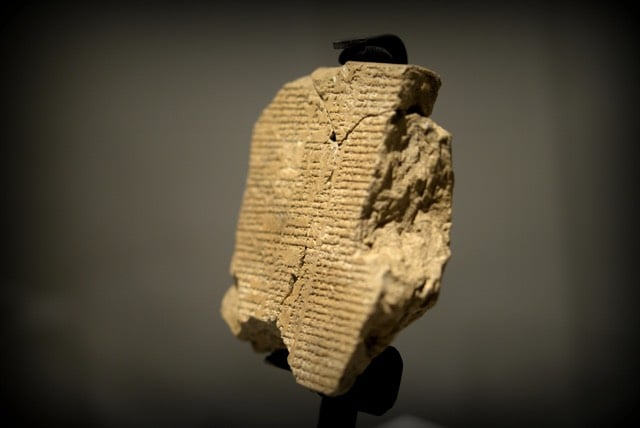
The Epic of Gilgamesh just got more epic. A recent find of a stone tablet dating back to the neo-Babylonian period (2000-1500 BCE) has added 20 new lines to the ancient Mesopotamian poem.
The tablet adds new verses to the story of how Gilgamesh and Enkidu slew the forest demigod Humbaba. Gilgamesh, King of Uruk, gets the idea to kill the giant Humbaba, guardian of the Cedar Forest, home of the gods, in Tablet II. He thinks accomplishing such a feat of strength will gain him eternal fame. His wise companion (and former wild man) Enkidu tries to talk him out of it — Humbaba was set to his task by the god Enlil — but stubborn Gilgamesh won’t budge, so Enkidu agrees to go with him on this quest. Together they overpower the giant. When the defeated Humbaba begs for mercy, offering to serve Gilgamesh forever and give him every sacred tree in the forest, Gilgamesh is moved to pity, but Enkidu’s blood is up now and he exhorts his friend to go through with the original plan to kill the giant and get that eternal renown he craves. Gilgamesh cuts Humbaba’s head off and then cuts down the sacred forest. The companions return to Uruk with the trophy head and lots of aromatic timber.
How the tablet was discovered is notable as well. Since 2011, the Sulaymaniyah Museum in the Kurdistan Region of Iraq was been paying smugglers to intercept artifacts leaving the country, no questions asked. The tablet was likely illegally excavated from the southern part of Iraq, and the museum paid the seller of this particular tablet $800 to keep it in the country.
This is glorious: an erotic poem by Chris Plante constructed from snippets of iPhone 6 reviews.
I have really big hands
Would be an understatement.
This is quite helpful.
When the tips of your fingers are grasping on for dear life,
Your fingers need to secure a firm grip.
I can still wrap my fingers around
Well…
More of everything.
No lines from John Gruber’s review, but Linus Edwards made a short poem just from that one:
Makes itself felt in your pants pocket.
Ah, but then there’s The Bulge.
I definitely appreciate the stronger vibrator.
(via @sippey)
Black Perl is a poem written in valid Perl 3 code:
BEFOREHAND: close door, each window & exit; wait until time.

    open spellbook, study, read (scan, select, tell us);

write it, print the hex while each watches,

    reverse its length, write again;

    kill spiders, pop them, chop, split, kill them.

        unlink arms, shift, wait & listen (listening, wait),

sort the flock (then, warn the "goats" & kill the "sheep");

    kill them, dump qualms, shift moralities,

    values aside, each one;

        die sheep! die to reverse the system

        you accept (reject, respect);

next step,

    kill the next sacrifice, each sacrifice,

    wait, redo ritual until "all the spirits are pleased";

    do it ("as they say").

do it(*everyone***must***participate***in***forbidden**s*e*x*).

return last victim; package body;

    exit crypt (time, times & "half a time") & close it,

    select (quickly) & warn your next victim;

AFTERWORDS: tell nobody.

    wait, wait until time;

    wait until next year, next decade;

        sleep, sleep, die yourself,

        die at last

# Larry Wall
It’s not Shakespeare, but it’s not bad for executable code.
Irish poet Seamus Heaney has died at 74. The Guardian has a brief account of his life; The Telegraph grapples more directly with the work There’s also his long, insightful interview with The Paris Review, from 1997.
.
“Heaney’s volumes make up two-thirds of the sales of living poets in Britain,” the BBC wrote in 2007, calling him “arguably, the English language’s greatest living bard.”
One of his best-known poems, “Digging,” compares his trade to that of his father and grandfather, who were farmers and cattle-raisers. These are its last two stanzas:
The cold smell of potato mould, the squelch and slap
Of soggy peat, the curt cuts of an edge
Through living roots awaken in my head.
But I’ve no spade to follow men like them.Between my finger and my thumb
The squat pen rests.
I’ll dig with it.
One of Heaney’s great later achievements was his translation of Beowulf, which I bought and read along with his Selected Poems when I was in college.
Previous translators struggled with the first word of Beowulf (“Hwaet!”) for decades. “Hark!” “What!”, and so on. Heaney’s version: “So.” <3
— Ellie Cumbo (@EllieCumbo) August 30, 2013
Heaney’s take on the Anglo-Saxon most reminds me of the first of Ezra Pound’s Cantos, a weird mix of old epic and contemporary free-verse imagery and meters, a translation of a translation of Homer that begins “And then” and ends “So that:”
When Swinburne died, W.B. Yeats is said to have told his sister, “Now I am King of the Cats.” When Robert Frost died, John Berryman asked, “who’s number one?”
I note this not to pose the question “who’s number one?” now that Heaney has died, but to observe that just as champion boxers and sprinters often have outsized competitive personalities that seem like caricatures compared to other athletes, even among writers, and even when they resist, as Heaney did, being drawn into literary feuds or political debate, great poets are often magnificent and terrible and troubling and glorious and weird.
One thing I will be doing from time to time this week is pulling down random books from my shelves and writing about them, under the belief that the internet is better when not all of it comes from the internet. Here’s the second installment (you can read the first here).
One of my favorite writers, poets, and teachers is Susan Stewart. She’s just one of those people who radiates intelligence and fun.
She also helped show me that you could put both of these things into critical writing — that plain, everyday language and willfully studied, obscure language were both traps.
Here is an audio recording of her reading one of my favorite of her poems, “Apple,” which begins:
If I could come back from the dead, I would come back
for an apple, and just for the first bite, the first
break, and the cold sweet grain
against the roof of the mouth, as plain
and clear as water.
This poem also includes a Twitter-worthy quip: “If an apple’s called ‘delicious,’ it’s not.”
And here is an excerpt from one of my favorite of her books (which I’m pretty sure was originally actually her doctoral thesis), On Longing: Narratives of the Miniature, the Gigantic, the Souvenir, the Collection:
Problems of the inanimate and the animate here bring us to a consideration of the toy. The toy is the physical embodiment of the fiction: it is a device for fantasy, a point of beginning for narrative. The toy opens an interior world, lending itself to fantasy and privacy in a way that the abstract space, the playground, of social play does not. To toy with something is to manipulate it, to try it out within sets of contexts, none of which is determinative… The desire to animate the toy is the desire not simply to know everything but also to experience everything simultaneously…
Here is the dream of the impeccable robot that has haunted the West at least since the advent of the industrial revolution. The eighteenth and nineteenth centuries mark the heyday of the automaton, just as they mark the mechanization of labor: jigging Irishmen, whistling birds, clocks with bleating sheep, and growling dogs guarding baskets of fruit. The theme of death and irreversibility reappears in the ambivalent status of toys like the little guillotines that were sold in France during the time of the Revolution. In 1793 Goethe wrote to his mother in Frankfurt requesting that she buy a toy guillotine for his son, August. This was a request she refused, saying that the toy’s maker should be put in stocks.
Such automated toys find their strongest modern successors in “models” of ships, trains, airplanes, and automobiles, models of the products of mechanized labor. These toys are nostalgic in a fundamental sense, for they completely transform the mode of production of the original as they miniaturize it: they produce a representation of a product of alienated labor, a representation which itself is constructed by artisanal labor. The triumph of the model-maker is that he or she has produced the object completely by hand, from the beginning assembly to the “finishing touches.”
It’s a kind of writing that’s totally within the boundaries of the historical and theoretical conventions of the academy, but is also always rhetorically and imaginatively precise and correct, from the individual syllable to the grouped processions of images.
I can’t tell you how rare that is. Probably you know already.
One thing I will be doing from time to time this week is pulling down random books from my shelves and writing about them, under the belief that the internet is better when not all of it comes from the internet. Here’s the first installment.
According to tradition, Simonides of Keos was the first Greek poet who composed and sung poems for money, rather than being kept by a patron. He was also famously stingy and liked to pose riddles:
They say that Simonides had two boxes, one for favors, the other for fees. So when someone came to him asking for a favor he had the boxes displayed and opened: the one was found to be empty of graces, the other full of money. And that’s the way Simonides got rid of a person requesting a gift.
Simonides’s world was one where old relationships of gift-exchange and patronage were breaking down in favor of what for Greeks was a fairly new invention, coinage. And all of his poetry and the stories around him seem to play with this: how the old world mythic heroes and Gods (Homer’s subjects) gave way to Olympic champions and rich merchants (Simonides’s subjects), the way value can be real but invisible, how words can be things that you exchange, like gifts or cash. This is one thing that helps make Simonides unusually modern.
That, at least, is poet/critic Anne Carson’s take in her terrific book Economy of the Unlost, which juxtaposes Simonides and the equally staggering twentieth-century poet Paul Celan:
Simonides of Keos was the smartest person in the fifth century B.C., or so I have come to believe. History has it that he was also the stingiest. Fantastical in its anecdoes, undeniable in its implications, the stinginess of Simonides can tell us something about the moral life of a user of money and something about the poetic life of an economy of loss.
No one who uses money is unchanged by that.
No one who uses money can easily get a look at their own practice. Ask eye to see its own eyelashes, as the Chinese proverb says. Yet Simonides did so, not only because he was smart.
Another argument Carson makes is that because Simonides was willing to write for anyone who would pay, his epigraphs — literally, writing that would be inscribed on a gravestone — is the “first poetry in the ancient Greek tradition about which we can certainly say, these are texts written to be read: literature” (emphasis mine).


Socials & More