




This site is made possible by member support. 💞
Big thanks to Arcustech for hosting the site and offering amazing tech support.
When you buy through links on kottke.org, I may earn an affiliate commission. Thanks for supporting the site!
kottke.org. home of fine hypertext products since 1998.
Beloved by 86.47% of the web.
kottke.org posts about mobile phones
Jargon watch: “book” as a synonym for “
Jargon watch: “book” as a synonym for “cool”. Sample usage: “That YouTube video is so book.” As books are decidedly uncool, you might wonder how this usage came about. Book is a T9onym of cool…both words require pressing 2665 on the keypad of a mobile phone but book comes up before cool in the T9 dictionary, leading to inadvertent uses of the former for the latter. (thx, david)
Booksquare surmises that turned sideways, the iPhone — with its bright 160 ppi screen — will be pretty decent for reading books and such. (via o’reilly)
Regarding some of the points in my iPhone round-up from yesterday, David Pogue has some answers to those questions and a whole lot more in his iPhone FAQ. “Is it ambidextrous? -No.” What does that even mean? As a lefty, am I out of luck? (via df)
iPhone round-up
By now you’ve all heard about the iPhone and read 60 billion things about it, so I’ll get straight to it. I’ve been tracking some of the best points from around the web and jotted down some thoughts of my own.
Caveat: Evaluating an interface, software or hardware, is difficult to do unless you have used it. An interface for something like a mobile phone is something you use on the time-scale of weeks and months, not minutes or hours. There are certain issues you can flag as potential problems, challenges, or triumphs after viewing demos, descriptions of functions, and the like, but until you’re holding the thing in your hand and living with it day-to-day, you really can’t say “this is going to work this way” or “I don’t like the way that functions” with anything approaching absolute confidence. With that said:
- In his keynote announcing it, Steve Jobs said the killer app for the iPhone was voice. The thing is, many people you talk to who are are under 35 use their phones more and more for text and less and less for voice. Same thing for Treo and Blackberry aficionados. Does the text entry via the touchscreen work as well as text entry via a mini keyboard? The tactility of raised buttons provides a lot of feedback to the typer’s fingers that a touchscreen does not. (Jason Fried said: “When you touch the [iPhone] it doesn’t touch you back.”) Can you type on it with your thumbs? What about if your thumbs are large? I know people who can text without looking at the keypad and/or Blackberry keyboard, that’s out the window with the touchscreen. Can you dial with one hand?
The touchscreen text entry is the biggest issue with the iPhone. If it works well, the iPhone has a good shot at success, and if not, it’s going to be very frustrating for those that rely on their mobile for text…and every potential customer of the iPhone is going to hear about that shortcoming and shy away.
- The price is pretty high. So was the price for the first iPod. And the Macintosh. Apple will approach this in a similar way to the iPod…start with a premium product at the high end and work their way down to shuffle-land. It isn’t difficult to imagine an iPhone nano that just does voice, SMS, music, and a camera. (Or an iPhone shuffle…you press the call button and it randomly calls someone from the ten contacts the shuffle synched from your computer that morning.)
- I guess we know why iPod development has seemed a little sluggish lately. When the Zune came out two months ago, it was thought that maybe Apple was falling behind, coasting on the fumes of an aging product line, and not innovating in the portable music player space anymore. I think the iPhone puts this discussion on the back burner for now. And the Zune? The supposed iPod-killer’s bullet ricocheted off of the iPhone’s smooth buttonless interface and is heading back in the wrong direction. Rest in peace, my gentle brown friend.
- How long before the other iPods start working like the iPhone? I imagine a widescreen video iPod with touchscreen but without a phone, wifi, camera, etc. will be introduced at some point after the iPhone comes out in June. Without the need for the clickwheel, the shape of the video and nano iPods becomes much more flexible. If they can cram all the memory and electronics into a smaller space, the nano could be half its current height with a touchscreen.
- What’s really kind of sad about the intensely exuberant reaction to the iPhone is that the situation with current mobile phones are so bad in the first place. It’s not like we didn’t see any of this coming or couldn’t imagine the utility of the iPhone’s features. Visual voicemail is a good idea, but the reason Nokia or Motorola didn’t introduce it years ago is that the carriers (Sprint, Verizon, T-Mobile, etc.) don’t want to support it despite its obvious utility and ease of implementation. (T-Mobile sends my Nokia phone a text message every time I get a voicemail…what could be simpler than sending the number along with it and shunting those messages to a special voicemail app on the phone to see a list of them? Listening to them out of sequence would be a bit harder, but doable. Blackberry announced they were doing this back in 2005.) Integrated Google Maps, email, and search makes obvious sense too. As for the touchscreen, we’ve all seen Jeff Han’s work on multi-touch interaction, Minority Report, and Wacom’s Cintiq, not to mention the mousepads on the MacBooks and the iPod’s clickwheel. The Japanese are pretty unimpressed with the whole thing.
What *is* fantastic about the iPhone is the way that they’ve put it all together; features are great, but it’s all about the implementation. Apple stripped out all the stuff you don’t need and made everything you do need really simple and easy. (That’s the way it appears anyway…see above caveat.)
- Regarding the above, a relevant passage from a Time magazine article on how the iPhone came about:
One reason there’s limited innovation in cell phones generally is that the cell carriers have stiff guidelines that the manufacturers have to follow. They demand that all their handsets work the same way. “A lot of times, to be honest, there’s some hubris, where they think they know better,” Jobs says. “They dictate what’s on the phone. That just wouldn’t work for us, because we want to innovate. Unless we could do that, it wasn’t worth doing.” Jobs demanded special treatment from his phone service partner, Cingular, and he got it. He even forced Cingular to re-engineer its infrastructure to handle the iPhone’s unique voicemail scheme. “They broke all their typical process rules to make it happen,” says Tony Fadell, who heads Apple’s iPod division. “They were infected by this product, and they were like, we’ve gotta do this!”
- From the video, it looks like it take four clicks (after unlocking the phone) to make a phone call. For everyday use, that seems excessive. I hope there’s going to be some sort of speed dial mechanism…with my current phone, pressing “2” and then “send” calls my wife (which I can basically do without looking, BTW).
- I don’t know what the state of the art is in voice recognition these days, but I’m a little surprised that’s not an input option here. To call someone, you say their name (my current phone does this). To text someone, you speak the message and they get the text on their end. Speaking “Google Maps, sushi near 10003” would have the expected result.
- Or maybe drawing graffiti on the screen with your fingers and other gestural input methods? You could have different swipes and taps as a speed dial mechanism…swipe the screen from top left to bottom right and then tap in the lower right hand corner to call mom, that sort of thing. Or Morse code maybe? ;)
- The OS X included with the phone obviously isn’t the version that’s running on my Powerbook right now. John Gruber proves that footnotes are often more interesting than the referring text and offers this little tidbit:
Several people have speculated that the iPhone’s version of OS X is actually a preview of what we’ll be getting with Leopard, the next version of Mac OS X.That is to say the core operating system at the core of Mac OS X, the computer OS used in Macs, and “OS X”, the embedded OS on the iPhone. More on this soon in a separate fireball, but do not be confused: Mac OS X and OS X are not the same thing, although they are most certainly siblings. The days of lazily referring to “Mac OS X” as “OS X” are now over.
- Lance warns us of the dreaded version 1.0 hardware from Apple.
- My favorite thing about the iPhone is the Google Maps integration. I would use that at least 4-5 times a week.
- Will phone numbers and addresses detected on web pages in Safari be clickable? Click to dial a phone number, click to look up an address with Google Maps, that sort of thing. Update: There’s a video online somewhere (anyone?) of a demo that shows a URL in an email and/or text message that’s clickable. (thx, Deron)
- The resolution of the screen on the iPhone is 160 ppi. People who have seen it close up report that the screen is extremely crisp and clear. Apple displays have been higher than 72 ppi for quite awhile, now but not as high as 160. How soon can we expect 160 ppi on the MacBooks?
- Double the width of the iPhone and you’ve got the iTablet. 640x480, a bigger virtual keyboard to type on, etc. Just a thought.
- My friend Chris suggested that it should ship with a dock that hooks directly to a monitor. Attach a keyboard and mouse to the monitor and voila!, you’ve got the world’s smallest portable computer.
- iPhone trademark dispute between Apple and Cisco: booorrrrr-ring.
- This is one of the biggest questions in the hardcore technology community: will Apple allow 3rd party development of widgets and apps for the iPhone? Right now it seems like they might not, but there’s a lot of speculation in the absence of information going on. It sure would be nice if they did, but Apple doesn’t have a good track record here. I bet the Dodgeball and Upcoming folks are looking at the integrated Google Maps and wishing they could integrate their apps in the same way. (And Flickr too!)
- Games! A no-brainer. Probably lots you can do with the motion sensors and proximity detectors, not to mention the touchscreen. Although the touchscreen does make it difficult to see and control the onscreen action at the same time. How would you play Pac-Man on the iPhone?
- Available in more than one color? Probably a few months after launch…or it could be right away.
- Parallels running on the iPhone was a joke, folks. Just pulling your ARM.
- Don’t you think that maybe every company should fire their founders after a few years and then hire them back a few years later? I mean, how crazy is it that Apple birthed the Apple II and the Macintosh — each a significant achievement that taken alone would have sealed Apple’s reputation for innovation in the history of computing — and then fired the guy that got them there, stumbled badly enough that they were heading for mediocrity and obscurity, and then brought Jobs back, who spurred a string of successes that has nearly overshadowed the company’s earlier achievements: OS X, the iMac, the iBooks/PowerBooks/MacBooks, the iPod, iTMS, and now the iPhone. It’s insane! Not to mention fun to watch. Perhaps Google should fire Larry and Sergey with the idea that they’ll take them back in a few years when they’re a little older, a little wiser, a little more seasoned in business, with a new perspective, and possessing an enormous amount of motivation to prove that their dismissal was a bad move.
- My favorite comment from the Digg thread about the model iPhone I made out of cardboard: “Nothing says you’ve never kissed a girl like toting around a paper iPhone.”
- From the Time article, a quote from Steve Jobs about how Apple does business: “Everybody hates their phone and that’s not a good thing. And there’s an opportunity there.”
- Interesting thoughts from Adam Baer in the wake of the iPhone announcement:
Apple has figured out a way to retain a hold on hearts and minds in a business previously based on bytes. I applaud its designs, I worry about its tactics and what they mean for the future of marketing and group think. A group that wants our devotion but doesn’t need the press, doesn’t want the press, can’t keep the press off its backs, is a group that’s more interested in mind control than in improving lives with its products.
- Some miscellaneous links: Watch the MacWorld keynote with the iPhone announcement. Fortune piece on how Apple kept the iPhone a secret for two years. David Pogue got an hour of hands-on time with the iPhone. The Digg post of the announcement got almost 20,000 diggs, more than 1,400 comments, and nearly crashed my browser when I went to look at it.
And that’s enough, I think.
Comparison of the iPhone with other smart phones…a nice companion piece to the comparison of my cardboard iPhone to various iPods, mobile phones, etc. So far, the market thinks that Apple’s got something good on their hands: Apple stock was up $7.10 today while RIMM (makers of Blackberry) dropped $11.16.
The Apple iPhone
Apple’s new iPhone looks like a thing of beauty. Widescreen touch interface, no buttons, runs OS X, useful widgets, integrated email, Google Maps, Google/Yahoo search, visual voicemail (see who voicemail is from before you call), SMS, Wifi, etc. etc. Oh, and it plays music.
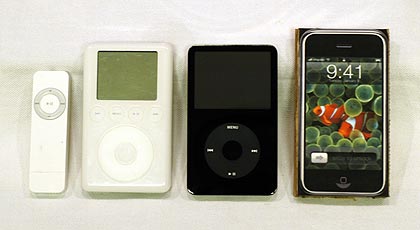
A lot of people are wondering just how big this thing is. Using the technical specs from apple.com, I grabbed some cardboard, scissors, and glue and made a scale model of the iPhone. Here it is:
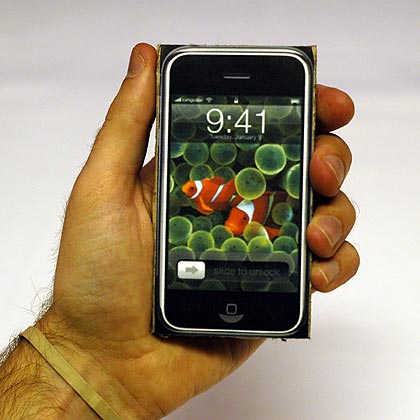
My hands aren’t that big (I can barely palm a basketball on a good day), but it still seems to fit pretty well. How does it stack up against similar devices?
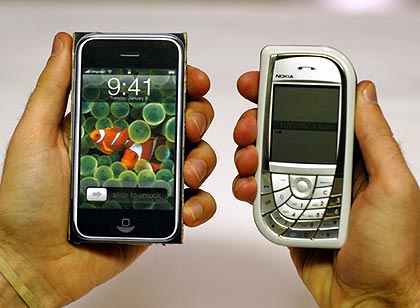
Here’s the iPhone vs. my current mobile phone, the Nokia 7610:
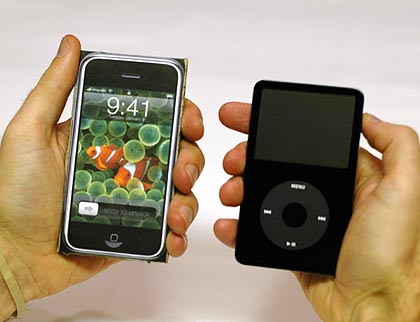
iPhone vs. a 5G iPod:
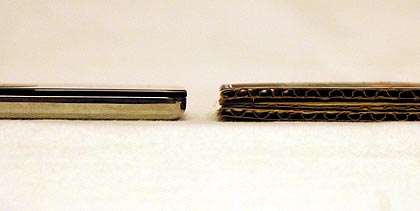
Thickness of the cardboard iPhone vs. the 5G iPod:
1G iPod shuffle, 3G iPod, 5G iPod and the iPhone:
iPhone vs. a TiVo remote and a Wii remote:
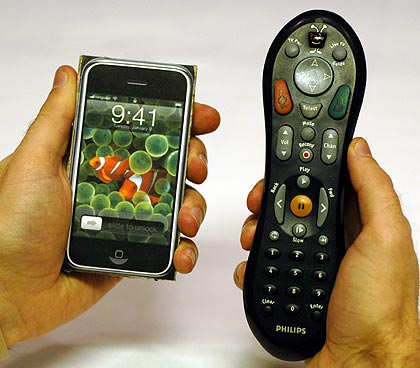
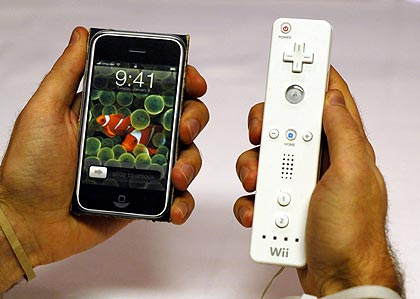
That’s all the gadgets I could find on a couple of hours notice.
I also dug up something I wrote a couple of years ago in the gigantic text file I keep on my Powerbook of ideas for kottke.org posts. 99% of the stuff in that file is completely dunderheaded, but I have to say I hit close to the mark on this one:
true convergence of phone + mp3 player will happen when someone solves this user experience puzzle: physically not enough room for two optimized interfaces (one for calls, one for music) on same small device. possible solution: no buttons, replace with touch screen that covers the whole front with one-touch switching between modes…
Once we’re able to get our hands on it and use the interface, the iPhone could turn out to be a disappointment, but they’re heading in the right direction at least. More thoughts soon.
(Like this story? Digg it.)
Interesting (and probably fake) photo of Apple’s alleged iPhone, which phone has no buttons…only a screen and a mousepad.
Some mobile phones come with water damage stickers that change color when they get wet, thereby voiding the warranty on your phone if it stops working, no matter if the color change and the breakage is related. “As a designer, I would much prefer to look at the problem as ‘How can we improve the sealing of phones so that water ingress is no longer a major problem?’ than ‘How can we design something to cover our backs and shift all the blame onto the user for our design fault?’”
The oh, don’t forget site offers an easy way to send yourself (and other people) reminders to a mobile phone. An API for this would be great…you could (theoretically) send all your iCal appointment alarms to the service.
More and more people are using their mobile phones to tell time instead of watches. Telling time has always been the #1 function I use on my phone.
Superman Returns
There’s a bit of a shout-out to citizen journalism in Superman Returns. Mid-movie, Daily Planet Editor in Chief White, Lois Lane, and Jimmy Olsen look at some photos of Superman spread across the chief’s desk. They’re great, iconic photos of the Man of Steel in action. White berates Olsen (and I’m paraphrasing here), “these are great and they were taken by a kid with a cameraphone. Whadda you got, Olsen?” Olsen throws his photos down on the desk; the one on top depicts a distant blurry streak across a blue sky.
“Look, in the sky, Chief.”
“It’s a bird.”
“It’s a plane.”
“No, look, it’s…”
Score one for the man on the scene.
Socials & More