kottke.org posts about iPod
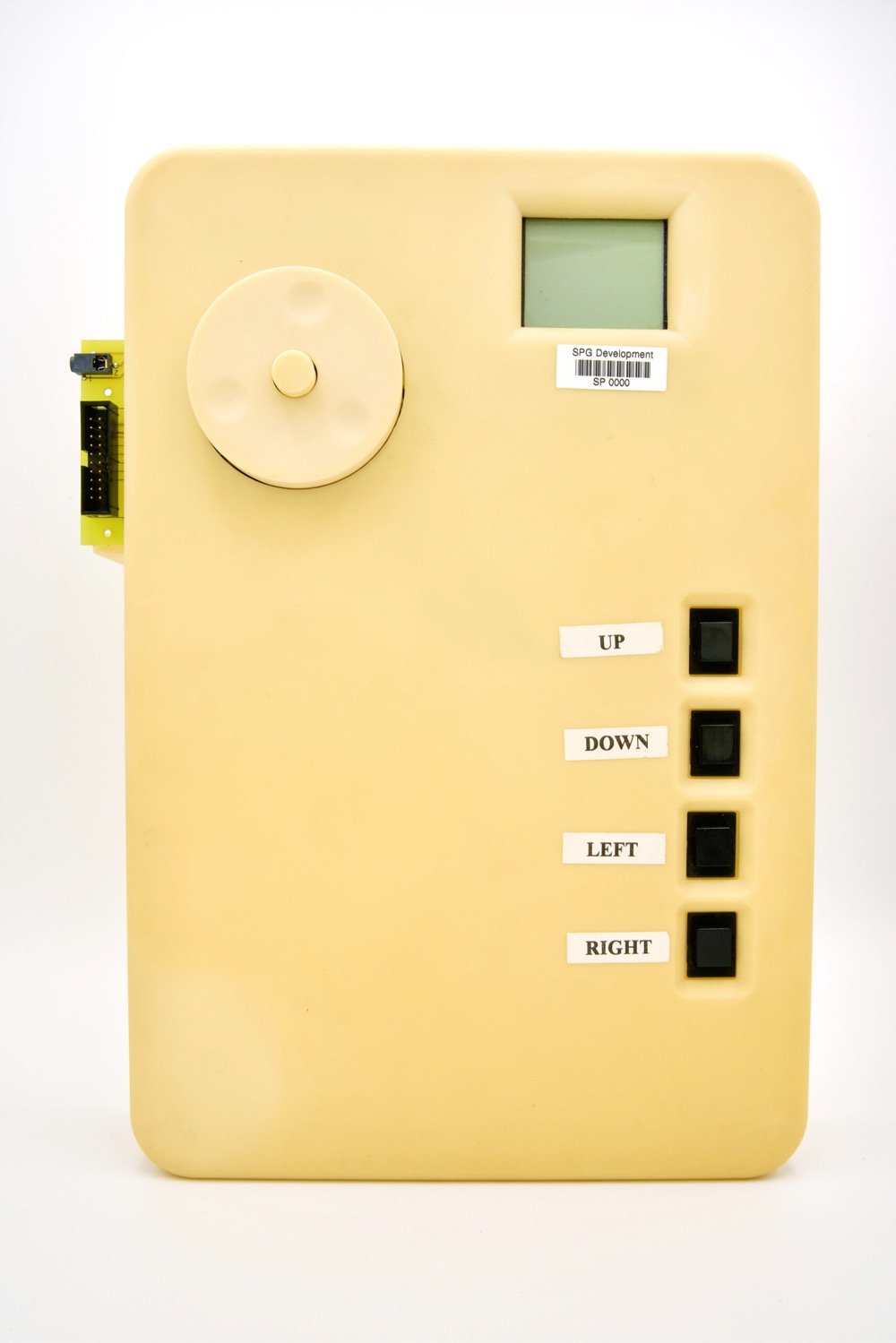
To mark the 20th anniversary of the iPod, Cabel Sasser shared some photos of one of the coolest artifacts in the Panic Archives: a prototype of the original iPod.
As you can see, it’s… quite large! We’ve always assumed that this mighty shell was designed to fit the large breadboards or circuit boards that were used during the earliest days of iPod development, until everything was eventually sized down to actual iPod-size. (It also has the Jobsian side-benefit of keeping the engineers in the dark about what the final device will look like.) I can’t get enough of those chunky, clunky, clicky black buttons wired up for navigation.
You can see how big it actually is when compared to the size of the actual iPod:
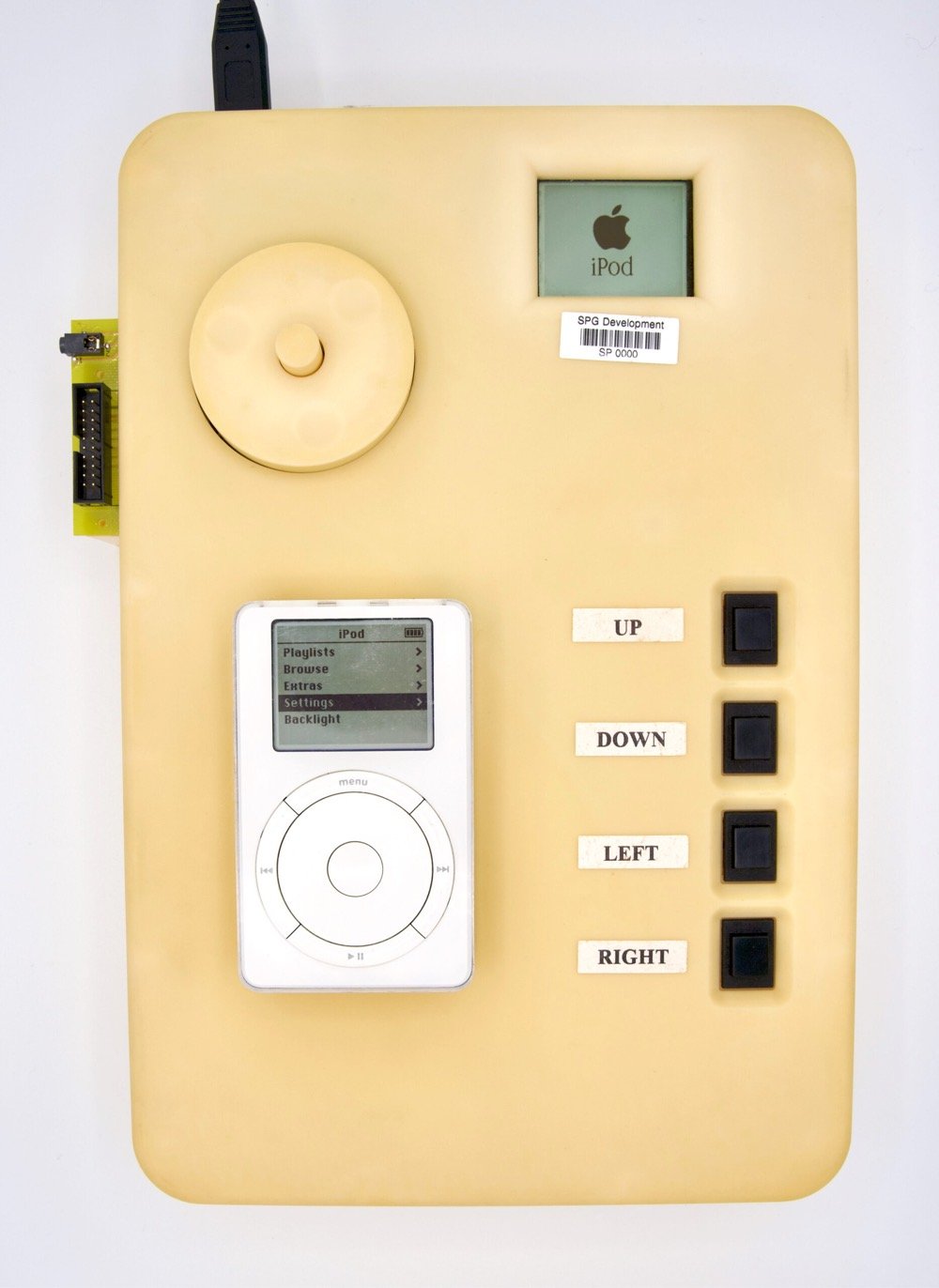
Update: Tony Fadell headed up development of the iPod at Apple and had this to say about the prototype above:
This is a P68/Dulcimer iPod prototype we (very quickly) made before the true form factor design was ready. Didn’t want it look like an iPod for confidentiality — the buttons placement, the size — it was mostly air inside — and the wheel worked (poorly)
How to charge your iPod using just an onion and some Gatorade. Oh yeah? When we were kids, we ran digital clocks off of potatoes and loved it! Fear the power of the tuber!
Update: It’s a myth, busted by Mythbusters no less. Like I said, tubers rule. (thx, everyone)
Before each race during the Olympics, Michael Phelps is seen sporting those ubiquitous white iPod earbuds. But what’s he listening to? A lot of rap and hip hop.
Two bits (bites? har har) of Apple news:
1. Steve Jobs has announced that an SDK will be available for the iPhone and iPod touch in February. No more hacking your phone to put applications on it.
2. You can now preorder OS X 10.5 (Leopard) at Amazon for $109…that’s $20 off the retail price. The offer comes with a pre-order price guarantee; if the price drops before it ships, you get it for the lower price.
My friend David Galbraith just launched a gadget site called Oobject. The gadgets are organized into hierarchically ordered collections and you can vote on the position of a particular gadget within the collection. Two of my favorite collections are the iPod knock-offs and revolting gold gadgets (it’s interesting that gold makes technology look vulgar and therefore cheap).
Oh, and David’s Smashing Telly is still cranking along nicely. I wish I had time to watch all the shows featured recently.
Apple is holding a special event today at 10am PT to announce a new product. Or something. No one knows exactly what but it seems to have something to do with music. Popular guesses include a 3G iPhone, a different iPod nano, a touchscreen iPod, and the availability of the Beatles entire musical catalog on iTunes. MacWorld, Engadget, MacObserver, and ArsTechnica (among others) will have live coverage.
Update: Jobs announced 99-cent ringtones, new colors for iPod shuffle, new form factor for iPod nano (fat vs. thin), renamed the iPod to iPod classic, introduced new iPod touch (basically the iPhone without the phone), new mobile iTunes Music Store that will work on iPod touch and the iPhone, odd partnership with Starbucks…click to buy currently playing songs in the store and free wifi for iTMS purchases (how about free wifi, period?), and the 8GB iPhone now costs $399. !!!!! I guess Apple’s plan on that was 1) gouge all the early adopters, and then 2) reduce the price to sell iPhones like crazy.
Long profile of Steve Jobs on the eve of his fourth act written by John Heilemann, who is one of my favorite technology/culture writers. I’m dying to find out what past Jobs-championed Apple product the iPhone will most resemble: the Lisa or the iPod?
The Fat Duck, one of molecular gastronomy’s main outposts, recently offered a course complete with its own soundtrack served up on iPods shuffle. “Heston Blumenthal, the chef, said he wanted to experiment with using sound to enhance a dining experience. Hence the iPod, playing the soothing sound of the sea breeze and waves gently caressing the seashore.”
Tourism, iPod-created personal environments, and the death of peripheral vision. “I was brought up to be constantly aware of others around me, to keep a sharp eye out to see if I was blocking someone’s way, holding someone up.”
OhMiBod is the ultimate iPod accessory: a vibrator that hooks up to the iPod and buzzes in time with the music. “I will never listen to music the same way again.” Don’t miss the playlists compiled specifically for OhMiBod use. NSFW. (thx, tania)
Regarding some of the points in my iPhone round-up from yesterday, David Pogue has some answers to those questions and a whole lot more in his iPhone FAQ. “Is it ambidextrous? -No.” What does that even mean? As a lefty, am I out of luck? (via df)
By now you’ve all heard about the iPhone and read 60 billion things about it, so I’ll get straight to it. I’ve been tracking some of the best points from around the web and jotted down some thoughts of my own.
Caveat: Evaluating an interface, software or hardware, is difficult to do unless you have used it. An interface for something like a mobile phone is something you use on the time-scale of weeks and months, not minutes or hours. There are certain issues you can flag as potential problems, challenges, or triumphs after viewing demos, descriptions of functions, and the like, but until you’re holding the thing in your hand and living with it day-to-day, you really can’t say “this is going to work this way” or “I don’t like the way that functions” with anything approaching absolute confidence. With that said:
- In his keynote announcing it, Steve Jobs said the killer app for the iPhone was voice. The thing is, many people you talk to who are are under 35 use their phones more and more for text and less and less for voice. Same thing for Treo and Blackberry aficionados. Does the text entry via the touchscreen work as well as text entry via a mini keyboard? The tactility of raised buttons provides a lot of feedback to the typer’s fingers that a touchscreen does not. (Jason Fried said: “When you touch the [iPhone] it doesn’t touch you back.”) Can you type on it with your thumbs? What about if your thumbs are large? I know people who can text without looking at the keypad and/or Blackberry keyboard, that’s out the window with the touchscreen. Can you dial with one hand?
The touchscreen text entry is the biggest issue with the iPhone. If it works well, the iPhone has a good shot at success, and if not, it’s going to be very frustrating for those that rely on their mobile for text…and every potential customer of the iPhone is going to hear about that shortcoming and shy away.
- The price is pretty high. So was the price for the first iPod. And the Macintosh. Apple will approach this in a similar way to the iPod…start with a premium product at the high end and work their way down to shuffle-land. It isn’t difficult to imagine an iPhone nano that just does voice, SMS, music, and a camera. (Or an iPhone shuffle…you press the call button and it randomly calls someone from the ten contacts the shuffle synched from your computer that morning.)
- I guess we know why iPod development has seemed a little sluggish lately. When the Zune came out two months ago, it was thought that maybe Apple was falling behind, coasting on the fumes of an aging product line, and not innovating in the portable music player space anymore. I think the iPhone puts this discussion on the back burner for now. And the Zune? The supposed iPod-killer’s bullet ricocheted off of the iPhone’s smooth buttonless interface and is heading back in the wrong direction. Rest in peace, my gentle brown friend.
- How long before the other iPods start working like the iPhone? I imagine a widescreen video iPod with touchscreen but without a phone, wifi, camera, etc. will be introduced at some point after the iPhone comes out in June. Without the need for the clickwheel, the shape of the video and nano iPods becomes much more flexible. If they can cram all the memory and electronics into a smaller space, the nano could be half its current height with a touchscreen.
- What’s really kind of sad about the intensely exuberant reaction to the iPhone is that the situation with current mobile phones are so bad in the first place. It’s not like we didn’t see any of this coming or couldn’t imagine the utility of the iPhone’s features. Visual voicemail is a good idea, but the reason Nokia or Motorola didn’t introduce it years ago is that the carriers (Sprint, Verizon, T-Mobile, etc.) don’t want to support it despite its obvious utility and ease of implementation. (T-Mobile sends my Nokia phone a text message every time I get a voicemail…what could be simpler than sending the number along with it and shunting those messages to a special voicemail app on the phone to see a list of them? Listening to them out of sequence would be a bit harder, but doable. Blackberry announced they were doing this back in 2005.) Integrated Google Maps, email, and search makes obvious sense too. As for the touchscreen, we’ve all seen Jeff Han’s work on multi-touch interaction, Minority Report, and Wacom’s Cintiq, not to mention the mousepads on the MacBooks and the iPod’s clickwheel. The Japanese are pretty unimpressed with the whole thing.
What *is* fantastic about the iPhone is the way that they’ve put it all together; features are great, but it’s all about the implementation. Apple stripped out all the stuff you don’t need and made everything you do need really simple and easy. (That’s the way it appears anyway…see above caveat.)
- Regarding the above, a relevant passage from a Time magazine article on how the iPhone came about:
One reason there’s limited innovation in cell phones generally is that the cell carriers have stiff guidelines that the manufacturers have to follow. They demand that all their handsets work the same way. “A lot of times, to be honest, there’s some hubris, where they think they know better,” Jobs says. “They dictate what’s on the phone. That just wouldn’t work for us, because we want to innovate. Unless we could do that, it wasn’t worth doing.” Jobs demanded special treatment from his phone service partner, Cingular, and he got it. He even forced Cingular to re-engineer its infrastructure to handle the iPhone’s unique voicemail scheme. “They broke all their typical process rules to make it happen,” says Tony Fadell, who heads Apple’s iPod division. “They were infected by this product, and they were like, we’ve gotta do this!”
- From the video, it looks like it take four clicks (after unlocking the phone) to make a phone call. For everyday use, that seems excessive. I hope there’s going to be some sort of speed dial mechanism…with my current phone, pressing “2” and then “send” calls my wife (which I can basically do without looking, BTW).
- I don’t know what the state of the art is in voice recognition these days, but I’m a little surprised that’s not an input option here. To call someone, you say their name (my current phone does this). To text someone, you speak the message and they get the text on their end. Speaking “Google Maps, sushi near 10003” would have the expected result.
- Or maybe drawing graffiti on the screen with your fingers and other gestural input methods? You could have different swipes and taps as a speed dial mechanism…swipe the screen from top left to bottom right and then tap in the lower right hand corner to call mom, that sort of thing. Or Morse code maybe? ;)
- The OS X included with the phone obviously isn’t the version that’s running on my Powerbook right now. John Gruber proves that footnotes are often more interesting than the referring text and offers this little tidbit:
That is to say the core operating system at the core of Mac OS X, the computer OS used in Macs, and “OS X”, the embedded OS on the iPhone. More on this soon in a separate fireball, but do not be confused: Mac OS X and OS X are not the same thing, although they are most certainly siblings. The days of lazily referring to “Mac OS X” as “OS X” are now over.
Several people have speculated that the iPhone’s version of OS X is actually a preview of what we’ll be getting with Leopard, the next version of Mac OS X.
- Lance warns us of the dreaded version 1.0 hardware from Apple.
- My favorite thing about the iPhone is the Google Maps integration. I would use that at least 4-5 times a week.
- Will phone numbers and addresses detected on web pages in Safari be clickable? Click to dial a phone number, click to look up an address with Google Maps, that sort of thing. Update: There’s a video online somewhere (anyone?) of a demo that shows a URL in an email and/or text message that’s clickable. (thx, Deron)
- The resolution of the screen on the iPhone is 160 ppi. People who have seen it close up report that the screen is extremely crisp and clear. Apple displays have been higher than 72 ppi for quite awhile, now but not as high as 160. How soon can we expect 160 ppi on the MacBooks?
- Double the width of the iPhone and you’ve got the iTablet. 640x480, a bigger virtual keyboard to type on, etc. Just a thought.
- My friend Chris suggested that it should ship with a dock that hooks directly to a monitor. Attach a keyboard and mouse to the monitor and voila!, you’ve got the world’s smallest portable computer.
- iPhone trademark dispute between Apple and Cisco: booorrrrr-ring.
- This is one of the biggest questions in the hardcore technology community: will Apple allow 3rd party development of widgets and apps for the iPhone? Right now it seems like they might not, but there’s a lot of speculation in the absence of information going on. It sure would be nice if they did, but Apple doesn’t have a good track record here. I bet the Dodgeball and Upcoming folks are looking at the integrated Google Maps and wishing they could integrate their apps in the same way. (And Flickr too!)
- Games! A no-brainer. Probably lots you can do with the motion sensors and proximity detectors, not to mention the touchscreen. Although the touchscreen does make it difficult to see and control the onscreen action at the same time. How would you play Pac-Man on the iPhone?
- Available in more than one color? Probably a few months after launch…or it could be right away.
- Parallels running on the iPhone was a joke, folks. Just pulling your ARM.
- Don’t you think that maybe every company should fire their founders after a few years and then hire them back a few years later? I mean, how crazy is it that Apple birthed the Apple II and the Macintosh — each a significant achievement that taken alone would have sealed Apple’s reputation for innovation in the history of computing — and then fired the guy that got them there, stumbled badly enough that they were heading for mediocrity and obscurity, and then brought Jobs back, who spurred a string of successes that has nearly overshadowed the company’s earlier achievements: OS X, the iMac, the iBooks/PowerBooks/MacBooks, the iPod, iTMS, and now the iPhone. It’s insane! Not to mention fun to watch. Perhaps Google should fire Larry and Sergey with the idea that they’ll take them back in a few years when they’re a little older, a little wiser, a little more seasoned in business, with a new perspective, and possessing an enormous amount of motivation to prove that their dismissal was a bad move.
- My favorite comment from the Digg thread about the model iPhone I made out of cardboard: “Nothing says you’ve never kissed a girl like toting around a paper iPhone.”
- From the Time article, a quote from Steve Jobs about how Apple does business: “Everybody hates their phone and that’s not a good thing. And there’s an opportunity there.”
- Interesting thoughts from Adam Baer in the wake of the iPhone announcement:
Apple has figured out a way to retain a hold on hearts and minds in a business previously based on bytes. I applaud its designs, I worry about its tactics and what they mean for the future of marketing and group think. A group that wants our devotion but doesn’t need the press, doesn’t want the press, can’t keep the press off its backs, is a group that’s more interested in mind control than in improving lives with its products.
- Some miscellaneous links: Watch the MacWorld keynote with the iPhone announcement. Fortune piece on how Apple kept the iPhone a secret for two years. David Pogue got an hour of hands-on time with the iPhone. The Digg post of the announcement got almost 20,000 diggs, more than 1,400 comments, and nearly crashed my browser when I went to look at it.
And that’s enough, I think.
David Denby had a great piece in the New Yorker last week about the present and future of movies. I was surprised to learn that Hollywood hates the movie theater-going experience as much or more than the rest of us:
Consider the mall or the urban multiplex. The steady rain of contempt that I heard Hollywood executives direct at the theatres has been amplified, a dozen times over, by friends and strangers alike. The concession stands were wrathfully noted, with their “small” Cokes in which you could drown a rabbit, their candy bars the size of cow patties; add to that the pre-movie purgatory padded out to thirty minutes with ads, coming attractions, public-service announcements, theatre-chain logos, enticements for kitty-kat clubs and Ukrainian bakeries-anything to delay the movie and send you back to the concession stand, where the theatres make forty per cent of their profits. If you go to a thriller, you may sit through coming attractions for five or six action movies, with bodies bursting out of windows and flaming cars flipping through the air-a long stretch of convulsive imagery from what seems like a single terrible movie that you’ve seen before. At poorly run multiplexes, projector bulbs go dim, the prints develop scratches or turn yellow, the soles of your shoes stick to the floor, people jabber on cell phones, and rumbles and blasts bleed through the walls.
If we want to see something badly enough, we go, of course, and once everyone settles down we can still enjoy ourselves. But we go amid murmurs of discontent, and the discontent will only get louder as the theatre complexes age. Many of them were randomly and cheaply built in response to what George Lucas conclusively demonstrated with “Star Wars,” in 1977: that a pop movie heavily advertised on national television could open simultaneously in theatres across the country and attract enormous opening-weekend audiences. As these theatres age, the gold leaf doesn’t slowly peel off fluted columns. They rot, like disused industrial spaces. They have become the detritus of what seems, on a bad day, like a dying culture.
Denby also considers what happens to movies when the primary target audience (12-30 year-olds make up 50% of the movie-going population) may prefer to watch movies on DVD, their computers, or on iPods.
No exhibition method is innocent of aesthetic qualities. Platform agnosticism may flourish among kids, but platform neutrality doesn’t exist. Fifty years ago, the length of a pop single was influenced by what would fit on a forty-five-r.p.m. seven-inch disk. The length and the episodic structure of the Victorian novel — Dickens’s novels, especially — were at least partly created by writers and editors working on deadline for monthly periodicals. Television, for a variety of commercial and spatial reasons, developed the single-set or two-set sitcom. Format always affects form, and the exhibition space changes what’s exhibited.
As a fan of watching movies on the big screen of a theater, I hope that sort of movie making doesn’t go away anytime soon.
Comparison of the iPhone with other smart phones…a nice companion piece to the comparison of my cardboard iPhone to various iPods, mobile phones, etc. So far, the market thinks that Apple’s got something good on their hands: Apple stock was up $7.10 today while RIMM (makers of Blackberry) dropped $11.16.
Older posts





Socials & More