kottke.org posts about games
Another excellent link from Quora’s weekly newsletter: What is the best sacrifice in the history of chess? A game played in 1934 featured the sacrifice of the queen & both rooks and was over so quickly (14 moves) that it’s referred to as The Peruvian Immortal. I found it easier to follow the game by watching it:
Building on yesterday’s “The dirty BLEEP,” here are a few more great moments in the artful use of censorship (or its illusion):
- Neven Mrgan and James Moore have an iOS game called “Blackbar” that involves playful use of blacked-out text. (If my last name were missing an expected vowel, I’d be interested in intentional omissions too.) It’s described as “serious,” “artsy,” and “texty,” all adjectives I hope I will one day earn.
- Jimmy Kimmel has gotten a lot of mileage out of “Unnecessary Censorship,” a recurring sketch that uses bleeps and blurs for comedic effect. A proprietor of a popular internet site named J—n K——e confided in me this week that “Kimmel’s… skit always makes me laugh until I pee my pants,” a pretty stirring endorsement if I’ve ever heard one.
Also, besides using the appearance of censorship to remix existing text, audio, and video like “Unnecessary Censorship” does or fully scripting the bleep ahead of time like Arrested Development or South Park do, there’s been a real rise in a mode that’s in between, something that’s deliberate but has the feel of being off-the-cuff. This is probably best exemplified by The Daily Show and The Colbert Report. Check out Ashton Kutcher’s “surprise” experience on Colbert:
Here the tension isn’t just between what you’ve heard and what you know was said, but also between the live experience and that of broadcast. It used to be that if you heard a bleep of an event that was recorded live, someone had gone off the rails, like Madonna on the David Letterman show.
Now, TV mostly just lets anything and everything rip for the people in the room, knowing it will amp up the energy in the crowd, but can be bleeped for broadcast later. Then sometimes (like with The Daily Show or Chappelle’s Show on DVD or Netflix), you can catch the uncensored cut at home.
So we get the live, the censored, and the edited-but-encensored experiences, and we’re always mentally bouncing between all three. We know it’s not really spontaneous, but knowing is part of what lets us in on the joke, even though we can’t be in the room.
In acceleration chess (aka progressive chess), each player gets to make one more move than the previous player.
White moves first, but then Black gets to move twice. Then White gets to move three times in a row, then Black four times in a row, then White five times in a row, and so on, with continuing escalation as the game proceeds.
You can see some gameplay here:
Cennydd Bowles spends a day at the World Chess Championship Candidates Tournament. Lovely little piece.
I’m overwhelmed to be in the same room as these men. I played through their games (well, except the younger ones) as a teenager, developing a love or dislike of their styles, and scratching my head at their depth. The skill gap in chess is remarkable: these Grandmasters would demolish someone who would easily beat someone who would wipe me off the board. Amid my admiration, I feel a vertiginous impulse: I could leap out of my seat, scatter the pieces, and make history as the world’s first chess streaker. The temptation soon fades.
Each player aligns the pieces, although the boards are already laid out in pristine formation. It’s a curious habit I recognise from my own experience. It helps to get your hands on the tools of your trade, to feel they’re yours.
I expected more left-handers.
(via @beep)
Play the one-second stopwatch game…it took me 62 tries to hit 1:00 exactly. We used to play this in school with an actual digital watch. We also had a version where we’d see how fast we could start and stop the timer. Good wholesome times…we weren’t rotting our brains with Candy Crush or Angry Birds Star Wars or social studies. (thx, nick)

Innovation in tic-tac-toe? A meta version of the game is actually challenging and fun to play if you’re not 4 years old.
This lends the game a strategic element. You can’t just focus on the little board. You’ve got to consider where your move will send your opponent, and where his next move will send you, and so on.
(via waxy)
This is like CSI for geography dorks: you’re plopped into a random location on Google Street View and you have to guess where in the world you are. So much fun…you get to say “wait, zoom in, enhance, whoa, back up” to yourself while playing. My top score is 14103…what’d you get? p.s. Using Google in another tab is cheating! (thx, nick)
Ms. Fobes, who lives in Raymore, Mo., plans meals around discounts offered at the grocery store and always checks coupon apps on her cellphone before buying clothes. When, a little over a year ago, J. C. Penney stopped promoting sales and offering coupons and instead made a big deal about its “everyday” low prices, Ms. Fobes stopped shopping there. It wasn’t that she thought the prices were bad, she said. She just wasn’t having any fun.
“It may be a decent deal to buy that item for $5,” said Ms. Fobes, who runs Penny Pinchin’ Mom, a blog about couponing strategies. “But for someone like me, who’s always looking for a sale or a coupon — seeing that something is marked down 20 percent off, then being able to hand over the coupon to save, it just entices me,” she said. “It’s a rush.”
That’s from an article in the NY Times about J.C. Penney’s recent overhaul by Ron Johnson, who sought to apply his Apple Store experience to the mid-range department chain. Being the sort of person who a) doesn’t like to shop, and b) doesn’t want any nonsense when I do need to shop, I don’t often think about shopping as a game. But it clearly is a game for some. As we don’t spend so much time on the savana anymore, the hunting of bargains and the gathering of sale items is about as primal as we get these days, aside from Halo and Call of Duty. But not every shopping experience is the same type of game. And maybe that’s where Johnson slipped up. The Apple Store game is more aspirational: buying the best products for reasonable prices and feeling part of a place & company that’s so minimalist, simple, smart, and cool. Maybe Penneys shoppers didn’t want to play that game…not at Penneys anyway.
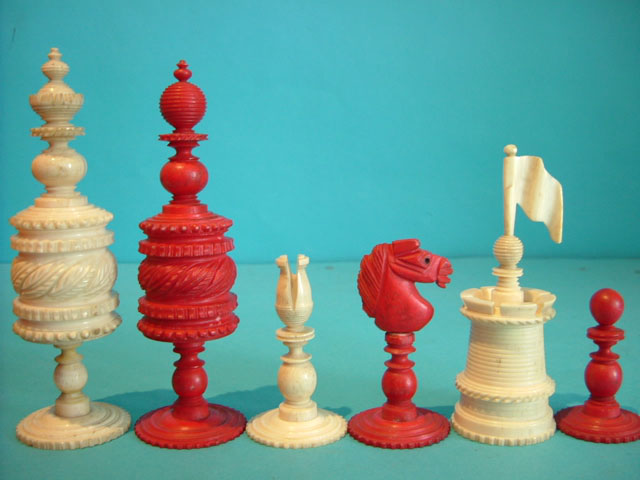
As chess increased in popularity across Europe in the 1800s, the proliferation in the variety of chess sets caused confusion amongst competitors, especially those hailing from different countries. The English typically used Barleycorn sets:
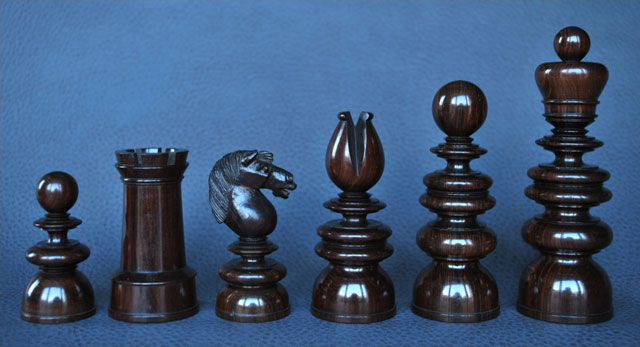
or St. George sets:
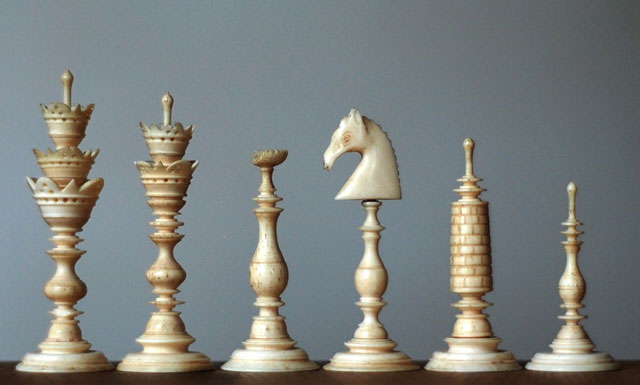
The Germans often used Selenus sets:
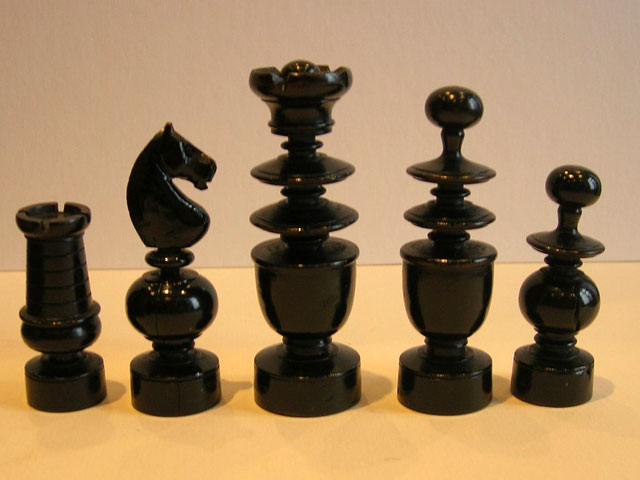
Regence sets were popular in France:
Chess set collector Ty Kroll explains the confusion:
English saw a different design for every chess club: St. George sets with their appearance of stacked disks, Dublin sets with more rounded middles, and Northern Uprights with columns instead, as well as elaborate, easily tipped Barleycorn sets. Germany had delicate Selenus sets, beautiful beyond belief, but fragile, tippable, and problematic for play. To tell which piece is which on some of these sets one must count the stacked crown. France saw elegant Regence style sets with some of the most confusing signatures in history. As in the English sets, queen’s were represented by orbs. The king’s floral crown closely resembles the modern Staunton signature for the queen. Knights were always taller than bishops the old French sets. Bishops were represented as fools, not clergymen, and therefore lacked the signature miter. What was worse, the knights in these sets were sometimes simple turned designs, not the recognizable horse’s head. This lead to common confusion as to which minor piece was which. The confusion of antique French knights and bishops is still a common problem today.
Then in the 1849, Nathaniel Cook designed and John Jaques began to sell a set that eventually came to be called the Staunton chess set:
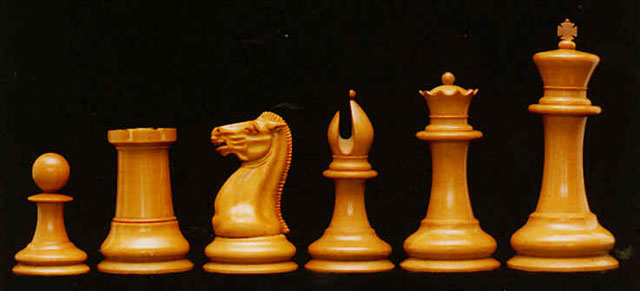
Howard Staunton was regarded as the top chess player of his era and organized the first international chess tournament in 1851. Staunton endorsed the set and it soon became the standard in chess competitions and, later, the official standard of the World Chess Federation. The most recent iteration of the official Staunton set is Daniel Weil’s design for World Chess:
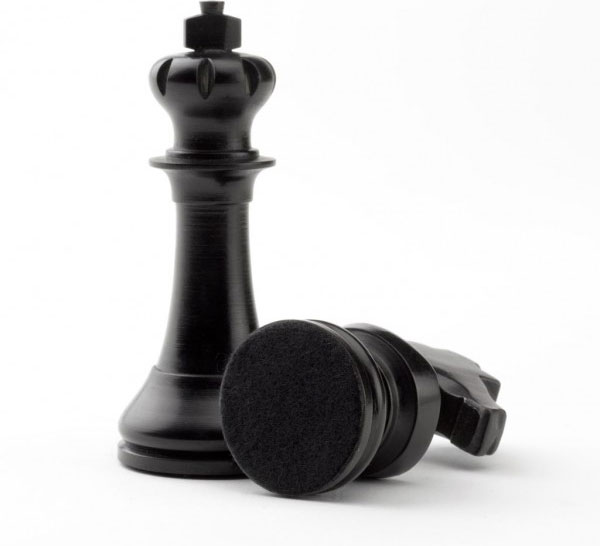
If you’re interested in learning more, Jimmy Stamp has a nice piece about the design of the original Staunton set and Weil’s update at Smithsonian magazine.
Ten friends started playing tag in high school and just never stopped. Now they fly across the country, hide in the bushes, and sneak into houses to tag the other players.
“You’re like a deer or elk in hunting season,” says Joe Tombari, a high-school teacher in Spokane, who sometimes locks the door of his classroom during off-periods and checks under his car before he gets near it.
One February day in the mid-1990s, Mr. Tombari and his wife, then living in California, got a knock on the door from a friend. “Hey, Joe, you’ve got to check this out. You wouldn’t believe what I just bought,” he said, as he led the two out to his car.
What they didn’t know was Sean Raftis, who was “It,” had flown in from Seattle and was folded in the trunk of the Honda Accord. When the trunk was opened he leapt out and tagged Mr. Tombari, whose wife was so startled she fell backward off the curb and tore a ligament in her knee.
“I still feel bad about it,” says Father Raftis, who is now a priest in Montana. “But I got Joe.”
(via @torrez)
The Verge has a long look into casinos which includes an interesting section on the first blackjack computers. It also describes the main strategy employed by casinos to prevent and catch cheating: a shit ton of cameras.
They keep a close eye on the tables, since that’s where cheating’s most likely to occur. With 1080p high-definition cameras, surveillance operators can read cards and count chips — a significant improvement over earlier cameras. And though facial recognition doesn’t yet work reliably enough to replace human operators, Whiting’s excited at the prospects of OCR. It’s already proven useful for identifying license plates. The next step, he says, is reading cards and automatically assessing a player’s strategy and skill level. In the future, maybe, the cameras will spot card counters and other advantage players without any operator intervention. (Whiting, a former advantage player himself, can often spot such players. Rather than kick them out, as some casinos did in the past, Aria simply limits their bets, making it economically disadvantageous to keep playing.)
With over a thousand cameras operating 24/7, the monitoring room creates tremendous amounts of data every day, most of which goes unseen. Six technicians watch about 40 monitors, but all the feeds are saved for later analysis. One day, as with OCR scanning, it might be possible to search all that data for suspicious activity. Say, a baccarat player who leaves his seat, disappears for a few minutes, and is replaced with another player who hits an impressive winning streak. An alert human might spot the collusion, but even better, video analytics might flag the scene for further review. The valuable trend in surveillance, Whiting says, is toward this data-driven analysis (even when much of the job still involves old-fashioned gumshoe work). “It’s the data,” he says, “And cameras now are data. So it’s all data. It’s just learning to understand that data is important.”
Ultimately, catching cheaters is a small part of what casino surveillance teams do. There simply aren’t that many cheats out there, compared to the number of purse-snatchers and pickpockets, the ordinary criminals that people like Ted Whiting deal with almost every day. When it comes to cheating, Whiting says, “We’re never going to be ahead. Remember that people who get paid to catch the bad guys get paid whether they catch them or not. The cheats don’t get paid unless they figure it out. So they’re motivated, and they’ve succeeded. But once they do, we go full in.”
Long-time crossword puzzle builder John Graham (aka Araucaria) is dying of esophageal cancer and used a crossword puzzle in the Guardian to reveal the news.
Above cryptic crossword No 25,842 sat a set of special instructions: “Araucaria,” it said, “has 18 down of the 19, which is being treated with 13 15”.
Those who solved the puzzle found the answer to 18 was cancer, to 19 oesophagus, and to 13 15 palliative care. The solutions to some of the other clues were: Macmillan, nurse, stent, endoscopy, and sunset.
Speaking from his home in Cambridgeshire, Araucaria said this particular puzzle had not taken him very long, adding that a crossword had seemed the most fitting way to make the announcement.
“It seemed the natural thing to do somehow,” he said. “It just seemed right.”
(via @daveg)
Over on Quartz, Zach Seward takes a neat look at the 14 year rise and fall of AOL through the zeitgeist-y lens of clues for that short, double vowel word being used in the New York Times crossword.
Mar. 29, 1998: Netcom competitor
Jun. 17, 1998: Chat room inits.
Oct. 4, 1998: Part of some E-mail addresses
(via ★faketv)
According to Hasbro, Monopoly was invented by Charles Darrow in 1933 and sold to Parker Brothers soon after. But that’s not quite the whole story.
The game’s true origins, however, go unmentioned in the official literature. Three decades before Darrow’s patent, in 1903, a Maryland actress named Lizzie Magie created a proto-Monopoly as a tool for teaching the philosophy of Henry George, a nineteenth-century writer who had popularized the notion that no single person could claim to “own” land. In his book Progress and Poverty (1879), George called private land ownership an “erroneous and destructive principle” and argued that land should be held in common, with members of society acting collectively as “the general landlord.”
Magie called her invention The Landlord’s Game, and when it was released in 1906 it looked remarkably similar to what we know today as Monopoly.
But it was Monopoly with a significant twist:
The game’s most expensive properties to buy, and those most remunerative to own, were New York City’s Broadway, Fifth Avenue, and Wall Street. In place of Monopoly’s “Go!” was a box marked “Labor Upon Mother Earth Produces Wages.” The Landlord Game’s chief entertainment was the same as in Monopoly: competitors were to be saddled with debt and ultimately reduced to financial ruin, and only one person, the supermonopolist, would stand tall in the end. The players could, however, vote to do something not officially allowed in Monopoly: cooperate. Under this alternative rule set, they would pay land rent not to a property’s title holder but into a common pot-the rent effectively socialized so that, as Magie later wrote, “Prosperity is achieved.”
With a lengthy section on the philosophy underpinning the original version of the game, this is more interesting than an article about a board game has the right to be.
Here’s a Quora answer about how those claw arcade games work. You know the ones, you’ve probably won once, but just once. My inclination was to call this a ‘fascinating Quora answer,’ but upon thinking about it, it’s not fascinating. The machines work exactly how you think they would. The operators can vary the strength of the claw to screw you just bad enough you keep sliding in your dollar bills.
Basically, most crane games are designed so the claw is randomly (and only once in many games) strong enough to let players win. Some even weaken in strength after a short time so players get close to victory only to see it slip from their grasp! Since the manuals for many skill games are available online, this is not hard to verify.
The answerer then goes on to link to many manuals so you can see for yourself. (via @sunilnagaraj)
Newer posts
Older posts





Socials & More