kottke.org posts about food
Little People is a series of photographs of tiny handpainted people depicted in different situations around London. Reminds me of the tiny people with food photos of Akiko Ida and Pierre Javelle. It would be neat to monkey with the depth of field in these photos so that somehow both the little people and the background were in focus, making it seem more like the people weren’t little.
A special bachelorette party menu from a French restaurant. “Steak Frites with Bearnaise drizzle slowly administered tableside by young, handsome, patient male waiter.”
Frito-Lay Angrily Introduces Line Of Healthy Snacks. “Weren’t Sun Chips healthy enough for you, you goddamn hippie bastards?”
At one of the few chain restaurants in Chinatown today, I witnessed a Spanish-speaking cashier taking an order from a Cantonese-speaking customer off of an English-only menu. It took awhile, but the woman seemed satisfied as she left with her food.
Cameron tells us about the peak-end rule, whereby you remember an experience by the high (or low) point and the ending. “Having recently been on a vacation, it strikes me that this heuristic is of utmost importance in planning long events.” The p-e rule is probably also something to keep in mind for event/conference organizers…end on a high note. Oh, and some restaurants do this really well: they send you home with a delicious something to enjoy the next day, extending the experience and ending on a high note with a yummy breakfast.
As part of a World Series promotion, Taco Bell will give away a free taco to everyone in the United States if someone hits a home run over the left field wall in tonight’s game 3. This is a big offer for a big company so of course their lawyers want to make darn sure that we know precisely what “Taco Bell” means when they say “home run”, “left field”, and “free taco” with an extensive list of terms and conditions. Surely the first legal document containing the phrase “a completely outside the bun idea”, the T&C is a fun read, but my favorite is the first condition that you agree to if you take advantage of the offer:
…to release, Major League Baseball Properties, Inc., Major League Baseball Enterprises, Inc., MLB Advanced Media, L.P., MLB Media Holdings, Inc., MLB Media Holdings, L.P., MLB Online Services, Inc., the Office of the Commissioner of Baseball, and the Major League Baseball Clubs, and each of their respective shareholders, employees, parents, directors, officers, affiliates, representatives, agents, successors, and assigns (hereinafter, “MLB Entities”) and Sponsor and their affiliates, subsidiaries, retailers, sales representatives, distributors and franchisees, and each of their officers, directors, employees and agents (“Promotional Parties”), from any and all liability, loss or damage incurred with respect to participation in this contest and/or the awarding, receipt, possession, and/or use or misuse of any Free Taco
Man, I really hope someone hits a left field home run tonight. I’m dying to see some creative misuse of free tacos.
Notes from day 3 at PopTech:
Chris Anderson talked about, ba ba baba!, not the long tail. Well, not explicitly. Chris charted how the availability of a surplus in transistors (processors are cheap), storage (hard drives are cheap), and surplus in bandwidth (DSL is cheap) has resulted in so much opportunity for innovation and new technology. His thoughts reminded me of how surplus space in Silicon Valley (in the form of garages) allowed startup entrepreneurs to pursue new ideas without having to procure expensive commercial office space.
Quick thought re: the long tail…if the power law arises from scarcity as Matt Webb says, then it would make sense that the surplus that Anderson refers to would be flattening that curve out a bit.
Roger Brent crammed a 60 minute talk into 20 minutes. It was about genetic engineering and completely baffling…almost a series of non sequiturs. “Centripital glue engine” was my favorite phrase of the talk, but I’ve got no idea what Brent meant by it.
Homaro Cantu gave a puzzling presentation of a typical meal at his Chicago restaurant, Moto. I’ve seen this presentation twice before and eaten at Moto; all three experiences were clear and focused on the food. This time around, Cantu didn’t explain the food as well or why some of the inventions were so cool. His polymer box that cooks on the table is a genuinely fantastic idea, but I got the feeling that the rest of the audience didn’t understand what it was. Cantu also reiterated his position on copyrighting and patenting his food and inventions. Meg caught him saying that he was trying to solve the famine problem with his edible paper, which statement revealed two problems: a) famines are generally caused by political issues and therefore not solvable by new kinds of food, printed or otherwise, and b) he could do more good if he open sourced his inventions and let anyone produce food or improve the techniques in those famine cases where food would be useful.
Richard Dawkins gave part of his PopTech talk (the “queerer than we can suppose” part of it) at TED in 2005 (video).
Bob Metcalfe’s wrap-up of the conference was a lot less contentious than in past years; hardly any shouting and only one person stormed angrily out of the room. In reference to Hasan Elahi’s situation, Bob said that there’s a tension present in our privacy desires: “I want my privacy, but I need you to be transparent.” Not a bad way of putting it.
Serena Koenig spoke about her work in Haiti with Partners in Health. Koening spoke of a guideline that PIH follows in providing healthcare: act as though each patient is a member of your own family. That sentiment was echoed by Zinhle Thabethe, who talked about her experience as an HIV+ woman living in South Africa, an area with substandard HIV/AIDS-related healthcare. Thabethe’s powerful message: we need to treat everyone with HIV/AIDS the same, with great care. Sounds like the beginning of a new Golden Rule of Healthcare.
2.7 billion results for “blog” on Google. Blogs: bigger than Jesus.
From the perspective of the outside observer, New York’s Little Italy seems like little more than a chunk of Disney World plopped down in the midst of lower Manhattan. On the ground, the reality is not much better, particularly if you’re out to find a good meal. Unlike neighboring Chinatown, Little Italy’s food reputation is not the best. Since we started working in our new office in Chinatown, a number of forays have been made into Little Italy in order to procure take-out to bring back to the office, particularly pizza-by-the-slice. The results have been disappointing; several slices of blah pizza and a deep-fried risotto ball with prosciutto, mozzarella, and peas (sounds fantastic, right?) that was way not fantastic.
Is there anywhere in this whole small country we can get good Italian food to go or pizza-by-the-slice? As it is, Little Italy is reflecting poorly on the mother country and its excellent cuisine, and it would be nice, if possible, to salvage some of that reputation.
Shopping in Chinatown at lunch: pork uterus for $2.99/lb.
Pete Wells writes in Food and Wine about recipes, copyrights, and patents. Meg picks up the thread and argues that copyrighting recipes would stifle innovation, not promote it, rewarding mostly the lawyers who insert themselves between our food and mouths. A commenter says, “By nature, food people are generous of spirit, and recognize that the great fun of food is in the sharing.”
R.W. Apple, longtime and beloved political and food writer for the NY Times, died early this morning aged 71. “In the interests of efficiency, The New York Times recently equipped its main office with…a 185-pound, water-cooled, self-propelled, semi-automatic machine called R. W. Apple Jr.” Here’s Apple’s last piece for the Times, on the cuisine of Singapore.
Update: The NY Times put up a piece that Apple filed right before he entered the hosptial that they were going to run later in the fall: The Global Gourmand.
Update: Ed Levine wrote a nice personal remembrance of Apple. See also Trillin’s article on Apple from the New Yorker.
Bill Buford tells the story of Food Network, a channel that Julia Child could never hope to appear on today.
Update: Accidental Hedonist on Food Network: “The network was no longer about making good food and understanding it, it became about using food to impress other people. Whether it was getting a meal out in 30 minutes, or making the perfect thanksgiving feast, the shows seemed to sell the idea of ‘having’ food knowledge, without actually having any.”
If you’ve ever used any of the various menu sites out there, you may have noticed that the menus are occasionally not as up-to-date or complete as they could be. A typical response in the blogosphere to a situation like this is to fire off a snarky missive about how menu sites suck, wish harm on the site’s owners and their children, and why don’t they just die already, those sucking bastards, and basically overreact in such a way as to make the writer feel temporarily better and all but ensures that nothing constructive comes of it.
Since its launch last year, I’ve admired the tone of Eater, a site about New York city food and dining. The site strikes the right balance between criticism, enthusiasm, insider knowledge, and detatched reportage while covering a topic where too much of any one of these is deadly for the reader. Last week, Eater took note of the menu site situation, but instead of just complaining, they went looking for some evidence and reported the results:
Last week, Eater began an exhaustive investigative series called MenuGate. For those who think we’d forgotten about it, ten-hut. Tomorrow morning, we’ll be conducting a SPOT INSPECTION of the major menu site players, then scoring them on how accurate (or inaccurate) their menus are. The benchmark will be the menu that’s freely available, at this very moment, on the restaurant’s official website.
In canning the snark, offering fair criticism, and letting the results speak for themselves, Eater made it possible for the menu sites to respond in a congenial fashion:
We saw you chose 11 Madison Park this morning to do a menu comparison and our menu was out of date. To be fair, we waited to let you investigate the differences before we updated the menu, even though we noticed the menu had changed. In any event, now that you’ve written your piece, we have updated the menu as we do for restaurants everyday. We have a team specifically assigned to update menus and we receive user submissions as well to let us know about restaurant changes.
The end result? The situation improved for everyone. A small improvement perhaps, but MenuGate is an ongoing Eater feature so we can expect future improvements. And perhaps when the menu sites get tired of taking their lumps each time around, MenuGate may lead them to think of better ways to keep their menus up-to-date and useful. Anil Dash wrote a post two years ago about how bloggers could take positive action against “Stuff That Sucks”:
I’m proud of what [bloggers have] done in creating so many different weblog communities, and I don’t want our legacy to be one of having the positives overshadowed by our frequent, though understandable, tendency to be unkind or uncivil to those we’re communicating with.
The way Eater has approached the menu sites issue is certainly a good example of what Anil was talking about. Good show.
Danny Meyer on the difference between service and hospitality: “Service is delivering on your promise. Hospitality is making people feel good while you’re delivering on that promise.” Meyer has a new book, Setting the Table, out tomorrow. (via eater)
Want to go apple picking without leaving Manhattan? There are three trees with ripe apples growing near where you get up on the High Line at 33rd Street.
If you asked me today to choose a medium in which to focus my future artistic energies, I’d have to go with the photo can. After finding this great Photojojo tutorial yesterday on using tin cans and glass jars as photo frames, I selected three recent pictures I’d taken and made this can triptych:
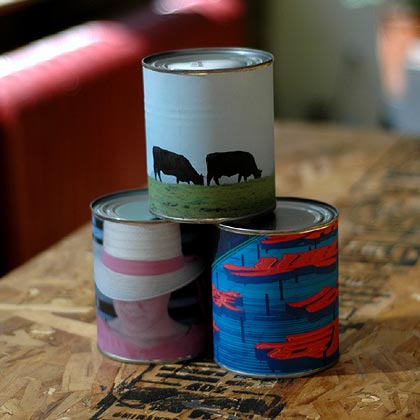
So cool! And simple too. I didn’t follow Photojojo’s directions exactly and I have a few observations to offer for those looking to play around with this:
- Paper quality. I just used regular old printer paper, not glossy photo paper or anything like that. This made the photos look more like actual cheap labels. I also didn’t worry too much about being careful with the glue. Again, a little mistake here and there actually enhances the effect.
- Glue. I removed the original label from the can and glued the photo directly to the can itself. Instead of rubber cement, I used a glue stick with acid-free acrylic emulsion. The glue stick made application really easy. And I didn’t apply the glue all the way around the can. I just glued down one end to the can, waited for that to dry, wrapped the photo around the can, pulled it tight, and glued the underside of that end to the end already affixed to the can. (When I tore the existing label off the can, I noticed that’s how it was glued on there, so I tried the same thing and it worked.)
- Can size, etc. Shopping in the canned food aisle of the supermarket takes on a different meaning when you’re not attempting to find green beans for dinner but trying to find aesthetically pleasing art supplies. I went with a larger can, one with stewed tomatoes; its proportions seemed more pleasing than those of a soup can. The problem was that when I got it home, it was almost 13 inches around, meaning that 8 1/2” x 11” paper wasn’t going to work. (I ended up getting some 8 1/2” x 14” paper.) So bring your tape measure to the grocery store with you to make sure the desired can will work with your paper size.
- No pop-tops. A lot of soup cans now feature pop-tops. Get the old fashioned kind instead…the last thing you want is Uncle Steve lifting your photo can off of the coffee table, fiddling with the pop-top, and, hey!, Chunky Vegetable three years past its expiration date all over the place.
- Botulism? Speaking of past the expiration date, what’s the shelf life of your artwork? The answer seems to be almost indefinitely when kept at temperatures at or below 75 degrees F, but I wouldn’t advise eating anything from your photo cans after a year or two. The risk of botulism is almost nonexistent in contemporary commercially canned food, but if you see any of your art swelling up, throw it out. In addition, botulism dislikes acidic environments, so you’re probably better off selecting cans with acidic food items in them, like tomatoes, fruits (without sweet syrups), and sauerkraut. But be careful not to get items that are too acidic…over a long period of time, the acid may eat through the can.
Good luck!
A reader dropped an interesting question into my inbox yesterday, and I thought I would open it up to the group. Darko writes that he’s in NYC for the next two weeks but doesn’t have a lot of money to spend because he lives and works in Serbia. So, he’s wondering a) what to eat on a daily basis that doesn’t cost a whole lot, and b) where to go for a splurge meal, a place with “really glorious food” that’s $80-100 for two.
Cheap everyday food has been the subject of many pieces online, including this kottke.org thread from Feb 2003, New York magazine’s Cheap Eats 2004, New York magazine’s Cheap Eats 2005, New York magazine’s Cheap Eats 2006, Eating Pleasure. Price: $2, and Delicious for a Dollar?
My recommendations would be: bagels, Chinatown (the five-for-a-buck dumpling places as well as some other restaurants), pizza ($2/slice anywhere in the city), street carts (particularly the hot dogs and pretzels, check out the best street food in NYC), sandwiches from a deli (although some delis can be expensive, particularly in Manhattan…anyone know of any cheap places?), Curry Hill (Indian food around Lexington and & 28th), getting out of the touristy places in Manhattan (head for the East Village or the Lower East Side), or getting out of Manhattan entirely (cheaper eats in Brooklyn, etc.). And to drink, New York City tap water is free and better than Evian.
The splurge meal is a bit tougher, although if you forsake having wine, you can eat pretty well for $50/person. It might be best to seek out this meal in Brooklyn…there are some great places there and you don’t have to pay the Manhattan premium. Going at lunchtime is another good option…you often get the same calibre of food at a lower price than dinner. Gotham Bar and Grill near Union Square has a prix fixe lunch for $25 (or used to…you should call ahead). I think Eleven Madison Park also has a similarly priced prix fixe at lunch (prix fixe = fixed price). Anyone have any other suggestions, particularly about good places in Brooklyn?
Megnut’s got the scoop: Gourmet magazine has named Alinea the best restaurant in the US, amazing considering its only been open a little more than a year. “[Grant Achatz] is redefining the American restaurant once again for an entirely new generation. And that — more than his gorgeous, inventive, and delicious food — is what makes Alinea the got-to-go-to restaurant in the country right now.” (I would argue that the food is the real reason to go, but whatever…)
For some, a trip to Austria steers their gastronomic attention to wiener schnitzel, but for me, it’s all about the wurst.1 Following the good advice of a reader to ignore the sausages on offer in cafes and restaurants, we hit up every lunchtime sausage stand we could find during our visit for the real deal.
In Salzburg, the typical stand offers 8-10 different kinds of wurst, from the familiar frankfurter to the spicy pusztakrainer. You can get your wurst on a plate with mustard and a piece of bread or as a “hot dog” (in a bun with mustard and ketchup). For my first wurst, I had a kasekrainer, hot dog-style with ketchup, and it turned out to be my favorite of the trip. Melted cheese (kase) filled the sausage and the bun was perfectly crispy on the outside and chewy on the inside. Meg sampled a burenwurst. The next day, we hit up another stand; I tried the frankfurter while Meg had a delicately flavored weisswurst (her favorite of the trip). She speculated they didn’t grill the weisswurst because it would interfere with mild flavor; the spicer wursts seemed to be grilled.
From thence to Innsbruck in the Austrian Alps. At 10,000 feet above sea level, we had an unspecifed wurst (the restaurant called it, basically, “the sausage of the day”) that ranks among the best food I’ve ever tasted, but that assessment may have been colored by the fact that we’d hiked up a glacier to get it. On our last day in Innsbruck, we surrendered to the comfort of cafe chairs and had bratwurst (mit sauerkraut und mustard) at a small place in the old town. After a hard day of walking, it beats eating standing up, which is how it works at the wurst stand.
Our final link in the sausage trail was Zurich, which is not in Austria but in the section of Switzerland near Austria and Germany. From a stand by the lake, we shared a pork-based sausage I forget the name of and another beloved weisswurst. Based on the relative unavailability of the wurst there, I get the feeling that the Swiss don’t take their sausages as seriously as the Austrians, at least in cosmopolitan Zurich. Not that the Swiss wurst wasn’t good; they just have other things to worry about…like fondue.2
But to focus entirely on the wurst is to ignore the equally fantastic brot (bread) that accompanies it and many other Austrian dishes. My favorite bread growing up in Wisconsin was called “Vienna bread” and I had always assumed that the cheap loaves we got at the local chain supermarket approximated something found in the Austrian capital. We didn’t get to Vienna, but the Austrian bread we had was indeed like the bread of my childhood…except about 1000 times better. The small, crisp roll we got with our wurst, called a semmel, was not unlike what’s called a roll or kaiser roll at an NYC deli. These rolls, accompanied by some richly flavorful butter, were also available at the complementary breakfast served at our hotel and I was tempted to violate the no-taking-food-from-the-breakfast-area rule and cram my bag full of them. If the bread at our hotel was that good, I can’t imagine what the best bakeries of the region have to offer. The French, whom I’ve always considered the champions of all things bread, might have something to worry about from Austria. Clearly, more delicious research is called for.
[1] Not that the rest of Austrian cuisine wasn’t uniformly excellent. I had a pork dish with spatzle in a creamy mushroom sauce at a Salzburg restaurant that I will crave for months to come. And that garlic soup at Ottoburg in Innsbruck! ↩
[2] I’d like to take this opportunity to apologize for the title of this post (the other option was “It was the wurst of times”). But count your blessings that you’re not reading an article on the yummy fondue we had in Zurich entitled “You’re damned if you fondue, and you’re damned if you fondon’t”. (I know what you’re thinking: “oh no, he fondidn’t…”) ↩
An outpost of Philly Slim’s, a restaurant specializing in Philly cheesesteaks, recently opened up near our apartment. In the weeks since its opening, the place has been near-empty every time I’ve walked past it. Without proper intel (i.e. a recommendation from friends or perhaps New York magazine), no one in the neighborhood wants to make the first move; when people wander by to glance at the menu, they take its emptiness as a sign that the food’s bad and head somewhere else for a meal. It’s a real catch-22 situation.
Last week, we were in the mood for some serious comfort food, so we tried out Philly Slim’s. And surprise of surprises, it was good. Really good. I tend to be disappointed by most steak sandwiches — the meat is usually thick, tough, and looks like it’s been boiled for weeks — but Philly Slim’s steak has a nice flavor and is sliced/chopped thin. The roll is nice & soft and doesn’t overwhelm the rest of the sandwich. The rest is pretty straightforward…Cheez Whiz, BBQ sauce, mayo, pickles, bacon, onions, mushrooms, tomatoes, and lettuce are among the toppings you can get on your sandwich. Add a Philadelphia-area soda, some onion rings, and a Tastykake for dessert, and you’re golden.
Bottom line: if you’re in the Union Square area and hungry, check out Philly Slim’s on University between 12th and 13th Streets. Ignore the lack of line and head on in.
Slideshow of Gerald Panter’s photos of the fast food stands of Los Angeles. “Menus which featured hamburgers and hot dogs seem to have given way to those featuring tacos and burritos, while former purveyors of such Mexican fare now feature teriyaki and other Asian specialities.”
Three Mexican fisherman were found alive after 11 months of drifting on the Pacific. They survived on raw fish, rain water, and sea birds. Immediately after being resuced, “they chowed down”. (via bb)
Apologies for the lack of posts over the last couple of days. I’m back in the midwest visiting my folks. I’m doing great; they have sausage shaped like beer bottles here!
Orgasm or excellent marinara? Can you tell the difference between the faces of Food Network celebrities and porn stars? Might be a little NSFW depending on where you W. (via ed)
Newer posts
Older posts





Socials & More