kottke.org posts about flying
If you are ever down and need an instant pick-me-up, watch this video of an aerobatic pilot doing tricks with his daughter as a passenger for the first time and your mood will improve greatly. The good stuff starts at about 50 seconds in.
Oh my, that laugh! (via @ianpierce)

Growing up, I had a pretty conventional childhood. In the northern Wisconsin of the 70s and 80s, that meant living in the country, dogs and cats, making ramps for our bikes in the driveway, Oscar Meyer bologna sandwiches for lunch, and a nuclear family of four that split into two soon after Ronald Reagan took office. But conventional childhoods are a myth. Every kid has some weird thing that distinguished their experience from everyone else’s. My weird thing is that I spent a lot of time in and around airplanes when I was young.
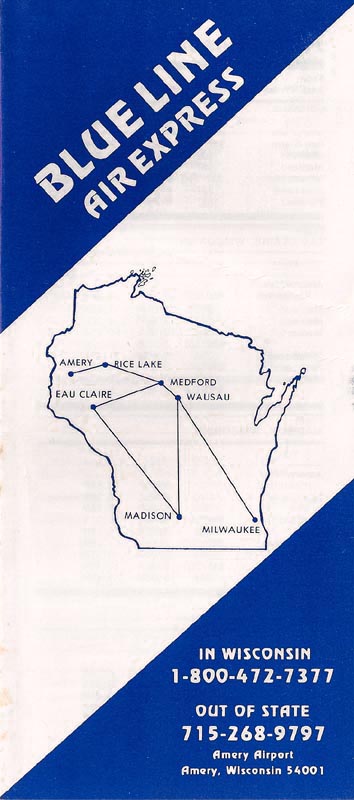
My dad joined the Navy after high school but couldn’t fly because of his eyesight. But sometime later, he got his private pilot’s license. In the 1970s, after bouncing around between two dozen different jobs and business ideas, he took a small rented airplane and turned it into a thriving freight and commuter airline called Blue Line Air Express.1 At its height, his company had 8 planes, a small fleet of cars and trucks,2 more than a dozen employees, and hangars at several different airports around northern WI. He and his employees delivered packages and people3 all over the tri-state area, from Chicago and Milwaukee to Minneapolis and Duluth.

And every once in awhile, I got to tag along. I remember one time in particular, we got up early on a Saturday, drove to a nearby town, hopped in the plane, and made it to Minneapolis, usually a two-hour drive, in time for breakfast. I’d go with him on deliveries sometimes; we’d drive a small piece-of-shit truck4 up to this huge FedEx hub in Minneapolis, load it full of boxes, and drive an hour to some small factory in a Wisconsin town and unload it. Once he had to deliver something to a cheese factory and my sister and I got a short tour out of it.
For family vacations, we would jump in the plane to visit relatives in the Twin Cities or in St. Louis. We flew down with some family friends to Oshkosh to attend the huge airshow. When I was in college, my dad would sometimes pick me up for school breaks in his plane. It was just a normal thing for our family, like anyone else would take a car trip. The only time it seems weird to me is when people’s eyes go wide after I casually mention that we had a runway out behind the house growing up.5

One of the last times I went flying with my dad, before it finally became too expensive for him to keep up his plane,6 we were flying into a small airport where he still kept a hangar. It was a fine day when we set out but as we neared our destination, the weather turned dark.7 You could see the storm coming from miles away and we raced it to the airport. The wind had really picked up as we made our first approach to land; I don’t know what the windspeed was, but it was buffeting us around pretty good. About 50 feet off the ground, the wind slammed the plane downwards, dropping a dozen feet in half a second. In a calm voice, my dad said, “we’d better go around and try this again”.8
The storm was nearly on top of us as we looped around to try a second time. It was around this time he announced, even more calmly, that we were “running a little low” on fuel. Nothing serious, you understand. Just “a little low”. There was a heavy crosswind, blowing perpendicular to the runway. Landing in a crosswind requires the pilot to point the airplane into the wind a little.9 Or more than a little…my memory probably exaggerates after all these years, but I swear we were at least 30 degrees off axis on that second approach. Just before touching down, he oriented the plane with the runway and the squawk of the tires let us know we were down. I don’t think it was much more than a minute or two after landing that the rain, thunder, and lightning started.10
But the thing was, I was never scared. I should have been probably…it was an alarming situation. I’d been flying with my dad my whole life and he’d kept me safe that whole time, so why should I start worrying now? That’s what fathers are supposed to do, right? Protect their children from harm while revealing the limits of the world?
Mark Vanhoenacker is a Boeing 747-400 pilot for British Airways who also happens to have a wonderful almost lyrical way with words. In this NY Times piece, Vanhoenacker gives an overview of how a London-to-Tokyo flight functions, from take-off & landings to what pilots see in the dark night skies to the determination of altitude.
Three altimeters in the cockpit — two bright digital readouts, and one old-school device with hands that turn like those of a clock — show 31,000 feet.
Yet we know that we are probably not as close to 31,000 feet as these altimeters suggest. We are somewhat lower; or perhaps we are higher. One thing is certain — it would be easy to find a dozen airliners flying over different parts of the world, all of whose altimeters displayed 31,000 feet, none of which are at the same altitude.
How is this possible?
Planes calculate their altitude by measuring air pressure. The air lies most heavily on places that are lowest, the places that have the most air piled above them. A barometric altimeter (baros, meaning weight) equates high air pressure — lots of air weighing down — with low altitude. As a plane climbs, there is less air above it. The altimeter senses less air weight and reports a higher altitude.
There’s a problem, however. Air pressure is not constant. It varies across the Earth. It also varies in each place as time and weather pass.
And I love this bit about the names of the geographic waypoints used to navigate the area around Boston:
Boston has etched a particularly rich constellation onto the heavens above New England. There is PLGRM, of course; CHWDH, LBSTA and CLAWW; GLOWB and HRALD for the city’s newspapers; while SSOXS, FENWY, BAWLL and OUTTT trace the fortunes of the city’s baseball team in long arcs across the stars. There’s a NIMOY waypoint; Leonard was born in Boston.
The piece is adapted from Vanhoenacker’s new book, Skyfaring: A Journey with a Pilot. My dad was a professional pilot for many years1 and I’ve always loved flying, so I’m definitely going to give this a read.
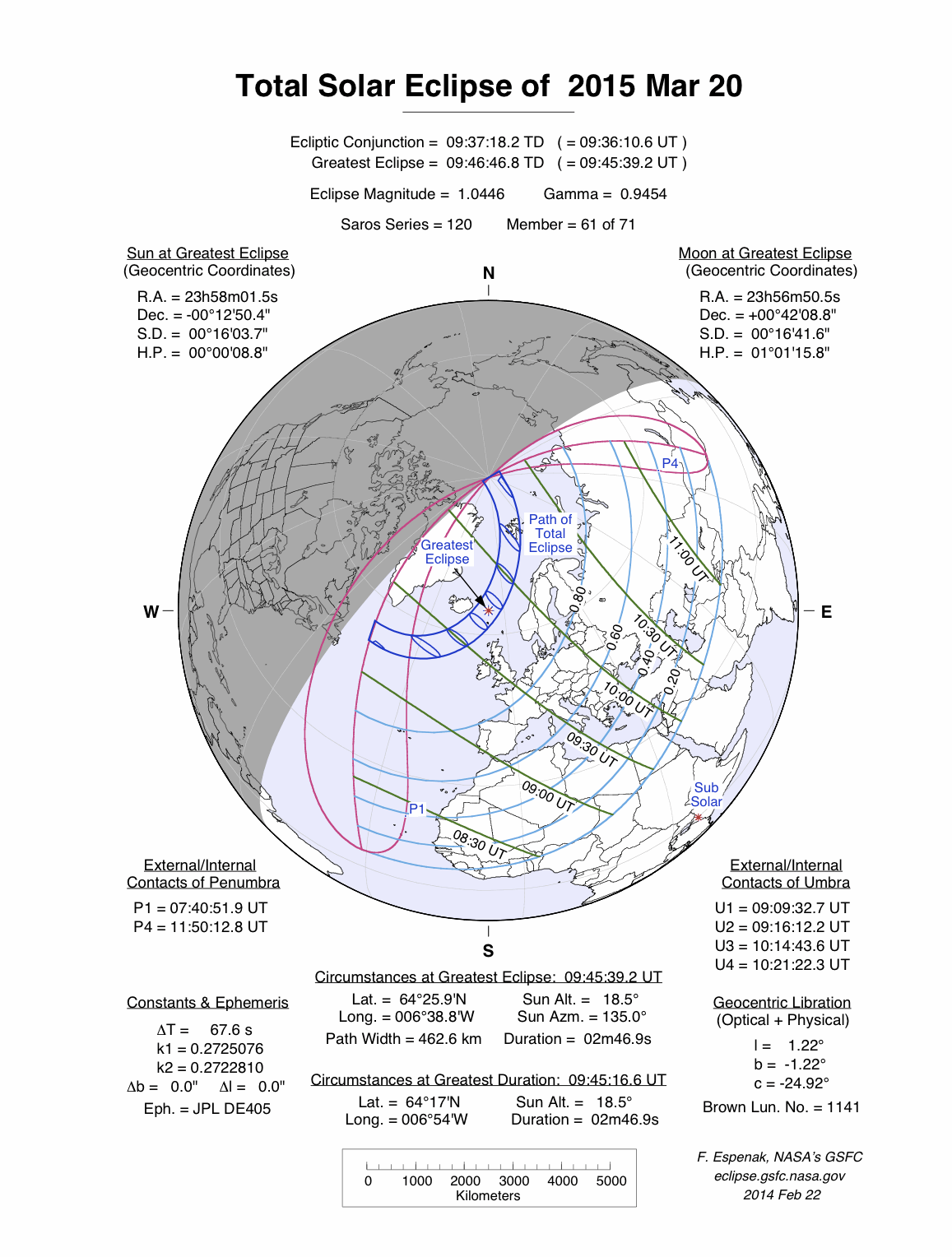
A group of astronomy enthusiasts rented a plane and flew through the shadow cast by the recent eclipse of the Sun. One passenger took the following video. Look at that shadow creeping across the cloud cover! So cool.
P.S. Still super excited for the 2017 eclipse! (via slate)

The Cooper Review unveils Delta Airlines’ new seating chart, including several new sections like Economy Discomfort and Where Is Your God Now? Economy. Also clearly marked are crying babies and passengers eating smelly sandwiches.
Are you ready for a new level of discomfort in air travel? A major US airline is considering a seating class called Economy Minus, which would offer smaller seats at a lower price.
Now a major airline may be considering another breakthrough idea: “Economy Minus,” a seat that offers less legroom at a discount price.
Before you scoff, consider that a new survey found that 42% of airline travelers said they would be very likely or somewhat likely to book a seat with less legroom if it means getting a cheap fare.
See also Why Airlines Want to Make You Suffer. (A: maximizing shareholder value)
In 2012, Joe Ayoob broke the world record for the longest distance paper airplane flight with a plane designed by John Collins. In this video, Collins demonstrates how to fold that plane, the Suzanne.
Directions for the design are also available in Collins’ New World Champion Paper Airplane Book.
In 1959, Lt Colonel William Rankin ejected from his F-8 Crusader at 47,000 feet. He was not wearing a pressure suit, which was a bummer because it was -58 °F outside the cockpit. Frostbite and symptoms of decompression1
immediately ensued. But his troubles were just beginning.
As the parachute opened, he felt the familiar tug upwards. Except instead of a slow descent, he experienced a rapid ascent. The powerful updraft filled his parachute like a sail and rocketed him vertically thousands of feet at a velocity of nearly 100 mph. During his ascent, he could see hail stones forming around him. The lightning was described by him as “blue blades several feet thick” and incredibly close. The thunder was so loud, he could feel it resonating in his chest cavity and remembered this more so than how loud it was. At one point, the lightning lit up his parachute leading him to believe he had died. The rain would pelt him from all directions, and at times was so intense, he had to hold his breath for fear of drowning. But this was only half the agony — the other half being the downdrafts.
Once the updraft exhausted itself, the associated downdraft would ensue. It was during this phase of his journey that he truly thought he would die. His parachute would collapse around him, much like a wet blanket, and plunge him into a rapid free fall towards earth. The odds of his parachute re-inflating correctly were slim, but not only did it do so once, it did numerous times through a multitude of updraft and downdraft cycles.
Under normal conditions, Rankin’s trip to the ground would have taken less than 10 minutes, but that thunderstorm kept him hostage for 40 minutes. (via @BadAstronomer)
Update: In 1966, pilot Bill Weaver and his navigator Jim Zwayer were testing an SR-71 Blackbird when something went wrong and the plane disintegrated around its occupants. Weaver was incredibly lucky to make it out alive.
My next recollection was a hazy thought that I was having a bad dream. Maybe I’ll wake up and get out of this mess, I mused. Gradually regaining consciousness, I realized this was no dream; it had really happened. That also was disturbing, because I could not have survived what had just happened. Therefore, I must be dead. Since I didn’t feel bad — just a detached sense of euphoria — I decided being dead wasn’t so bad after all. As full awareness took hold, I realized I was not dead, but had somehow separated from the airplane. I had no idea how this could have happened; I hadn’t initiated an ejection. The sound of rushing air and what sounded like straps flapping in the wind confirmed I was falling, but I couldn’t see anything. My pressure suit’s face plate had frozen over and I was staring at a layer of ice.
(via @axlotl)
Great piece about how Lufthansa cares for those who need medical attention while flying.
On a Lufthansa flight, making a public call for any medical professionals on the plane is a last resort. The airline prefers to be far more discreet. After all, does the whole plane always need to know that somebody on board is having a problem? To accomplish this, Lufthansa launched the Doctors on Board program for physicians.
Doctors on Board allows Lufthansa to identify doctors long before an emergency occurs. By doing this, the cabin crews can personally and discreetly summon the doctor if their skills are needed during a flight. In order to find doctors who could potentially participate in this program, the airline scoured the data from its Miles and More frequent flier program. By doing this, Lufthansa was able to identify 15,000 doctors who regularly fly the airline. Of those, 10,000 opted to join the program.
Participation in the Doctors on Board program carries with it several benefits. The doctors are issued a handbook about aviation medicine, as well as receiving news and information via both the internet and postal mailings. They are insured by Lufthansa for any care that they provide during a flight. They are also rewarded with 5,000 Miles and More award miles and a discount code for €50 off of their next flight, plus they receive a special bag tag identifying their participation in the program. Finally, they are given the opportunity to participate in a course on aviation medicine and on-board emergency handling, for which they are paid an additional fee.
This is real customer service: thoughtful, anticipatory, active, thorough. (via @marcprecipice)

Derek Low used a ton of his frequent flyer miles to book passage from Singapore to NYC in Singapore Airlines’ better-than-first-class Suites Class and wrote all about it. Suites Class = private cabin, double bed, caviar, foie gras, lounging beforehand in “The Private Room”, Dom Pérignon, Givenchy pajamas, etc. etc.
In the Suites, you don’t just lie on a seat that has gone flat. Instead, you step aside while the Singapore Airlines flight attendants transform your Suite into a bedroom, with a plush mattress on top of a full-sized bed. When the adjacent suite is empty, the dividing partition can be brought down to create a double bed.
(via df)
Update: After reports of plagiarism from several sources after Low published his initial version of his piece, he changed the pilfered text and removed photos taken from elsewhere. (thx, all)
In celebration of National Aviation Day, In Focus has a slideshow of photos of the Wright Brothers’ first flights.
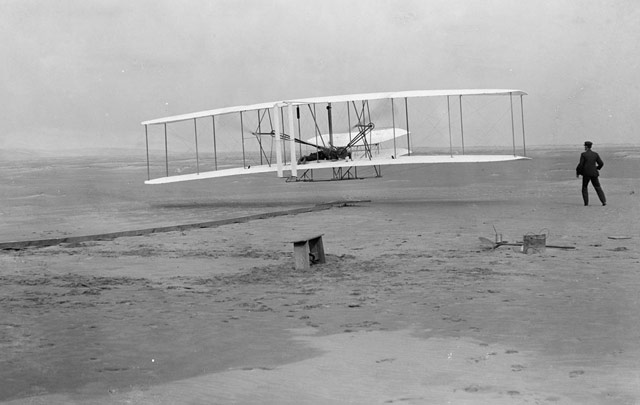
The caption on that photo reads:
First flight: 120 feet in 12 seconds, on December 17, 1903. This photograph shows man’s first powered, controlled, sustained flight. Orville Wright at the controls of the machine, lying prone on the lower wing with hips in the cradle which operated the wing-warping mechanism. Wilbur Wright running alongside to balance the machine, has just released his hold on the forward upright of the right wing. The starting rail, the wing-rest, a coil box, and other items needed for flight preparation are visible behind the machine. Orville Wright preset the camera and had John T. Daniels squeeze the rubber bulb, tripping the shutter.
The Wright Brothers were 32 & 36 years old when they made their first flight at Kitty Hawk in 1903. The Wright Flyer was not the product of daring youthful innovation (as with Picasso, Bill Gates, or Mozart) but rather of years of experience and experimentation (like Cezanne, Twain, or Frank Lloyd Wright).
Great piece from Craig Mod about how to survive air travel.
Authorities recommend arriving two hours before international flights. I say four. Get there four hours before your flight. You are a hundred and fifty years old. Your friends laugh at you. Have patience.
Arrive early and move through the airport like the Dalai Lama. You are in no rush. All obstacles are taken in stride, patiently, with a smile. Approach the nearly empty check-in counter. Walk up and say, I’m a bit early but I’m here to check in to … Marvel at their surprise and then their generosity. Suddenly you are always able to get an exit row or bulkhead seat. Suddenly, sure, they can slip you into Business. Suddenly tickets that are supposedly unchangeable, cannot be modified, are, after a few calls, some frowns, upbeat goodbyes, specially modifiable for you. This is what happens when there is no one behind you in line to check in.
What Mod fails to mention here in regard to supposedly unchangeable tickets and the like is that he’s one of the most disarmingly charming motherfuckers in the entire world. And here is the crux of the whole piece:
You are hacking the airport by arriving early, knowing that all the work you could have done at home — the emails or writing or photo editing — can be done at the airport.
I don’t travel much anymore, but I’ve begun to arrive at the airport earlier than I need to because I got tired of rushing and I can work from pretty much anywhere with wifi. That mask shit though? That’s too much.

In Brazil’s National Air and Space Museum, there is a golden globe containing the preserved heart of Alberto Santos-Dumont, a man who thought he beat the Wright Brothers in building and flying the first heavier-than-air flying machine. Santos-Dumont’s first success was with dirigibles; at the turn of the century, he would regularly use his personal airship to fly to dinner or to visit friends.
Imagine the frenetic pace of life in belle époque Paris. Automobiles appearing on the streets, attracting huge crowds. The telegraph bringing news from all over the world. Cafés playing phonographs while their patrons drank absinthe and cocaine wine. Now imagine a Parisian walking the streets in the early morning, in a time where an automobile was still a fascinating novelty, and then suddenly, a small airship appears floating just above the street. A crowd would gather to see the aviator driving his Baladeuse (The Wanderer), a personal sized dirigible, over the streets as if it were a carriage or automobile. Santos-Dumont would then land in front of his favorite café, tie the guide rope much like one might tie a horse to a hitching post, and walk in for a meal. It must have been quite a sight. Going to the café was not the only time Santos-Dumont used his Baladeuse — he was also fond of surprising his friends by landing in front of their porches with his airship.
Paul Hoffman wrote a well-reviewed book about Santos-Dumont called Wings of Madness.
The latest installment of the In Focus series on WWI is Aerial Warfare.

Great series so far, really enjoying it. Start from the beginning if you haven’t seen it yet.
What do you do when you have a seaplane without wheels, no water, and you need to take off? You put it on a trailer, drag it down the runway until you get the proper speed, and just pull back on the stick:
Damn, that’s cool. I knew it was gonna take off and it still baked my noodle a little bit. I think this is why so many people (myself included) had trouble with the airplane on the treadmill question. All that really matters for takeoff and continued flight is the speed of the plane relative to the air — how it gets to that point or what the surface is doing isn’t really relevant — but when you’re observing it, it seems impossible. (via @deronbauman)
Newer posts
Older posts





Socials & More