kottke.org posts about crime
The Nicholas Barclay/Frédéric Bourdin case, which David Grann covered in a 2008 article for the New Yorker, has now inspired a documentary film coming out in July.
As I wrote about Grann’s piece:
At some point, Bourdin’s story gets intertwined with that of Nicholas Barclay, a teen who went missing in Texas in 1994. After that, the story proceeds like the craziest episode of Law and Order you’ve ever seen.
(via @aaroncoleman0)
Antonin Scalia once said that no one had ever been executed in the US for a crime they didn’t commit. Well, the Columbia Human Rights Law Review is devoting its entire spring issue to the case of Carlos DeLuna, who was executed by the state of Texas in 1989 for the murder of Wanda Lopez. Their investigation reveals that another Carlos, Carlos Hernandez, actually committed the murder.
Many other glaring discrepancies also stand out in the DeLuna case. He was put on death row largely on the eyewitness testimony of one man, Kevan Baker, who had seen the fight inside the Shamrock and watched the attacker flee the scene.
Yet when Baker was interviewed 20 years later, he said that he hadn’t been that sure about the identification as he had trouble telling one Hispanic person apart from another.
Then there was the crime-scene investigation. Detectives failed to carry out or bungled basic forensic procedures that might have revealed information about the killer. No blood samples were collected and tested for the culprit’s blood type.
Fingerprinting was so badly handled that no useable fingerprints were taken. None of the items found on the floor of the Shamrock - a cigarette stub, chewing gum, a button, comb and beer cans - were forensically examined for saliva or blood.
There was no scraping of the victim’s fingernails for traces of the attacker’s skin. When Liebman and his students studied digitally enhanced copies of crime scene photographs, they were amazed to find the footprint from a man’s shoe imprinted in a pool of Lopez’s blood on the floor - yet no effort was made to measure it.
“There it was,” says Liebman. “The murderer had left his calling card at the scene, but it was never used.”
Even the murder weapon, the knife, was not properly examined, though it was covered in blood and flesh.
Other photographs show Lopez’s blood splattered up to three feet high on the walls of the Shamrock counter. Yet when DeLuna’s clothes and shoes were tested for traces of blood, not a single microscopic drop was found. The prosecution said it must have been washed away by the rain.
Awful. See also Cameron Todd Willingham.
On the Friday after Thanksgiving in 1962, George Wright and another man walked into a gas station in NJ with the intention of robbing its owner, Walter Patterson. After a scuffle, Wright’s associate shot Patterson, wounding him severely enough he would die two days later. Ten years later, after escaping from jail, Wright helped hijack an airplane with 86 passengers, ransomed the passengers for $1 million, flew to Algeria, and disappeared for 40 years. Last year he was arrested in Portugal.
This profile in GQ by Michael Finkel is sympathetic, but fascinating. Wright is described as a positive member of the community, a man rehabilitated, which is supposed to be the purpose of prison. And yet, he’s never paid for his crimes. If pressed, I’d have to say I agree with how it ended up playing out.
During my flight back from Portugal, I try to sort out how I feel about Wright. I’m troubled, of course, by the gas-station crime—even if it wasn’t his gun that fired, he still let an innocent man die. He never called for help. Still, he was a teenager at the time. You can no longer use youthful rashness as an excuse when you’re 29, brandishing a loaded weapon on an airplane and holding more than ninety people hostage. That incident could’ve easily ended in disaster. Wright is fortunate it did not. And I am not entirely sure there aren’t other crimes—crimes for which Wright wasn’t caught. He may still have secrets inside him. We’ll never know.
(via Long Reads)
A collection of vintage mugshots from the 1920s. Crime used to be a lot more civilized.
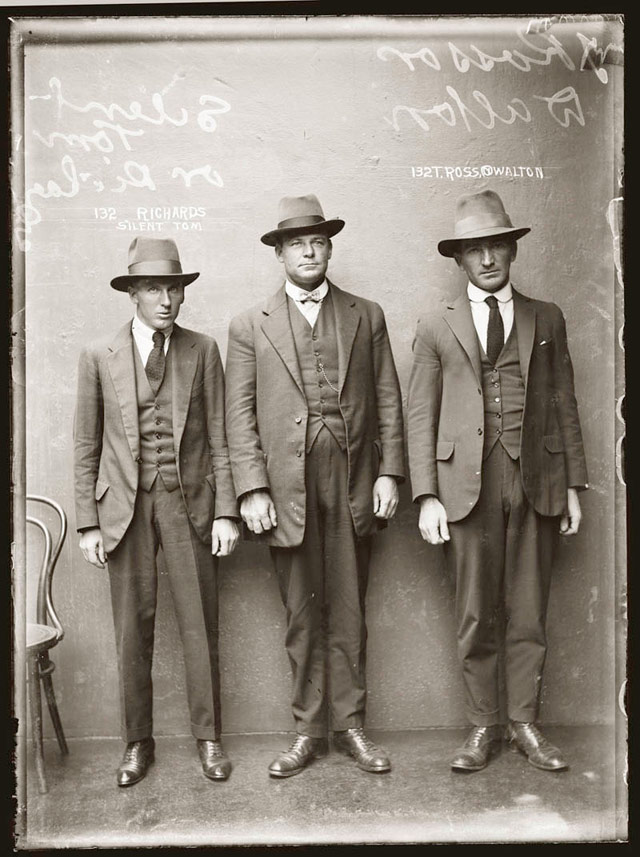
(thx, david)
Remember this New Yorker profile of Lenny Dykstra’s “improbable post-career success story”?
Dykstra ordered a Coke and French fries with ketchup: “And I’m actually going to have that as my meal-might be the oddest order of the day.” (Healthy living was never his specialty.) When the Coke arrived, he sent it back, believing it to be Diet. After the fries were delivered, he made a show of extracting a “You’re welcome” from the waiter, who had since moved on to another table. “I pay a thousand bucks a night — actually, three thousand bucks a night — and people are discourteous,” he said, shaking his head. “There’s some point in life when you have to grow up.”
For many ballplayers, the growing-up point does not arrive until after retirement, when all the freebies vanish and equipment managers and hotel maids can no longer be relied upon for regular laundry service. Dykstra last played in the majors in 1996, at age thirty-three. Improbably, he has since become a successful day trader, and he let me know that he owns both a Maybach (“the best car”) and a Gulfstream (“the best jet”). The occasion for our lunch, however, was a new venture: Dykstra is launching a magazine, intended specifically for pro athletes, called The Players Club. An unfortunate number of his former teammates have ended up broke, or divorced, or worse. The week before we met, the ex-Yankee Jim Leyritz, himself twice divorced and underemployed, had hit a woman while driving home from a bar. He never grew up.
“You’ve got the ten per cent who are going to find their way no matter what,” Dykstra said of the athlete population. “And you get the ten per cent that are fuckheads no matter what— we’ll paste an ‘L’ to ‘em.” The rest need guidance, and Dykstra, who will write a regular column called “The Game of Life,” is prepared to give it. “This will be the world’s best magazine,” he said.
Since then, Dykstra has declared bankruptcy, divorced from his wife, was sentenced to three years in state prison for grand theft auto (and several other charges), and most recently was sentenced to nine months in jail for assault and indecent exposure. He’s also awaiting trial on federal bankruptcy fraud charges.
Casey Neistat tries to steal his own bike in several locations around NYC and finds it’s pretty easy…even if you’re doing so right in front of a police station.
I recently spent a couple of days conducting a bike theft experiment, which I first tried with my brother Van in 2005. I locked my own bike up and then proceeded to steal it, using brazen means — like a giant crowbar — in audacious locations, including directly in front of a police station. I wanted to find out whether onlookers or the cops would intervene. What you see here in my film are the results.
This is a video of the earlier attempt he mentions. (via ★ironicsans)
Con man Victor Lustig shared a list of commandments written for aspiring con men. Among them:
1. Be a patient listener (it is this, not fast talking, that gets a con-man his coups).
8. Never boast. Just let your importance be quietly obvious.
Aaron Cohen calls this “the best story you’ll read about a burglary you’ll read this week” and I think he’s right.
When John Davidson’s apartment gets robbed, he learns that the easiest way to get his stuff back is to have one drug dealer lie to another drug dealer while he lies to the police.
Adrian Chen has an interview with a renegade IT guy named Martin who does social media, hacking, and other tech stuff for “High Net-worth Individuals” and criminals. One of things he does is set up drug rings with prepaid cell phones and a rotating collection of SIM cards a la the Barksdale/Bell drug crew in The Wire.
With Martin’s system, each crewmember gets a cell phone that operates using a prepaid SIM card; they also get a two-week plastic pill organizer filled with 14 SIM cards where the pills should be. Each SIM card, loaded with $50 worth of airtime, is attached to a different phone number and stores all contacts, text messages and call histories associated with that number, like a removable hard drive. This makes a new SIM card effectively a new phone. Every morning, each crewmember swaps out his phone’s card for the card in next day’s compartment in the pill organizers. After all 14 cards are used, they start over at the first one.
Of course, it would be hugely annoying for a crewmember to have to remember the others’ constantly changing numbers. But he doesn’t have to, thanks to the pill organizers. Martin preprograms each day’s SIM card with the phone numbers the other members have that day. As long they all swap out their cards every day, the contacts in the phones stay in sync. (They never call anyone but each other on the phones.) Crewmembers will remind each other to “take their medicine,” Martin said.
That’s clever. The “take their medicine” detail reads like it’s straight out of the movies.
Lakhdar Boumediene was imprisoned in the Guantanamo Bay detention camp for seven years on no charge and with no trial.
On Wednesday, America’s detention camp at Guantanamo Bay will have been open for 10 years. For seven of them, I was held there without explanation or charge. During that time my daughters grew up without me. They were toddlers when I was imprisoned, and were never allowed to visit or speak to me by phone. Most of their letters were returned as “undeliverable,” and the few that I received were so thoroughly and thoughtlessly censored that their messages of love and support were lost.
This is deeply deeply shameful.
An entrepreneur shares the business lessons imparted to him by a organized crime boss.
Interesting things happen when we cut out the middleman. In addition to reducing cost, we often end up creating an internal byproduct that can be productized and sold to a completely new customer. (Amazon Web Services is an example of this.) Sometimes the middleman’s market is so huge, that a freaking enormous business can be built simply by providing their customers a lower cost and more efficient option.
A group of buildings whose tenants continually complained about living conditions changed hands so frequently that city officials could do nothing about it….until a group representing the tenants used social network analysis to reveal the connections between all of the seemingly separate owners.
It was now obvious that properties exchanged hands not as independent and valid real estate investments but as a conspiracy to avoid fixing the building violations. The green links represent borrowed money flowing into the buildings through new mortgages. As time went on, and the buildings appreciated in value during a real estate boom — loans from the mortgage company allowed the owners to “strip mine” the equity from the buildings. This is a common slumlord modus operandi — they suck money out of a building rather than put money back in for maintenance.
Up until very recently, Glasgow’s gang culture made the city one of the most violent in western Europe. Then a program led by Karyn McCluskey turned the city in a better direction.
The unit’s big moment, McCluskey says, was understanding that violence works “like an infectious disease. It’s passed on. You can catch it. You might live and die in a square mile. Your life is not predictable or manageable. You may have alcoholic parents, suffer domestic violence. Nobody cares about you. You’re incapable of empathy: hard-wired for violence.”
They coined a phrase: recreational violence. “There’s also the thrill, the sensation-seeking,” McCluskey says. “You look at their faces on the CCTV, they’re loving it. They’re young guys just not equipped to make good decisions for themselves, caught up in the gang dynamic.”
So, if they see themselves as a group, treat them as a group, reasoned McCluskey. She went to the United States and met a man called David Kennedy, whose model for tackling gang violence had worked in Boston since the late 1990s. In the jargon, it’s known as a “focused deterrence strategy”, harnessing a multitude of different agencies plus resources from within the community. McCluskey set about bringing it to Glasgow.
Since late 2008, the program has cut the rate of violent offending by 46%. John Seabrook wrote about David Kennedy and his program for the New Yorker in 2009. (via @jcn)
Over the past two years, the NYPD has been taking panoramic images of crime scenes in an attempt to better record the evidence.
Each panorama takes between 3 to 30 minutes to produce, depending on the available light, and is added to a database where detectives can access it. Before the switch to the Panoscan, crime scene images sometimes took days to process. Now, soon after the photos are posted, investigators can point and click over evidence from a scene that they might have missed in the hectic hours after the crime.
The short answer is “you can’t” but the longer answer by a former patrol officer is more interesting.
How often do you drive in this manner? Unless you’re running because you’re on parole, this is likely your first dance. Sure, you’ve driven fast before — for a while. Then, for whatever reason, you got uncomfortable and backed off. Maybe your car made a sound you got concerned about, maybe you caught a glint you thought might be a trooper’s windshield, maybe you thought you heard the faintest pulses of a siren. Whatever it was, it weakened your resolve and you slowed down. You have no such luxury here. And while this is fresh for you, this is, to many of the people pursuing you, another day another dollar. They’ve trained for this in training scenarios and have been involved in pursuits in the field. They run code multiple times a week. Even if one of your pursuers was a rookie who got eaten up by the stress, there will be a dozen vets to take his place.
(thx, byrne)
Newer posts
Older posts





Socials & More