kottke.org posts about Vincent van Gogh
In an episode of Doctor Who from 2010, the Doctor and his companion Amy take Vincent van Gogh, who was not a commercially successful artist in his own lifetime, to the Musée d’Orsay to see an entire room filled with his paintings. The resulting scene is unexpectedly touching.
Loving Vincent is an upcoming feature-length film about Vincent van Gogh that is animated in an unusual way: using 12 oil paintings per second. They’ve trained dozens of painters — and are looking for more if you’re interested — in the style of van Gogh to illustrate every instant of the film. Here are some of the painters working on the movie:

Update: A full trailer is out:
(via colossal)
Adam Westbrook talks about Vincent van Gogh and the benefit of doing creative work without the audience in mind. Having never read Csikszentmihalyi’s Flow (I know, I know), I was unfamiliar with the word “autotelic”. From Wikipedia:
Mihaly Csikszentmihalyi describes people who are internally driven, and as such may exhibit a sense of purpose and curiosity, as autotelic. This determination is an exclusive difference from being externally driven, where things such as comfort, money, power, or fame are the motivating force.
Doug Belshaw has a bit more on autotelism and how it relates to education.
Gene Kogan used some neural network software written by Justin Johnson to transfer the style of paintings by 17 artists to a scene from Disney’s 1951 animated version of Alice in Wonderland. The artists include Sol Lewitt, Picasso, Munch, Georgia O’Keeffe, and van Gogh.
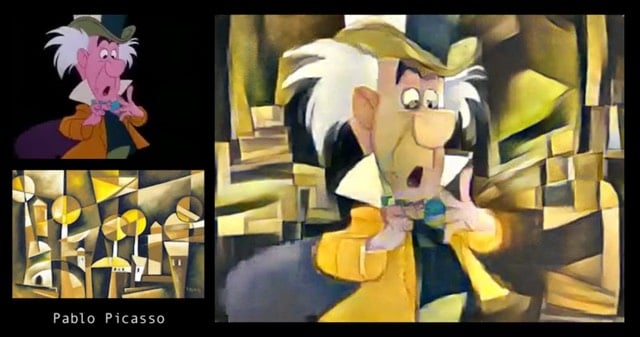
The effect works amazingly well, like if you took Alice in Wonderland and a MoMA catalog and put them in a blender. (via prosthetic knowledge)
Yarin Gal used an “inpainting” algorithm to extend the canvases of notable paintings. Like van Gogh’s Starry Night or Hokusai’s The Great Wave off Kanagawa:
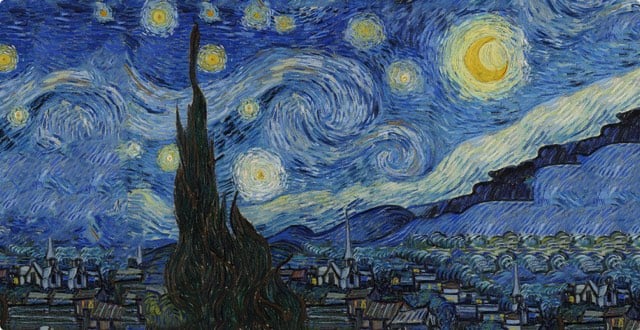
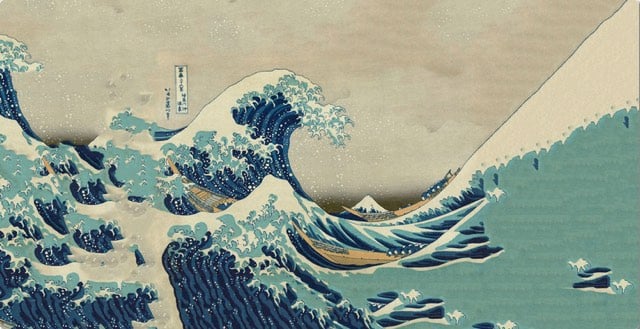
There’s a post on the Wolfram Alpha blog about how you can achieve similar effects using the Wolfram Language.
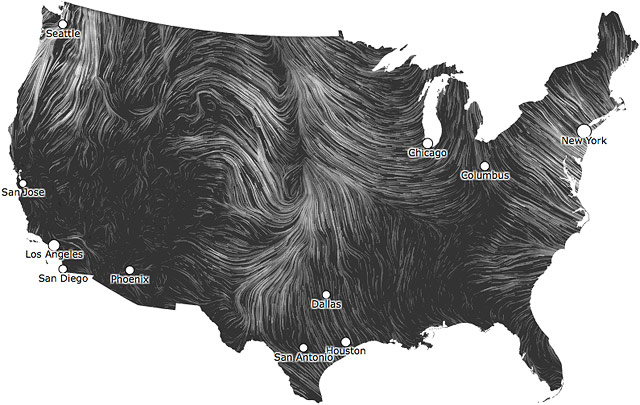
A pair of recent info visualizations look as though they were painted by Vincent van Gogh. Wind Map shows the realtime flow of wind over the United States.
Perpetual Ocean is a NASA animation of ocean currents around the world.
Would be cool to see both of these rendered through Stamen’s watercolor filter.
Photograph of the graves of Vincent and Theodore van Gogh in Auvers-sur-Oise, France. (Don’t quite know why I’m posting this…it just struck me is all.)
Vincent van Gogh painted turbulence quite accurately. Mexican scientists “have found that the Dutch artist’s works have a pattern of light and dark that closely follows the deep mathematical structure of turbulent flow”.
A quick note about the Van Gogh show at the Met that’s closing at the end of the month: if you’re in NYC, go see it. Admittedly, I’m a fan of Van Gogh, but I thought this was one of the best museum exhibitions I’ve ever seen. The exhibition features drawings (as well as a few paintings) from his short 10-year career as an artist, and you can really see how much he progressed during that time and how much his drawings and paintings were related. I can’t wait to go back over to the MoMA and look at Starry Night and The Postman and view them not as paintings, but more as drawings done with paint.
Opening tomorrow at the Met Museum in NYC, an exhibition of drawings by Vincent van Gogh. October 18, 2005 through December 31, 2005.
Astronomers have determined the precise location and time that Ansel Adams took a famous photograph of the moon in Yosemite National Park and are going to attempt to recreate the shot in September. The same forensic team has previously determined when Van Gogh painted “White House at Night”.
Newer posts
Older posts


Socials & More