kottke.org posts about Twitter
If you’d like to follow kottke.org on Twitter, you may do so here. Tweets will consist of a post title and the permalink URL, updated every time I publish a new post (more or less). Thanks to arc90 for their PHP Twitter API library. Note: this is a separate Twitter account from my personal one. Never will kottke.org updates be pushed automatically to my personal Twitter account. I am not a dick, I would never do that to you.
About 2 hours ago, the Mars Phoenix rover twittered that it had found evidence of ice on Mars.
Are you ready to celebrate? Well, get ready: We have ICE!!!!! Yes, ICE, *WATER ICE* on Mars! w00t!!! Best day ever!!
The Mars rover said “w00t”. Here’s the w00t-less press release and the associated images that show the ice sublimating from the surface over the last four days.
Tweetup n.
A real world meeting between two or more people who know each other through the online Twitter service.
I had a tweetup with my wife this morning. And last night. And the day before that. TMI?
I took a quick Twitter poll this morning: What’s the opposite of standing: sitting or lying down? The results: lying down wins but sitting is a close second. My favorite answer, which several people gave, is doing a headstand (or hanging upside down).
Now, what about this: What’s the opposite of sitting: lying down or standing?
How this whole When Obama wins thing got started: some Adaptive Path folk musing about state name changes if Obama won:
Dan was twittering something about Alabama, but wrote “Alambama”. He joked that when Barack Obama wins the election, certain states will probably be renamed - Alobama, Califobama, Nevama, Massabama, New Yobama. Of course, I thought that was hilarious and started thinking about other things that would change once Obama wins. So, a few of us started twittering silly little things, thinking of it as an inside joke.
Overnight, a few people caught on giving it a life of its own.
And if you’re so inclined, you could Digg When Obama wins and help melt my web server.
Update: It’s on Reddit as well.
Last night, folks on Twitter began to contemplate what will happen if Barack Obama wins the nomination. The meme seems to have begun with Andrew Crow’s vision for the future:
When Obama wins… unicorns will crap ice cream and pastries.
I collected a bunch of the best ones and made a page that cycles through them: When Obama wins.
The stodgy old New Yorker has a Twitter account and its friends are NPR, Harper’s, Gothamist, Huffington Post, the NY Times, and the WSJ, among others. Magazines should have friends, no? (Sniff, the WSJ has no friends.)
Jeff Jarvis rightly recommends following Time.com’s Ana Marie Cox’s Twitter feed as she follows the Republican Presidential candidates around the country. A recent, uh, tweet: “Myrtle Beach: McCain staffers very excited and pleased about the prospect of ‘Team McCain: California’ jackets.” These are the sort of details I wish made it to publication, but Twitter is, I suppose, a publication of its own, right?
“People say, You must have been the class clown. And I say, No, I wasn’t. But I sat next to the class clown, and I studied him.”
- Dr. Allan Pearl
This is why I love my Twitter: it fulfills in me a primal urge to act out in class, in little bursts. Since having moved past school and into the working world, the class clowning urge was one I’d kept dormant. As it turns out, however, blurting out ridiculous things to a roomful of people offers every bit the dopamine jolt as an adult as it did as a kid, which turns out to be very therapeutic.
In Twitter, there is a sense of ordered play. There is no judgement. You can talk to your neighbors, stand up and give a report on what you’re doing, pass notes, make fart noises if that’s your schtick (the highest form of comedy), or sit in the back, observing. But if you do a real banger mouthfart, like where your arm gets all wet and people actually think they smell something, there’s the joy of peer approval, in the form of a “favorite.”
Oh, and an added benefit of Twitter: it helps you to develop an economy of words and conciseness of ideas. Because the longest mouthfart isn’t always the funniest one.
Video of Twitter on CSI. They even stayed within the 140 character limit. (via waxy)
From my inbox this morning:

We can’t have nice things on the internet.
A bunch of presentations on how to scale web apps, including Flickr, Twitter, LiveJournal, and last.fm.
Regarding the Twitter vs. Blogger thing from earlier in the week, I took another stab at the faulty Twitter data. Using some educated guesses and fitting some curves, I’m 80-90% sure that this is what the Twitter message growth looks like:
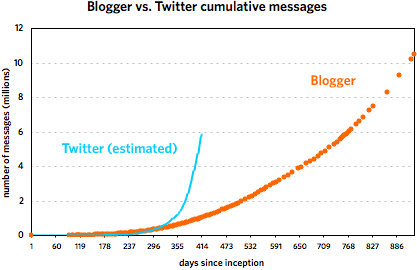
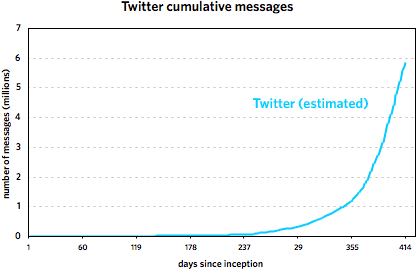
These graphs cover the following time periods: 8/23/1999 - 3/7/2002 for Blogger and 3/21/2006 - 5/7/2007 for Twitter. It’s important to note that the Twitter trend is not comprised of actual data points but is rather a best-guess line, an estimate based on the data. Take it as fact at your own risk. (More specifically, I’m more sure of the general shape of the curve than with the steepness. My gut tells me that the curve is probably a little flatter than depicted rather than steeper.)
That said, most of what I wrote in the original post still holds, as do the comments in subsequent thread. Twitter did not grow as fast as the faulty data indicated, but it did get to ~6,000,000 messages in about half the time of Blogger. Here are the reasons I offered for the difference in growth:
1. Twitter is easier to use than Blogger was and had a lower barrier to entry.
2. Twitter has more ways to update (web, phone, IM, Twitterific) than did Blogger.
3. Blogger’s growth was limited by a lack of funding.
4. Twitter had a larger pool of potential users to draw on.
5. Twitter has a built-in social aspect that Blogger did not.
And commenters in the thread noted that:
6. Twitter’s 140-character limit encourages more messages.
7. More people are using Twitter for conversations than was the case with Blogger.
What’s interesting is that these seeming advantages (in terms of message growth potential) for Twitter didn’t result in higher message growth than Blogger over the first 9-10 months. But then the social and network effects (#5 and #7 above) kicked in and Twitter took off.
This morning I posted a comparison of the growth in messages with both Blogger and Twitter. The Twitter data was based on information collected by Andy Baio in a post that was widely read in the blogosphere. In the course of looking at the Twitter data, neither of us noticed that from Nov 21, 2006 to Feb 4, 2007 and March 9, 2007 to the present, the Twitter post IDs had the same last digit, indicating that the data is not strictly sequential. If you look at Twitter’s public timeline, the Twitter post IDs skip around by multiples of 10.
Anil suggested via email that could be an artifact of database sharding and lo and behold, if you take off the last digit of the post ID, they seem to become sequential again, more or less. He’s going to ask the Twitter gang about it.
For right now though, the parts of this morning’s post that rely on Twitter data from the above dates is incorrect. Basically, all of it. Here it is in all caps: WRONG WRONG WRONG ERROR ERROR, F——-, WOULD NOT BUY DATA ANALYSIS FROM AGAIN. In hindsight, it seems obvious that the data was incorrect…that sort of growth seems impossible, especially when Twitter was having all sorts of scaling problems. Anyway, good thing this is just a blog and not a refereed journal, eh? Big thanks to the commenters in the other post for pointing me toward the error. More as I have it.
Update: Email from Biz Stone, who works for Twitter. He says:
There’s truth in the essence of what you’re talking about here — Twitter updates *are* coming in faster and furiouser than Blogger updates. However, the way we number Twitter updates has switched back and forth a few times which pretty much screws up the exactness of your analysis.
We have been doubling the number of active users about every three weeks for a sustained period of months now which is definitely contributing significantly to more and more updates. Also, active users of Twitter a measured by how many times they update per day (at Blogger it was per month). So activity in general at Twitter is crazy by comparison.
We’re going to start digging in to more data visualization, user patterns, etc in the coming weeks so if there’s anything you think we should be looking at specifically please let us know!
So we’ll have to wait a few weeks for an accurate look at this stuff. (thx, biz)
Important update: I’ve re-evaluated the Twitter data and came up with what I think is a much more accurate representation of what’s going on.
Newer posts
Older posts






Socials & More