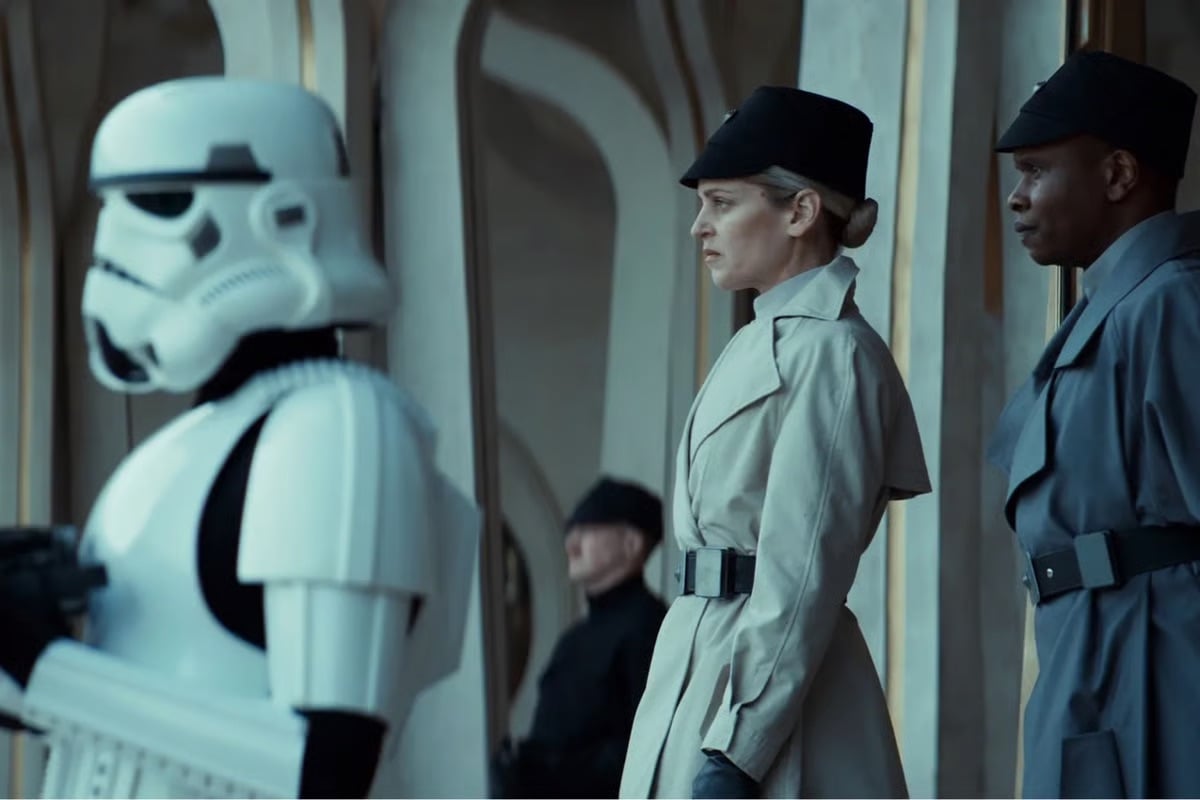
Now that Andor has been out for a while, showrunner Tony Gilroy is free to speak his mind on what the show was all about. I mean, it was pretty clear to the audience, but now he can say his piece. Andor won a Peabody Award and at the awards ceremony, Gilroy gave the following acceptance speech:
We spent six years contemplating a fascist takeover of a galaxy far, far away. Six years thinking about what happens to ordinary beings when an authoritarian, insane, unchecked regime comes into the deal, and the show is really kind of what we learned.
If you’re not willing to fight for the things that you love — your family, community, your culture, your planet, your truth, freedom — there’s an asshole ready to come in and take it away. We learned that bravery and sacrifice and resistance comes in all shapes and sizes, and we learned that courage is contagious.
There’s so much is happening, it’s a fire hose of crap that you just can’t get through. And here we are. There isn’t a new cycle that goes by right now that doesn’t contain a variety of outrages that in any other time in our history in America wouldn’t be grounds for treason.
Please do not stop. Please do not turn out the lights until we can kill this nightmare. And fuck the Empire!
Gilroy also recently appeared on Peabody’s podcast We Disrupt This Broadcast where he talks about the show’s prescience regarding the current political moment. From the transcript:
So any really specific prescient coincidence, and there probably will be some, they’re not intentional. They weren’t intentional at the time. They’re sadly what they are. And we were not looking at the newspaper when we wrote this. It doesn’t behoove me to do that. It’s incredibly, almost narcissistic how people feel that they’re always living at the edge of history in a way that’s just so unique. We feel so special.
And the sad truth is that, you know, we are just in another wheel of history. And I must admit that after 9/11 and Vietnam and Covid and Watergate and all the things I’ve grown up, I’m 68. I kind of thought, well, I’ve seen all the history I’m gonna see. I don’t feel that way anymore. I don’t feel so special anymore as a human who’s lived on the planet and lived in something called civilization. I think sadly, it’s sort of a Catherine Reel of repetitive stupidity.
See also Andor Creator Tony Gilroy Is Free to Speak About Fascism Now and An Interview With Andor’s Creator, Tony Gilroy.
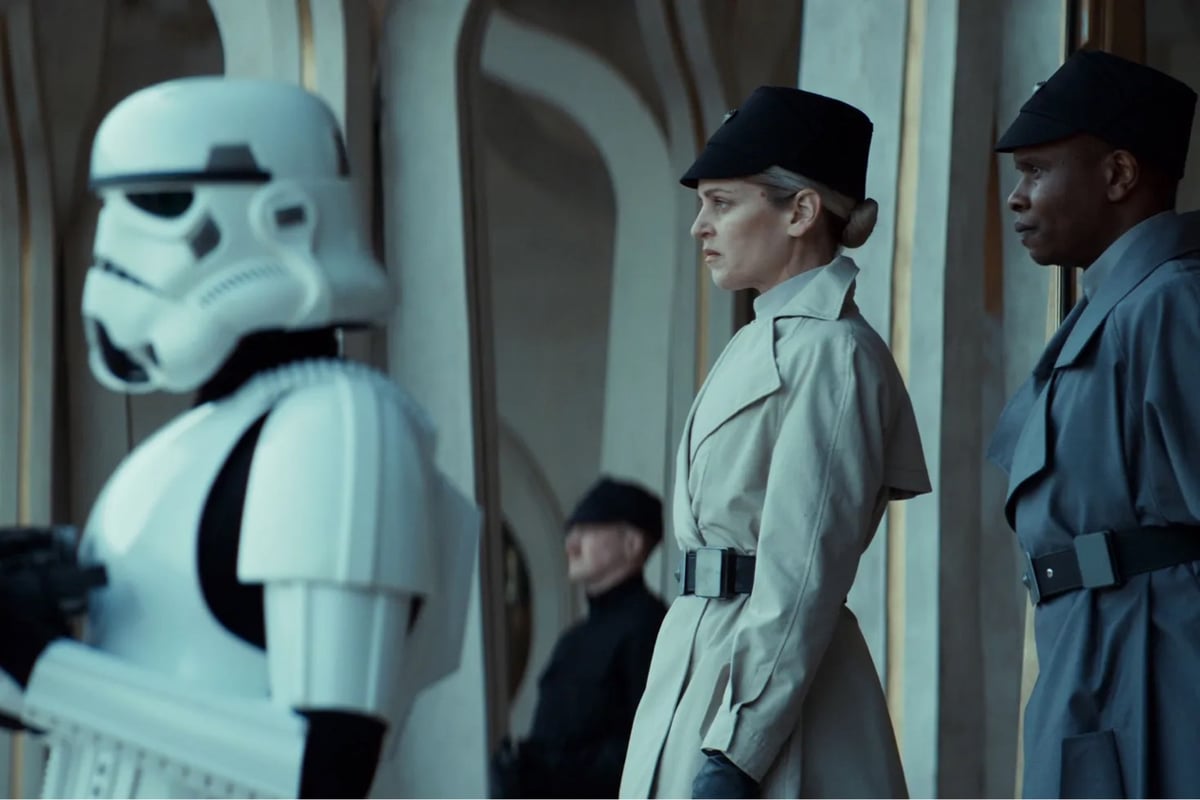
Early on in the promotional period for season two of Andor, a series explicitly about fascism that depicted a genocide, Disney asked creator Tony Gilroy not to use the words “fascism” and “genocide”. Now that promotional period has passed and he can speak freely. Here’s Gilroy’s recent interview with Hollywood Reporter. They asked him about the prescience of the show given current events, especially those in Minnesota, and his response is spot-on:
The simplest answer to the strange synchronicity of all of this is really on them, the outside forces. We were pretty much doing a story about authoritarianism and fascism, and the Empire is very clearly a great example of that. It’s a great place to deal with those issues, and as we’ve discussed many times before, we had this wide open canvas to deal with it.
So you get out your Fascism for Dummies book for the 15 things you do, and we tried to include as many of them as we could in the most artful way possible. How were we supposed to know that this clown car in Washington was going to basically use the same book that we used? So I don’t think it’s prescience so much as the sad familiarity of fascism and the karaoke menu of things that you go through to do it. You could list them from the show, or you could list them from the newspaper.
In the beginning, it was very confusing. People were like, “Oh, you’re psychic,” or, “The show is prescient.” But in the rear-view mirror, it’s really a much sadder explanation than that.
Gilroy also mentions a book that’s coming out this summer: The Art of Star Wars: Andor (Amazon). He says: “Every page has ideas that we talked about over the course of a million meetings, and it’s just so good.”
Like many others, I became a little obsessed with Andor over the past few months. I was lukewarm on the first season when it came out, but a pre-s02 rewatch completely changed my tune — I think it’s one of the best things I’ve ever seen on television. Season 2 was almost as good and the whole thing together was really affecting, thought-provoking, and just marvelously well-done.
In this interview with conservative NY Times’ columnist Ross Douthat, series creator Tony Gilroy nails why the show was so interesting:
The five years that I have been given are extremely potent. You have the Empire really closing down, really choking, really ramping up. The emperor is building the Death Star.
They are closing out corporate planets and absorbing them into the state. They are imperialistically acquiring planets and taking what they want. The noose is tightening dramatically.
There still is a Senate. There are senators that are speaking out impotently.
The Senate has been all but completely emasculated by the time this five-year tranche is over.
And there are revolutionary groups, rebellious groups, and people who are acting rebelliously, who wouldn’t even know how to describe themselves as part of any movement. There is a completely wide spectrum of unaffiliated cells and activists that are rising independently across the galaxy.
At the same time, you have a group of more restrained politicians who are trying to make an organized coalition of a rebellion on a place called Yavin, which will end up being the true end of the true victory of the Rebel Alliance.
I wanted to do a show all about the forgotten people who make a revolution like this happen — on both sides — and I want to take equal interest and spend as much time understanding the bureaucrats and the enforcers of the rebellion. I think one of the fascinating things about fascism is that, when it’s done coming after the people whose land it wants and who it wants to oppress and whoever it wants to control, by the time it gets rid of the courts and the justice and consolidates all its power in the center, it ultimately eats its young. It ultimately consumes its own proponents.
The rest of the interview is very much worth a read as well, particularly the bits where, for example, Douthat presses Gilroy on Andor being a “left-wing show”, Gilroy says no, Douthat scoffs, and, sensing Douthat is telling on himself, Gilroy fires back, “Do you identify with the Empire? Do you identify with the Empire?” And Gilroy continues later:
You could say: Why has Hollywood for the last 100 years been progressive or been liberal? I think it’s much larger. I’ll go further and say: Why does almost all literature, why does almost all art that involves humans trend progressive?
Let’s stick with Hollywood. Making a living as an actor or as a writer or a director — without the higher degree of empathy that you have, the more aware you are of behavior and all kinds of behavior, the better you’re going to be at your job. We feed our families by being in an empathy business. It’s just baked in. You’re trying to pretend to be other people. The whole job is to pretend to be other, and what is it like to look from this? People may be less successful over time at portraying Nazis as humans, and that may be good writing or bad writing, and there may be people that have an ax to grind. But in general, empathy is how I feed my family. And the more finely tuned that is, the better I am at my job.
That is what actors do: I’m going on Broadway, I’m playing a villain for six months. I got to live in that. I’m playing the slave, I’m playing the fisherman, I’m playing the nurse, I’m the murderer — you have to get in there. You have to live lives through other people. I think that the simple act of that transformation and that process automatically gives you what I would describe as a more generous and progressive point of view. It just has to.
Like I said, well worth a read/listen. (via sippey)





Socials & More