kottke.org posts about NY Times
The NY Times Magazine is out with its annual Year in Ideas issue. 2007 was the year of green — green energy, green manufacturing, and even a green Nobel Prize for Al Gore — and environmentalism featured heavily on the Times’ list. But I found some of the other items on the list more interesting.
Ambiguity Promotes Liking. Sometimes the more you learn about a person or a situation, the more likely you are to be disappointed:
Why? For starters, initial information is open to interpretation. “And people are so motivated to find somebody they like that they read things into the profiles,” Norton says. If a man writes that he likes the outdoors, his would-be mate imagines her perfect skiing companion, but when she learns more, she discovers “the outdoors” refers to nude beaches. And “once you see one dissimilarity, everything you learn afterward gets colored by that,” Norton says.
I’m an optimistic pessimist by nature; I believe everything in my life will eventually average out for the better but I assume the worst of individual situations for the reasons proposed in the article above. That way, when I assume something isn’t going to work out, I’m rarely disappointed.
The Best Way to Deflect an Asteroid involves a technique called “mirror bees”.
The best method, called “mirror bees,” entails sending a group of small satellites equipped with mirrors 30 to 100 feet wide into space to “swarm” around an asteroid and trail it, Vasile explains. The mirrors would be tilted to reflect sunlight onto the asteroid, vaporizing one spot and releasing a stream of gases that would slowly move it off course. Vasile says this method is especially appealing because it could be scaled easily: 25 to 5,000 satellites could be used, depending on the size of the rock.
What an elegant and easily implemented solution. But Armageddon and Deep Impact would have been a whole lot less entertaining using Dr. Vasile’s approach.
The Cat-Lady Conundrum. More than 60 million Americans are infected with Toxoplasma gondii, a parasite that most people get from their cats. And it’s not exactly harmless:
Jaroslav Flegr, an evolutionary biologist at Charles University in the Czech Republic, is looking into it. He has spent years studying Toxo’s impact on human behavior. (He found, for example, that people infected with Toxo have slower reflexes and are 2.5 times as likely to get into car accidents.)
This may explain why I can’t seem to get past “Easy” on Guitar Hero.
The Honeycomb Vase is actually made by bees. One unintended consequence of having a vase made out of beeswax is that flowers last longer in it:
Libertiny is convinced that flowers last longer in them, because beeswax contains propolis, an antibacterial agent that protects against biological decay. “We found out by accident,” he explains. “We had a bouquet, which was too big for the beeswax vase, so we put half of the flowers in a glass vase. We noticed the difference after a week or so.
Prison Poker. This is a flat out brilliantly simple idea:
[Officer Tommy Ray] made his own deck of cards, each bearing information about a different local criminal case that had gone cold. He distributed the decks in the Polk County jail. His hunch was that prisoners would gossip about the cases during card games, and somehow clues or breaks would emerge and make their way to the authorities. The plan worked. Two months in, as a result of a tip from a card-playing informant, two men were charged with a 2004 murder in a case that had gone cold.
The Gomboc is the world’s first Self-Righting Object.
It leans off to one side, rocks to and fro as if gathering strength and then, presto, tips itself back into a “standing” position as if by magic. It doesn’t have a hidden counterweight inside that helps it perform this trick, like an inflatable punching-bag doll that uses ballast to bob upright after you whack it. No, the Gomboc is something new: the world’s first self-righting object.
More information is available on the Gomboc web site. You can order a Gomboc for €80 + S&H.
Update: The Gomboc is available for sale but it doesn’t come cheap. The €80 version is basically a paperweight with a Gomboc shape carved out of it. It’s €1000+ for a real Gomboc, which is ridiculous. (thx, nick)
Yanksfan vs Soxfan mines the NY Times archive and turns up a 1914 article that mentions a youngster named Babe Ruth:
“Babe” Ruth, a youngster, opposed the Giants, who made nine hits off him. Four double plays, all started by Claude Derrick, who handled twelve outs of the thirteen chances, kept the Giants from scoring more runs.
YvS and Soccer Dad also found a series that the Times did on another youngster, Manny Ramirez, back when Manny being Manny meant hitting .650 in his senior year in high school.
Glenn from Coolfer took a spin through the NY Times recently opened online archive and highlighted some interesting news about the music industry, notably about how technology and the Internet changed the game in the late-90s/early-00s.
If someone likes an artist, they’re going to buy the CD. The number of those who download and opt against buying the CD is very small. There are plenty of libraries in this country, yet people still buy books. The Napster opponents underestimate the American fascination with ownership.
Mental Floss has an ongoing feature called The First Time News Was Fit To Print, which chronicles the first mentions of famous people, places, and events in the NY Times. Among the topics covered so far: The Simpsons, Kobe Bryant, and Starbucks.
While poking around in the newly opened archives of the New York Times yesterday, I stumbled upon an article called How We Dine (full text in PDF) from January 1, 1859. I’m not well versed in the history of food criticism, but I believe this is perhaps the first restaurant review to appear in the Times and that the unnamed gentleman who wrote it (the byline is “by the Strong-Minded Reporter of the Times”) is the progenitor of the paper’s later reviewers like Ruth Reichl, Mimi Sheraton, and Frank Bruni.
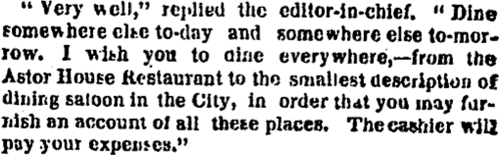
The article starts off with a directive from the editor-in-chief to “go and dine”:
“Very well,” replied the editor-in-chief. “Dine somewhere else to-day and somewhere else to-morrow. I wish you to dine everywhere, — from the Astor House Restaurant to the smallest description of dining saloon in the City, in order that you may furnish an account of all these places. The cashier will pay your expenses.”
Before starting on his quest, the reporter differentiates eating from dining — noting that many believe “whereas all people know how to eat, it is only the French who know how to dine” — and defines what he means by an American dinner (as opposed to a French one). Here’s his list of the types of American dinner to be found in New York, from most comfortable to least:
1. The Family dinner at home.
2. The Stetsonian dinner.
3. The Delmonican, or French dinner.
4. The Minor dinner of the Stetsonian principle.
5. The Eating-house dinner, so called.
6. The Second-class Eating-house dinner.
7. The Third-class Eating-house feed.
The remainder of the article is devoted to descriptions of what a diner might find at each of these types of establishments. Among the places he dined was Delmonico’s, where dining in America is said to have originated:
Once let Delmonico have your order, and you are safe. You may repose in peace up to the very moment when you sit down with your guests. No nobleman of England — no Marquis of the ancienne nobless — was ever better served or waited on in greater style that you will be in a private room at Delmonico’s. The lights will be brilliant, the waiters will be curled and perfumed and gloved, the dishes will be strictly en règle and the wines will come with precision of clock-work that has been duly wound up. If you “pay your money like a gentleman,” you will be fed like a gentleman, and no mistake… The cookery, however, will be superb, and the attendance will be good. If you make the ordinary mistakes of a untraveled man, and call for dishes in unusual progression, the waiter will perhaps sneer almost imperceptibly, but he will go no further, if you don’t try his feelings too harshly, or put your knife into your mouth.
According to a series of articles by Joe O’Connell, Delmonico’s was the first restaurant in the US when it opened in 1830 and invented Eggs Benedict, Oysters Rockefeller, Baked Alaska, Lobster Newberg, and the term “86’d”, used when the popular Delmonico Steak (#86 on menu) was sold out, or so the story goes. O’Connell’s history of Delmonico’s provides us with some context for the How We Dine piece:
The restaurant was a novelty in New York. There were new foods, a courteous staff, and cooking that was unknown at the homes of even the wealthiest New Yorkers. The restaurant was open for lunch and dinner.
The restaurant featured a bill of fare, which was itself new. Those who dined at inns were fed on a set meal for a set price. As a result, everyone was fed the same meal and were charged the same price, whether they ate little or much. In Paris, however, restaurants offered their patrons a “bill of fare”, a carte, which listed separate dishes with individual prices. Each patron could choose a combination of dishes which was different from the other patrons. Each dish was priced separately. Thus, the restaurant was able to accommodate the tastes and hunger of each individual. The various dishes and their prices were listed on a carte or (the English translation) “bill of fare”. Today, we call it a menu.
And from Delmonico’s developed many different types of dining establishments, which the Strong-Minded Reporter set out to document thirty years later. Contrast his visit to Delmonico’s with the experience in the “sandwich-room” at Browne’s Auction Hotel, an eating-house:
The habitués of the place are rarely questioned at all. The man who has eaten a sandwich every day for the past ten years at the Auction Hotel no sooner takes his seat than a sandwich is set before him. The man who has for the same period indulged daily in pie or hard boiled eggs (there are some men with amazing digestion) is similarly treated. The occasional visitor, however, is briefly questioned by the attendant before whom he takes his place. “Sandwich?” or “Pie?” If he say “Sandwich,” in reply, the little man laconically inquires, “Mustard?” The customer nods, and is served. If his mission be pie, instead, a little square morsel of cheese is invariably presented to him. Why such a custom should prevail at these places, no amount of research has yet enabled me to ascertain. Nothing can be more incongruous to pie than cheese, which, according to rule and common sense, is only admissible after pie, as a digester. But the guests at the Auction Hotel invariably take them together, and with strict fairness — a bite at the pie, and a bite at the cheese, again the pie, and again the cheese, and so on until both are finished.
The experience of being a regular has barely changed in 150 years. And finally, our intrepid reporter visits an unnamed third class eating-house:
The noise in the dining hall is terrific. A guest has no sooner seated himself than a plate is literally flung at him by an irritated and perspiring waiter, loosely habited in an unbuttoned shirt whereof the varying color is, I am given to understand, white on Sunday, and daily darkening until Saturday, when it is mixed white and black — black predominating. The jerking of the plate is closely followed up by a similar performance with a knife and a steel fork, and immediately succeeding these harmless missiles come a fearful shout from the waiter demanding in hasty tones, “What do you want now?” Having mildly stated what you desire to be served with, the waiter echoes your words in a voice of thunder, goes through the same ceremony with the next man and the next, through an infinite series, and rushes frantically from your presence. Presently returning, he appears with a column of dishes whereof the base is in one hand and the extreme edge of the capital is artfully secured under his chin. He passes down the aisle of guests, and, as he goes, deals out the dishes as he would cards, until the last is served, when he commences again Da Capo. The disgusting manner in which the individuals who dine at this place, thrust their food into their mouths with the blades of their knives, makes you tremble with apprehensions of suicide…
The entire article is well worth the read…one of the most interesting things I’ve found online in awhile.
Update: According to their web site, a restaurant in New Orleans named Antoine’s claims that they invented Oysters Rockefeller. Another tidbit: from what I can gather, the Delmonico’s that now exists in lower Manhattan has little to do with the original Delmonico’s (even though they claim otherwise), sort of like the various Ray’s Pizza places sprinkled about Manhattan. (thx, everyone who sent this in)
Now that the NY Times has discontinued their Times Select subscription program and made much more of their 150+ years of content available for anyone to read and link to, let’s take a look at some of the more notable items that the non-subscriber has been missing.
- Access to the last two years-worth of columns from the NY Times’ noted Op-Ed columnists, including Thomas Friedman, Maureen Dowd, David Brooks, and Paul Krugman.
- The first mention of the World Wide Web in the Times in February 1993. According to the article, the purpose of the web is “[to make] available physicists’ research from many locations”. Also notable are this John Markoff article on the internet being overwhelmed by heavy traffic and growth…in 1993, and a piece, also by Markoff, on the Mosaic web browser.
- Early report of Lincoln’s assassination…”The President Still Alive at Last Accounts”.
- A report on Custer’s Last Stand a couple of weeks after the occurance (I couldn’t find anything sooner). The coverage of Native Americans is notable for the racism, both thinly veiled and overt, displayed in the writing, e.g. a story from September 1872 titled The Hostile Savages.
- From the first year of publication, a listing of the principle events of 1851.
- An article about the confirmation of Einstein’s theory of gravity by a 1919 expedition led by Arthur Eddington to measure the bending of starlight by the sun during an eclipse.
- A front page report on the 1906 San Francisco earthquake, including a seismograph of the quake which the Times labeled “EARTHQUAKE’S AUTOGRAPH AS IT WROTE IT 3,000 MILES AWAY”.
- The first mention of television (as a concept) in the Times, from February 1907. “The new ‘telephotograph’ invention of Dr. Arthur Korn, Professor of Physics in Munich University, is a distinct step nearer the realization of all this, and he assures us that ‘television,’ or seeing by telegraph, is merely a question of a year or two with certain improvements in apparatus.”
- First mention of Harry Potter. Before it became a phenomenon, it was just another children’s book on the fiction best-seller list.
- Some of the output by prolific Times reporter R.W. Apple is available (after 1981, pre-1981).
- A report during the First World War of the Germans using mustard gas. Lots more reporting about WWI is available in the Times archive.
- Not a lot is available from the WWII era, which is a shame. For instance, I wish this article about the dropping of the first atomic bomb on Hiroshima was available in the Times archive. Nothing about the moon landing, Kennedy’s assassination, Watergate, etc. etc. either. :(
- On The Table, Michael Pollan’s blog from last summer about food soon after the publication of The Omnivore’s Dilemma.
- Urban Planet, a blog about cities from Steven Johnson, author of The Ghost Map.
- Oddly, The Principles of Uncertainty, an illustrated blog by Maira Kalman isn’t available anymore. Update: Kalman’s blog is probably unavailable because it’s due to be published in book form in October. (thx, rafia) Further update: Kalman’s blog is back online and wonderful. The culprit was a misconfiguration at the Times’ end. (thx, rich)
- Several other previously unavailable blogs are listed here and here.
- It looks like most of the links to old NY Times articles I (and countless other early bloggers) posted in the late 90s and early 00s now work. Tens of thousands of broken links fixed in one pass. Huzzah!
I’ll also note that this move by the Times puts them in a much better position to win the Long Bet between Dave Winer and the Times’ Martin Nisenholtz at the end of this year.
In a Google search of five keywords or phrases representing the top five news stories of 2007, weblogs will rank higher than the New York Times’ Web site.
As of the end of 2005, the Times was not faring very well against blogs.
Update: One more: a report on the sinking of the Titanic. A small mention of the sinking was published in the paper the previous day.
No more Times Select. The NY Times finally admits what everyone else knew two years ago and stops charging for their content. Additionally, all content from 1987 to the present and from 1851 to 1922 will be offered free of charge.
What changed, The Times said, was that many more readers started coming to the site from search engines and links on other sites instead of coming directly to NYTimes.com.
How did that change not happen for the Times when it happened to the entire rest of the web 3-4 years ago?
Today’s NY Times covers virtual book tours, the increasingly popular practice of book authors touring blogs instead of touring the non-virtual bookstores of the US and staying in non-virtual and expensive hotel rooms. From the article’s midst:
[Booktour.com] was founded by Chris Anderson, the editor in chief of Wired and the author of “The Long Tail”; Adam Goldstein, a 19-year-old sophomore at M.I.T.; and Kevin Smokler, a publishing expert credited with creating the first blog book tour. That was for “Stiff: The Curious Lives of Human Cadavers” by the science writer Mary Roach, in 2003. Since then, Mr. Smokler said, “It’s become de rigueur for public relations to include blogs and online media as part of regular touring.”
kottke.org was one of the tour stops for the Stiff book tour (here’s the entry) but I also participated in the first blog book tour more than a year earlier, for a book called Rainy Day Fun and Games for Toddler and Total Bastard, written by Greg Knauss and published by So New Media, a small publishing concern lovingly run by Ben Brown and James Stegall and now, sadly, defunct. The Rainy Day Fun… tour was the inspiration for Kevin in putting together the later tour. Not sure why the Times indicated otherwise.
And if you want to go back before most people were aware of these blog thingies, author M.J. Rose recalls participating in a virtual tour circa 2000:
So the NYT finally did an article on Author blog tours, which if memory serves, some of us have been doing for a quite a long time… in 2000 I did one that included Salon and BookReporter.com and a few other places that updated regularly and operated the way blogs do even though then we didn’t call them that.
Update: So New Media is still going strong…just their old domain is no longer working. (thx, greg) And hey, Rainy Day Fun and Games for Toddler and Total Bastard is still available ($5!) and still funny. I’m planning a re-read now that I’m a total bastard and soon-to-be toddler wrangler.
Edward Tufte highlights some infographics done by Megan Jaegerman for the NY Times in the 90s. Tufte: “Her work is elegant, smart, finely detailed, inventive, and informative. A fierce researcher and reporter, she writes gracefully and precisely. Her best work is the best work in news graphics.”
It’s been awhile since I’ve done one of these. Here are some updates on some of the topics, links, ideas, posts, people, etc. that have appeared on kottke.org recently:
Two counterexamples to the assertion that cities != organisms or ecosystems: cancer and coral reefs. (thx, neville and david)
In pointing to the story about Ken Thompson’s C compiler back door, I forgot to note that the backdoor was theoretical, not real. But it could have easily been implemented, which was Thompson’s whole point. A transcript of his original talk is available on the ACM web site. (thx, eric)
ChangeThis has a “manifesto” by Nassim Taleb about his black swan idea. But reader Jean-Paul says that Taleb’s idea is not that new or unique. In particular, he mentions Alain Badiou’s Being and Event, Jacques Derrida, and Gilles Deleuze. (thx, paul & jean-paul)
When I linked The Onion’s ‘Most E-Mailed’ List Tearing New York Times’ Newsroom Apart, I said “I’d rather read a real article on the effect the most popular lists have on the decisions made by the editorial staff at the Times, the New Yorker, and other such publications”. American Journalism Review published one such story last summer, as did the Chicago Tribune’s Hypertext blog and the LA Times (abstract only). (thx, gene & adam)
Related to Kate Spicer’s attempt to slim down to a size zero in 6 weeks: Female Body Shape in the 20th Century. (thx, energy fiend)
Got the following query from a reader:
are those twitter updates on your blog updated automatically when you update your twitter? if so, how did you do it?
A couple of weeks ago, I added my Twitter updates and recent music (via last.fm) into the front page flow (they’re not in the RSS feed, for now). Check out the front page and scroll down a bit if you want to check them out. The Twitter post is updated three times a week (MWF) and includes my previous four Twitter posts. I use cron to grab the RSS file from Twitter, some PHP to get the recent posts, and some more PHP to stick it into the flow. The last.fm post works much the same way, although it’s only updated once a week and needs a splash of something to liven it up a bit.
The guy who played Spaulding in Caddyshack is a real estate broker in the Boston area. (thx, ivan)
Two reading recommendations regarding the Jonestown documentary: a story by Tim Cahill in A Wolverine Is Eating My Leg and Seductive Poison by former People’s Temple member Deborah Layton. (thx, garret and andrea)
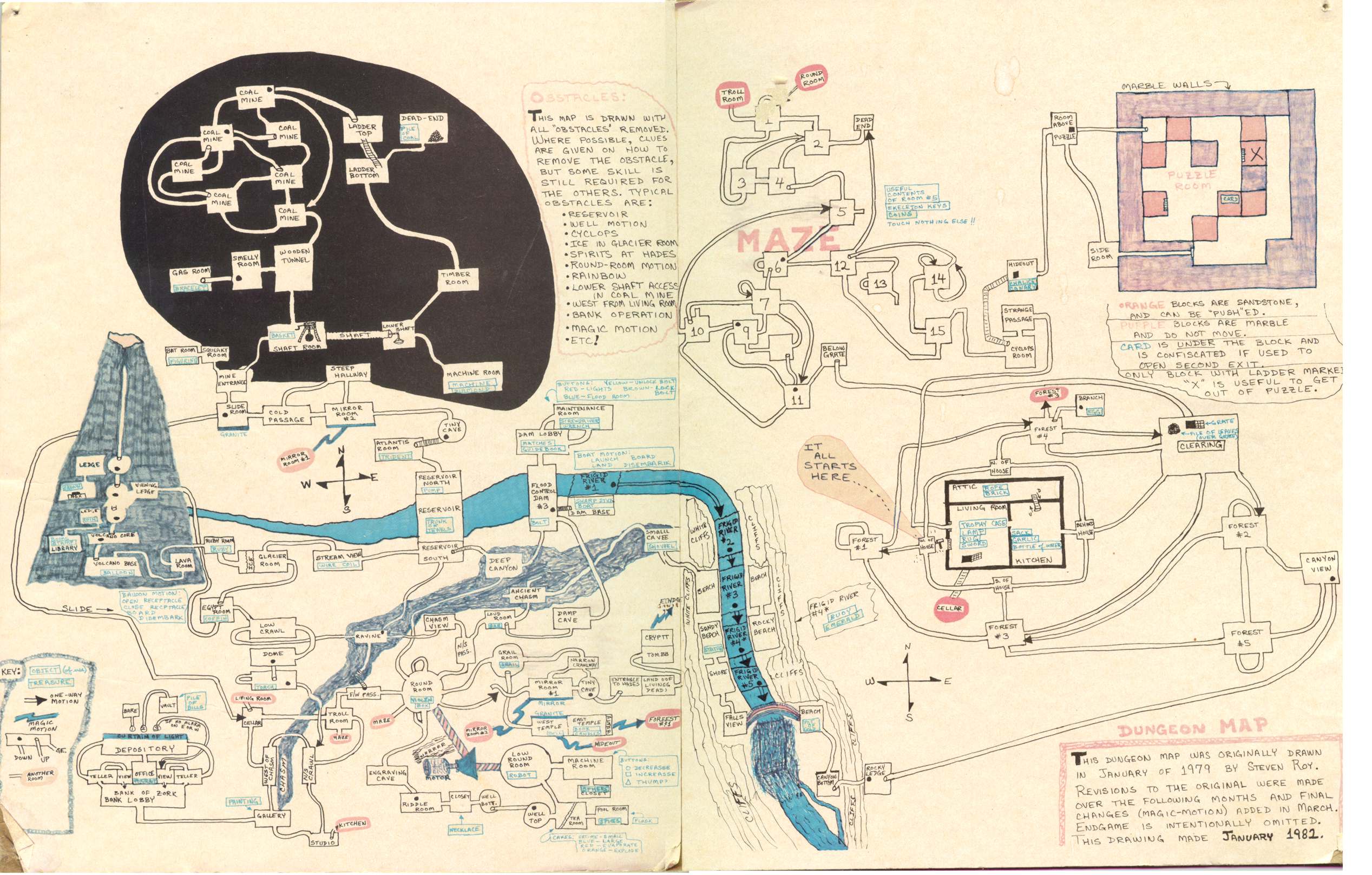
In case someone in the back didn’t hear it, this map is not from Dungeons and Dragons but from Zork/Dungeon. (via a surprising amount of people in a short period of time)
When reading about how low NYC’s greenhouse gas emissions are relative to the rest of the US, keep in mind the area surrounding NYC (kottke.org link). “Think of Manhattan as a place which outsources its pollution, simply because land there is so valuable.” (thx, bob)
NPR did a report on the Nickelback potential self-plagiarism. (thx, roman)
After posting about the web site for Miranda July’s new book, several people reminded me that Jeff Bridges’ site has a similar lo-fi, hand-drawn, narrative-driven feel.
In the wake of linking to the IMDB page for Back to the Future trivia, several people reminded me of the Back to the Future timeline, which I linked to back in December. A true Wikipedia gem.
I’m ashamed to say I’m still hooked on DesktopTD. The problem is that the creator of the game keeps updating the damn thing, adding new challenges just as you’ve finally convinced yourself that you’ve wrung all of the stimulation out of the game. As Robin notes, it’s a brilliant strategy, the continual incremental sequel. Version 1.21 introduced a 10K gold fun mode…you get 10,000 gold pieces at the beginning to build a maze. Try building one where you can send all 50 levels at the same time and not lose any lives. Fun, indeed.
Regarding the low wattage color palette, reader Jonathan notes that you should use that palette in conjunction with a print stylesheet that optimizes the colors for printing so that you’re not wasting a lot of ink on those dark background colors. He also sent along an OS X trick I’d never seen before: to invert the colors on your monitor, press ctrl-option-cmd-8. (thx, jonathan)
Dorothea Lange’s iconic Migrant Mother photograph was modified for publication…a thumb was removed from the lower right hand corner of the photo. Joerg Colberg wonders if that case could inform our opinions about more recent cases of photo alteration.
In reviewing all of this, the following seem related in an interesting way: Nickelback’s self-plagiarism, continual incremental sequels, digital photo alteration, Tarantino and Rodriquez’s Grindhouse, and the recent appropriation of SimpleBits’ logo by LogoMaid.
When I saw the title for this article — ‘Most E-Mailed’ List Tearing New York Times’ Newsroom Apart — I said, hey this is going to be pretty interesting. But then I click through and it’s The Onion. Which is funny and all, but I’d rather read a real article on the effect the most popular lists have on the decisions made by the editorial staff at the Times, the New Yorker, and other such publications.
British celebrity chef Gordon Ramsay had high hopes for his new restaurant in NYC, but it garnered only two stars from the New York Times on Thursday in a review that called the restaurant cautious, polite, predictable, and timid. NYC food site Eater reports that copies of the NY Times distributed at the hotel in which Ramsay’s restaurant is located had the Dining section, and therefore the disappointing review, removed from them.
Newer posts
Older posts



Socials & More