kottke.org posts about NY Times
The NY Times has posted their annual Year in Ideas collection for 2008, packaged this year in an “interactive feature”, which is Esperanto for “no permalinks”. A favorite so far in paging through is Tokujin Yoshioka’s Venus Natural Crystal Chair, a piece of furniture grown in mineral water.
Update: Permalinks are a go. I repeat, permalinks are a go. Here’s the one for the crystal chair. (thx, everyone)
Wednesday was the only the fourth time that the NY Times used 96 pt. type for the headline on the front page of the paper. In chronological order:
MEN WALK ON MOON
NIXON RESIGNS
U.S. ATTACKED
OBAMA
The Wednesday edition of the Times was very popular. It was sold out all over the city so people lined up outside the Times’ building to buy copies. Copies are available on eBay for $100 or more.
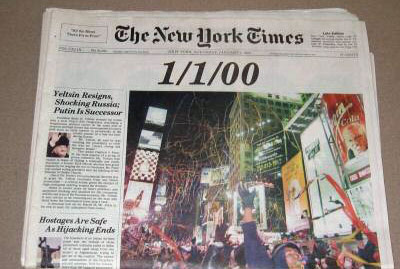
Update: The Times used 96 pt. type for the front page headline on at least one other occasion: January 1, 2000. I wonder if there are others. (thx, jeff)
Update: The Times is selling copies of the Nov 5 paper on their site but it’s currently being hammered by buyers so maybe try again in a few hours? (thx, matt)
In a huge shocker, the NY Times has endorsed Barack Obama for President. They also have an interactive feature that shows the newspaper’s past endorsements, from Lincoln in 1860 to the last Republican candidate endorsed, Dwight Eisenhower in 1956.
According to Editor and Publisher, Obama is leading McCain in newspaper endorsements by more than 2-to-1, including most of the major papers. Obama: LA Times, NY Times, Sacramento Bee, SF Chronicle, SJ Mercury, Washington Post, Chicago Tribune, Chicago Sun-Times, Boston Globe, NY Daily News, The Houston Chronicle. McCain: San Diego Union-Tribune, Tampa Tribune, Boston Herald, New York Post, Dallas Morning News, The Detroit News.
NY Times resident crossword puzzle master Will Shortz on how to solve the NY Times crossword puzzle.
Mental flexibility is a great asset in solving crosswords. Let your mind wander. The clue “Present time” might suggest nowadays, but in a different sense it might lead to the answer yuletide. Similarly, “Life sentences” could be obit, “Inside shot” is x-ray and my all-time favorite clue, “It turns into a different story” (15 letters), results in the phrase SPIRAL STAIRCASE.
A collection of old book ads from the NY Times.
We’re going to begin this project with a look at the country’s golden age of book advertisements, which ran from roughly 1962-73. Why those dates? The books - and the ads for them - were terrific: fresh, pushy, serious and wry, often all at the same time. There was a new sense of electricity in the culture and in the book world.
The authors featured include Alice Walker, Cormac McCarthy, Joan Didion, Toni Morrison, and Susan Sontag.
Paul Krugman on the how the NY Times makes its money.
The New York Times is known for its hard news coverage, but he observes that from a business perspective it’s primarily a fashion and food publication that runs a small political news operation on the side. One issue of T Magazine, he says, pays for an entire NYT European bureau.
A map of the world as reported by the New York Times. Countries are color coded by the amount of times they are mentioned in the Times, per capita. Greenland, Iraq, New Zealand, Iceland, and Panama are disproportionally represented.
After a stutter step back in late February, NY Times releases their slick archive browser, TimesMachine. Here’s the announcement from the team that put it together.
TimesMachine is a collection of full-page image scans of the newspaper from 1851-1922 (i.e., the public domain archives). Organized chronologically and navigated by a simple calendar interface, TimesMachine provides a unique way to traverse the historical archives of The New York Times. Topics ranging from the Civil War to the sinking of the Titanic to the first cross-country auto race to women’s fashions in the 20s are just a few electronic flips away. And of course, there’s the advertisements.
Unfortunately, full access to the archives through TimesMachine is only available to subscribers. (via fimoculous)
Khoi Vinh, design director of NYTimes.com and Subtraction, will be answering questions from readers all this week. Look for Khoi’s initial responses later in the day and week.
In past few years, several prominent US magazines and newspapers have begun to offer their extensive archives online and on DVD. In some cases, this includes material dating back to the 1850s. Collectively it is an incredible record of recent human history, the ideas, people, and events that have shaped our country and world as recorded by writers, photographers, editors, illustrators, advertisers, and designers who lived through those times. Here are some of most notable of those archives:
Harper’s Magazine offers their entire archive online, from 1850 to 2008. Most of it is only available to the magazine’s subscribers. Associate editor Paul Ford talks about how Harper’s archive came to be.
The NY Times provides their entire archive online, most of it for free. Most of the stories from 1923 to 1986 are available for a small fee. The Times briefly launched an interface for browsing their archive called TimesMachine but withdrew it soon after launch.
Time Magazine has their entire archive online for free, from 1923 to the present.
Sports Illustrated has all their issues online for free, dating back to 1954.
The Atlantic Monthly offers all their articles since Nov 1995 and a growing number from their archive dating back to 1857 for free. For a small fee, most of the rest of their articles are available as well, although those from Jan 1964 - Sept 1992 are not.
The Washington Post has archives going back to 1877. Looks like most of it is for pay.
The New Yorker has free archives on their site going back to 2001, although only some of the articles are included. All of their articles, dating back to 1925, are available on The Complete New Yorker DVD set for $40.
Rolling Stone offers some of their archive online but the entire archive (from 1967 to 2007) is available as a 4-DVD set for $79.
Mad Magazine released a 2-DVD set of every issue of the magazine from 1952-2006.
And more to come…old media is slowly figuring out that more content equals more traffic, sometimes much more traffic.
Update: Nature has their entire archive online, dating back to 1869. (thx, gavin)
The NY Times launches TimesMachine, an alternate look into their vast online archive. It’s basically an interface into every single page of the newspaper from Sep 18, 1851 to Dec 30, 1922. The advertising on these old pages is fascinating.
Update: For whatever reason, the Times has taken TimesMachine offline.
An official decision has been reached in the Long Bet between Dave Winer and Martin Nisenholtz of the NY Times. The bet was made in 2002 when Winer asserted that:
In a Google search of five keywords or phrases representing the top five news stories of 02007, weblogs will rank higher than the “New York Times” Web site
Winer won the bet but it’s worth noting that the Times has a growing stable of good blogs itself. (via workbench)
In 1984, Maureen Dowd, now an op-ed columnist, was a reporter on the “Metropolitan staff” of the New York Times. This excerpt (from a 5112-word piece) ran in the Times magazine on November 4, 1984, with the headline “9PM TO 5AM.” (It’s behind the paywall here.)
On Monday nights, Area offers ”obsession” nights—with fixations such as sex, pets and body oddities. At a recent ”sex evening,” nude jugglers and whip dancers moved in and out of the crowd while an ex-nun heard sexual confessions in the ladies’ room and an old man played with inflatable dolls in a pool.
This evening, the theme is ”confinement,” and the club is decorated with dolls in pajamas chained under water, a caged rabbit and go-go dancers armed with guns and dressed in Army fatigues.
”Where’s Andy Warhol?” asks a young punk, dragging on a joint and scanning the crowd. ”I want to get a good look at him.”
”I think he went to Limelight,” says his friend. At Limelight, a church- turned-club on the Avenue of the Americas at 20th Street, halolike arcs of light stream from stained-glass windows.
”We should go there,” says someone else.
”We should go there immediately,” says another.
They scurry off to Limelight, unaware that their quarry, wearing corduroys and a backpack, is standing unobtrusively at the bar.
”This is the best bar in town,” Andy Warhol says. ”You could take everything out and put it in a gallery.”
Matt Dillon, Vincent Spano and Mickey Rourke, each confident in his role as a teen idol, make their separate ways through the crowd, as young girls reach out to touch their arms, backs, anything. Director Francis Ford Coppola is talking to the actress Diane Lane.
Nearby, Don Marino, an up-and-coming actor, is talking to Brian Jones, an up-and-coming director. ”L.A. is a whole different world,” the actor says. ”You go to the A party, the B party and you are home in bed by 11 for your 5 o’ clock call the next morning. In New York, you’ve got to be seen at night, you’ve got to get around.”
The young director scans the room. ”I know people Coppola knows,” he says. ”I wonder if I could go say hi.”
Rogers Cadenhead has beaten me to the punch in calculating the winner of the Dave Winer/Martin Nisenholtz Long Bet pitting the NY Times vs. blogs to see who ranks higher in end of the year search results for the 5 most important news stories of 2007. The winner? Wikipedia.
The Times has really improved their position in Google since 2005…opening up their archives helped, I bet.
Newer posts
Older posts




Socials & More