kottke.org posts about Covid-19
Tomer Hanuka asked his third-year illustration students at SVA to “come up with a post-pandemic New Yorker magazine cover” and posted some of their wonderful & thoughtful work to Twitter. Here are a few that caught my eye:

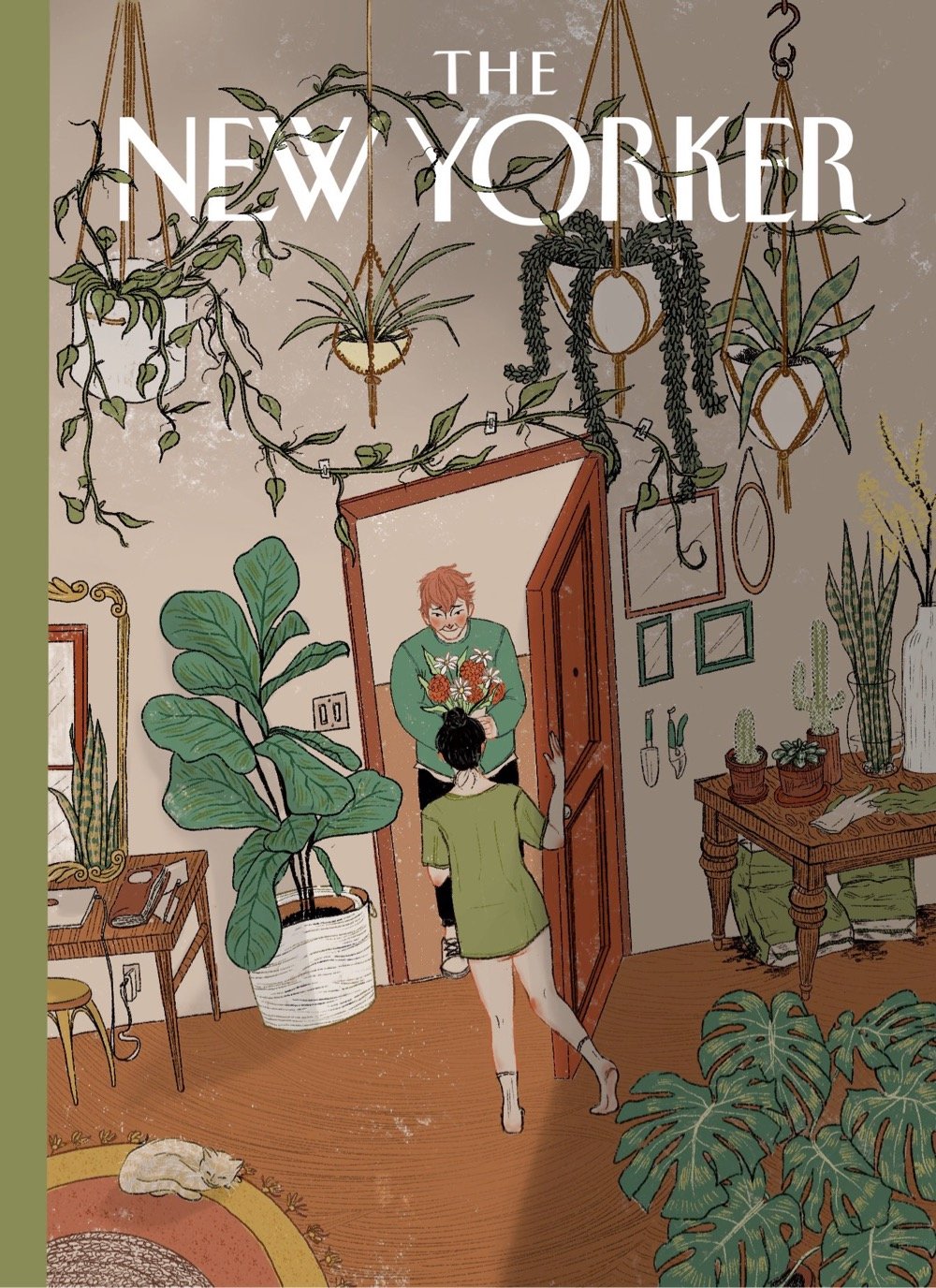
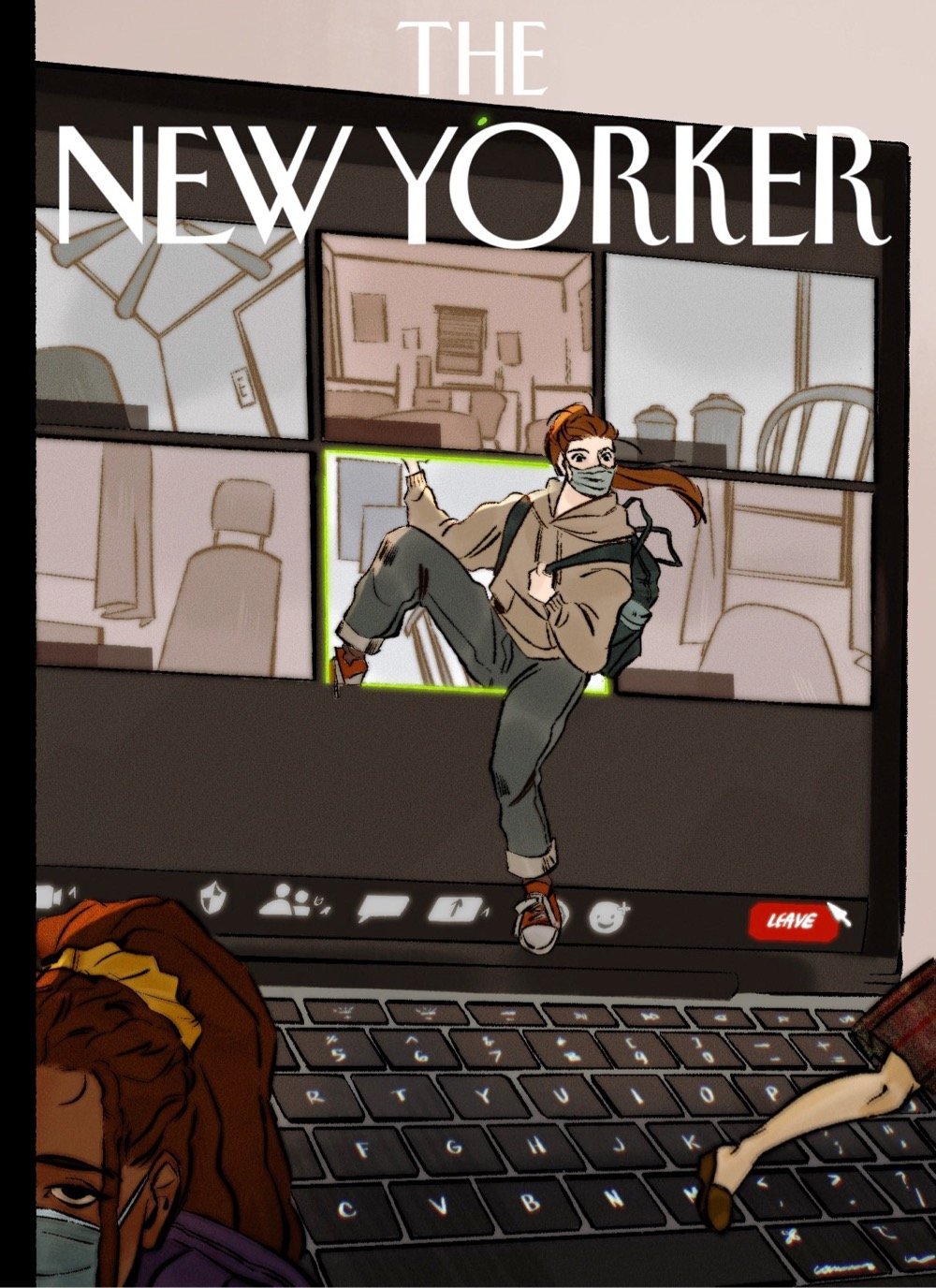
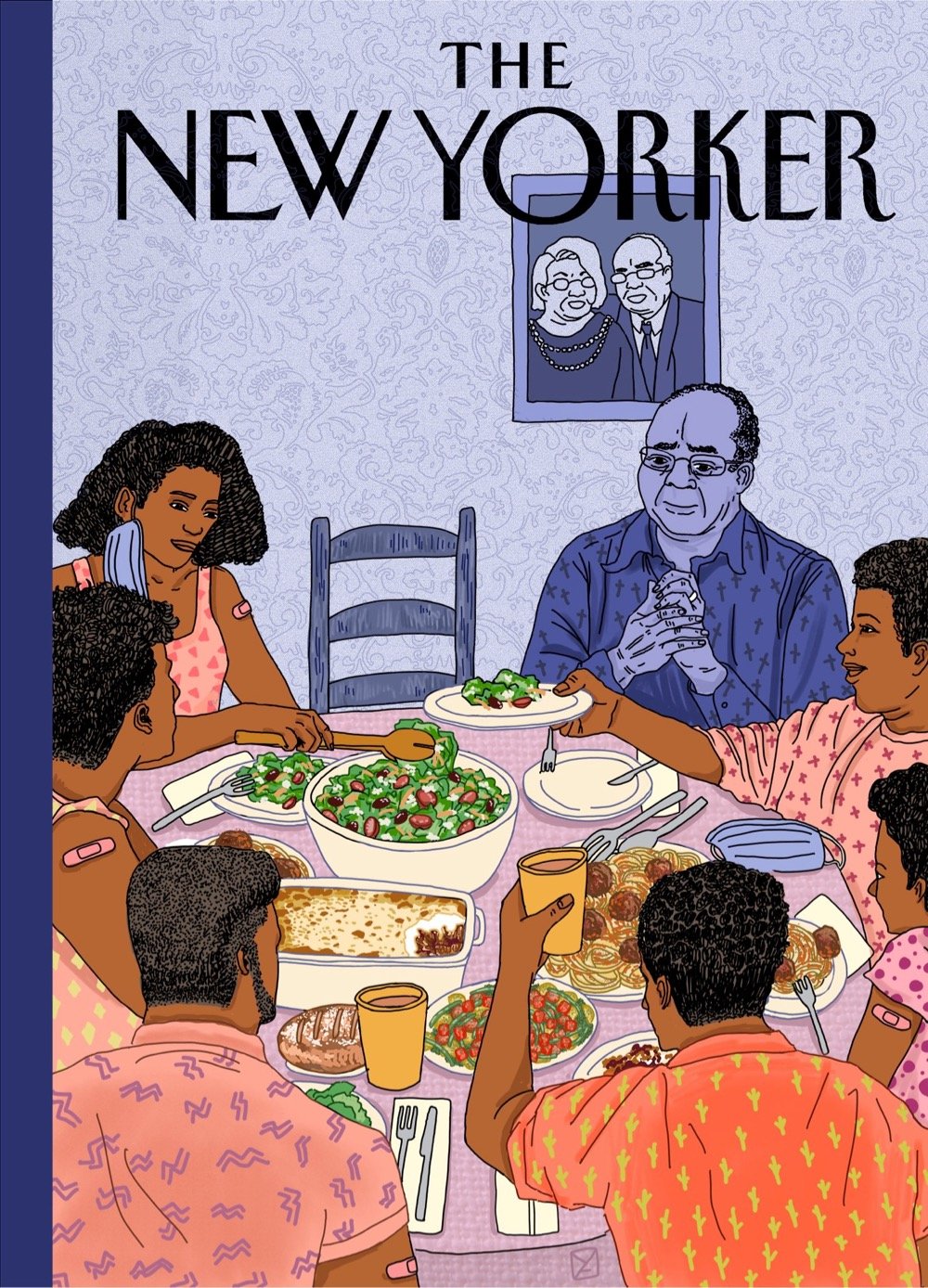
The second cover down, by Katrina Catacutan, is probably my favorite (the body language of the woman answering the door is just perfect) but the last image by Amy Young hit me like a ton of bricks. The New Yorker should run all of these covers for an issue of the magazine in a few weeks — collect them all!
In a letter published in The Lancet, a group of scholars argue, with an extensive review of the available evidence, that the primary mode of transmission from human to human of the virus responsible for Covid-19 is via aerosols, not through larger particles called droplets or through fomites (transfer from surfaces). Here are three of their ten reasons why:
Third, asymptomatic or presymptomatic transmission of SARS-CoV-2 from people who are not coughing or sneezing is likely to account for at least a third, and perhaps up to 59%, of all transmission globally and is a key way SARS-CoV-2 has spread around the world, supportive of a predominantly airborne mode of transmission. Direct measurements show that speaking produces thousands of aerosol particles and few large droplets, which supports the airborne route.
Fourth, transmission of SARS-CoV-2 is higher indoors than outdoors and is substantially reduced by indoor ventilation. Both observations support a predominantly airborne route of transmission.
Fifth, nosocomial infections have been documented in health-care organisations, where there have been strict contact-and-droplet precautions and use of personal protective equipment (PPE) designed to protect against droplet but not aerosol exposure.
The letter concludes with a plea by the authors for public health officials to finally embrace this reality: “The public health community should act accordingly and without further delay.”
I can’t believe we’re actually still arguing about this. One of the authors, Jose-Luis Jimenez, wrote this seminal Time magazine piece that provided the smoke analogy that is the mental model I’ve been using to think about potential risks during the pandemic.
When it comes to COVID-19, the evidence overwhelmingly supports aerosol transmission, and there are no strong arguments against it. For example, contact tracing has found that much COVID-19 transmission occurs in close proximity, but that many people who share the same home with an infected person do not get the disease. To understand why, it is useful to use cigarette or vaping smoke (which is also an aerosol) as an analog. Imagine sharing a home with a smoker: if you stood close to the smoker while talking, you would inhale a great deal of smoke. Replace the smoke with virus-containing aerosols, which behave very similarly, and the impact is similar: the closer you are to someone releasing virus-carrying aerosols, the more likely you are to breathe in larger amounts of virus. We know from detailed, rigorous studies that when individuals talk in close proximity, aerosols dominate transmission and droplets are nearly negligible.
Another of the authors, Zeynep Tufekci, has been arguing the case for aerosols (and masks & overdispersion) since early in the pandemic, and she succinctly explained in a Twitter thread how predominantly aerosol transmission fits with the mitigation methods that have really worked around the world:
Airborne transmission unites three things crucial to recognize for effective COVID-19 mitigation: transmission without symptoms (thus aerosols), clusters driving the epidemic (also aerosols) and masks/ventilation indoors being key (hey, also aerosols). This framework is coherent.
Her whole thread is worth a read — like this bit about how other respiratory pathogens are likely spread by aerosols and not droplets (as commonly believed):
Fascinatingly, you search the scientific record high and low, but there really is little to no direct evidence for gravity-sprayed droplets being predominant mode of transmission for respiratory illnesses outside of coughing/sneezing. It’s many… assumptions. Like a tradition.
If any good comes out of the pandemic at all, a better and more useful scientific understanding of how respiratory pathogens are transmitted would be a good start.
Update: One of the authors, Trisha Greenhalgh, responds succinctly to criticisms of the paper in this Twitter thread.
Criticism 1: “The paper is just opinion, and several authors aren’t even doctors.”
Response: No. It’s well-researched scholarly argument, produced by an interdisciplinary team of 6 professors including 3 docs, 2 aerosol scientists and 1 social scientist.
In 1955, epidemiologist Thomas Francis Jr. announced the results of a field trial of the polio vaccine that Jonas Salk had developed. America erupted in joy.
Now a phalanx of bulky television cameras focussed on Francis as he prepared to report on the efficacy of the vaccine. He had good news to share: to cheers from the audience, he explained that the Salk vaccine was sixty to seventy per cent effective against the most prevalent strain of poliovirus, and ninety per cent effective against the other, less common strains. All this had been shown through what was, at that time, the largest vaccine trial ever conducted.
All afternoon and evening, church bells rang out across America. People flooded into the streets, kissing and embracing; parents hugged their kids with joy and relief. Salk became an instant national hero, turning down the offer of a ticker-tape parade in New York City; President Dwight D. Eisenhower invited him to the White House and, later, asked Congress to award him a Congressional Gold Medal. That night, from the kitchen of a colleague’s house, Salk — whose name was being touted in newspapers, magazines, radio reports, and television news broadcasts around the world — gave his first network-TV interview to Edward R. Murrow, whose show “See It Now” had exposed the tactics of Senator Joseph McCarthy a year earlier. Blushing in admiration, Murrow asked the doctor, “Who owns the patent on this vaccine?” “The people,” Salk said, nobly. “There is no patent. Could you patent the sun?”
In the days that followed, schoolchildren were instructed by their teachers to write thank-you notes to Salk. Universities lined up to offer him honorary degrees. Millions of American doctors, nurses, and parents got down to the serious business of vaccinating their children against polio, using a shot they’d been anticipating for seventeen years.
But the polio vaccine rollout had its challenges, including a manufacturing negligence & oversight failure that resulted in tens of thousands of polio cases in otherwise healthy children.
In May, the polio vaccination drive was temporarily suspended. Leonard Scheele, the U.S. Surgeon General, inspected the facilities of all six vaccine companies and fired the government officials he considered to be culpable; the director of the N.I.H. and the Secretary of Health voluntarily resigned. New safety procedures were developed, including an improved means of filtering the viral mix just before the formaldehyde was added. Better tests were developed to detect live virus, and stricter record-keeping was instituted. The incident could have created a vaccine-hesitancy crisis. But, incredibly, the American public readily accepted the medical establishment’s explanation for the failure, and its pledges to right the situation. The nation’s trust in medical progress and in Dr. Salk was so resolute that, when it was announced that a new, safe polio vaccine was available, parents pushed their children back to the head of the line. It’s hard to imagine such an outcome today.
This is a very good and bracing essay from David Roth for Defector about a certain type of knee-jerk libertarian response to the pandemic in the US.
In place of any actually ennobling liberty or more fundamental freedom, contemporary American life mostly offers choices. But since most of these are not really choices at all in any meaningful way, it might be more accurate to say that we’re offered selection. The choice between paying for health insurance and running up six figures of non-dischargeable debt because you got sick, for instance, is honestly less a choice than a hostage situation. But because the second outcome is still extremely possible even if you choose to pay for health insurance, it’s more correct to say that the choice is already made, and that the decision is more about choosing from an array of variously insufficient and predatory options the one whose name or price or risk you like most. Sometimes there isn’t even that, and the choice is a binary one between something and nothing. None of this is really what anyone would choose, but these ugly individuated choices are what we get.
And then:
The broader complacent and unreasoned acceptance that props up our otherwise untenable status quo is shot through all these facile “it’s a private matter and a personal choice” formulations; if you have accepted that mostly useless choices between dreary outcomes are all you could ever get as a citizen in the wealthiest and most powerful country on earth, then you have also accepted that these choices are actually very important, and that making them is the thing makes you free. None of these personal choices actually make anything better for the person making them. In the case of the vaccine, those choices have devastating downstream impacts for all the people who glance off the choice-maker as they carve their personal hero’s journeys through the world. None of this matters as much as the idea that the choice is theirs to make.
The NY Times has a profile of Dr. Katalin Kariko, who struggled for decades against a system unwilling to consider and fund her ideas about how messenger RNA could be used to instruct cells inside human bodies to “make their own medicines”. Her work has culminated in two highly effective vaccines for Covid-19 and is being extended to produce possible vaccines for HIV, the flu, tuberculosis, and malaria.
Now Katalin Kariko, 66, known to colleagues as Kati, has emerged as one of the heroes of Covid-19 vaccine development. Her work, with her close collaborator, Dr. Drew Weissman of the University of Pennsylvania, laid the foundation for the stunningly successful vaccines made by Pfizer-BioNTech and Moderna.
For her entire career, Dr. Kariko has focused on messenger RNA, or mRNA — the genetic script that carries DNA instructions to each cell’s protein-making machinery. She was convinced mRNA could be used to instruct cells to make their own medicines, including vaccines.
Stat also wrote a piece about Kariko and the development of the mRNA vaccines. It seems like Kariko will be strongly considered for a Nobel Prize in Chemistry for her achievements. The Covid vaccines will save hundreds of thousands of lives alone, and if mRNA can indeed be harnessed to protect against HIV and malaria, the effect on the world will be immense. Give Kariko all the prizes and whatever she wants to be happy in life — she’s earned it and more.
Update: From Derek Thompson at The Atlantic, How mRNA Technology Could Change the World.
But mRNA’s story likely will not end with COVID-19: Its potential stretches far beyond this pandemic. This year, a team at Yale patented a similar RNA-based technology to vaccinate against malaria, perhaps the world’s most devastating disease. Because mRNA is so easy to edit, Pfizer says that it is planning to use it against seasonal flu, which mutates constantly and kills hundreds of thousands of people around the world every year. The company that partnered with Pfizer last year, BioNTech, is developing individualized therapies that would create on-demand proteins associated with specific tumors to teach the body to fight off advanced cancer. In mouse trials, synthetic-mRNA therapies have been shown to slow and reverse the effects of multiple sclerosis. “I’m fully convinced now even more than before that mRNA can be broadly transformational,” Özlem Türeci, BioNTech’s chief medical officer, told me. “In principle, everything you can do with protein can be substituted by mRNA.”
Produced by BBC Studios Natural History Unit and narrated by David Attenborough, The Year Earth Changed is an upcoming documentary that looks at what happened to the natural world when much of the world’s human population stayed indoors for a few months.
From hearing birdsong in deserted cities, to witnessing whales communicating in new ways, to encountering capybaras in South American suburbs, people all over the world have had the chance to engage with nature like never before. In the one-hour special, viewers will witness how changes in human behavior — reducing cruise ship traffic, closing beaches a few days a year, identifying more harmonious ways for humans and wildlife to coexist — can have a profound impact on nature. The documentary, narrated by David Attenborough, is a love letter to planet Earth, highlighting the ways nature bouncing back can give us hope for the future.
The Year Earth Changed debuts on Apple+ on April 22, aka Earth Day. (I can’t believe they resisted calling this Nature Is Healing though…)
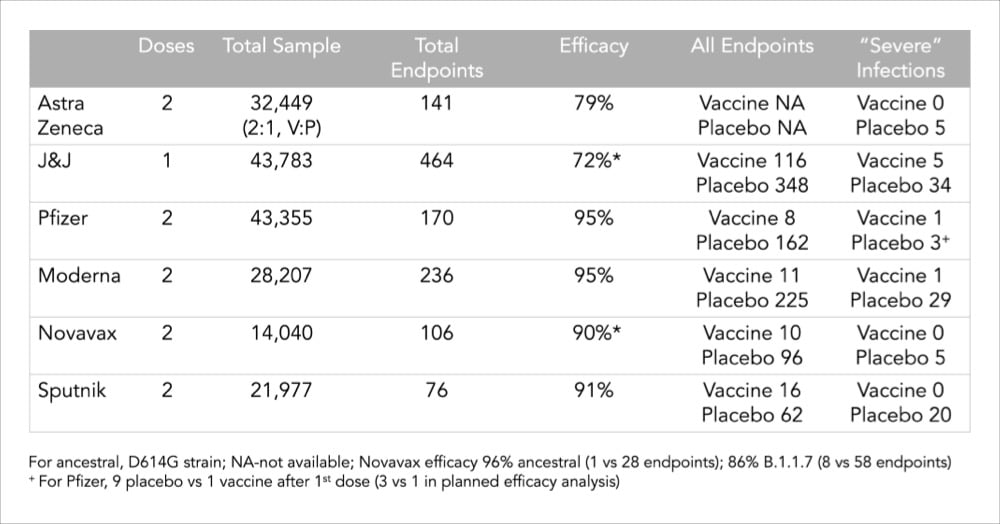
Related to my post from last month about what a 95% or 66% efficacy rate of a vaccine even means, Vox made a clear and concise video about why comparing vaccine efficacy rates is difficult — trials were done in different countries with different variants under different conditions with different levels of disease — and why protection against severe illness, hospitalization and death is a better way to compare and evaluate these vaccines. As this chart from Dr. Eric Topol shows, all of the major vaccines show strong protection against severe illness.
I thought this interview with Dr. Ashish K. Jha, dean of the Brown University School of Public Health, was really good and useful in terms of calibrating expectations with regard to the “end” of the pandemic, vaccines, and variants. On the guidance that vaccinated people should be getting:
I think it is essential that we give guidance to people. And I think we should give guidance to people on what they can do safely once they are vaccinated. People say, “Can your behavior change?” My answer is: absolutely! That’s a major motivation for getting vaccinated. First of all, what’s very clear to me is vaccinated people hanging out with other vaccinated people is pretty darn close to normal. You don’t have to wear a mask. You can share a meal. The chance that a fully vaccinated person will transmit the virus to another fully vaccinated person who then will get sick and die … I mean, sure, people get struck by lightning, too. But you don’t make policy based on that. And we need to remind people that there is a huge benefit to getting vaccinated, which is that you are safe enough to do the things you love with other vaccinated people.
After getting his second dose of the Covid-19 vaccine at a clinic at Berkshire Community College, Yo-Yo Ma got out his cello and performed a 15-minute impromptu concert for the others folks at the clinic.
When Ma had first visited the clinic for his first shot, he did so quietly, taking in the surroundings, staff said. But brought his cello when he returned for the second shot.
Staff described how a hush fell across the clinic as Ma began to play. “It was so weird how peaceful the whole building became, just having a little bit of music in the background,” said Leslie Drager, the lead clinical manager for the vaccination site, according to the Washington Post.
Why is it weird? Music is amazing. I know you could never get such a “frivolous” spending measure through an American deliberative body these days, but how awesome would it be for the government to commission out-of-work musicians to play at vaccination clinics? Ok maybe you couldn’t have anyone sing and the brass & woodwinds would probably have to sit this one out, but you could have strings, guitars, percussion, pianos, DJs, etc. there to play some relaxing, uplifting, or energetic music, according to local custom & culture. Bring back the WPA!
According to a study conducted by the Pew Research Center, among those people who said they probably or definitely won’t get a Covid-19 vaccine, the top two reasons given were “concern about side effects” and “the vaccines were developed and tested too quickly”. For our purposes here, I’m going to ignore the first concern — the data is pretty conclusive that, on average, the vaccine side effects are minimal when compared to the effects of actually contracting Covid-19 — and focus on the quick development timeline. If you’re among those who are apprehensive about the unprecedented speed at which the world’s governments and scientific community mobilized to create several effective Covid-19 vaccines, I hope the following will help you make a good decision.
In reading a bunch of different resources (linked below throughout), I identified six main reasons why the Covid-19 vaccines were developed so quickly compared to past efforts.
1. The need was urgent. Covid-19 changed the entire world in a very short span of time and it was evident in the absence of an effective vaccine, tens of millions more people would unnecessarily die and/or suffer and the rest of us would be living in fear of disease and death. This urgency drove several of the other factors here: the availability of funding, resources, and collaboration.
2. Funding & focus. Companies and governments threw billions and billions of dollars at this. Companies, research centers, and scientists dropped other stuff they were working on to study SARS-CoV-2 and Covid-19. Governments prioritized regulatory approval for trials, etc. From a thread by Dr. Kat Arney:
Relatively few in the scientific, pharma & policy worlds care about vaccines compared w/ drugs. Most vaccine programmes are underfunded as they’re perceived as not profitable, only relevant to LMICs, & have few research groups/companies working on them. Getting funding & research capacity for vax usually takes months/years. COVID-19 vaccine was a massive global research effort w/ $millions for multiple groups/projects in weeks. Years of funding cycles & lab research happened in months, huge amount of time saved.
And from a presentation given by Dr. Anthony Fauci:
We proceeded at risk. So people say, what do you mean by “at risk”? Are you risking safety? Are you risking scientific integrity? No, it’s a financial risk. In other words, you invest in things that cost a lot of money before you even have an answer to whether the prior step worked.
And a classic example is the production of large scale amounts of clinical lots, which have been produced and are being produced before you even know that your vaccine works, so that you have hundreds of millions of doses ready to go. If the vaccine works, you’ve saved many months. If the vaccine doesn’t, you lost a lot of money, to the tune of hundreds of millions if not billions of dollars. But it was felt it was worth that investment and that risk financially in order to save time.
More on that here. As Dr. Faheem Younus put it, “We didn’t cut corners; we cut the crap!”
3. Availability of volunteers & high incidence of disease. In order to statistically show the vaccine works, you need people to test it on and you need enough people in the studies to get sick. Kat Arney again:
To show vax effectiveness, you need a high number of people with the disease in the population — big problem with the Ebola vax is that it took so long to develop the outbreak was over & the couldn’t get enough numbers to conclusively show it worked
We’re in a global pandemic — the vaccine is being tested in places with very high community prevalence, so trials can hit pre-determined statistical milestones very quickly. Huge amount of time saved.
Hundreds of thousands of people around the world volunteered to test these vaccines — without them, we’d be months and years away from a safe, tested vaccine.
4. International & corporate collaboration. Countries and companies shared research, data, and resources because the primary goal was to develop effective vaccines and save lives, not make a profit. For instance, Chinese researchers posted the genome for SARS-CoV-2 on January 11, 2020, allowing the effort to develop a vaccine to begin.
5. We knew a lot about coronaviruses from previous work. This wasn’t an effort that started from scratch. From Bloomberg:
The Pfizer-BioNTech and Moderna vaccines may seem brand new, but they are the culmination of more than a decade of work that started during the SARS and MERS outbreaks. Vaccines were even developed against MERS but were never needed. Nevertheless, scientists learned a huge amount from working with that virus, which is from the same family as the one that causes Covid-19.
From Dr. Habibul Ahsan:
Really, most of the vaccine platform development work is already done. You just have to do the remaining part, which is adding the right viral antigens to the already-proven platform and making sure it’s safe and effective in humans. Even in just the last five to 10 years, we’ve made big leaps in developing new kinds of vaccine platforms like those being tested for SARS-CoV-2.
6. Scientific and technological capability. Ok, we know a lot about coronaviruses but humanity’s general scientific and technological abilities have never been stronger or more powerful. Again from Bloomberg:
Remember also that technology has evolved rapidly — for example, we’re now about able to sequence the genomes of every mutant version of the virus in less than a day. That helps in speeding up vaccine development.
Dr. Mark Toshner sums up the effort:
However we have collectively now shown that with money no object, some clever and highly motivated people, an unlimited pool of altruistic volunteers, and sensible regulators that we can do amazing things.
Further reading: The lightning-fast quest for COVID vaccines — and what it means for other diseases (Nature), How were researchers able to develop COVID-19 vaccines so quickly? (Univ. of Chicago), The race for the COVID-19 vaccine: A story of innovation and collaboration (Carnall Farrar), COVID-19 vaccines: development, evaluation, approval and monitoring (European Medicines Agency).
For reasons I do not quite understand, I just spent the better part of an hour reading two oral histories of March 11, 2020, aka the day the United States finally took the Covid-19 pandemic seriously — this one from Wired published back in April 2020 and this one published today by Buzzfeed News. You may not want to relive that day and everything it’s come to signify, but apparently I did. (See also a Twitter search for “year ago today” and Covid One Year Ago.)
Several things happened on 3/11 that made Americans and their government finally realize that our lives were about to significantly change: the stock market plunged, the NBA suspended its season after a player tested positive, the WHO called it a “pandemic” for the first time, Trump addressed the nation and announced a ban on travel from Europe, and Tom Hanks & Rita Wilson announced that they had tested positive for the virus.
Claudia Sahm: Frankly, the night before, the 10th, I was in a bit of a panic because I was worried that I was overreacting. It was like gaslighting the way Trump and Republicans and Fox News would talk about the coronavirus. Like, “We’ve got this one, it’s not a big deal. It’s like the common flu.” Listening to that, I was saying, “We need to get going.” Congress needs to do real things. That morning, I stood in front of the House Democrats at the minority whip breakfast and told them what they needed to do with a relief package. I told the House Democrats that the $8.3 billion package that they had passed the week before was an insult.
DANIEL MERTZLUFFT, director of Ratatouille: The TikTok Musical, who was then in a Broadway theater audience: In the three hours I was seeing Company, the world had changed. I went to drinks after work with friends, one of whom is a business owner that works in theater marketing, and I remember him arriving at the bar and sort of realizing for the first time what it must have been like on the day the Great Depression started. What he said was, “This is not a month; this is going to be months. My business no longer exists. I have to fire my entire team.”
The Trump, Hanks, and NBA news all hit within a period of 30 minutes — I vividly remember being on Twitter and texting w/ friends as the news rolled in that evening. I’d stocked up on food & such during the last week in February and had been fully convinced the day before by this video on the exponential growth of epidemics that this was going to be a world-changing event, but the pace of events that evening was unprecedentedly dizzying. (via the morning news)
Stat’s Andrew Joseph and Helen Branswell on the short-term, middle-term, and long-term future of the coronavirus in the US. The short-term outlook is dominated by vaccination & variants; some parts of the country will continue to be affected by outbreaks:
Conditions may be ripe for a better summer, however. Vaccine supplies should be flowing more freely, at least in the U.S.; the Biden administration now expects enough vaccine doses in hand for all adults by the end of May. With most vulnerable populations protected, there should be fewer hospitalizations and deaths. And with warmer weather, people can return to outdoor life.
Widespread transmission of the virus could be replaced by more sporadic and localized outbreaks. There’s also growing evidence that vaccines don’t just protect people from getting symptomatic Covid-19, but can reduce transmission.
And in the long-term, well, SARS-CoV-2 will be around for years and even decades to come:
Years from now, SARS-CoV-2 could join the ranks of OC43, 229E, NL63, and HKU1 — the four endemic, seasonal coronaviruses that cause a chunk of common colds every year. Essentially, our immune systems — primed by vaccines, boosters, and previous encounters with the coronavirus — will be ready to knock back SARS-2 when we see it again, potentially blocking an infection or leading to one that causes no symptoms or maybe just the sniffles.
It’s good to read stuff like this — it provides a basis to use when calibrating your optimism or pessimism for future activities and desires.
After the Biden administration announced they will have enough Covid-19 vaccine supply to cover every single adult in the country by the end of May, I got to wondering about what they were going to do with the tens & hundreds of millions of surplus doses already procured for the remainder of the year. “Oh,” I thought, naively, “We’ll be able to distribute it to countries that can’t easily procure or manufacture vaccines of their own!” And I’m sure some of that will happen, if only for PR purposes. But it’s perhaps more likely that America will practice vaccine diplomacy and use the stockpile to reestablish its global leadership.
The United States has backed away from the world. This isn’t a Clinton thing or a W Bush thing or an Obama thing or a Trump thing or a Biden thing, but instead a United States thing. The American people lost interest in playing a constructive role in the world three decades ago, and America’s political leadership has molded itself around that fact. Trump may have been instinctually and publicly hostile to all things international, but Biden is only different in tone. Biden’s Buy-American program is actually more anti-globalization than Trump’s America-First rhetoric as it is an express violation of most of America’s international trade commitments. TeamBiden says it wants to reestablish America’s global leadership…but it plans to do so without any troops or money. Sorry, but that’s not how it works.
Which makes the possibilities for vaccine diplomacy wildly interesting. The United States has no responsibility to provide COVID vaccines to the world. It can — it will — distribute them, but it will want something in return.
Even if you disagree with some of the analysis here, it will be interesting to watch where America’s stockpile ends up. Given Biden’s rhetoric of “listening to the science” when it comes to the pandemic, I hope that at least some of that supply goes to places that need it most to make certain the pandemic doesn’t sputter on for years, generating potentially dangerous new variants, even if it’s politically disadvantageous.
Update: Countries now scrambling for COVID-19 vaccines may soon have surpluses to donate by Jon Cohen and Kai Kupferschmidt for Science magazine:
Like three dozen other countries, the United States contracted with multiple vaccine companies for several times the number of doses needed to cover its population. No one knew at the time which, if any, of the candidate vaccines would work or when they might prove safe and effective. But by now, most of the prepurchased vaccines appear to offer solid protection — which means many countries will receive far more vaccine than they need. The excess doses the United States alone may have by July would vaccinate at least 200 million people.
A chart in the article notes that the US has procured enough vaccine to cover almost 1.5 billion people after fully vaccinating its entire population.
Zeynep Tufekci has written an important piece for The Atlantic on the mistakes that the media, public health officials, and the public keep making during the pandemic and how we can learn from them. A big one for me is how scientists & other public health officials and agencies communicate their knowledge to the public and how the media interprets and amplifies those messages.
Thus, on January 14, 2020, the WHO stated that there was “no clear evidence of human-to-human transmission.” It should have said, “There is increasing likelihood that human-to-human transmission is taking place, but we haven’t yet proven this, because we have no access to Wuhan, China.” (Cases were already popping up around the world at that point.) Acting as if there was human-to-human transmission during the early weeks of the pandemic would have been wise and preventive.
Later that spring, WHO officials stated that there was “currently no evidence that people who have recovered from COVID-19 and have antibodies are protected from a second infection,” producing many articles laden with panic and despair. Instead, it should have said: “We expect the immune system to function against this virus, and to provide some immunity for some period of time, but it is still hard to know specifics because it is so early.”
Similarly, since the vaccines were announced, too many statements have emphasized that we don’t yet know if vaccines prevent transmission. Instead, public-health authorities should have said that we have many reasons to expect, and increasing amounts of data to suggest, that vaccines will blunt infectiousness, but that we’re waiting for additional data to be more precise about it. That’s been unfortunate, because while many, many things have gone wrong during this pandemic, the vaccines are one thing that has gone very, very right.
This pair of statements she highlights — “no clear evidence of human-to-human transmission” and “There is increasing likelihood that human-to-human transmission is taking place, but we haven’t yet proven this, because we have no access to Wuhan, China” — are both factually true but the second statement is so much more helpful, useful, and far less likely to be misinterpreted by people who aren’t scientists that making the first statement is almost negligent.
A film crew from the NY Times recently spent several days in the Covid-19 ICU in Arizona, at the time one of the hardest hit places in the world. Two of the nurses wore GoPro cameras while working to witness what they did on a daily basis — the 12-hour days, the grief, the care, the constant death. This video is incredible and incredibly difficult to watch — you actually see a patient die on camera, surrounded by nurses and family (virtually).
So many Americans have died in hospitals without family by their side, but they were not alone. Nurses brush patients’ teeth, change their catheters and hold their hands in their final moments.
At the beginning of the video, one of the nurses says, “Unless you’re actually in there, you have no idea.” Thanks to their willingness to share their experiences, now we at least have some idea.
Update: Vox talked to some ICU doctors about what it’s like for their patients when they die from Covid-19. Because of patient confidentiality and the contagious nature of the disease, society (and even the families) has been “protected and sheltered from seeing the worst of this disease”.
Imagine trying to breathe through a very narrow straw, says Jess Mandel, chief of pulmonary, critical care, and sleep medicine at UC San Diego Health. “You can do that for 15 to 20 seconds, but try doing it for two hours.” Or for days or weeks.
Patients struggling through low oxygen levels like this have told Kenneth Remy, an assistant professor of critical care medicine at Washington University School of Medicine in St. Louis, that it feels like a band across their chest or that their lungs are on fire. Or like a thousand bees stinging them inside their chest. Others might have thick secretions in their lungs that make it feel like they are trying to breathe through muck. Many people say it feels like they’re being smothered.
The ordeal is so taxing that many wish for death. “You hear the patients say, ‘I just want to die because this is so excruciating,’” Remy says. “That’s what this virus does.”
Newer posts
Older posts





Socials & More