kottke.org posts about Covid-19
In The Atlantic, epidemiologists Julia Marcus and Gregg Gonsalves explain why public health officials are not being hypocritical in their support of the antiracism protests around the country.
At its core, the argument being leveled against public-health experts is that the reason for the protests shouldn’t matter. The coronavirus doesn’t care whether it’s attending an anti-lockdown protest or an anti-racism one. But these two kinds of protests are not equivalent from a public-health perspective. Some critics might argue that the anti-lockdown protests promoted economic activity, which can help stave off the health implications of poverty. (On this count, public-health experts were ahead of the curve: Many — including one of us — were advocating for a massive infusion of assistance to individual Americans as early as March.) But these protests were organized by pro-gun groups that believe the National Rifle Association is too compromising on gun safety. Egged on by the president to “save your great 2nd Amendment,” anti-lockdown protesters stormed government buildings with assault rifles and signs reading COVID-19 IS A LIE. The anti-lockdown demonstrations were explicitly at odds with public health, and experts had a duty to oppose them. The current protests, in contrast, are a grassroots uprising against systemic racism, a pervasive and long-standing public-health crisis that leads to more than 80,000 excess deaths among black Americans every year.
If “conservative commentators” cared at all about keeping people safe from Covid-19 infection, they would have denounced the I-Need-A-Haircut protests as reckless and they didn’t. Instead, they engage in these bad faith arguments that are just designed to stir up outrage.
Gonsalves wrote a thread on Twitter a few days ago that’s relevant here as well.
The risk to all of us was inflamed by an absolute decision at the highest levels that this epidemic was not worth an all-out, coordinated, comprehensive national mobilization. It took weeks for the President to even agree that the epidemic wouldn’t go away on its own.
The US, the richest nation in the world, then couldn’t get it together to scale-up the number of tests we needed to understand what was going on in our communities with SARS-COV-2, and in the end said it was up to the states to figure it all out.
And then this is the last word as far as I’m concerned:
We’ve all been put at far more jeopardy during this pandemic by our political leaders than by the people on the streets over the past week or so.
One of the countries with the best response to Covid-19 has been Iceland. The country didn’t lockdown nor do many people wear masks, but they have virtually eliminated the virus through a vigorous program of test, trace, and isolate that was coordinated by public-health authorities. Iceland’s numbers were high in the beginning (the virus was carried into the country from people returning from vacation) but they acted quickly and aggressively — Elizabeth Kolbert has the story for the New Yorker.
Möller pulled up a series of graphs and charts on her laptop. These showed that, per capita, Iceland had had more COVID-19 cases than any other Scandinavian country, and more than even Italy or Britain. There was an outbreak in a nursing home in the town of Bolungarvík, in northwestern Iceland, and one in the Westman Islands, an archipelago off the southern coast, which seemed to have started at a handball game. (In Europe, handball is a team sport that’s sort of a cross between basketball and soccer.)
“The numbers in the beginning were terrible,” Möller said. She attributed the country’s success in bringing the caseload down in part to having got an early start. The “trio,” along with officials from Iceland’s university hospital, had begun meeting back in January. “We saw what was going on in China,” she recalled. “We saw the pictures of people lying dead in emergency departments, even on the street. So it was obvious that something terrible was happening. And, of course, we didn’t know if it would spread to other countries. But we didn’t dare take the chance. So we started preparing.” For example, it was discovered that the country didn’t have enough protective gear for its health-care workers, so hospital officials immediately set about buying more.
The Atlantic’s Ed Yong interviewed several people who, like thousands of others around the world, have been experiencing symptoms of Covid-19 for months now, indicating that the disease is chronic for some. Thousands Who Got COVID-19 in March Are Still Sick:
I interviewed nine of them for this story, all of whom share commonalities. Most have never been admitted to an ICU or gone on a ventilator, so their cases technically count as “mild.” But their lives have nonetheless been flattened by relentless and rolling waves of symptoms that make it hard to concentrate, exercise, or perform simple physical tasks. Most are young. Most were previously fit and healthy. “It is mild relative to dying in a hospital, but this virus has ruined my life,” LeClerc said. “Even reading a book is challenging and exhausting. What small joys other people are experiencing in lockdown-yoga, bread baking-are beyond the realms of possibility for me.”
One of those who has been sick for months is Paul Garner, a professor of infectious diseases:
It “has been like nothing else on Earth,” said Paul Garner, who has previously endured dengue fever and malaria, and is currently on day 77 of COVID-19. Garner, an infectious-diseases professor at the Liverpool School of Tropical Medicine, leads a renowned organization that reviews scientific evidence on preventing and treating infections. He tested negative on day 63. He had waited to get a COVID-19 test partly to preserve them for health-care workers, and partly because, at one point, he thought he was going to die. “I knew I had the disease; it couldn’t have been anything else,” he told me. I asked him why he thought his symptoms had persisted. “I honestly don’t know,” he said. “I don’t understand what’s happening in my body.”
Garner wrote about his experience for BMJ.
The illness went on and on. The symptoms changed, it was like an advent calendar, every day there was a surprise, something new. A muggy head; acutely painful calf; upset stomach; tinnitus; pins and needles; aching all over; breathlessness; dizziness; arthritis in my hands; weird sensation in the skin with synthetic materials. Gentle exercise or walking made me worse — I would feel absolutely dreadful the next day. I started talking to others. I found a marathon runner who had tried 8 km in her second week, which caused her to collapse with rigors and sleep for 24 hours. I spoke to others experiencing weird symptoms, which were often discounted by those around them as anxiety, making them doubt themselves.
We still have no idea what the long-term effects of this disease are going to be. But it is definitely not the flu. And I remain unwilling to risk myself or my family getting it.
From an April 17th Facebook post by Paul Field, a succinct summary of how the pandemic exposes American deficiencies. It’s tough to not just quote the whole thing, so here’s the beginning:
Everyone is entitled to their own opinion, but you need to know how silly you look if you post some variation of, “Welcome to Socialism…”
You are not seeing Socialism. What you are seeing is one of the wealthiest, geographically advantaged, productive capitalist societies in the world flounder and fail at its most basic test. Taking care of its people.
This crisis is not about the virus.
This crisis is about the massive failure of our, “Booming economy,” to survive even modest challenges. It is about the market dissonance of shortages in stores, even as farmers/producers destroy unused crops and products. This crisis is about huge corporations needing an emergency bailout within days of the longest Bull Market in our history ending and despite the ability to borrow with zero percent interest rates.
The pandemic has revealed that American democracy and our economic system is extremely fragile. Ok, unless you’re wealthy, in which case you’re going to be fine, all part of the plan, etc.
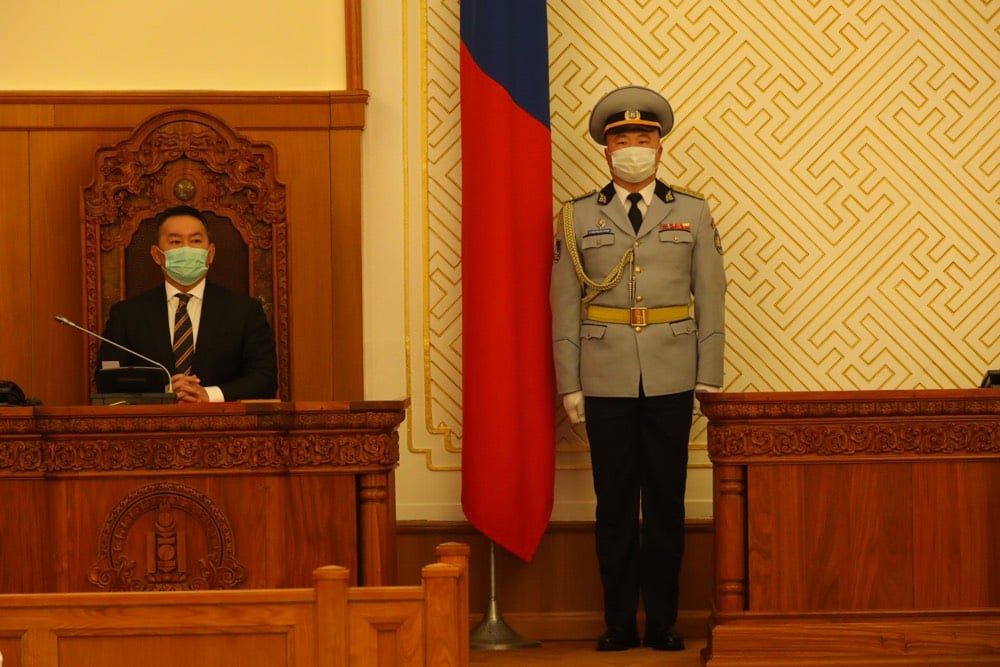
Several countries have had solid responses to the Covid-19 pandemic: Taiwan, South Korea, New Zealand, and Hong Kong. But Indi Samarajiva thinks we should be paying much more attention to Mongolia, a country of 3.17 million people where no one has died and no locally transmitted cases have been reported.1 Let’s have that again: 3.17 million people, 0 local cases, 0 deaths. How did they do it? They saw what was happening in Wuhan, coordinated with the WHO, and acted swiftly & decisively in January.
Imagine that you could go back in time to January 23rd with the horse race results and, I dunno, the new iPhone. People believe you. China has just shut down Hubei Province, the largest cordon sanitaire in human history. What would you scream to your leaders? What would you tell them to do?
You’d tell them that this was serious and that it’s coming for sure. You’d tell them to restrict the borders now, to socially distance now, and to get medical supplies ready, also now. You’d tell them to react right now, in January itself. That’s 20/20 hindsight.
That’s exactly what Mongolia did, and they don’t have a time machine. They just saw what was happening in Hubei, they coordinated with China and the WHO, and they got their shit together fast. That’s their secret, not the elevation. They just weren’t dumb.
When you go to World In Data’s Coronavirus Data Explorer and click on “Mongolia” to add their data to the graph, nothing happens because they have zero reported cases and zero deaths. They looked at the paradox of preparation — the idea that “when the best way to save lives is to prevent a disease rather than treat it, success often looks like an overreaction” — and said “sign us up for the overreacting!”
Throughout February, Mongolia was furiously getting ready - procuring face masks, test kits, and PPE; examining hospitals, food markets, and cleaning up the city. Still no reported cases. Still no let-up in readiness. No one was like “it’s not real!” or “burn the 5G towers!”
The country also suspended their New Year celebrations, which are a big deal in Asia. They deployed hundreds of people and restricted intercity travel to make sure, though the public seemed to broadly support the move.
Again — and I’ll keep saying this until March — there were still NO CASES. If you want to know how Mongolia ended up with no local cases, it’s because they reacted when there were no local cases. And they kept acting.
For example, when they heard of a case across the border (ie, not in Mongolia) South Gobi declared an emergency and put everyone in masks. The center also shut down coal exports — a huge economic hit, which they took proactively.
As you can see, at every turn they’re reacting like other countries only did when it was too late. This looked like an over-reaction, but in fact, Mongolia was always on time.
I have to tell you true: I got really upset reading this. Like crying and furious. The United States could have done this. Italy could have done this. Brazil could have done this. Sweden could have done this. England could have done this. Spain could have done this. Mongolia listened to the experts, acted quickly, and kept their people safe. Much of the rest of the world, especially the western world — the so-called first-world countries — failed to act quickly enough and hundreds of thousands of people have needlessly died and countless others have been left with chronic health issues, grief, and economic chaos.

That’s the front page of the NY Times today, listing the names of hundreds of the nearly 100,000 Americans who have died from Covid-19 (the full listing is of ~1000 names and continues inside the paper).

Here’s a more readable PDF version and an online version that scrolls and scrolls and scrolls. They compiled the list by going through obituaries from local newspapers from around the countries.
Putting 100,000 dots or stick figures on a page “doesn’t really tell you very much about who these people were, the lives that they lived, what it means for us as a country,” Ms. Landon said. So, she came up with the idea of compiling obituaries and death notices of Covid-19 victims from newspapers large and small across the country, and culling vivid passages from them.
Alain Delaquérière, a researcher, combed through various sources online for obituaries and death notices with Covid-19 written as the cause of death. He compiled a list of nearly a thousand names from hundreds of newspapers. A team of editors from across the newsroom, in addition to three graduate student journalists, read them and gleaned phrases that depicted the uniqueness of each life lost:
“Alan Lund, 81, Washington, conductor with ‘the most amazing ear’ … “
“Theresa Elloie, 63, New Orleans, renowned for her business making detailed pins and corsages … “
“Florencio Almazo Morán, 65, New York City, one-man army … “
“Coby Adolph, 44, Chicago, entrepreneur and adventurer … “
Every one of these names was a person with a whole life behind them and so much more to come. Each has a family and friends who are mourning them. Here are a few more of their names and short stories:
Romi Cohn, 91, New York City, saved 56 Jewish families from the Gestapo.
Jermaine Ferro, 77, Lee County, Fla., wife with little time to enjoy a new marriage.
Julian Anguiano-Maya, 51, Chicago, life of the party.
Alan Merrill, 69, New York City, songwriter of “I Love Rock ‘n’ Roll.”
Lakisha Willis White, 45, Orlando, Fla., was helping to raise some of her dozen grandchildren.
In the past five months, more Americans have died from Covid-19 than in the decade-plus of the Vietnam War and the death toll is a third of the number of Americans who died in World War II. When this is over (whatever that means), the one thing we cannot do is forget all of these people. And we owe to them to make this mean something.
As summer ramps up in North America, people are looking to get out to enjoy the weather while also trying to keep safe from Covid-19 infection. Here in Vermont, I am very much looking forward to swim hole season and have been wondering if swimming is a safe activity during the pandemic. The Atlantic’s Olga Khazan wrote about the difficulty of opening pools back up this summer:
The coronavirus can’t remain infectious in pool water, multiple experts assured me, but people who come to pools do not stay in the water the entire time. They get out, sit under the sun, and, if they’re like my neighbors, form a circle and drink a few illicit White Claws. Social-distancing guidelines are quickly forgotten.
“If someone is swimming laps, that would be pretty safe as long as they’re not spitting water everywhere,” says Angela Rasmussen, a virologist at Columbia University. “But a Las Vegas-type pool party, that would be less safe, because people are just hanging out and breathing on each other.”
This story by Christopher Reynolds in the LA Times focuses more on transmission via water (pool water, salt water, river/lake water).
“There is no data that somebody got infected this way [with coronavirus],” said professor Karin B. Michels, chair of UCLA’s Department of Epidemiology, in a recent interview.
“I can’t say it’s absolutely 100% zero risk, but I can tell you that it would never cross my mind to get COVID-19 from a swimming pool or the ocean,” said Paula Cannon, a professor of molecular microbiology and immunology at USC’s Keck School of Medicine. “It’s just extraordinarily unlikely that this would happen.”
As long as you keep your distance of course:
Rather than worry about coronavirus in water, UCLA’s Michels and USC’s Cannon said, swimmers should stay well separated and take care before and after entering the pool, lake, river or sea.
“I would be more concerned about touching the same lockers or surfaces in the changing room or on the benches outside the pool. Those are higher risk than the water itself,” Michels said. “The other thing is you have to maintain distance. … More distance is always better.”
Sorta related but not really: ten meters is definitely more distance.
After 2+ months of lockdown in most areas, a small minority of Americans want our country to go back to “normal” despite evidence and expert advice to the contrary. They want to get haircuts, not wear masks in public, go to crowded beaches, and generally go about their lives. These folks couch their desires in terms of freedom & liberty: the government has no right to infringe on the individual freedoms of its citizens.
But governments routinely do just that for all kinds of good reasons — e.g. you can’t murder someone just because you feel like it — and as Johns Hopkins’ public health historian Graham Mooney points out, there’s a precedent for a different way of thinking about freedom in the context of public health.
In response to these vehement appeals to individual freedom, public-health leaders in London, Liverpool, Manchester and elsewhere developed a powerful counterargument. They too framed their argument in terms of freedom — freedom from disease. To protect citizens’ right to be free from disease, in their view, governments and officials needed the authority to isolate those who were sick, vaccinate people, and take other steps to reduce the risk of infectious disease.
One of the most important reformers was George Buchanan, the chief medical officer for England from 1879 to 1892. He argued that cities and towns had the authority to take necessary steps to ensure the communal “sanitary welfare.” He and other reformers based their arguments on an idea developed by the 19th-century English philosopher John Stuart Mill, who is, ironically, remembered largely as a staunch defender of individual liberty. Mill articulated what he called the “harm principle,” which asserts that while individual liberty is sacrosanct, it should be limited when it will harm others: “The sole end for which mankind are warranted, individually or collectively, in interfering with the liberty and action of any of their number, is self-protection,” Mill wrote in On Liberty in 1859. Public-health reformers argued that the harm principle gave them the authority to pursue their aims.
An essay published in The Lancet in 1883 sums up this view nicely: “We cannot see that there is any undue violation of personal liberty in the sanitary authority acting for the whole community, requiring to be informed of the existence of diseases dangerous to others. A man’s liberty is not to involve risk to others,” the author wrote. “A man with smallpox has the natural liberty to travel in a cab or an omnibus; but society has a right that overrides his natural liberty, and says he shall not.”

Kate Burridge and Howard Manns recently wrote a piece about how the Covid-19 pandemic is changing the English language. It’s written from an Australian perspective, so some of the slang might be a bit hard to follow for Americans et al.
In these times of COVID-19, there are the usual suspects: shortenings like “sanny” (hand sanitizer) and “iso” (isolation), abbreviations like BCV (before corona virus) and WFH (working from home), also compounds “corona moaner” (the whingers) and “zoombombing” (the intrusion into a video conference).
Plenty of nouns have been “verbed” too — the toilet paper/pasta/tinned tomatoes have been “magpied”. Even rhyming slang has made a bit of a comeback with Miley Cyrus lending her name to the virus (already end-clipped to “the Miley”). Some combine more than one process — “the isodesk” (or is that “the isobar”) is where many of us are currently spending our days.
“I’ve got the Miley”…I’ve always been a fan of rhyming slang. Linguist Tony Thorne, who specializes in slang & jargon, has compiled a list of new language introduced to (and by) the general public because of the pandemic.
Quarantimes - a hashtag or label for the prevailing circumstances under lockdown due to the coronavirus pandemic
Rona, Lady Rona, roni, rone - the coronavirus personified/familiarised
Boomer remover - the coronavirus viewed as a phenomenon resulting in the decimation of the baby boomer demographic
Covidiot - a person behaving irresponsibly in conditions of containment
Doomscrolling/doomsurfing - obsessively accessing upsetting news online
Infits - outfits worn in conditions of confinement
Zoom mullet - a hairstyle developed in lockdown which is ‘camera-ready’ (presentable to a webcam) at front and sides and dishevelled at the rear
Covid waltz - manoeuvring to avoid close contact with passers-by while distance restrictions are in place
Apropos Couchella illustration by the awesome Gemma Correll. (via lera boroditsky)
Recent polling compiled by Randall Munroe indicates that Americans agree on what to do about the Covid-19 pandemic to a greater extent than they “feel positively about kittens” or even “enjoy apple pie”.
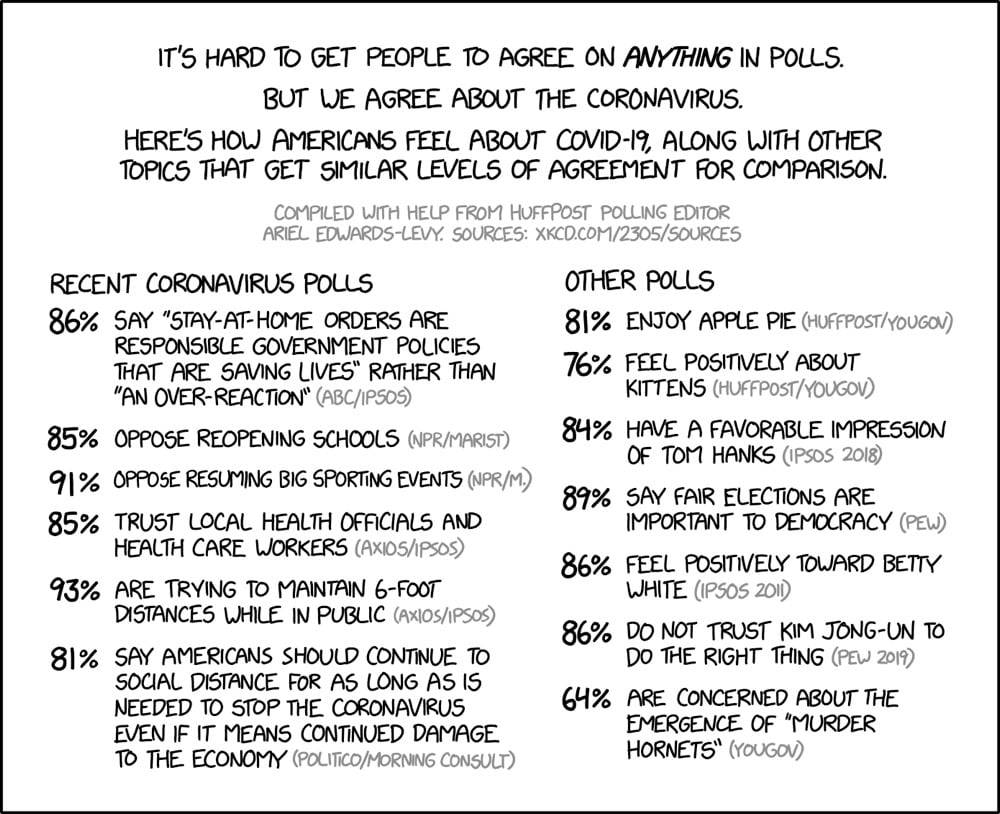
Here’s a list of his sources.
There are a lot of different lenses you can use to look at how the United States and its government have confronted the Covid-19 pandemic. Race is a particularly useful one. As a reminder, here’s America’s current operating racial contract (from an Atlantic piece by Adam Serwer):
The implied terms of the racial contract are visible everywhere for those willing to see them. A 12-year-old with a toy gun is a dangerous threat who must be met with lethal force; armed militias drawing beads on federal agents are heroes of liberty. Struggling white farmers in Iowa taking billions in federal assistance are hardworking Americans down on their luck; struggling single parents in cities using food stamps are welfare queens. Black Americans struggling in the cocaine epidemic are a “bio-underclass” created by a pathological culture; white Americans struggling with opioid addiction are a national tragedy. Poor European immigrants who flocked to an America with virtually no immigration restrictions came “the right way”; poor Central American immigrants evading a baroque and unforgiving system are gang members and terrorists.
Serwer goes on to argue that the recently shifting American response to the pandemic, primarily in conservative circles, is due to an increasing awareness of which groups are bearing the brunt of the crisis: black and Latino Americans.
That more and more Americans were dying was less important than who was dying.
The disease is now “infecting people who cannot afford to miss work or telecommute-grocery store employees, delivery drivers and construction workers,” The Washington Post reported. Air travel has largely shut down, and many of the new clusters are in nursing homes, jails and prisons, and factories tied to essential industries. Containing the outbreak was no longer a question of social responsibility, but of personal responsibility. From the White House podium, Surgeon General Jerome Adams told “communities of color” that “we need you to step up and help stop the spread.”
This is a response that America is quite comfortable with because it fits with our racial contract, under which Jim Crow never actually ended. The US isn’t the only place this is happening btw. Early on, Singapore was praised for its response to the pandemic, but their reliance on and mistreatment of an underclass of migrant workers caused a secondary surge in cases.
Singapore is a small city-state with a population of just under 6 million inhabitants. On a per capita basis, it’s the second-richest country in Asia.
But its economy relies heavily on young men from Bangladesh, India and other countries who work jobs in construction and manufacturing. Singapore has no minimum wage for foreign or domestic employees. The foreign workers’ salaries can be as low as US$250 per month, but a typical salary is $500 to $600 a month.
As some places in the United States and other countries are opening back up (some very prematurely), immunologist and biologist Dr. Erin Bromage has written a practical guide to the known Covid-19 risks and how to avoid them that’s based on recent scientific research. He begins:
It seems many people are breathing some relief, and I’m not sure why. An epidemic curve has a relatively predictable upslope and once the peak is reached, the back slope can also be predicted. We have robust data from the outbreaks in China and Italy, that shows the backside of the mortality curve declines slowly, with deaths persisting for months. Assuming we have just crested in deaths at 70k, it is possible that we lose another 70,000 people over the next 6 weeks as we come off that peak. That’s what’s going to happen with a lockdown.
As states reopen, and we give the virus more fuel, all bets are off. I understand the reasons for reopening the economy, but I’ve said before, if you don’t solve the biology, the economy won’t recover.
But since things are opening up anyway (whether epidemiologists like it or not), Bromage goes through a number of scenarios you might potentially find yourself in over the next few months and what the associated risks might be. His guiding principle is that infection is caused by exposure to the virus over time — increase the time or the exposure and your risk goes up. For example, public bathrooms might give you a ton of exposure to the virus over a relatively short period of time:
Bathrooms have a lot of high touch surfaces, door handles, faucets, stall doors. So fomite transfer risk in this environment can be high. We still do not know whether a person releases infectious material in feces or just fragmented virus, but we do know that toilet flushing does aerosolize many droplets. Treat public bathrooms with extra caution (surface and air), until we know more about the risk.
But being in the same room with another person simply breathing may not carry a large risk if you limit the time.
A single breath releases 50-5000 droplets. Most of these droplets are low velocity and fall to the ground quickly. There are even fewer droplets released through nose-breathing. Importantly, due to the lack of exhalation force with a breath, viral particles from the lower respiratory areas are not expelled.
But that time would drop sharply if the person is speaking:
Speaking increases the release of respiratory droplets about 10 fold; ~200 copies of virus per minute. Again, assuming every virus is inhaled, it would take ~5 minutes of speaking face-to-face to receive the required dose.
Again, this is all indoors. Being in enclosed spaces with other humans, particularly if they are poorly ventilated, is going to hold higher risks for the foreseeable future.
The reason to highlight these different outbreaks is to show you the commonality of outbreaks of COVID-19. All these infection events were indoors, with people closely-spaced, with lots of talking, singing, or yelling. The main sources for infection are home, workplace, public transport, social gatherings, and restaurants. This accounts for 90% of all transmission events. In contrast, outbreaks spread from shopping appear to be responsible for a small percentage of traced infections. (Ref)
Importantly, of the countries performing contact tracing properly, only a single outbreak has been reported from an outdoor environment (less than 0.3% of traced infections). (ref)
The Michael Pollan version of advice for socializing during the pandemic might be: Spend time with people, not too much, mostly masked and outdoors.
As someone who suspects I may have had a mild case of Covid-19 a couple of months ago, I’ve been thinking about getting tested for antibodies. But as this video from ProPublica shows, even really accurate tests may not actually tell you all that much.
And the thing is, the “do I have Covid-19 right now” tests are plagued by the same issue.
For patients getting tested, the main concern is how to interpret the outcome: If I test negative with an RT-PCR genetic test, what are the chances I actually have the virus? Or if I test positive with an antibody test, does it actually mean I have the antibodies?
It turns out that the answers to these questions don’t just hinge on the accuracy of the test. “Mathematically, the way that works out, that actually depends on how many people in your area have Covid,” Eleanor Murray, an assistant professor of epidemiology at the Boston University School of Public Health, said.
The rarer the disease in the population, the less you’ll learn by testing.
Let’s say we have a hypothetical Covid-19 test for antibodies that is both 99 percent sensitive — meaning almost all people with antibodies will test positive — and 99 percent specific, meaning almost all people who were never infected will yield a negative result.
If you test a group of 100 uninfected people, odds are one of them will still test positive even though they don’t have the virus. Conversely, if you test 100 people who were infected, it’s likely one of them will still test negative.
Now let’s presume the virus has a prevalence rate of 1 percent, so one person in 100 carries antibodies to it. If you test 100 random people and get a positive result, what is the chance that this person was truly infected?
Deborah Birx, the White House Covid-19 response coordinator, explained the answer at a press conference on April 20: “So if you have 1 percent of your population infected and you have a test that’s only 99 percent specific, that means that when you find a positive, 50 percent of the time will be a real positive and 50 percent of the time it won’t be.”
So even if I test positive for antibodies and I assume that confers immunity, given that the number of confirmed infections in Vermont is so low (~900 statewide), it doesn’t seem like I would be justified in changing my behavior at all. I would still have to act as though I’ve never had the virus, both for my own health and the health of those around me. Maybe if I had two or three corroborating tests could I be more certain…
From Nature’s David Cyranoski, a piece that takes a look at what the latest research says about SARS-CoV-2, where it came from, and how it is able to infect the human body. I’m going to highlight a few things from the article I thought were particularly interesting. As Cyranoski has done throughout, I’d like to stress that because this virus is so new to us and the situation is moving so quickly, many of these results are based on preliminary research, have been published in pre-print papers, and haven’t been peer-reviewed.
The first is about the detective work being done to trace where SARS-CoV-2 came from and how long it’s been in existence (possibly decades).
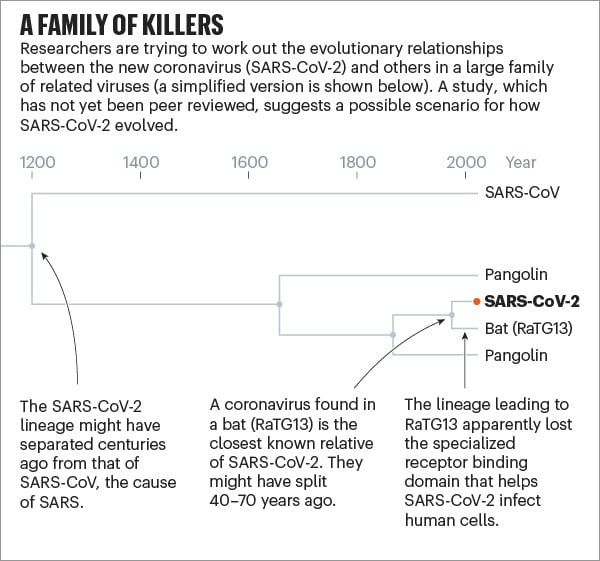
But studies released over the past few months, which have yet to be peer-reviewed, suggest that SARS-CoV-2 — or a very similar ancestor — has been hiding in some animal for decades. According to a paper posted online in March, the coronavirus lineage leading to SARS-CoV-2 split more than 140 years ago from the closely related one seen today in pangolins. Then, sometime in the past 40-70 years, the ancestors of SARS-CoV-2 separated from the bat version, which subsequently lost the effective receptor binding domain that was present in its ancestors (and remains in SARS-CoV-2). A study published on 21 April came up with very similar findings using a different dating method.
The section on how the virus acts in the body is particularly interesting because it attempts to explain the unusual and varying behaviors SARS-CoV-2 exhibits and causes in different parts of the human body. For example, SARS-CoV-2, unusually, can initially infect two places in the body: the throat and lungs.
Having these two infection points means that SARS-CoV-2 can mix the transmissibility of the common cold coronaviruses with the lethality of MERS-CoV and SARS-CoV. “It is an unfortunate and dangerous combination of this coronavirus strain,” he says.
The virus’s ability to infect and actively reproduce in the upper respiratory tract was something of a surprise, given that its close genetic relative, SARS-CoV, lacks that ability. Last month, Wendtner published results of experiments in which his team was able to culture virus from the throats of nine people with COVID-19, showing that the virus is actively reproducing and infectious there. That explains a crucial difference between the close relatives. SARS-CoV-2 can shed viral particles from the throat into saliva even before symptoms start, and these can then pass easily from person to person. SARS-CoV was much less effective at making that jump, passing only when symptoms were full-blown, making it easier to contain.
These differences have led to some confusion about the lethality of SARS-CoV-2. Some experts and media reports describe it as less deadly than SARS-CoV because it kills about 1% of the people it infects, whereas SARS-CoV killed at roughly ten times that rate. But Perlman says that’s the wrong way to look at it. SARS-CoV-2 is much better at infecting people, but many of the infections don’t progress to the lungs. “Once it gets down in the lungs, it’s probably just as deadly,” he says.
And this is a somewhat hopeful speculation on one of the many possible ways the Covid-19 pandemic could go:
“By far the most likely scenario is that the virus will continue to spread and infect most of the world population in a relatively short period of time,” says Stöhr, meaning one to two years. “Afterwards, the virus will continue to spread in the human population, likely forever.” Like the four generally mild human coronaviruses, SARS-CoV-2 would then circulate constantly and cause mainly mild upper respiratory tract infections, says Stöhr. For that reason, he adds, vaccines won’t be necessary.
Some previous studies support this argument. One showed that when people were inoculated with the common-cold coronavirus 229E, their antibody levels peaked two weeks later and were only slightly raised after a year. That did not prevent infections a year later, but subsequent infections led to few, if any, symptoms and a shorter period of viral shedding.
The OC43 coronavirus offers a model for where this pandemic might go. That virus also gives humans common colds, but genetic research from the University of Leuven in Belgium suggests that OC43 might have been a killer in the past.
But then, from a few paragraphs down:
People like to think that “the other coronaviruses were terrible and became mild”, says Perlman. “That’s an optimistic way to think about what’s going on now, but we don’t have evidence.”
For now, it’s just another thing we don’t know about this virus we learned about only 5 months ago. It’s a long road ahead, but I’m thankful that so many scientists are bent on making sense of it all.
This short description by Jay Rosen accurately describes the Trump administration’s plan for dealing with the Covid-19 pandemic.
The plan is to have no plan, to let daily deaths between one and three thousand become a normal thing, and then to create massive confusion about who is responsible — by telling the governors they’re in charge without doing what only the federal government can do, by fighting with the press when it shows up to be briefed, by fixing blame for the virus on China or some other foreign element, and by “flooding the zone with shit,” Steve Bannon’s phrase for overwhelming the system with disinformation, distraction, and denial, which boosts what economists call “search costs” for reliable intelligence.
Stated another way, the plan is to default on public problem solving, and then prevent the public from understanding the consequences of that default. To succeed this will require one of the biggest propaganda and freedom of information fights in U.S. history, the execution of which will, I think, consume the president’s re-election campaign.
While his actions often have complex effects, Trump has never been a complicated person. This “plan” fits with what we know about Trump’s personality & behavior, plays to his strengths by relying on reactions & tactics and not strategy, is consistent with Occam’s razor, allows his administration to continue pursuing his aggressive agenda (restricting immigration, strengthening big business, weakening public institutions, enriching himself, consolidating power, getting re-elected), and whips his base into a frenzy. As Dave Eggers put it in a satirical opinion piece for the NY Times:
Having no plan is the plan! Haven’t you been listening? Plans are for commies and the Danish. Here we do it fast and loose and dumb and wrong, and occasionally we have a man who manufactures pillows come to the White House to show the president encouraging texts. It all works! Eighteen months, 800,000 deaths, no plan, states bidding against states for medicine and equipment, you’re on your own, plans are lame.
There’s no galaxy brain here, only a twitchy muscle attached to a frayed nerve.
Newer posts
Older posts




Socials & More