Details are finally starting to trickle out about how various iOS apps use the address book data on your phone. The Verge and Venture Beat both have good article on the subject. What they’re finding is nowhere near the 13/15 ratio that Dustin Curtis reported last week but Curtis has also said:
Second, for obvious reasons, I promised the developers I reached out to that I would never reveal who they are. Many of them have, since last week, changed their practices.
What I like about The Verge and VB articles is that they both end with Apple’s role in all this. In a future release, Apple should make sure that rogue parties can’t do stuff like this. If you’re going to have a store where every app has to be approved for the good of the end users and the integrity of the system, this is *exactly* the type of thing they should be concerned with.
Update: Insider did some digging as well.
Yesterday, developer Arun Thampi noticed that the Path iPhone app uploads a user’s address book to their server without asking the user first. And by address book, I mean all the phone numbers and addresses and email addresses of everyone in your phone’s address book just gets sent off to Path. And not only that, Path stored that information on its server. To their credit, Path apologized and deleted the data from their server.
But this is a larger problem than just Path. In a post from earlier today, Dustin Curtis reveals the dirty little secret of iPhone developers everywhere.
It’s not really a secret, per se, but there’s a quiet understanding among many iOS app developers that it is acceptable to send a user’s entire address book, without their permission, to remote servers and then store it for future reference. It’s common practice, and many companies likely have your address book stored in their database. Obviously, there are lots of awesome things apps can do with this data to vastly improve user experience. But it is also a breach of trust and an invasion of privacy.
I did a quick survey of 15 developers of popular iOS apps, and 13 of them told me they have a contacts database with millons of records. One company’s database has Mark Zuckerberg’s cell phone number, Larry Ellison’s home phone number and Bill Gates’ cell phone number. This data is not meant to be public, and people have an expectation of privacy with respect to their contacts.
13 out of 15! Zuckerberg’s cell phone number! Maybe I’m being old-fashioned here, but this seems unequivocally wrong. Any app, from Angry Birds to Fart App 3000, can just grab the information in your address book without asking? Hell. No. And Curtis is right in calling Apple out about this…apps should not have access to address book information without explicitly asking. But now that the horse is out of the barn, this “quiet understanding” needs to be met with some noisy investigation. What happened to Path needs to happen to all the other apps that are storing our data. There’s an opportunity here for some enterprising data journalist to follow Thampi’s lead: investigate what other apps are grabbing address book data and then ask the responsible developers the same questions that were put to Path.
Update: I am aware of this very confusing display of data from the Wall Street Journal. It indicates that of the ~50 iPhone apps surveyed, only three (Angry Birds, Facebook, and TextPlus 4) transmit address book data to a server. That’s not exactly the widespread problem that Curtis describes (the data sets are likely different)…it would be nice to see the net cast a bit wider.
Update: Oh, and that WSJ survey is two years old. (thx, @marcprecipice)
Speaking of Apple, here’s a profile of Jerry Manock, who worked for Apple from 1977 to 1984 and designed the case for the Apple II and helped design the Macintosh. Manock was Jobs’ first Jony Ive.
The whole basis of the class I’ve taught at UVM for 21 years is … integrated product development, which means concurrently looking at all of these things: the aesthetics, the engineering, the marketing … which is what we were doing at Apple. Not necessarily purposefully, but everybody was just thrown together… I would walk through the software place and look around and see what people were doing … walk through the marketing area. I had my drawings all on the walls, so anybody could come up. There was a red pencil hanging there. I’d say, “If you see something you don’t like, or is a problem — I don’t care whether it’s a janitor or Steve — write the correction, circle it, put your phone there and I’ll call you and we’ll talk about it.”
(thx, mike)
I take this to mean that any iPhone app can download your address book to their servers? What. The. Hell! Apple?
Upon inspecting closer, I noticed that my entire address book (including full names, emails and phone numbers) was being sent as a plist to Path. Now I don’t remember having given permission to Path to access my address book and send its contents to its servers, so I created a completely new “Path” and repeated the experiment and I got the same result - my address book was in Path’s hands.
Amazon is somewhat of an unusual company for American investors because it focuses on the long-term (10- 20-year timelines) instead of the short-term (quarterly earnings).
“If everything you do needs to work on a three-year time horizon, then you’re competing against a lot of people,” Mr. Bezos told reporter Steve Levy last month in an interview in Wired. “But if you’re willing to invest on a seven-year time horizon, you’re now competing against a fraction of those people, because very few companies are willing to do that. Just by lengthening the time horizon, you can engage in endeavors that you could never otherwise pursue. At Amazon we like things to work in five to seven years. We’re willing to plant seeds, let them grow-and we’re very stubborn.”
Like Apple, Amazon is one of those large market cap growth stocks that investors don’t really know what to do with. Both stocks are still undervalued compared to much of the rest of the market, IMO.
Gothamist has some photos of the new Apple Store in NYC’s Grand Central Terminal.
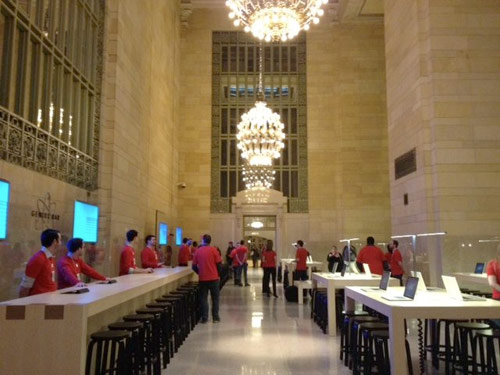
The company was obviously under tight constraints as to what they could do with the store (they would have loved to encase the whole thing in plexiglass probably), but from the looks of things, they did a marvelous job. There’s so little styling — the whole store is just tables and screens mostly — that it looks like the Apple Store not only belongs there, but that it’s been there forever, like Grand Central was designed with the Apple Store in mind. If you walk around Grand Central, not a lot of the other retail locations can say that, if any. (photo by katie sokoler)
Steve Silberman has a nice piece on Susan Kare, the woman who designed the original icons for the Macintosh, including a never-before-seen look at her initial sketches for some of them.
Inspired by the collaborative intelligence of her fellow software designers, Kare stayed on at Apple to craft the navigational elements for Mac’s GUI. Because an application for designing icons on screen hadn’t been coded yet, she went to the University Art supply store in Palo Alto and picked up a $2.50 sketchbook so she could begin playing around with forms and ideas. In the pages of this sketchbook, which hardly anyone but Kare has seen before now*, she created the casual prototypes of a new, radically user-friendly face of computing - each square of graph paper representing a pixel on the screen.
Riffing off of a short observation I sent him, John Gruber speculates about what an Apple TV ecosystem might look like.
Why not the same thing [as Newsstand] for TV channels? We’re seeing the beginnings of this, with iPhone and iPad apps like HBO Go, Watch ESPN, and the aforementioned Bloomberg TV+. Letting each TV network do their own app allows them the flexibility that writing software provides. News networks can combine their written and video news into an integrated layout. Networks with contractual obligations to cable operators, like HBO and ESPN, can write code that requires users to log in to verify their status as an eligible subscriber.
This smells right to me…it’s a very Apple-y way of approaching the TV/movie problem. Rather than fight with the studios and networks over content sold through the iTunes Store (where the studios control the licensing rights), just provide a platform (iPhone + iPad + iTV + App Store) controlled by Apple and if the studios/networks want to reach those customers, they need to provide an app…with Apple taking a 30% cut of the App *and* content sales.
James Higgs wrote a provocative piece on something that I’ve noticed recently as well: the two sides to Apple’s design aesthetic. On the one hand:
[Apple’s] devices have become increasingly simple and pared down, even as the power contained in them has increased. There is very little, if anything, extraneous on the Magic Trackpad or the MacBook Air. And of course the iPhones 4 and 4S are radically simple, yet well-constructed masterpieces of industrial design.
Yet, when it comes to stuff that isn’t hardware:
But no one laughs when Apple delivers a calendar application for the iPad that tries its hardest to look like a real-word desktop calendar pad, complete with fake leather and “torn” pages.
Still fewer have a chuckle when they see the new Address Book app on Mac OS X Lion, or the even more recent Find My Friends iPhone app.
These apps, and many more besides, all stem from a completely different, and I would say opposite aesthetic sensibility than the plain devices they run on.
They are an expression of purest kitsch, sentimentality, and ornamentation for its own sake. In Milan Kundera’s brilliant definition, kitsch is “the absolute denial of shit”. These are Disney-like apps, sinister in their mendacity.
This isn’t a recent thing either…look at the cheeseball themes and transitions in Keynote (many of them used by Jobs in his keynotes), some of the default system fonts, the emphasis in past keynotes on things like Mail.app themes, etc. Without too much effort, you could pull together many design examples from their currently shipping software that make it appear as though Apple doesn’t have a good aesthetic sense of design at all. But then you look at the general aesthetics of OSX and iOS…I don’t know, it’s really confusing how the same company, especially one that had such strong design leadership, could produce something as beautifully spare as iOS and something as cheesy as the Game Center app. (via ★thefoxisblack)
Dan Lyons posted the notes of a long conversation he had with Steve Wozniak last week. Lots of Apple history and prehistory…I didn’t know, for instance, that Woz designed the Apple I before Jobs was involved.
I was highly regarded for my engineering skills. But I never wanted money. I would have been a bad person to run a company. I wanted to be a nice guy. I wanted to make friends with everybody. Yes I came up with the idea for the personal computer but I don’t want to be known as a guy who changed the world. I want to be known as an engineer who connected chips in a really efficient way or wrote code that is unbelievable. I want to be known as a great engineer. I’m thankful Steve Jobs was there. You need someone who has a spirit for the marketplace. Who has the spirit for who computers change humanity. I didn’t design the Apple II for a company. I designed it for myself, to show off. I look at all the recent Apple products, like the iPhone, the iPad, and even Pixar, and it was like everything Steve worked on had to be perfect. Because it was him. Every product he created was Steve Jobs.
And Woz is *still* an Apple employee! He makes $100 a week. (via stellar)
I am incredibly sad this morning. Why am I, why are we, feeling this so intensely? I have some thoughts about that but not for now. For now, I’m just going to share some of the things I’ve been reading and watching about Jobs. And after that, I think I’m done here for the day and will move on to spend some time building my little thing that I’m trying to make insanely great.
The 2005 Stanford Commencement Speech. For me, the speech is better in text than in video.
Your time is limited, so don’t waste it living someone else’s life. Don’t be trapped by dogma - which is living with the results of other people’s thinking. Don’t let the noise of others’ opinions drown out your own inner voice. And most important, have the courage to follow your heart and intuition. They somehow already know what you truly want to become. Everything else is secondary.
The iPhone announcement in 2007. I am with Dan Frommer on this one: this is Jobs at his absolute best. He was just so so excited about this thing that he and his team had created, so proud. His presentation is also a reminder of how revolutionary the iPhone was four years ago.
Part two is here.
Here’s to the crazy ones… Here’s a version of the famous Think Different commercial narrated by Steve Jobs…it never aired on TV.
Compare to the aired version with Richard Dreyfuss narrating.
Steven Levy on Jobs. Levy covered Apple and Jobs extensively for many years; his obit is a good one.
Jobs usually had little interest in public self-analysis, but every so often he’d drop a clue to what made him tick. Once he recalled for me some of the long summers of his youth. I’m a big believer in boredom,” he told me. Boredom allows one to indulge in curiosity, he explained, and “out of curiosity comes everything.” The man who popularized personal computers and smartphones — machines that would draw our attention like a flame attracts gnats — worried about the future of boredom. “All the [technology] stuff is wonderful, but having nothing to do can be wonderful, too.”
Steve Jobs’ grass-stained shoes. Damn you Gruber for making me tear up like that.
I like to think that in the run-up to his final keynote, Steve made time for a long, peaceful walk. Somewhere beautiful, where there are no footpaths and the grass grows thick. Hand-in-hand with his wife and family, the sun warm on their backs, smiles on their faces, love in their hearts, at peace with their fate.
Steve Jobs rainbow over Pixar. What does it mean?
Moments after news broke about Steve Jobs’ death, a rainbow popped out of the Pixar campus (taken with my iPhone 4). Rest in peace, Steve, and thank you.
Jobs testing Photo Booth filters. Perhaps these aren’t the best photos ever taken of Steve Jobs, but they are among my favorites.
Walt Mossberg remembers his friend. Among journalists, few knew Jobs as well as Mossberg; he shares his stories and tribute here.
I have no way of knowing how Steve talked to his team during Apple’s darkest days in 1997 and 1998, when the company was on the brink and he was forced to turn to archrival Microsoft for a rescue. He certainly had a nasty, mercurial side to him, and I expect that, then and later, it emerged inside the company and in dealings with partners and vendors, who tell believable stories about how hard he was to deal with.
But I can honestly say that, in my many conversations with him, the dominant tone he struck was optimism and certainty, both for Apple and for the digital revolution as a whole. Even when he was telling me about his struggles to get the music industry to let him sell digital songs, or griping about competitors, at least in my presence, his tone was always marked by patience and a long-term view. This may have been for my benefit, knowing that I was a journalist, but it was striking nonetheless.
At times in our conversations, when I would criticize the decisions of record labels or phone carriers, he’d surprise me by forcefully disagreeing, explaining how the world looked from their point of view, how hard their jobs were in a time of digital disruption, and how they would come around.
This quality was on display when Apple opened its first retail store. It happened to be in the Washington, D.C., suburbs, near my home. He conducted a press tour for journalists, as proud of the store as a father is of his first child. I commented that, surely, there’d only be a few stores, and asked what Apple knew about retailing.
He looked at me like I was crazy, said there’d be many, many stores, and that the company had spent a year tweaking the layout of the stores, using a mockup at a secret location. I teased him by asking if he, personally, despite his hard duties as CEO, had approved tiny details like the translucency of the glass and the color of the wood.
He said he had, of course.
4 Steve. Loved this tweet:
From now on, the “4S” is going to stand for, “For Steve.” #apple
Dada. Oh and this one from Neven Mrgan too:
Heartwarming/breaking: shortly following the news of Steve’s death, our daughter called me “dada” for the first time. It goes on.
The Computer That Changed My Life. Bryce Roberts shares the story of the first Apple computer he bought.
As I sat alone in my makeshift office in Sandy, UT I decided that I wanted to start fresh, all the way down to my operating system. It sounds funny now, but it was an important psychological move for me. I wanted the next level to look and feel different than what I’d experienced in the past in every possible way.
I fired up my Sony Viao and surfed over to Apple.com. I wasn’t an Apple fanboy. I’d never owned one of their machines. And that was the point.
I didn’t know if I would love it or even like it, but it was going to be different. And different was exactly how I wanted the next level to feel.
This is *exactly* why I bought an iBook in 2002 after a lifetime of Windows/DOS machines.
Statement from Bill Gates. It really says something about a person when once-bitter rivals become friends later in life.
For those of us lucky enough to get to work with him, it’s been an insanely great honor. I will miss Steve immensely.
Apple’s homepage. Pitch-perfect tribute. Archive here.
Brian Lam apologies to Steve Jobs for being an asshole. If you followed the whole Gizmodo/iPhone thing, this is worth a read.
I was on sabbatical when Jason got his hands on the iPhone prototype.
An hour after the story went live, the phone rang and the number was from Apple HQ. I figured it was someone from the PR team. It was not.
“Hi, this is Steve. I really want my phone back.”
He wasn’t demanding. He was asking. And he was charming and he was funny. I was half-naked, just getting back from surfing, but I managed to keep my shit together.
And from the kottke.org archives, the 60+ posts I’ve made over the years about Jobs.
A common reaction to Apple’s announcement of the iPhone 4S yesterday was disappointment…Mat Honan’s post at Gizmodo for instance.
I was hoping for something bold and interesting looking. The iPhone 4 was just that when it shipped. So too were the original iPhone and the iPhone 3G. If I’m going to buy a new phone, of course I want it to look new. Because of course we care about having novel designs. If we didn’t we’d all be lugging around some 10-inch thick brick with a 12 day battery life.
Mat’s is an understandable reaction. After I upgraded my iPhone, Macbook Pro, and OS X all at once two years ago, I wrote about Apple’s upgrade problem:
From a superficial perspective, my old MBP and new MBP felt exactly the same…same OS, same desktop wallpaper, same Dock, all my same files in their same folders, etc. Same deal with the iPhone except moreso…the iPhone is almost entirely software and that was nearly identical. And re: Snow Leopard, I haven’t noticed any changes at all aside from the aforementioned absent plug-ins.
So, just having paid thousands of dollars for new hardware and software, I have what feels like my same old stuff.
Deep down, when I stop to think about it, I know (or have otherwise convinced myself) that these purchases were worth it and that Apple’s ease of upgrade works almost exactly how it should. But my gut tells me that I’ve been ripped off. The “newness” cognitive jolt humans get is almost entirely absent.
For me, yesterday’s event, Apple’s continued success in innovation *and* business, and the recent CEO change provided a different perspective: that Apple makes two very complementary types of products and we should be excited about both types.
The first type of product is the most familiar and is exemplified by Steve Jobs: Apple makes magical products that shape entire industries and modify social structures in significant ways. These are the bold strokes that combine technology with design in a way that’s almost artistic: Apple II, Macintosh, iPod, iPhone, and iPad. When they were introduced, these products were new and exciting and no one quite knew where those products were going to take us (Apple included). That’s what people want to see when they go to Apple events: Steve Jobs holding up a rainbow-hued unicorn that you can purchase for your very own.
The second type of product is less noticed and perhaps is best exemplified by Apple’s new CEO, Tim Cook: identify products and services that work, continually refine them, innovate at the margins (the addition of Siri to the iPhone 4S is a good example of this), build interconnecting ecosystems around them, and put processes and infrastructure in place to produce ever more of these items at lower cost and higher profit. The wheel has been invented; now we’ll perfect it. This is where Apple is at with the iPhone now, a conceptually solved problem: people know what they are, what they’re used for, and Apple’s gonna knuckle down and crank out ever better/faster/smarter versions of them in the future. Many of Apple’s current products are like this, better than they have ever been, more popular than they have ever been, but there’s nothing magical about them anymore: iPhone 4S, iPod, OS X, iMacs, Macbooks, etc.
The exciting thing about this second type of product, for investors and consumers alike, is Apple is now expert at capturing their lightning in a bottle. ‘Twas not always so…Apple wasn’t able to properly capitalize on the success of the Macintosh and it almost killed the company. What Tim Cook ultimately held up at Apple’s event yesterday is a promise: there won’t be a return to the Apple of the 1990s, when the mighty Macintosh devolved into a flaky, slow, and (adding insult to injury) expensive klunker and they couldn’t decide on a future direction for their operating system (remember Copland?). There will be an iPhone 5 in the future and it will be better than the iPhone 4S in significant & meaningful ways but it will also *just work*. And while that might be a bit boring to Apple event watchers, this interconnected web of products is the thing that makes the continued development of the new and magical products possible.





Socials & More