kottke.org posts about 2016 election
Neil Halloran, creator of the excellent Fallen of World War II interactive visualization of the casualties of WWII, is working on a similar visualization about the possible effects of a global nuclear conflict. He recently uploaded an in-progress video of the project with a special 2016 election message at the end. Amazing and scary to see how much of a difference WWII made in the global death rate and how minuscule that would be in comparison to a global nuclear war.
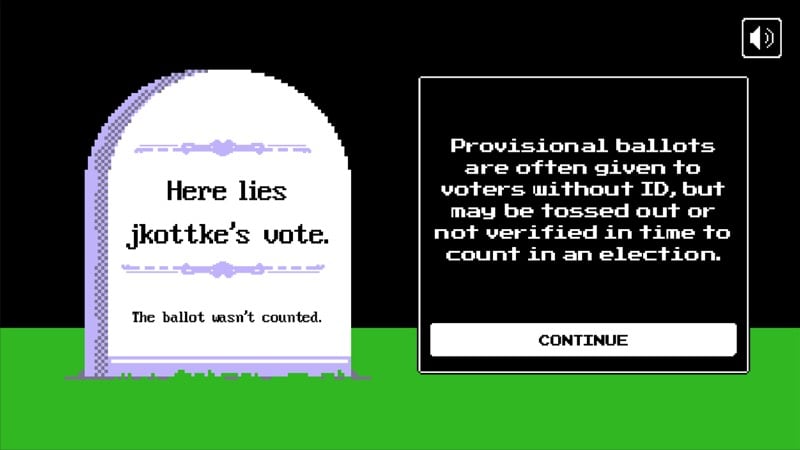
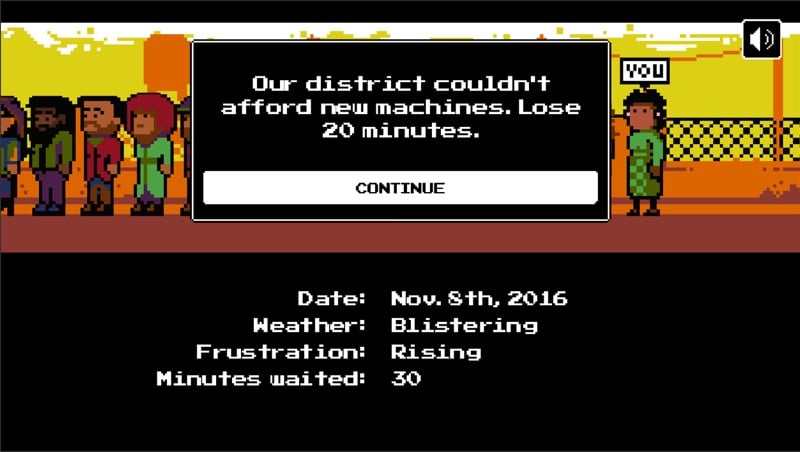
The NY Times has released their first video game editorial in the form of an Oregon Trail spin-off by GOP Arcade highlighting how the Republican Party engages in voter suppression tactics, especially in areas with many voters of color. In the game, you can play as a white programmer from California, a Latina nurse from Texas, or a black salesman from Wisconsin. As might expect, it takes somewhat longer to finish the game as some of these players versus others.
On Nov. 8, a new generation of Americans will make their own heroic journeys — to the polls. Some paths will be more intrepid than others, particularly for blacks, Latinos and pretty much anyone who brings the kind of diversity to our polling places that they have historically lacked. Thanks to laws passed by Republicans to fight the nonexistent threat of voter fraud, the perils will be great. Long lines and voter ID laws, not to mention pro-Trump election observers, will try to keep these voters from the polls.
More on voter suppression at Vox.
In a short essay from Literary Hub titled New York is a Book Conservatives Should Read, Rebecca Solnit writes an open letter to Donald Trump urging him to take some lessons from the city in which he lives. Solnit argues that Trump’s wealth has insulated him from experiencing one of the true pleasures of American cities like New York: energetic and meaningful diversity.
You treat Muslims like dangerous outsiders but you seem ignorant of the fact that the town you claim to live in has about 285 mosques, and somewhere between 400,00 and 800,000 Muslims, according to New York’s wonderful religious scholar Tony Carnes. That means one out of ten or one out of twenty New Yorkers are practitioners of the Islamic faith. A handful of Muslims, including the Orlando mass murderer, who was born in Queens, have done bad things, but when you recognize how many Muslims there are, you can stop demonizing millions for the acts of a few.
NYC is only one-third white and is home to hundreds of thousands of Muslims and Jews and millions of blacks, Latinos, and Asians.
Speaking of African-Americans: have you ever been to Harlem or the Bronx? You keep talking about black people like you’ve never met any or visited any black neighborhoods. Seriously, during that last debate you said, “Our inner cities are a disaster. You get shot walking to the store. They have no education. They have no jobs. I will do more for African-Americans and Latinos than she can ever do in ten lifetimes. All she’s done is talk to the African-Americans and to the Latinos.” Dude, seriously? Did you get this sense of things from watching TV-in 1975?
Solnit wrote the piece after compiling her most recent book, Nonstop Metropolis: A New York City Atlas.
Bringing together the insights of dozens of experts — from linguists to music historians, ethnographers, urbanists, and environmental journalists — amplified by cartographers, artists, and photographers, it explores all five boroughs of New York City and parts of nearby New Jersey. We are invited to travel through Manhattan’s playgrounds, from polyglot Queens to many-faceted Brooklyn, and from the resilient Bronx to the mystical kung fu hip-hop mecca of Staten Island.
This NY Times piece on the political inclinations of rural areas vs cities is an interesting companion to Solnit’s letter.
“There is something really kind of strange and interesting about the connection between peoples’ preferences — what they view as the good life, where they want to live — and their partisanship,” said Jonathan Rodden, a political scientist at Stanford. His precinct-level maps of presidential election results show deep blue in the densest, central parts of metropolitan areas, where you’d find the Main Streets, city halls, row homes and apartment buildings. The farther you travel from there, the redder the precincts become. And this is true whether you look around New York City or Terre Haute, Ind.
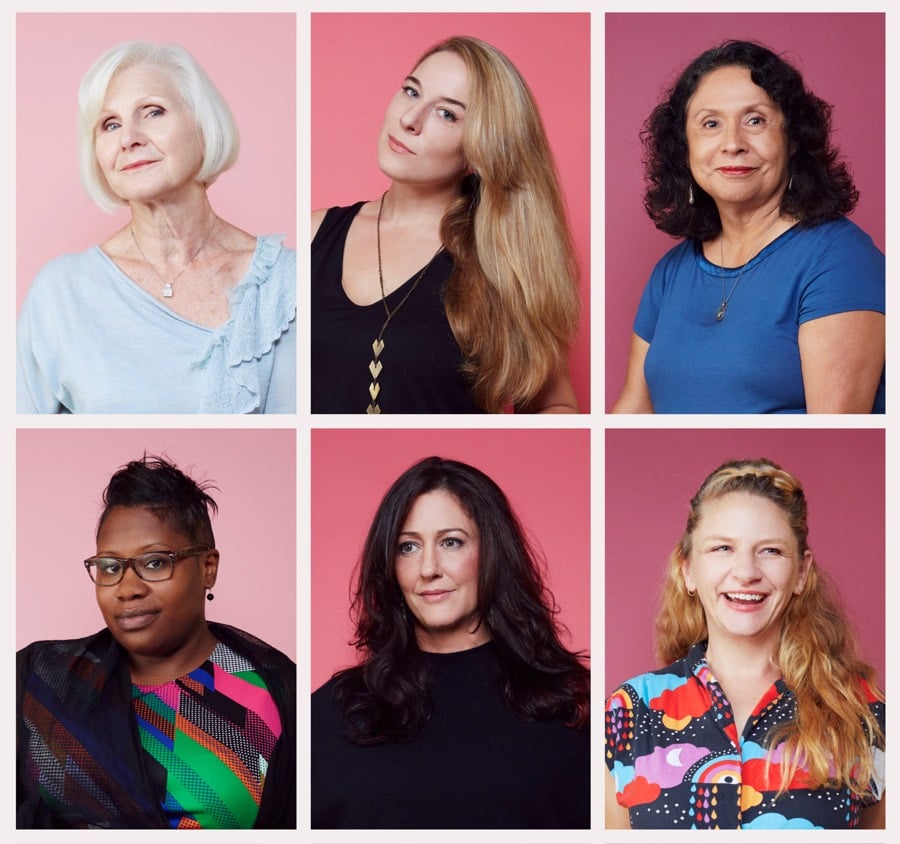
Photographer Helena Price, who you may recall from the Techies project earlier this year, has created a project called The Pussy Project about “women’s perspectives on the significance of this election and its ramifications on society.”. Photos of women are paired with each person’s thoughts on the election. Price explains how the project came about on Medium:
The name is a trigger for all of us. For many it represents the moment in the Trump campaign that incited so many women to finally get angry, get involved and speak out. That shift — the sudden activation of women across America to vocalize their feelings about this election — is what I set out to explore with this project.
Happy to see several women I know and admire interviewed for this…plus Jessica Hische did the logo and Maggie Mason edited the interviews.
On Conan last night, Louis C.K. had some things to say about the 2016 presidential election.
If you vote for Hillary you’re a grownup; if you vote for Trump you’re a sucker; if you don’t vote for anyone, you’re an asshole.
Last year, back when he was only one of more than a dozen GOP candidates, I discovered Citizen Kane was one of Donald Trump’s favorite movies via a video filmed by Errol Morris.
Trump acquits himself pretty well on Kane and its lessons — although I would not characterize Kane’s fall as “modest” — and his commentary about the film is probably the first actually interesting thing I have ever heard him say. But I watched all the way to the end and he shoots himself in the foot in the most Trumpian & misogynistic way — it’s actually perfect.
Spurred by a recent re-watch of Citizen Kane, Anthony Audi digs deeper into Trump’s misunderstanding of the film and finds that the course of Trump’s life has followed that of Charles Foster Kane.
He understands instinctively that by controlling the press, he can shape opinions on a mass scale — bending the truth as he sees fit. Over time, and through his marketing savvy, he develops a powerful media empire. Because that’s not enough, he then turns his sights to politics, running for New York governor as a stepping-stone to the White House. At campaign rallies, Kane gleefully brags about his poll numbers, and vows to lock up his opponent Jim Gettys, whom he condemns as an establishment tool. “Here’s one promise I’ll make,” he finally thunders. “My first official act as governor of the state will be to appoint a special district attorney to arrange for the indictment, prosecution, and conviction of “Boss” Jim W. Gettys!”
Kane never gets to fulfill that pledge. Instead, he loses the election-his campaign derailed by a last minute sex scandal. His editors know what to do, and the following day their headlines scream: “FRAUD AT POLLS!”
The piece is entitled Donald Trump Modeled His Life on Cinematic Loser Charles Foster Kane. Consciously or not, Trump does seem to be following Kane’s playbook here, right down to the fascism.
Specifically, Citizen Kane was a vision of what fascism might resemble in America. Both men knew better than to expect Hitler or Mussolini on our shores. They knew that our demagogue would be glossier, more entertaining-more American; and the man they conjured, inspired by real-life plutocrats like William Randolph Hearst, happened to look an awful lot like Donald Trump.
Read the whole thing…this is right up there with the best explainers of why Trump is the way he is. And part 2 is coming soon, an interview with Morris about Trump’s love of Kane.
Update: Audi’s interview with Morris was posted a couple of weeks before the election. Morris says Trump suffers from Irony Deficit Disorder.
Somehow he identifies clearly with Kane. Kane is Trump. And it’s not the kind of identification that I would make if I were Trump. Of course that issue — if I were Trump, what would I do, what would I think, what would I say? — it’s one of those counterfactuals I’m probably not equipped to address. But, if I were Donald Trump, I would not want to emphasize that connection with Kane. You know, a megalomaniac in love with power and crushing everything in his path. The inability to have friends, the inability to find love. The moral that Trump takes from Kane — I mean, it’s one of the great lines that I recorded. I ask, “Do you have any advice for Charles Foster Kane, sir?” You know, let’s get down to the psychiatric intervention. How can we help this poor man? He’s obviously troubled. How can we help him? Donald, help me out here!
And Donald says, “My advice to Charles Foster Kane is find another woman!” And you know, I thought, is that really the message that Welles was trying to convey? That Kane had made poor sexual choices, poor marriage choices?
As a chaser to the last post, here’s Hillary Clinton’s latest campaign commercial. This is right up there with the best political ads I’ve seen. Obama’s words are taken from his speech to the Congressional Black Caucus last month.
Our work’s not done. But if we are going to advance the cause of justice, and equality, and prosperity, and freedom, then we also have to acknowledge that even if we eliminated every restriction on voters, we would still have one of the lowest voting rates among free peoples. That’s not good, that is on us.
And I am reminded of all those folks who had to count bubbles in a bar of soap, beaten trying to register voters in Mississippi. Risked everything so that they could pull that lever. So, if I hear anybody saying their vote does not matter, that it doesn’t matter who we elect, read up on your history. It matters. We’ve got to get people to vote.
In fact, if you want to give Michelle and me a good sendoff, and that was a beautiful video, but don’t just watch us walk off into the sunset now, get people registered to vote. If you care about our legacy, realize everything we stand for is at stake, on the progress we have made is at stake in this election.
My name may not be on the ballot, but our progress is on the ballot. Tolerance is on the ballot. Democracy is on the ballot. Justice is on the ballot. Good schools are on the ballot. Ending mass incarceration, that’s on the ballot right now.
I am soooo tired of this election and this stupid, lying, racist, sexist, bullying predator of a candidate and the memes but this Arrested Development-style fact-checking of Donald Trump is really pretty good and right in my wheelhouse. I am terrible at following my own advice.
In the late 1980s, five black and Latino teenagers were wrongly convicted of raping a woman jogging in Central Park. The Central Park Five is a documentary film directed by Ken Burns, Sarah Burns, and David McMahon which tells the story from the perspective of the those five teens. I’ve seen the film, it’s excellent, and it’s currently available to watch for free on the PBS website.
The five men and this terrific miscarriage of justice are back in the news because of Donald Trump. In 1989, just a few weeks after the attack in Central Park, Trump took out a full-page ad in the Daily News denouncing the crime and the teens in which he calls for bringing back the death penalty.
Perhaps he thought it gave him gravitas, that spring, to weigh in on the character of the teen-agers in the park: “How can our great society tolerate the continued brutalization of its citizens by crazed misfits? Criminals must be told that their CIVIL LIBERTIES END WHEN AN ATTACK ON OUR SAFETY BEGINS!”
When NYC finally settled with the wrongly convicted men in 2014, Trump denounced the settlement, joining a police detective in calling it “the heist of the century.” And just before Trump’s crowing about sexual assault of women broke over the weekend, Trump reaffirmed that despite all evidence to the contrary, he believes that the five men are still guilty.
Frontline has posted their 2-hour documentary about Donald Trump, Hillary Clinton, and the 2016 presidential election to YouTube.
Hillary Clinton and Donald Trump are two of the most polarizing presidential candidates in modern history. Veteran FRONTLINE filmmaker Michael Kirk goes beyond the headlines to investigate what has shaped these two candidates, where they came from, how they lead and why they want one of the most difficult jobs imaginable.
This looks excellent…I might watch this instead of the debate tonight.1
When the story about Donald Trump bragging about sexually assaulting women broke, the NY Times took the unusual step of publishing exactly what the presidential candidate said.
In the three-minute recording, which was obtained by The Washington Post, Mr. Trump recounts to the television personality Billy Bush of “Access Hollywood” how he once pursued a married woman and “moved on her like a bitch, but I couldn’t get there,” expressing regret that they did not have sex. But he brags of a special status with women: Because he was “a star,” he says, he could “grab them by the pussy” whenever he wanted.
“You can do anything,” Mr. Trump says.
He also said he was compulsively drawn to kissing beautiful women “like a magnet” — “I don’t even wait” — and talked about plotting to seduce the married woman by taking her furniture shopping. Mr. Trump, who was 59 at the time he made the remarks, went on to disparage the woman, whom he did not name, saying, “I did try and fuck her. She was married,” and saying, “She’s now got the big phony tits and everything.”
It was unusual because of the Times’ policy of not printing profanity, even if the profane words themselves are newsworthy. In this case, the editors felt they had no choice but to print the actual words spoken by Trump.
In piece published earlier the same day the Trump story broke, Blake Eskin, who has been tracking the Times’ non-use of profanity at Fit to Print, highlights the racial and classist implications of the policy.
As I’ve noticed over the years while documenting how the Times writes around profanity, a lot of the expletives the Times avoids come up around race: in stories about hip-hop, professional sports, and police shootings. (I’m getting all the data into a spreadsheet so I can back up this assertion.)
The Times seems compelled both to tell readers that people curse in these contexts and to frown upon it.
It’s as if profanity is like a sack dance or a bat flip, a classless flourish that the archetypal Times reader, who is presumably white, can take vicarious pleasure in without having to perform it himself.
You cannot tell authentic stories about people who are systematically discriminated against in our society without using their actual words and the actual words spoken against them related to that discrimination. Full stop.
Update: Eskin wrote a follow-up about his data analysis of the NY Times profanity avoidance for Quartz.
The “other” category includes faux-folksy formulations such as “a word more pungent than ‘slop,’” and “a stronger version of the phrase ‘gol darn,’” as well as the straightforward, “He swore.” When I began the Fit to Print project, I could enjoy the cleverness of some of these contortions. But after reading through hundreds of examples over several years, expletive avoidance no longer strikes me as an interesting puzzle for a writer to solve. The policy just seems prissy, arbitrary, and delusional.
The more I think about the Times’ policy, the more absurd it becomes. There seems to be a relatively simple solution: if the profanity does work in the service of journalism — particularly if the entire article is about the profanity in question — print it. It is doesn’t, don’t. I mean, are Times editors afraid their reporters will start handing in articles with ledes like “Well, this fucking election is finally winding down, thank Christ.”?
In the latest issue of The Economist, President Obama wrote a letter about the “four crucial areas of unfinished business in economic policy” that his successor will have to deal with.
Wherever I go these days, at home or abroad, people ask me the same question: what is happening in the American political system? How has a country that has benefited-perhaps more than any other-from immigration, trade and technological innovation suddenly developed a strain of anti-immigrant, anti-innovation protectionism? Why have some on the far left and even more on the far right embraced a crude populism that promises a return to a past that is not possible to restore — and that, for most Americans, never existed at all?
It’s true that a certain anxiety over the forces of globalisation, immigration, technology, even change itself, has taken hold in America. It’s not new, nor is it dissimilar to a discontent spreading throughout the world, often manifested in scepticism towards international institutions, trade agreements and immigration. It can be seen in Britain’s recent vote to leave the European Union and the rise of populist parties around the world.
Much of this discontent is driven by fears that are not fundamentally economic. The anti-immigrant, anti-Mexican, anti-Muslim and anti-refugee sentiment expressed by some Americans today echoes nativist lurches of the past — the Alien and Sedition Acts of 1798, the Know-Nothings of the mid-1800s, the anti-Asian sentiment in the late 19th and early 20th centuries, and any number of eras in which Americans were told they could restore past glory if they just got some group or idea that was threatening America under control. We overcame those fears and we will again.
Look at Obama, busting out the Know-Nothings like it ain’t nothing.
Jeet Heer writing for The New Republic: Clinton Proved Trump Is a Man You Can Bait in a Debate.
In her acceptance speech at the Democratic convention, Hillary Clinton called out Donald Trump memorably, saying, “A man you can bait with a tweet is not a man we can trust with nuclear weapons.” The insight that Trump is easy to provoke formed the core of Clinton’s successful strategy in the first debate on Monday, as she repeatedly incited the Republican nominee to both adopt an off-putting aggressive tone and to make a series of damaging self-admissions.
This reminded me of poker player Annie Duke’s explanation of how she used the gender stereotypes of her male opponents against them.
I figured it was part of the game that if somebody was at the table who was so emotionally invested in the fact that I was a woman, that they could treat me that way, that probably, that person wasn’t going to make good decisions at the table against me. So I really tried to sort of separate that out and think about it from a strategic place of, how can I come up with the best strategy to take their money because I guess, in the end, isn’t that the best revenge?
Trump sounds like he’s a combination of the angry and disrespecting chauvinists:
VEDANTAM: She says she divided the men who had stereotypes about her into three categories.
DUKE: One was the flirting chauvinists, and that person was really viewing me in a way that was sexual.
VEDANTAM: With the guys who were like that, Annie could make nice.
DUKE: I never did go out on a date with any of them, but you know, it was kind of flirtatious at the table. And I could use that to my advantage.
VEDANTAM: And then there was the disrespecting chauvinist. Annie says these players thought women weren’t creative.
DUKE: There are strategies that you can use against them. Mainly, you can bluff those people a lot.
VEDANTAM: And then there’s a third kind of guy, perhaps the most reckless.
DUKE: The angry chauvinist.
VEDANTAM: This is a guy who would do anything to avoid being beaten by a woman. Annie says you can’t bluff an angry chauvinist. You just have to wait.
DUKE: What I say is, until they would impale themselves on your chips.
Although I suspect his chauvinism is only part of his poor debate showing…his insecurity is off the charts as well.
When you see how well it works for Donald Trump, do you ever think to yourself, “Oh, maybe I should be more racist”?
I loved this. If Galifianakis can’t get her to break, what hope does Trump have in the debates? Maybe this is part of her debate prep?
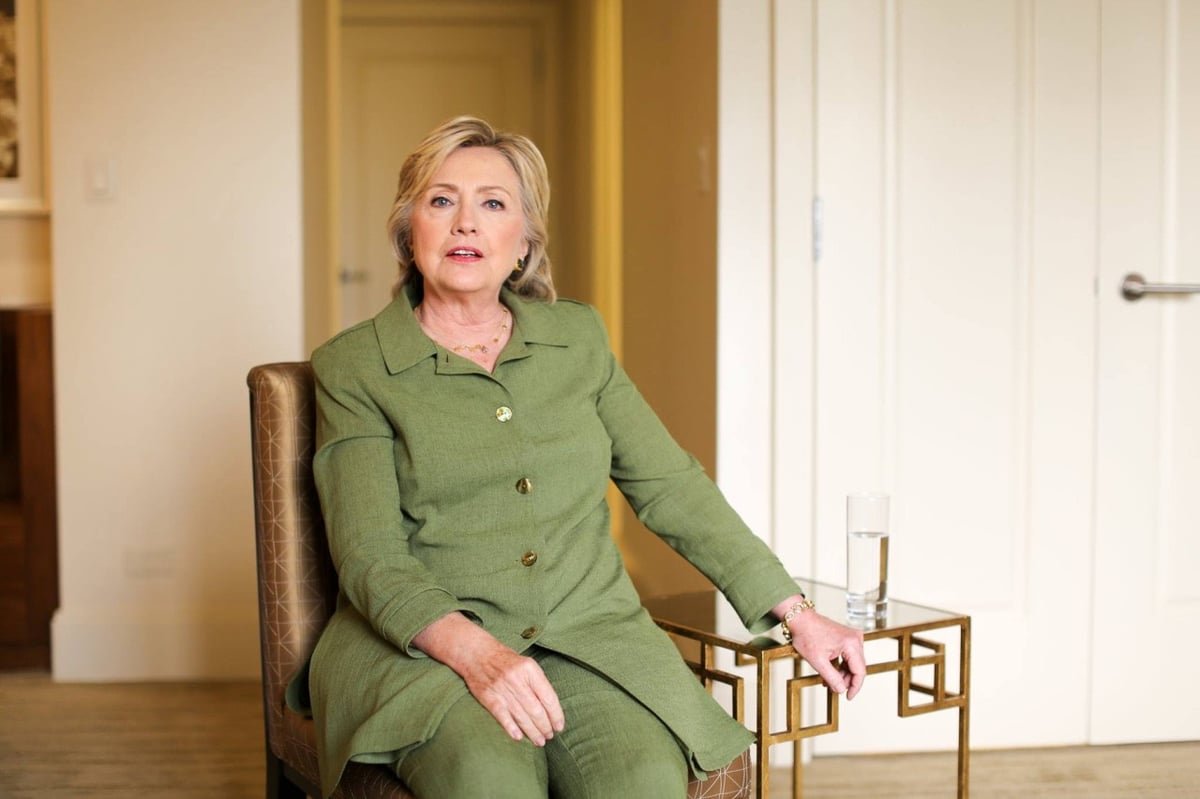
Humans of New York recently caught up with Hillary Clinton and she talked about how her public persona came to be.
I know that I can be perceived as aloof or cold or unemotional. But I had to learn as a young woman to control my emotions. And that’s a hard path to walk. Because you need to protect yourself, you need to keep steady, but at the same time you don’t want to seem ‘walled off.’ And sometimes I think I come across more in the ‘walled off’ arena. And if I create that perception, then I take responsibility. I don’t view myself as cold or unemotional. And neither do my friends. And neither does my family. But if that sometimes is the perception I create, then I can’t blame people for thinking that.
Clinton is just a different type of politician than her husband or Obama, for good reason.
Women are seen through a different lens. It’s not bad. It’s just a fact. It’s really quite funny. I’ll go to these events and there will be men speaking before me, and they’ll be pounding the message, and screaming about how we need to win the election. And people will love it. And I want to do the same thing. Because I care about this stuff. But I’ve learned that I can’t be quite so passionate in my presentation. I love to wave my arms, but apparently that’s a little bit scary to people. And I can’t yell too much. It comes across as ‘too loud’ or ‘too shrill’ or ‘too this’ or ‘too that.’ Which is funny, because I’m always convinced that the people in the front row are loving it.
When she says “it’s not bad,” that’s a perfect illustration of not being able to say exactly what you want how you want. A woman gets excited and she seems deranged or unhinged but a man gets excited and he’s seen as passionate? That seems bad to me.
P.S. Clinton is reading Elena Ferrante’s Neapolitan novels!
“You know what I have started reading and it’s just hypnotic is the Neapolitan novels by Elena Ferrante,” she tells Linsky, commenting on Ferrante’s intoxicating novels about female relationships in Naples, Italy that have an intense cult following. “I had to stop myself so I read the first one. I could not stop reading it or thinking about it.”
They’re the best fiction I’ve read in ages…so sad I’ve finished them all.
Newer posts
Older posts





Socials & More