



AIGA’s Design Annual for 2005
AIGA’s Design Annual for 2005. Lots of good work in there; I saw the book design winners on display in NYC last fall.

This site is made possible by member support. 💞
Big thanks to Arcustech for hosting the site and offering amazing tech support.
When you buy through links on kottke.org, I may earn an affiliate commission. Thanks for supporting the site!
kottke.org. home of fine hypertext products since 1998.
Beloved by 86.47% of the web.
AIGA’s Design Annual for 2005. Lots of good work in there; I saw the book design winners on display in NYC last fall.
Mark Bittman cooks homemade food in challenging America’s top chefs. Daniel Boulud laughed at the complexity of Bittman’s dish, but gave an 8/10 in taste…and it only took 10 minutes to prepare.
Audio of Malcolm Gladwell’s keynote from SXSW 2005 is available for streaming or download.
Is some of the music on Bush’s iPod stolen?. This is “exactly the kind of behavior the music industry characterizes as theft”.
While browsing the magazine section in the bookstore today, I heard a peculiar laugh. A few seconds later, a slightly different peculiar laugh but enough alike the first laugh for me to realize it was the same person. Then a few moments later, another odd laugh by the same person. And by odd and peculiar, I mean this person’s laughs were really pretty loud, obnoxious and disruptive in the quiet of the magazine-browsing space, like someone portraying a horrible laugher in a comedy skit. But whatever, she’s having fun with a witty friend or something.
After a couple more minutes, I turn to walk out of the magazine section and I catch the laugher in action and she’s cackling at something she’s listening to *on her headphones*. I just about throttled her.
An outline of Edward Tufte’s three books on information display.
Meetup is now requiring all groups to pay $19/month. Seems like this will kill off a bunch of the more casual groups.
Tiger, the new version of Apple’s OS X operating system, is out on April 29.
Housing price data from Consumer Reports; shows what’s overvalued and undervalued, etc..
Several news organizations, including the Associated Press, are supporting the bloggers in the Apple trade secrets case. This is an interesting development…the argument I’ve heard is that no newspaper would have run this story because there were trade secrets involved.
This biography of electricity — and of the men and women who had a hand in uncovering its inner workings — begins in the first moments after the Big Bang. Which is probably not where your high school textbook started its exploration of the subject, nor will you find many of the oftentimes surprising stories Bodanis uses to illustrate his tale.
The first mobile phone was developed in 1879? Thomas Edison, inventor of the light bulb, “had a vacuum where his conscience ought to be”? Alexander Graham Bell, in part, invented the telephone to impress a girl (well, acutally the girl’s parents)? Samuel Morse stole the telegraph from a guy named Joseph Henry and patented it, but not before he ran for mayor of New York City on an anti-black, anti-Jew, and, most especially, anti-Catholic platform? None of that was in my high school science textbook and such is the authority of the textbook that I have a hard time believing some of it. You’re thinking maybe Bodanis is embellishing for the sake of making a more exciting story (history + electricity? wake me when it’s over!), but then you get to the 50 pages of notes and further reading on the subject and realize he’s shooting straight and science is more strange, exciting, and sometime seedy than your teachers let on.
Interview with Bob Mankoff, New Yorker cartoon editor, on the humor research he’s doing at the U of Michigan. “It’s a 3-year research project with their psychology department, using New Yorker cartoons to see how people process humor.”
Good visual instructions on how to cut all types of food. “Good knife skills are a combination of knowledge and practice — the knowledge of which knives to use for which tasks, the knowledge of how to hold and move a knife, the knowledge of how various foods are structurally composed, and many other little bits of knowledge.”
The falling dollar and how the Asians are trying to keep it afloat.
Audio visual slideshow of photographer Sebastiao Salgado’s work.
Money Counter: visual comparisions of government funds spent on this versus that. The Whitewater/Lewinsky vs. 9/11 Commission comparison is especially, I don’t know, surprising? not surprising? maddening? ridiculous? disheartening?
Create the most infectious web meme and win big prizes in the Contagious Media Showdown.
On the Segway flop in the UK. Hasn’t been doing too hot in the US either.
The Man Date: can men meet for dinner instead of at a bar without feeling, like, completely queer about it?. The real question here is how did the reporter get all these guys to reveal their monumental insecurities to the NY Times? What a bunch of tools.
Express Train, photography taken in and around the NYC subway system.
Why Robert Rodriguez quit the Directors Guild to make Sin City. They wouldn’t allow Frank Miller, a first-time director and non-Guild member, to be Rodriguez’s co-director on the film.
Some interesting stats and observations about tipping. “Tipping is less prevalent in countries where unease about inequality is especially strong” and “drawing a smiley face on the check increases a waitress’s tips by 18 percent but decreases a waiter’s tips by 9 percent”.
Airlines are trying to cut down on people selling or trading their frequent flier miles for stuff like concert tickets. One traveller is “trying to sell ”an authentic envelope’ for $600 that also comes with two free round-trip tickets to anywhere in the continental United States.”
Two years ago, Stephen Dubner wrote an article for the NY Times Magazine on Steven Levitt, an economist with a knack for tackling odd sorts of problems. Last year, Dubner and Levitt collaborated on an article called What the Bagel Man Saw about the economic lessons gleaned from a man who’s been successfully selling bagels on the honor system in offices for more than 20 years. Now Levitt and Dubner are out with a new book called Freakonomics: A Rogue Economist Explores the Hidden Side of Nearly Everything, an overview of Levitt’s work and collaborations with other economists.
Dr. Levitt was kind enough to answer a few questions I had about the book:
jkottke: In Freakonomics, you state that you’re interested in applying economic tools to “more interesting” subjects than what one may have learned about in my high school economics class. What’s your definition of economics? Is it a tool set or a science or what?
Steven Levitt: I think of economics as a worldview, not a set of topics. This worldview has a few different pieces. First, incentives are paramount. If you understand someone’s incentives, you can do a pretty good job of predicting their behavior. Second, the appropriate data, analyzed the right way are key to understanding a problem. Finally, political correctness is irrelevant. Whatever the answer happens to be, whether you think it will be popular or not, that is the answer you put forth.
jkottke: Your talent for ignoring seemingly applicable but ultimately irrelevant information (not that different from a professional-grade batter taking cues from certain aspects of a pitcher’s mechanics and ignoring the extraneous ones in order to hit well), where does that come from? Good genes or was it all the books in your childhood home?
Levitt: If nothing else, I had an unusual home environment. My father is a medical researcher whose claim to fame is that he is the world’s expert on intestinal gas (he’s known as the King of Farts). My mother is a psychic who channels books. From an early age, my life was different from that of other kids. For instance, when I was in junior high, my father would wake me up at night to drill me with questions in hopes that I would be the star of the local high school quiz show.
jkottke: In looking at the world through data, you’ve investigated cheating schoolteachers, falling crime rates due to abortion, and the parallels between McDonald’s corporate structure and the inner workings of a crack-dealing gang. What’s the oddest or most surprising thing you’ve uncovered with this approach? Maybe something you still can’t quite believe or explain?
Levitt: It’s not the oddest result I’ve ever come up with, but there is one finding I have always puzzled over: when cities hire lots of Black cops, the arrest rates of Whites go up, but no more Blacks get arrested. When cities hire White cops, the opposite happens (more Black arrests, no more White arrests). It was an amazingly stark result, but I’m not quite sure what the right story is.
jkottke: In the chapter on the effect of abortion on crime rates, you and Stephen take care emphasizing what the data says and the strong views that people in the US hold on the issue of abortion. Still, if someone wants to twist your observations into something like “abortion is good because it lowers crime”, it’s not that difficult. Have your observations in this area caused any problems for you? Any extreme reactions?
Levitt: I have gotten a whole lot of hate mail on the abortion issue (as much from the left as from the right, amazingly). What I try to tell anyone who will listen — few people will listen when the subject is abortion — is that our findings on abortion and crime have almost nothing to say about public policy on abortion. If abortion is murder as pro-life advocates say, then a few thousand less homicides is nothing compared to abortion itself. If a woman’s right to choose is sacrosanct, then utilitarian arguments are inconsequential. Mainly, I think the results on abortion imply that we should do the best we can to try to make sure kids who are born are wanted and loved. And it turns out that is something just about everyone can agree on.
jkottke: In the book, you say “a slight tweak [in incentives] can produce drastic and unforseen results”. If you were the omnipotent leader of the US for a short time, what little tweak might you make to our political, cultural, or economic frameworks to make America better (if you can forgive the subjectivity of that word)?
Levitt: I would start by increasing the IRS budget ten-fold and doing a lot more tax audits. If everyone paid their taxes, tax rates could be much lower and otherwise honest people wouldn’t be tempted to cheat. For some reason, everyone hates the idea. But we can’t all be cheating more than average on our taxes. I think it would be for the better. And after I got done with that, I’d legalize sports betting, and I would also do away with most of the nonsense and hassle that currently goes into airport security.
jkottke: In the war between the film and music industries and their customers, there’s an argument over how much the explosive increase in Internet piracy affects sales of CDs, movie tickets, and DVDs. Using the same data, the music/movie industry argues that sales are down because of piracy (or at least diminished from what they “should” be in a piracy-free marketplace) while the other side argues that sales are up and that piracy may actually have a beneficial effect. The question of “how does piracy affect record/movie sales?” seems well suited to your particular application of economic tools. Have you looked at this question? And if not, do you have sense of which special view of the data might reveal an answer?
Levitt: I have not myself studied the issue. I have a former student who has studied this issue. Alejandro Zentner. He argues that music sales are way down as a consequence of downloading. He uses the availability/price of high-speed internet across areas and relates that to patterns of self-reported music buying.
But on the other hand, I have a good friend Koleman Strumpf who has also written on this and comes to the opposite conclusion using a whole bunch of clever arguments.
This is a great issue - an important one and a tough one. Having studied both of these papers, I don’t know which one to believe.
—-
Thanks, Steven. For more information on Freakonomics, check out the book’s web site — which includes a weblog written, in part, by the authors — or buy the book on Amazon. Check out also this email conversation between Levitt and Steve Sailer on the connection between legalized abortion and reduced crime in the 1990s, a short profile in Wired, and this profile in Esquire (free subscription required).
Update: Here’s a Freakonomics excerpt from Slate on how distinctively black or white names affect a child’s course in life.
People have been asking and I have been promising, so here it is: the “how the kottke.org micropatron fund drive went” post. And then we shall never speak of it again until, maybe, next February.
(Oh, a quick note about the gift giveaway. I have distributed all the gifts, so if I contacted you about winning one and you wrote back, whatever gift you received should be on its way to you shortly, either via email or snail mail. If you haven’t received anything or don’t received anything in the next week or so, drop me an email and I’ll follow up with the lackabout that’s in charge of distributing your particular gift. Thanks!)
Instead of just droning on for many paragraphs about the fund drive, how much I made, the lessons learned, etc., I’m going to show you this graph that sums up the whole thing…and then I’m going to drone on for many paragraphs about the fund drive, how much I made, the lessons learned, etc. etc.
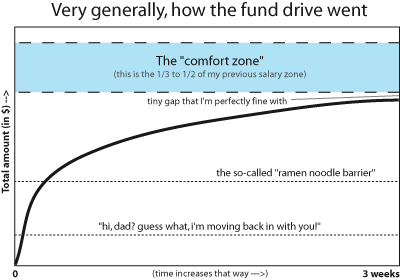
Note: This “graph” is not actually from the data and is not to scale. But the general trends and zones are fairly accurate. Plus, it’s kinda purty with the blue there.
(And before we get going, I’d again like to thank everyone who has contributed to the site so far. I really appreciate it.)
So that’s how much money came in over the three week fund drive period. As you can see, there was a rush at the beginning (over half of the total amount came in during the first 48 hours), followed by a small-but-steady stream of contributions until the end of the drive. The curve blasted through the “I have to move back in with my parents” barrier within the first few hours and exceeded the point at which I could eat something besides ramen noodles for every meal sometime during the second day.
The most I got from any one individual was $500, with a couple more people giving $200 or more. The majority of people gave the suggested amount of $30, which demonstrates the power of suggestion but leaves me wondering what people would have “priced” the site at had they been given no suggested amount. (My guess from the responses is that $30 was artifically high, but not too far off as an average. But that’s just a guess.) Four people contributed two cents or less, either as a joke (“here’s my two cents”) or as the equivalent of leaving your waiter a penny tip for crappy service, but since PayPal takes the first 30 cents of any payment, I didn’t see any of it. Two people handed me their contributions in person at SXSW and it was fun to able to thank them in the flesh.
And a bunch of people gave $1-5 each, usually accompanied by a very nice note that said something like they wished they could afford more because they really wanted to support me but money was tight or they were in college or grad school or something like that. Those were my favorite contributions to receive because it shows that there are people out there who value media and think about what kinds of media they want to support financially, even though they may not be able to afford it. And that they chose to support kottke.org makes me feel good about my efforts here. (And also nervous because I feel the need to really kick some ass to put their scarce dollars to good use.)
As I mentioned in my initial post about all this, my goal was to make “about 1/3 to 1/2 of my former yearly salary to support my efforts here for a year” and I very nearly reached that goal, although not quite as you can see from the graph. But it’s close enough that I’m not going to worry too much about it and I won’t need to supplement my income with any freelance work, which means I can focus on the site full-time, something I’m very pleased about. I probably could have made more had I pushed harder or guilted people into giving a little more to “put me over the top”.
Near the end of the drive, a friend commented to me that he was impressed at how restrained I had been in not pimping the fund drive out to the max. A better salesman than I could have made a lot more, I think…maybe even double. (Then again, a better salesman would probably do the whole site differently and I’m not sure it would be quite the same, you know?) But I knew that the regular kottke.org readers would read what I had to say about why their contribution was important to me and the site, consider what it meant to them, and then make a decision…no coercion necessary.
And finally, the answer to the $64,000 question: is this a sustainable business model for independent media on the Web? The short answer is probably no, with a few caveats. I did make enough to support myself for a year, but I’m already worried about next year (if I decide to ask for contributions again at that point) because there’s going to be the inevitable drop-off in year-over-year contributions. I think several people who contributed this time around did so as an experiment or as “back payment” for the previous 6-7 years of content and may not be so likely to contribute next time. And some are going to decide it’s not worth it to them to keep up their “subscription”.
Some who didn’t contribute may look at the site’s performance over the next year and decide to contribute the second time around, but all things remaining equal, I think the overall amount of contributions for the second year will be 1/2 to 2/3 the first year’s amount. However, now that I’m focusing on the site full-time, the traffic will probably increase over the next year, which will add to the pool of available contributors, but it would probably need to increase quite a bit to make up the difference.
Looking at the numbers, less than 1/3 of a percent of my current average monthly unique visitors contributed to kottke.org…that’s less than 1 in 300. I expected more than that, but I think it’s difficult to “sell” media in an environment where people are increasingly not paying directly for media. Most media is bought for viewers/readers by advertisers, making it either free or much cheaper than it would be. We pay for cable (and most of us are paying for a ton of channels we don’t even watch), but NBC is free and they support themselves by advertising to their viewers. Magazines are heavily ad-supported…an issue of Vogue or Wired would probably be $30 if they didn’t run ads. Most of the commerical media on the Web is free and supported by banner and text ads. Many movies are subsidized by marketing tie-ins and cross-promotions and movie theatres make their money by getting people into the theatre to munch on popcorn & candy and view the ever-growing amount of ads they show you before the previews (more ads!) start. And those smaller movies that you love because they don’t suck like the big Hollywood films? They wouldn’t even be made if they weren’t subsidized by the Shrek 2s of the world bringing hundreds of millions of dollars worldwide. Plus, when Coke runs an ad on TV or in a magazine, you may not be paying a lot for that show or magazine, but you’re probably paying a lot more for that can of Coke.
But anyway, it’s all indirect so people don’t think too much about it, and so it’s difficult, I think, to get people to support media directly (myself included…I certainly don’t want to pay $30 an issue for Wired). Difficult, but certainly not impossible.
So and but anyhoo, where does that leave the folks who want to do reader/viewer supported media? Can you actually blog for a living and not plaster ads all over your site? Here are a few suggestions from what I’ve learned so far:
1. Consider advertising. No, really. If you’re ok with the trade-offs involved, it’s easier, more stable, and more lucrative. There’s a reason media is heavily supported by ads.
2. Think community (or cult of personality). The more investment people have in a site, the more they will be willing to pay for it. There are a lot of people who have been reading kottke.org for a long time (thanks!) and are probably fairly invested in it, but compare that to any of the popular political sites or knitting sites or other topic or event-based sites that intensely involve their readers (through various means) and make them feel as though they are part of a group. kottke.org doesn’t have much of a community associated with it or a rabid following and I don’t polarize people the way some of the political blogs do, so my “earning power” is limited, but that’s not what the site is about. But if you site is about community and/or getting people rallied around a cause or something, you’re going to have an easier time raising funds.
3. Be committed to growing traffic. That’s not one of my top priorities here[1], but if your primary goal is making money, increasing traffic is the best way to do that. (How? Posting more often is the easiest way. If you can, get Slashdotted…that’ll get you more traffic that the front page of the New York Times.) If you’re doing something like subscriptions or contributions, you’ve always got to replace the people that you’re going to lose for whatever reason.
4. Keep costs low. Duh. I guess what I mean by this is because you can run most types of blogs from anywhere, if you live in Brazil, the Czech Republic, Malaysia, or India, you’re going to have an easier time supporting yourself than if you live in a big city in the US…as long as you have reliable high speed internet access. Bad news for Americans, Japanese, Europeans, and those who live in other places with a high cost of living…unless you’re in high school and still living on your parent’s dime.
And that’s about it for now…that’s more than I wanted to write, but once I get rambling… If anyone is interested, the contribution form is still available for use and will be available for the next few months, but I just won’t be bothering you about it.
[1] Are you getting the sense that I don’t treat this site as a business too much? Good, because I don’t. Most of that stuff I wrote above (traffic, the “price” of the site, conversion rates, etc.) doesn’t factor into how I think about the site at all. The fund drive was, for me, a fairly uncomfortable undertaking that I would have liked to avoid if I didn’t need to support myself financially with it. The day that kottke.org becomes a real business that focuses on profit first (instead of the pseudo-business labor-of-love it is now) is the day the site will probably start to suck[2]. Instead, I’m going to do my best in setting a course I think is favorable for the site and hope that there’s a way to support myself with it along the way.
[2] The wiseacres in the back will no doubt exclaim at this point, “start to suck? Ha, you’re long past that!”
The Since U Been Gone-nomenon reaches Howard Stern. Stern: Ted Leo “sounds like Tiny Tim.”
So, it turns out that weird popping noise I heard last night from the direction of the kitchen[1] was the can of Pepsi I’d put in the freezer[2] exploding. And now the inside of the freezer has cola-colored ice sprayed all over; it looks like a yeti projectile-vomited in there or something. Sometimes I don’t feel ready to be an adult.
[1] “Huh,” I thought when I heard it, “I wonder what that was?” And then before I could go check, “Ooh, something shiny on the Web!”
[2] To cool it down quickly because I was out of ice because, surprise, the ice trays don’t magically fill themselves when you live alone.
Nikon is coming out with new D-SLRs soon. The successor to the Nikon D70 (dammit, I just got mine a few months ago!) as well as a more entry-level D-SLR.
Remembering Phil Hartman. The Sinatra Group is probably one of my top five favorite SNL skits ever.
Good overview of what the Internet Archive is up to these days.
Lauren Greenfield photo series documenting the beauty regimes of 6 New York women. “Some women spend $1700 monthly on beauty, more than many women pay for rent. Does spending more mean looking better?”
Flash developers can now add an option to their Flash movies to view the source.
Nominees for the 2005 James Beard Awards announced (PDF file). Nominees include Steingarten, many Minneapolis journalists, Blue Hill at Stone Barnes, Per Se, Keller, Boulud, Danny Meyer, Dan Barber. All five best new restaurtant nominees are in NY.
How to Blog Safely (About Work or Anything Else). I can hear Dooce now…JUST WHERE WAS THIS TWO YEARS AGO?
Study: tall, slender, beautiful people get paid more. “They showed that women who were obese…earned 17 percent lower wages on average than women [of recommended weight]”. 17%! That’s quite a disparity.
Stewart Brand interviews Jane Jacobs about cities. “Cities are about the most durable things we have. People think of them as superficial things, but they aren’t. They’re very, very basic. Rural places, which are considered more fundamental and more basic, actually are hangers-on of cities in most cases.”
Just got back from seeing Wilco’s Jeff Tweedy, Larry Lessig, and Steven Johnson talk about “Who owns culture?” at the New York Public Library. They webcast the event, so if you’ve never seen Lessig wield his formidable PowerPoint clicker, you may be able to catch it archived there at some point. I’m not going to try to weave this into something narrative, so here are a few random thoughts/observations:
My favorite quote of the evening, from Tweedy (I think I got this down accurately): “I’d like people to hear my music and say they don’t like it rather than not be able to hear it because they can’t afford it”.
Tweedy: “Music is finished in the audience”. He credited the audience with 50% ownership in the creation of a musical piece…the creator is not much until someone listens to the music they’ve created.
Lessig: Fair use doesn’t apply to music or movies like it does for text. I can excerpt a book and critique it, but if I wanted to play a clip of a new Fischerspooner song on a podcast and then review the album, I’d need to secure the rights ahead of time.
Johnson: Why isn’t there a company that has come along and basically done what the record companies do for artists (distribute and promote records) but do it without all the overhead and let the artists keep the rights to their material? This is probably being done on a small scale (Factory Records comes to mind), but at first blush, this seems like a fantastic business opportunity. All the economies of scale without the monopoly.
Wilco’s cover of Don’t Fear the Reaper. I think it goes without saying that it needs more cowb, ah screw it.
Tweedy: Wouldn’t it be great if an artist like Paul McCartney decided that he had made enough money and just started giving his music away to people to enjoy because that’s what music is all about for him. Quote from this Wired article: “If Metallica still needs money then there’s something really, really wrong.”
Tweedy: What the music and movie companies are asking of artists, to create in a vacuum, is impossible. Not being able to sample, use a piece as a jumping off point for another piece, borrow tunes from other songs, or otherwise be influenced by an artist or poet or writer, it’s not possible because that’s what art is.
Lessig/Tweedy: Legislating against things like remixing and sampling is racist (also mentioned briefly in this Wired article). The argument goes that genres that tend to rely heavily on sampling and remixing (like hip-hop and rap) tend to be practiced by minorities and that legislating against them is de facto racism. More generally, it’s about the powerful (who, in the US, tend to be middle-aged white men) trying to keep their power by limiting the powerless (i.e., the poor and otherwise disenfranchised, who, in the US, tend to be minorities). (Apologies if this is confusing or I misrepresented Tweedy’s views on this or overused the word “tends”…racism is one of those hot button issues and I don’t want anyone to fly off the handle and say Tweedy or I said that all poor people are black and like rap music or some nonsense like that. Anyway, tried to be careful with it, but the above may not necessarily reflect the nuance of Tweedy’s views on this issue.)
At one point, Johnson and Tweedy started talking about alternative models for music distribution and Tweedy made the point that music has been around for a lot longer than the record companies and there’s lots of ways that music (and other forms of media) has traditionally been distributed, like via subscriptions and patronage. And Steven missed the perfect opportunity to say, “a friend of mine is exploring a micropatronage model for blogging….” ;)
James Kunstler lays out a gloomy and depressing energy crisis future in The Long Emergency. “Our lives will become profoundly and intensely local. Daily life will be far less about mobility and much more about staying where you are.”
Socials & More