Each year, the British Lawn Mower Racing Association holds a 12-hour lawn mower race in which teams of three drivers compete for a half a day of non-stop racing around a track at speeds up to 50 mph.
As usual, the teams will line up in a traditional Le Mans grid formation with the drivers running to their machines at the start.
The teams of three drivers (male and female) compete throughout the night at speeds approaching 50 mph — and without any form of suspension other than a padded seat, this is no stroll in the park! The pace remains unrelenting for the full 12 hours and it’s not unknown for the first three mowers to be on the same lap when the chequered flag drops. This is a true test of human endurance and mechanical reliability.
The video above follows one of the teams competing in this year’s race to see what the sport is all about. (I didn’t know where to drop a “Deere v Cub Cadet” joke in, so I’ll just leave it here.)
Real Engineering takes a look at some of the greatest innovations in F1 racing, including those that have made their way into passenger cars, like disc brakes, carbon fiber construction, and aerodynamics. The part about how the teams of engineers started competing with each other to increase the aerodynamics was really interesting. The 2014 F1 season was an instance where one team’s innovations were so dominant that the drivers were almost irrelevant. Mercedes dominated in 2015 and 2016 as well, but rule changes for 2017 (wider tires, wider cars, and lower spoilers mean faster cornering) will have everyone scrambling to find the advantages.
Formula 1 driver Fernando Alonso recently tried his luck at a go-kart track in the UK. Starting from last position, he worked his way up to first in less than three laps.
That’s neat, but I’m more interested in the person in the lead kart, who presumably hasn’t won two F1 championships and hasn’t been racing karts since age 3, who holds Alonso off for an entire lap before being passed. Nice work, mate! (via digg)
Now for the bumper view! Wow, the easiest way to work out what on Earth is going on. Oh, the car’s giving the one in front a little sniff. Ah, they’re a bit like dogs, aren’t they? Petrol dogs.
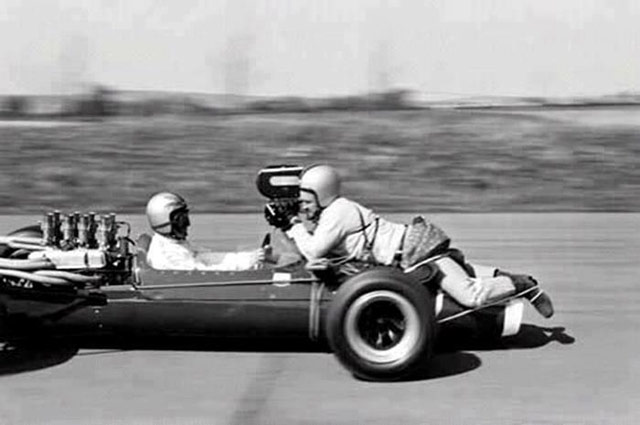
Back in the olden days, you just tied your cameraman right to the car:
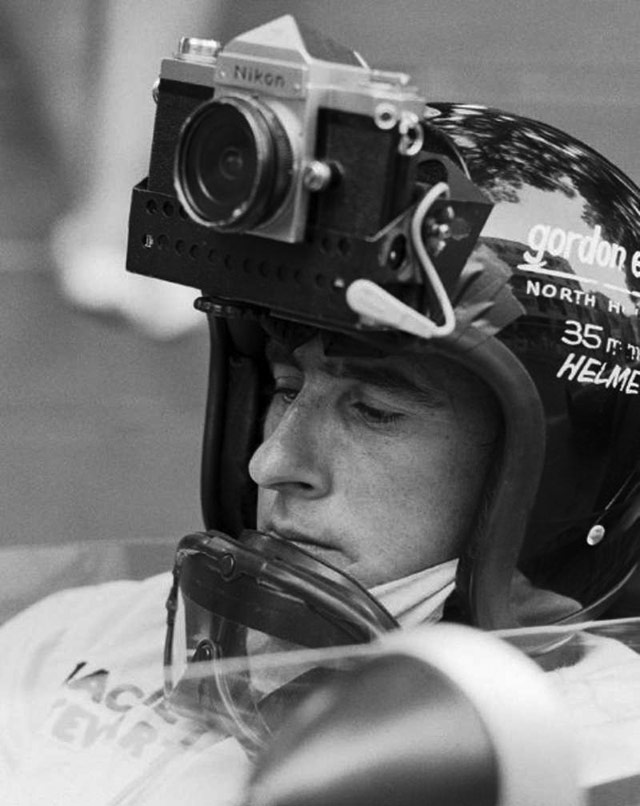
Looks almost as goofy as Google Glass. Legendary F1 driver Jackie Stewart wore this stills-only proto-GoPro at the Monaco Grand Prix in 1966 (though not during the actual race):
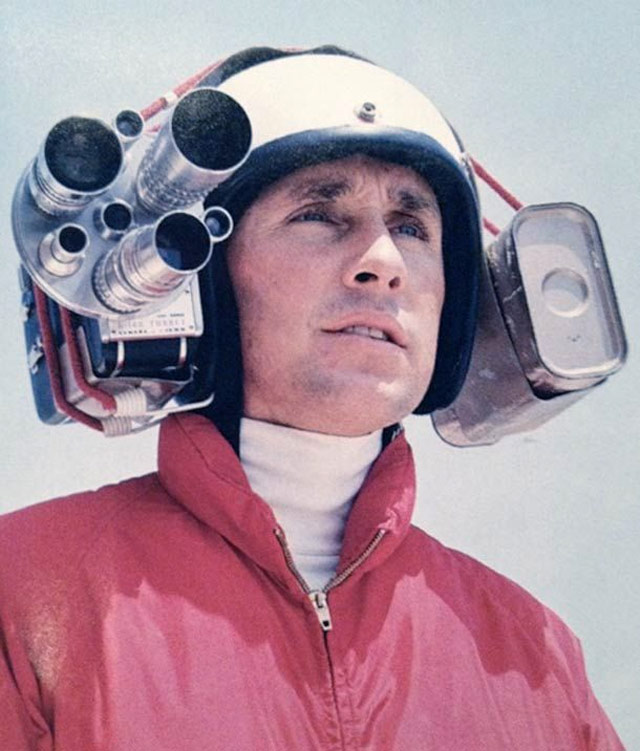
Stewart ended up winning that race. I believe Stewart is also the model for this contraption, which looks like a film camera counterbalanced with a battery pack?
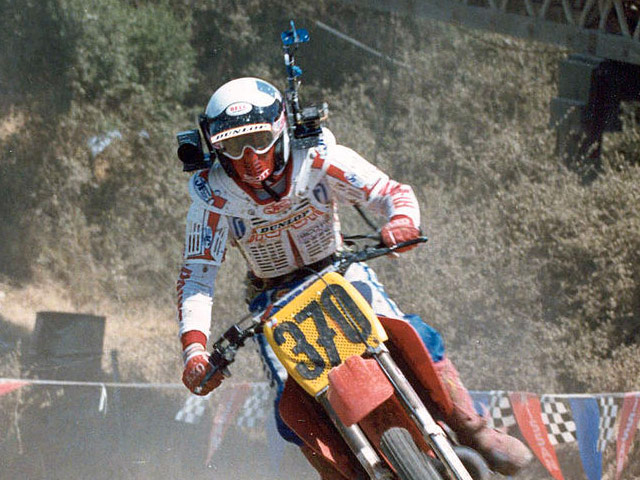
That couldn’t have been comfortable. For some reason, neither of Stewart’s helmet cams are recognized by Wikipedia as being the first documented helmet cam, which is instead attributed to a motorcycle race in 1986:
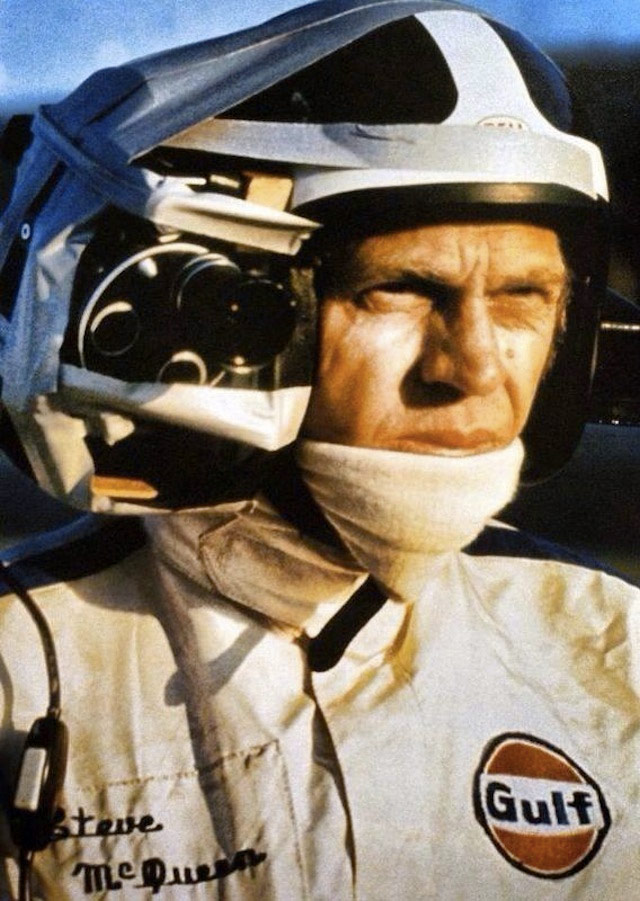
Update: Not even a bulky taped-up helmet camera can keep Steve McQueen from looking cool:
Well, he just barely looks cool. McQueen wore the helmet during the filming of 1971’s Le Mans. While researching this, I came across another film featuring McQueen that used helmet cams to get footage: 1971s On Any Sunday, a documentary about motorcycle racing. (via @jackshafer)
Coming into this season, Formula One made a lot of rule changes: new engines, better turbo systems, two different power sources (fuel & electrical), fixed-ratio gearboxes, etc. The cars had to be redesigned from top to bottom. Whenever a situation like this occurs, there’s an opportunity for technical innovation (rather than the gradual improvements that tend to occur when the environment remains mostly unchanged). This year, the Mercedes team built their engines to get more out of the new turbo system than the other teams.
What Mercedes’ boffins have done, according to Sky Sports F1 technical guru Mark Hughes, is split the turbo in half, mounting the exhaust turbine at the rear of the engine and the intake turbine at the front. A shaft running through the V of the V6 engine connects the two halves, keeping the hot exhaust gases driving the turbo from heating the cool air it’s drawing into the engine.
Aside from getting cooler air into the engine and extracting more power (maybe as much as 50 horsepower), this setup also allows Mercedes to keep drivetrain components closer to the center of the car. It also allowed the team to use a smaller intercooler, which cools off the heated air before going into the engine, compared to the rest of the cars.
And the result so far? Utter Mercedes domination. Out of the three races this year, the two drivers for the Mercedes team (Lewis Hamilton and Nico Rosberg) have three first-place finishes and two second-place finishes (Hamilton had to retire with engine issues in the first race). Mercedes was certainly competitive last year, finishing second, but Red Bull-Renault easily beat them in the points race and one of their drivers finished 1st in 13 out of 19 races. More relevant to the discussion here is how easily these races are being won by Mercedes. In each of the three races, a member of the Mercedes team qualified in pole position, recorded the fastest lap, and beat the other teams’ drivers by more than 24 seconds in each case. To put that last stat in perspective, last year the winning team beat the second place team by more than 20 seconds in only three races, with the margin typically in the 3-10 second range.
So yeah, Mercedes is killing it so far. And the other teams aren’t happy about it. Shades of the situation over Speedo’s LZR Racer swimming suit.
Update: I said earlier that one of the changes was “no refueling during races” which has been the case for a few years now (hence the 2-second pit stop). Also, this video is a great explanation of how Mercedes turbo is designed and how it helps make their car go faster:
Update: The 2014 Formula One season is over and the Mercedes team sustained their advantage throughout. If anything, their advantage increased over the course of the season. Just take a look at the driver’s standings; in only one race (out of 19) did a Mercedes driver fail to finish in the top two slots. And when they won, it was usually by large margins. In the 2014 Brazilian Grand Prix for example, the two Mercedes drivers finished within 1.5 seconds of each other with the 3rd place driver finishing almost 40 seconds later. The Mercedes team finished with 701 points overall, nearly 300 points more than the second place finishers and almost equalling the number of points of the 2nd and 3rd place teams combined. Whatever the team’s technical advantage was, it was too much for the other teams to deal with.
Watch Ferrari’s F1 pit crew do a pit stop in a bit over two seconds:
I wish this were in slow motion because I’ve watched this three times now and I still cannot understand how it’s done. My favorite part is how calm they all are about it. Here’s a longer video that shows the process over and over from several points of view, including from a GoPro mounted on the chest of the wheelgun man:
Watch for the guy on the front jack pirouetting out of the way. I would love to read a long piece on how F1 pit crews train and practice. There are tantalizing bits in shorter articles, like this one from Autosport.com:
With three people per wheel, two jack operators, and a handful of mechanics fulfilling other functions, each pit crew comprises nearly 20 people.
Each is trained for a specific role and teams take their preparation as seriously as drivers’, managing crewmen’s fitness and diet.
They are drilled incessantly at both the factory and during race weekends, with hundreds of pitstop practices until the process is instinctive.
Although problems such as faulty guns are rehearsed, everyone focuses on their own job — in a two-second pitstop, there is no time to see what everyone else is doing. By the time an error has been alerted, the car has often already pulled away, as was the case at the Nurburgring.
Teams now spend huge sums to design their own equipment and improve the fitness of their teams who also work as mechanics. McLaren is working with the English Institute of Sport to hone their 24-member team’s technique while Williams has partnered with Olympic champion Michael Johnson’s Performance Center to work on everything from diet to eye-hand coordination to core strength.
Training has also been ramped up. Most teams have rigs to practice on in the factory and pit stops are practiced as many as 70 times over a typical race weekend. Each stop is timed and videotaped for later review.
“When you had to go from 3.5 seconds down to a lower number, then you really need to be very specific and accurate on how you train because everything needs to be very synchronized to achieve that level of fast time and consistency,” said Williams’ chief race engineer Xevi Pujolar, whose team had its fastest pit stop this season in Spain after making changes to its crew but still is almost a second behind the top teams.
“There still a lot of room for improvement and we are working hard to catch up to these guys that do close to two seconds,” Pujolar said. “If you look at video of pit crew and how they move during pit stop, everything is so well coordinated. To achieve this level of coordination on every pits stop requires a lot of training.”
Alain Prost retired from F1 racing for the final time in 1993, with his last race coming at the Australian Grand Prix in November. He finished second in the race to his fierce rival Ayrton Senna but handily won the World Championship to the runner-up Senna. But the two of them raced for one final time in December of that year…driving go-karts.
Predictably, the pair took it very seriously: four-time world champion Prost having tested extensively before the event; Senna, a three-time title holder, having a kart shipped to Brazil so that he could practise.
Speaking of what fast looks like, here’s a pair of synced videos that show just how fast F1 cars are. On the left are drivers participating in a track day, that is, normal folks who want to drive their cars fast on a real race course. A couple of them look like actual GT cars and are moving pretty quick. On the right, you’ve got F1 cars on the same track. It’s not even close:
Update: In a speed test, an F1 car starts 40 seconds after a Mercedes sports car and 25 seconds after a V8 Supercar (essentially an Australian NASCAR) and still catches them by the end of the first lap.
File this one under what fast looks like: motorcycle racers reach speeds in excess of 200 mph as they navigate the tiny curved roads of the Isle of Man during the Isle of Man TT race. The crash at 1:30, which is insane by the way, involves a stone wall, sheep, and was filmed cinematically from a helicopter.
There’s a driving technique called heel-and-toe where the driver uses all three pedals (brake, clutch, throttle) at once to make deceleration smoother, especially in the turns.
Heel-toe or heel-and-toe double-declutching is used before entry into a turn while a vehicle is under braking, preparing the transmission to be in the optimal range of rpm to accelerate out of the turn. One benefit of downshifting before entering a turn is to eliminate the jolt to the drivetrain, or any other unwanted dynamics. The jolt will not upset the vehicle as badly when going in a straight line, but the same jolt while turning may upset the vehicle enough to cause loss of control if it occurs after the turn has begun. Another benefit is that “heel-and-toeing” allows the driver to downshift at the last moment before entering the turn, after starting braking and the car has slowed, so the engine speed will not be high enough when the lower gear is engaged.
Here is a video of Formula One great Ayrton Senna demonstrating the techique in a Honda NSX. You’ll note he’s wearing a button-down shirt, dress pants, Italian loafers, and no helmet while burying the speedometer on his way around the track.
It’s a bit difficult to understand from the video what Senna is actually doing…this step-by-step video shows the heel-and-toe technique more clearly. (thx, micah)
I can’t find a great account of it (go here and here for the basics), but the story of how Tony Stewart won the 2011 Sprint Cup Championship at the Ford 400 in Homestead, FL is flat-out amazing and as thrilling as anything that’s happened in sports over the past 12 months: an aging former champion wins five out of the last ten NASCAR races (more than 10% of his total career victories), including a final race in which he recovered from two slow pit stops (one of which was agonizingly slow), passed 118 cars total, came from back of the pack twice, made several ballsy four-across passes, and was saved from defeat by a passing rain shower. And the guy he was chasing the whole time (in this race and the points standings) was driving great…it’s just that Stewart was racing insanely great, right on the edge.
I’ve seen very little coverage of this on the big generalist sports blogs…nothing on Deadspin and only a short “Tony Stewart won some NASCAR thingie” on Grantland. Come on! Simmons, Klosterman, someone, get on this!
At 1 o’clock on a bright October afternoon, I’m standing in a convenience store parking lot five miles east of Martinsville, Va. In the 24 hours before the green flag drops on the Subway 500, I need to find a ride to the speedway and a $75 ticket to the sold-out race. Problem is, all I have on me is $20, a cell phone and a camcorder. And I’m not allowed to use any media connections to get into the race-or so much as mention the letters ESPN (at least not in that order).
According to Yates and his fellow Cannonballers, trying to beat that record today is pointless. Their argument goes something like this: Cannonball records were set back when the free-wheelin’ ’70s hooked up with the greed-is-good ’80s for fat lines of cocaine and unprotected sex. But these, brother, are Patriot Act days - executive-privilege end times in which no rogue deed goes untracked, no E-ZPass unlogged, no roaming cell phone unmonitored by perihelion satellite. Big Brother is definitely watching. Big Speed, the old Cannonballers say, is a quaint, 20th-century idea, like pay phones or print magazines.
Roy was inspired to take up fast driving by the short film C’était un Rendez-vous, where Claude Lelouch races through Paris at breakneck speeds to meet his sweetheart in Montmartre. Here’s the route they took, another piece on the record in the NY Times, and a book by Roy on his exploits. This is the sort of thing that is really, really cool up until the moment Roy’s tricked out BMW makes contact with a family minivan at 120mph…and then, not so much.
Those guys look like they’re doing about 90-95… BFD. You see that all the time going up and down I-5 and I-95.. I once was doing about 90 down I-95 and got passed by a HOUSE on a flatbed truck. (yawn)






Stay Connected