kottke.org posts about science
In response to comments about a video of him getting the Covid-19 vaccine — “Come with me if you want to live!” — Arnold Schwarzenegger says that if you want to build biceps, you should listen to him. He’s the expert. But if you want to know what to do about Covid-19, you should listen to epidemiologists and doctors.
Dr. Fauci and all of the virologists and epidemiologists and doctors have studied diseases and vaccines for their entire lives, so I listen to them and I urge you to do the same. None of us are going to learn more than them by watching a few hours of videos. It’s simple: if your house is on fire, you don’t go on YouTube, you call the damn fire department. If you have a heart attack, you don’t check your Facebook group, you call an ambulance. If 9 doctors tell you you have cancer and need to treat it or you will die, and 1 doctor says the cancer will disappear, you should always side with the 9. In this case, virtually all of the real experts around the world are telling us the vaccine is safe and some people on Facebook are saying it isn’t.
In general, I think if the circle of people you trust gets smaller and smaller and you find yourself more and more isolated, it should be a warning sign that you’re going down a rabbit hole of misinformation. Some people say it is weak to listen to experts. That’s bogus. It takes strength to admit you don’t know everything. Weakness is thinking you don’t need expert advice and only listening to sources that confirm what you want to believe.
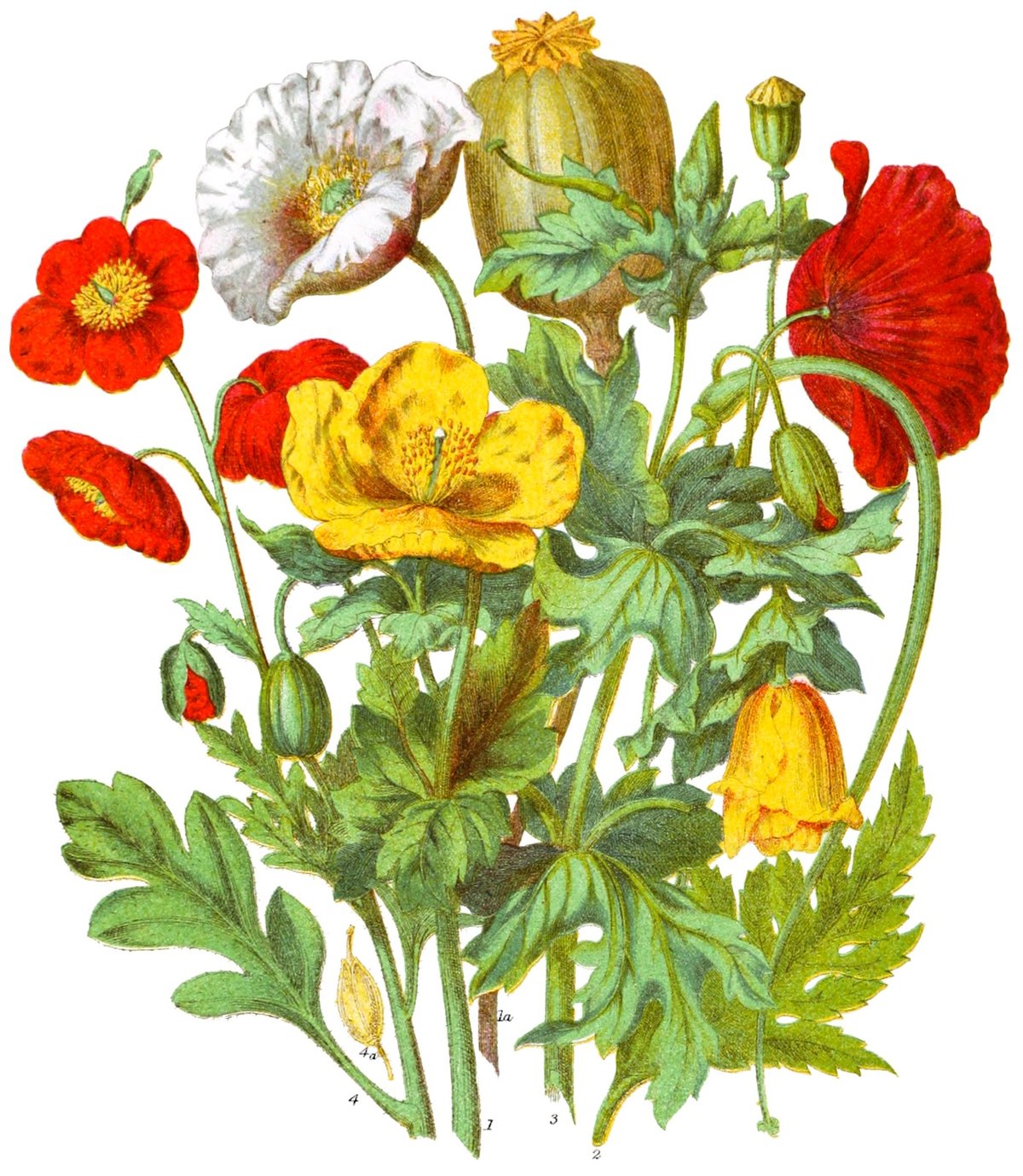


Nicholas Rougeux has beautifully reproduced & remastered botanical illustrator Elizabeth Twining’s catalog of plants and flowers from 1868, Illustrations of the Natural Orders of Plants. Each of the 160 illustrations is accompanied by explanatory text from the original book and an interactive version of the image (click on the highlighted plant for more info).
Posters based on the illustrations are available and, get this, so are puzzles!
In an opinion piece for the NY Times, Zeynep Tufekci and epidemiologist Michael Mina are urging for new trials of the Moderna and Pfizer/BioNTech Covid-19 vaccines to begin immediately to see how effective a single dose might be in preventing new infections. If the trials do indicate that a single dose works, that would effectively double the number of people we could vaccinate within a certain time period, saving countless lives in the US and worldwide.
Both vaccines are supposed to be administered in two doses, a prime and a booster, 21 days apart for Pfizer and 28 days for Moderna. However, in data provided to the F.D.A., there are clues for a tantalizing possibility: that even a single dose may provide significant levels of protection against the disease.
If that’s shown to be the case, this would be a game changer, allowing us to vaccinate up to twice the number of people and greatly alleviating the suffering not just in the United States, but also in countries where vaccine shortages may take years to resolve.
But to get there — to test this possibility — we must act fast and must quickly acquire more data.
For both vaccines, the sharp drop in disease in the vaccinated group started about 10 to 14 days after the first dose, before receiving the second. Moderna reported the initial dose to be 92.1 percent efficacious in preventing Covid-19 starting two weeks after the initial shot, when the immune system effects from the vaccine kick in, before the second injection on the 28th day
That raises the question of whether we should already be administrating only a single dose. But while the data is suggestive, it is also limited; important questions remain, and approval would require high standards and more trials.
The piece concludes: “The possibility of adding hundreds of millions to those who can be vaccinated immediately in the coming year is not something to be dismissed.”
If you crack a fertilized chicken egg into a transparent container — in this case, plain old kitchen plastic wrap — and incubate it, you can observe the embryo as it develops and eventually “hatches” into a chick, heartbeat and all. The process takes about 21 days from start to finish.
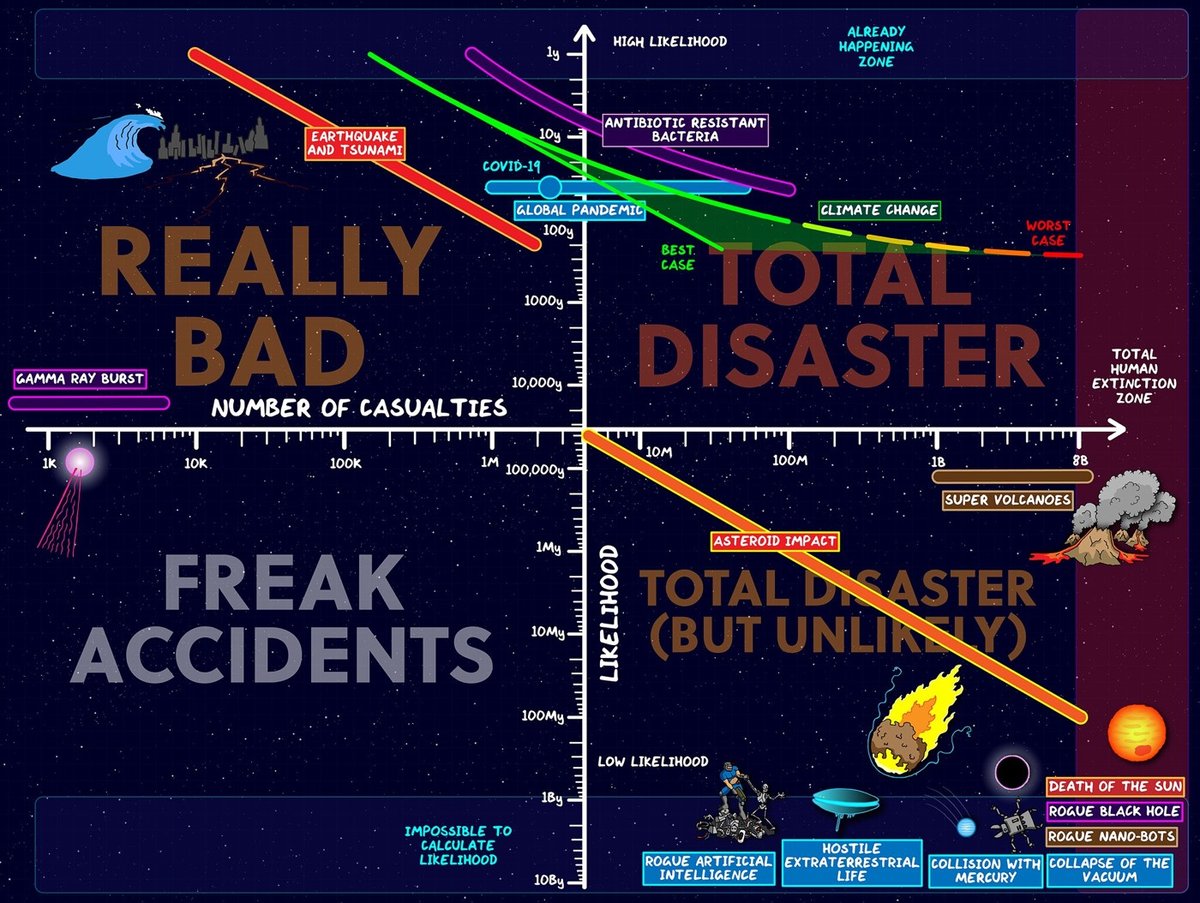
Spurred by the pandemic — what he calls “the first experience we’ve had of a global disaster affecting every single person on Earth”1 — Domain of Science’s Dominic Walliman takes stock of many of the possible catastrophes that might befall humanity, ranking possible threats based on their likelihood and the number of potential casualties.
This year was the first experience we’ve had of a global disaster affecting every single person on Earth. And also how unprepared society was to deal with it, despite plenty of people giving warnings that this was going to happen at some stage.
But in the midst of all the doom I started to wonder, what other things could threaten humanity, that we are not thinking about? So I made the Map of Doom to list all the threats to humanity in one place.
The result is the quadrant chart and the video above as well as the Map of Doom.
One could imagine a third dimension of this chart: what, if anything, humans can do about each of these threats. Earthquakes can be detected, buildings can be designed to withstand them, and evacuation procedures enacted and prioritized. Many effects of climate change can be mitigated. Asteroids can be detected, but doing something about them might prove difficult. We’ve lowered the threat of nuclear war — for now. Supervolcanoes? Yikes.
You can find a list of references used in the video’s description. (via open culture)
In remarks to the German parliament today, German Chancellor Angela Merkel advocated for tighter Covid-19 restrictions, as cases & deaths in Germany reach new peaks. The restrictions she’s referring to were recommended by “a national academy of scientists and academics” and are intended at reducing the spread of Covid-19 over the December holidays. The impassioned argument that she makes in this short video clip (full report here) is difficult for me to find fault with (even though conservative members of her parliament and Twitter commenters disagree). Here’s a partial transcript:
If the price we pay is 590 deaths per day, then that is unacceptable in my view. And when scientists are practically begging us to reduce our contacts for a week before we see Grandma and Grandpa, grandparents and older people at Christmas, then perhaps we really should think again about whether we can’t find a way to start the school holidays on the 16th instead of the 19th. What will we say when we look back on this once-in-a-century event if we weren’t able to find a solution for these three days? And it may be the case that sending children home is the wrong thing to do, if so then it will have to be digital lessons or something else. I don’t know, this is not my area of expertise and I don’t want to interfere. I only want to say: if we have too many contacts now, in the run-up to Christmas, and it ends up being the last Christmas with our grandparents, then we will have done something wrong. She should not let this happen.
I teared up watching her talk. In the US, we are dealing with many more cases (which will turn into eventual deaths) and deaths than Germany, both in absolute and per capita terms. It’s like 10 fully-loaded passenger planes a day are crashing with no survivors and there are small things that we all can do to keep many of those people alive and … many of us just don’t want to do those things!
Like Merkel says, we are going to look back on this and be completely ashamed that we didn’t do these things and that we elected people that won’t advocate for these things on our behalf and that we let 300-400,000 Americans die and countless others lose loved ones and go bankrupt and get evicted and lose their businesses and be chronically ill and be food insecure and and and. If we aren’t ashamed, if we don’t reckon with all of this someday, then maybe nothing can redeem us and we deserved it all.
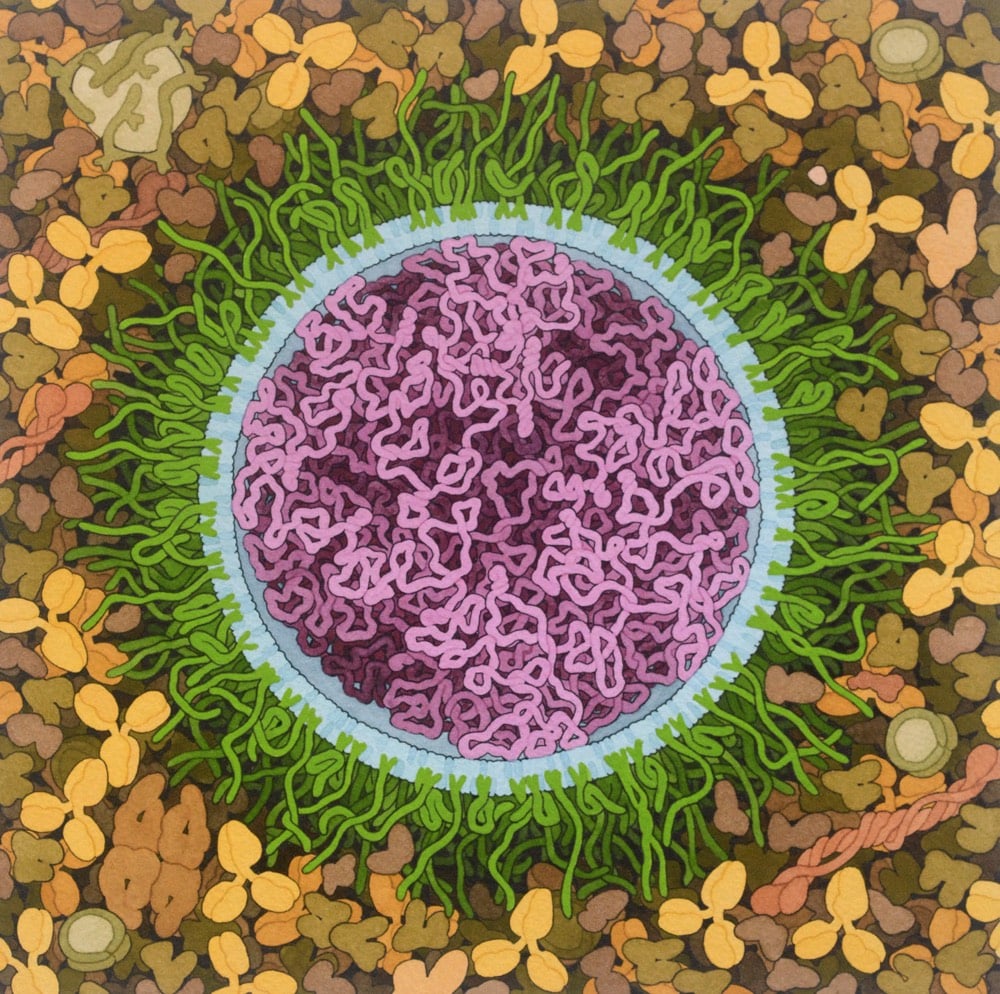
Artist and biologist David Goodsell has done a painting of the Covid-19 mRNA vaccine.
The vaccine structure is highly idealized, with spike mRNA in magenta, lipids in blue, and PEG-lipid in green. The background is blood serum or lymph.
Both the Pfizer/BioNTech and the Moderna Covid-19 vaccines are based on mRNA — you can brush up on how they work at Stat or the CDC.
mRNA vaccines are a new type of vaccine to protect against infectious diseases. To trigger an immune response, many vaccines put a weakened or inactivated germ into our bodies. Not mRNA vaccines. Instead, they teach our cells how to make a protein — or even just a piece of a protein — that triggers an immune response inside our bodies. That immune response, which produces antibodies, is what protects us from getting infected if the real virus enters our bodies.
See also Goodsell’s painting of a SARS coronavirus from back in February.
The NY Times recently surveyed 700 epidemiologists about how they are personally living during the pandemic and what they think is going to happen next. Epidemiologists should have a better idea than most of us about how to act during a viral pandemic, so there’s lots of good information in there about vaccines and high-risk behaviors. But I found their answers to a pair of speculative questions about a return to normalcy most interesting.
How and when will life go back to normal?
“For some, it has gone back to normal, and because of this, it will be two to three years before things are back to normal for the cautious, at least in the U.S.”
- Cathryn Bock, associate professor, Wayne State University
“The new normal will be continued masking for the next 12 to 18 months and possibly the next few years. This is a paradigm shift.”
- Roberta Bruhn, co-director, Vitalant Research Institute
What will never return to normal?
“My relationships with people who have taken this pandemic lightly and ignored public health messages and recommendations.”
- Victoria Holt, professor emeritus, University of Washington
“Every part of my daily life that involves interaction with anyone other than my spouse.”
- Charles Poole, associate professor, University of North Carolina
For many people, the pandemic has altered almost every aspect of their lives. If we listen to what epidemiologists are telling us (like we should have back in early 2020 to avoid much of our present hardship), it could help us accept that the pandemic will continue to affect most aspects of our lives even after it is “over”.
Free Covid-19 illustration courtesy of Pixel True.
Zeynep Tufekci reports on a small study from Korea that has big implications on how we think about transmission of SARS-CoV-2. Scientists traced two cases back to a restaurant and discovered that transmission had occurred over quite a long distance in a very short period of time.
If you just want the results: one person (Case B) infected two other people (case A and C) from a distance away of 6.5 meters (~21 feet) and 4.8m (~15 feet). Case B and case A overlapped for just five minutes at quite a distance away. These people were well beyond the current 6 feet / 2 meter guidelines of CDC and much further than the current 3 feet / one meter distance advocated by the WHO. And they still transmitted the virus.
As Tufekci goes on to explain, the way they figured this out was quite clever: they contact traced, used CCTV footage from the restaurant, recreated the airflow in the space, and verified the transmission chain with genome sequencing. Here’s a seating diagram that shows the airflow in relation to where everyone was sitting:
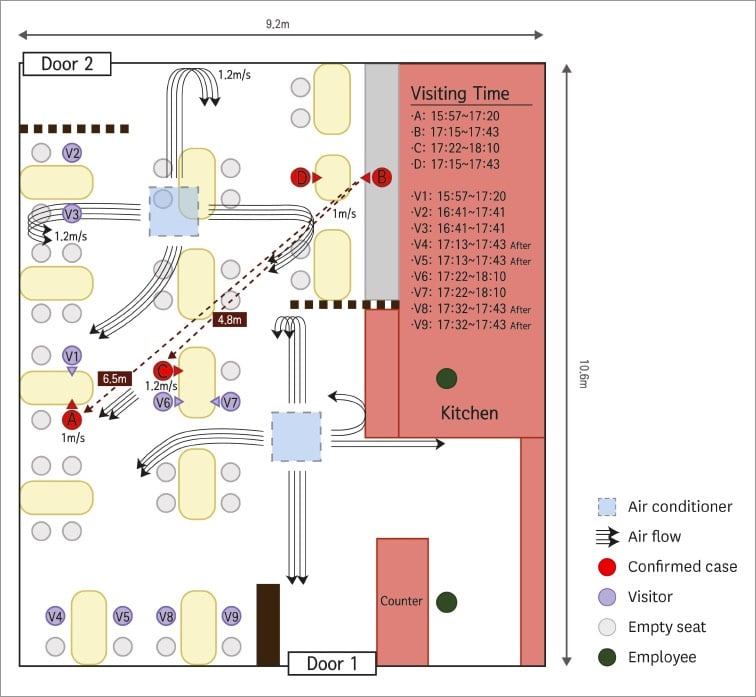
Someone infecting another person 21 feet away in only five minutes while others who were closer for longer went uninfected is an extraordinary claim and they absolutely nailed it down. As Sherlock Holmes said: “Once you eliminate the impossible, whatever remains, no matter how improbable, must be the truth.” And the truth is that in some cases, the recommended 6 feet of distance indoors is not sufficient when people aren’t wearing masks. Airflow matters. Ventilation matters. Which way people are facing matters. How much people are talking/laughing/yelling/singing matters. Masks matter. 6 feet of distance does not confer magical protection. All that can make it tough to figure out if certain situations are safe or not, but for me it’s an easy calculation: absolutely no time indoors with other people not wearing masks. Period. As Tufekci concludes:
I think there are three broad lessons here. One, small data can be extremely illuminating. Two, air flow and talking seem to matter a great deal. Three, sadly, indoor dining and any activity where people are either singing or huffing and puffing (like a gym) indoors, especially with poor ventilation, clearly remains high risk.
Read her whole post — as she says, it’s “perhaps one of the finest examples of shoe-leather epidemiology I’ve seen since the beginning of the pandemic”.
The Milky Way galaxy may be home to billions or even trillions of rogue planets (planets that don’t orbit stars). In this video, Kurzgesagt considers how the Earth could go rogue (by following a nearby massive star away from the Sun) and what would happen to our oceans, atmosphere, and lives if it happened.
The first part of the video is pretty bleak — “as the days turn dark, the final winter of humanity would begin” — while the second part is hopeful: we’ll be able to predict our ejection thousands of years before it happens and may be able to prepare. In light of the world’s response to the pandemic and climate change, it would certainly be interesting to see if human civilization could get it together to save itself from a cold death in outer space. I have no doubt that scientist could accurately diagnose the problem and supply solutions, but the politics would be a total mess.
With the first approved Covid-19 vaccines set to roll out in the US soon, some of the focus has shifted to how the vaccine will be distributed and its equitable allocation. Part of the distribution logistics puzzle is making sure there are enough glass vials to hold and transport the vaccine around the nation to those waiting to be vaccinated. For the New Yorker, Christopher Payne took some photos of two Corning factories that are manufacturing vials as fast as they can.
But back in the early 19th century, for a colonial empire dealing with overseas smallpox epidemics, glass vials were not an option. Smallpox vaccination at that time was most reliably accomplished by transferring material from cowpox blisters on one person (or cow) to another person. The freshly inoculated person got a little sick but later proved to be immune to the much deadlier smallpox. So when Spain’s Royal Philanthropic Vaccine Expedition set sail in 1803 to inoculate the inhabitants of their overseas colonies for smallpox, they used the bodies of human beings to transport the vaccine. To be more specific, they used “twenty-two orphan boys, ages three to nine”.1
And so it was that, “in the era before refrigeration, freeze-dried vaccines, and jet aircraft,” writes medical historian John Bowers, “the successful circumnavigation of the globe with the vaccine…rested on a single medium — little boys.” During the long crossing, approximately twenty-two orphans who had not previously contracted smallpox or cowpox were “vaccinated in pairs every ninth or tenth day,” via arm-to-arm inoculation (taking lymph from an unbroken pustule on a recently vaccinated boy and introducing it under the skin of another). This created a vaccine chain — the vaccine remained active and viable for the entire journey.
The three-year expedition was success and an early & effective example of philanthropic healthcare, but you also have to note here that the reason the Americas were ravaged by smallpox was because Spain brought it there in the first place.
Update: In The Atlantic, Sam Kean provides some more detail on the vaccination effort.
Given the era, it’s likely that no one asked the orphans whether they wanted to participate — and some seemed too young to consent anyway. They’d been abandoned by their parents, were living in institutions, and had no power to resist. But the Spanish king, Carlos IV, decided to make them a few promises: They would be stuffed with food on the voyage over to make sure they looked hearty and hale upon arrival. After all, no one would want lymph from the arm of a sickly child. Appearance mattered. And they’d get a free education in the colonies, plus the chance at a new life there with an adoptive family. It was a far better shake than they’d get in Spain.
In an incredible effort, science has provided the world with what looks like an incredibly effective vaccine for Covid-19. For Stat, Helen Braswell writes about the challenges of turning that vaccine into vaccinations. In the US, despite heroic work from individuals and individual groups, our public health system has proved unequal to the challenge of addressing the pandemic, and we’re now turning, in part, to that system to distribute and administer the vaccines, as well as to educate the public and drum up support for vaccination. The people that we’re counting on are public officials and healthcare workers worn out from what is essentially one 9-month-long wave of illness, hospitalizations, and death across the country. Misinformation and skepticism of science and government has sowed “justified distrust” about vaccines in many people:
Concern about the vaccines, however, cuts across ethnic and socioeconomic groups. President Trump’s overt efforts to pressure the FDA to issue EUAs before the Nov. 3 election — before the vaccine trials were finished — has deepened the sense of unease. The CDC’s early pandemic testing fiasco, coupled with its sidelining by the Trump administration, has eroded its standing as a trusted source of information.
Alison Buttenheim, an associate professor of nursing and health policy at the University of Pennsylvania, refers to the current situation as a perfect storm of “justified distrust.”
“People who don’t think twice about vaccinating their kids totally on time, who get their flu shot every year, are in the sort of, ‘Hmmm. Might wait six months on this one,’” Buttenheim, who works on vaccine acceptance, told STAT. “I’ve heard people say, ‘I’ll get the European one,’” she said, adding other people have said they would get vaccinated after Anthony Fauci, director of the National Institute of Allergy and Infectious Diseases, gets vaccinated.
And it’s not just the general public. A recent survey of 2,000 doctors and nurses in New Jersey found that 60% of doctors planned to take a Covid vaccine, but only 40% of nurses intended to, Health Commissioner Judith Persichilli said in a recent “60 Minutes” segment about Operation Warp Speed.
Fauci, along with other respected public health officials and workers, should get vaccinated live on CNN. Stream it on YouTube and Twitch. It won’t convert the anti-vax, anti-mask, QAnon wingnuts (nothing will) but if you can at least get healthcare workers and at-risk folks on board, it would be time well spent.
But that’s only one small piece of the puzzle. Braswell’s piece is long and comprehensive look at the challenges regarding the Covid-19 vaccines and is worth reading all the way through.
After Terri Nelson noticed people complaining online about a lack of scent from newly purchased scented candles, Kate Petrova analyzed Amazon reviews for candles from the past three years and found a drop in ratings for scented candles beginning in January 2020 (compared to a smaller ratings decline for unscented candles).
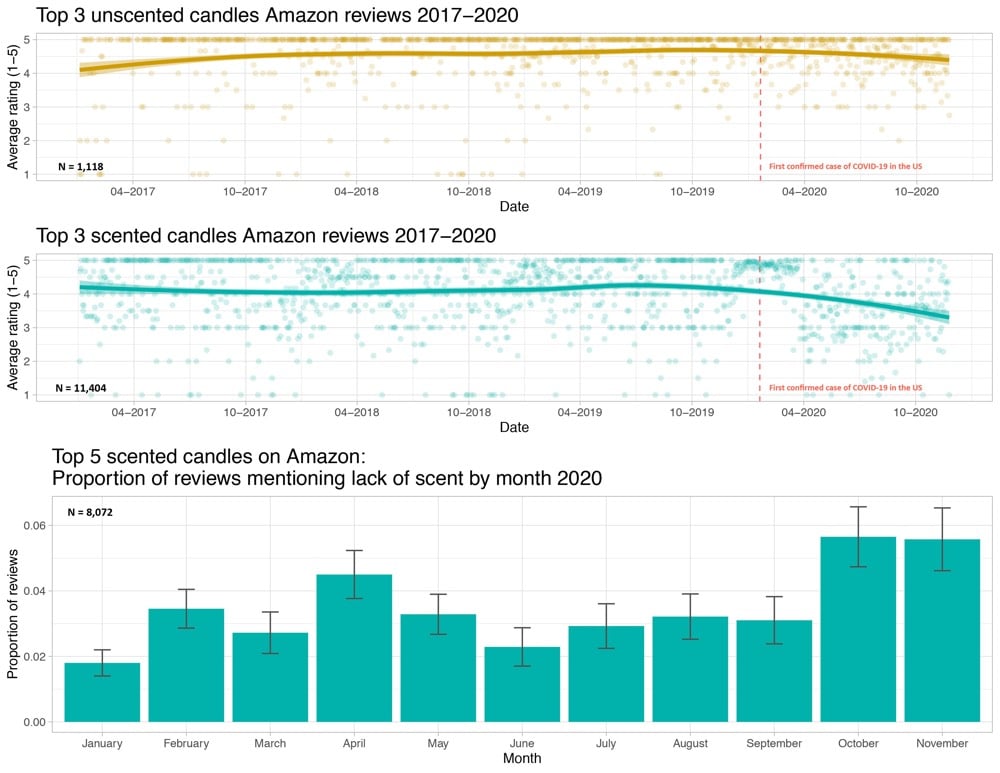
The hypothesis is that some of these buyers have lost their sense of smell due to Covid-19 infections and that’s showing up in the ratings.
With the positive news about the Covid-19 vaccine trials, I assume many of you have started to think about the potential end of the pandemic — what we’ll do, where we’ll go, who we’ll see, and reckon with what’s changed and what’s been lost. I know I have. Alex Hutchinson has written an intriguing piece on what sports science might be able to tell us about the psychology of a situation like the pandemic, where the finish line is poorly defined, ever-changing, or even non-existent.
As it happens, there’s a whole subfield of sports science, at the intersection of physiology and psychology, that explores this terrain. It’s called teleoanticipation, a term coined in 1996 by German physiologist Hans-Volkhart Ulmer to describe how our knowledge of an eventual endpoint (or telos) influences the entirety of an experience. Using endurance sports as their medium, researchers in this subfield have probed what happens when you hide the finish line, surreptitiously move it or take it away entirely. For those of us tempted by promising vaccine updates to start fantasizing about an end to the pandemic, these researchers have some advice: don’t.
Instead, the key seems to be remaining in the moment instead of focusing on the goal.
It turns out that, if you ask yourself “Can I keep going?” rather than “Can I make it to the finish?” you’re far more likely to answer in the affirmative.
This squares with mindfulness practices from Buddhism and Stoicism but also reminds me of a motivational trick I first heard a few years ago: that you can do anything for 10 seconds — and then you just begin a new 10 seconds. Turns out that was popularized by Unbreakable Kimmy Schmidt. Good advice can come from anywhere.
Now that the preliminary results of various Covid-19 vaccine trials are coming out (and looking promising), attention is turning to the eventual distribution of the vaccines. The logistics of getting the doses out to hospitals, clinics, and doctor’s offices is one concern but so is the question of who should get vaccinated first. Supplies of the vaccines will be limited at first, so we’ll need to decide as a society what distribution method is most fair and is of the most benefit to the greatest number of people.
To this end, and in response to a request by the CDC and NIH, the National Academies of Sciences, Engineering, and Medicine formed a committee to produce a report called Framework for Equitable Allocation of COVID-19 Vaccine. The 252-page report is available to the public for free to read online or download.
In addition several recommendations — including that the vaccine be distributed to everyone free of charge — a central feature of the report is a four-phase system of vaccine distribution, summarized in this graphic:
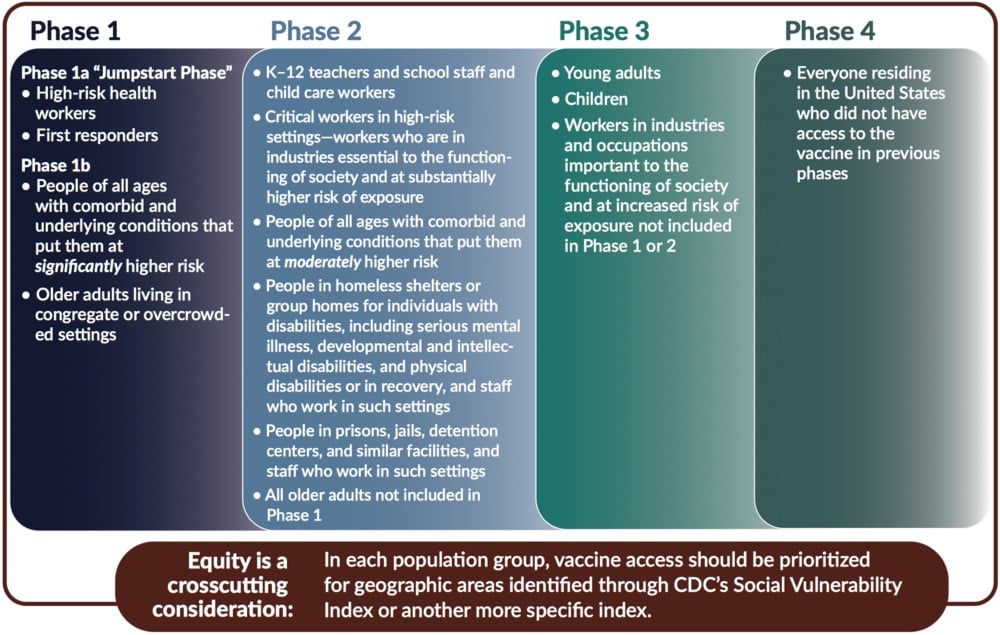
I’d like to stress that this graphic does not show all groups of people included in each phase — please consult the text of the report for that before you go sharing that graphic on social media without context. For example, here’s the full description for “high-risk health workers” in Phase 1a:
This group includes frontline health care workers (who are in hospitals, nursing homes, or providing home care) who either (1) work in situations where the risk of SARS-CoV-2 transmission is higher, or (2) are at an elevated risk of transmitting the infection to patients at higher risk of mortality and severe morbidity. These individuals — who are themselves unable to avoid exposure to the virus — play a critical role in ensuring that the health system can care for COVID-19 patients.
These groups include not only clinicians (e.g., nurses, physicians, respiratory technicians, dentists and hygienists) but also other workers in health care settings who meet the Phase 1a risk criteria (e.g., nursing assistants, environmental services staff, assisted living facility staff, long-term care facility staff, group home staff, and home caregivers). The health care settings employing these workers who are at increased risk of exposure to the virus may also include ambulatory and urgent care clinics; dialysis centers; blood, organ, and tissue donation facilities; and other non-hospital health care facilities. Finally, there are community and family settings where care for infected patients occurs. Not all the workers in these settings are paid for their labor, but, while they are caring for infected people, they all need to be protected from the virus.
Situations associated with higher risk of transmission include caring for COVID-19 patients, cleaning areas where COVID-19 patients are admitted, treated, and housed, and performing procedures with higher risk of aerosolization such as endotracheal intubation, bronchoscopy, suctioning, turning the patient to the prone position, disconnecting the patient from the ventilator, invasive dental procedures and exams, invasive specimen collection, and cardiopulmonary resuscitation. In addition, there are other frontline health care workers who, if they have uncontrolled exposure to the patients or the public in the course of their work, should be in this initial phase. This group includes those individuals distributing or administering the vaccine — especially in areas of higher community transmission — such as pharmacists, plasma and blood donation workers, public health nurses, and other public health and emergency preparedness workers. The committee also includes morticians, funeral home workers, and other death care professionals involved in handling bodies as part of this high-risk group.
The report declines to list specific industries which would be covered in Phase 2’s “critical workers in high-risk settings” but generally says:
The industries in which these critical workers are employed are essential to keeping society and the economy functioning. Since the beginning of the pandemic, millions of people have been going to work and risking exposure to the virus to ensure that markets have food; drug stores have pharmaceutical products; public safety and order are maintained; mail and packages are delivered; and buses, trains, and planes are operating.
Note also the text at the bottom of the graphic: they recommend that within each phase, priority be given to geographic areas where folks are more socially vulnerable in situations like these (e.g. as represented in the CDC’s Social Vulnerability Index).
In developing this phased approach, the committee focused on those who are at the most risk of exposure, severe illness or death, and passing along the virus to others as well as critical workers:
Risk of acquiring infection: Individuals have higher priority to the extent that they have a greater probability of being in settings where SARS-CoV-2 is circulating and of being exposed to a sufficient dose of the virus.
Risk of severe morbidity and mortality: Individuals have higher priority to the extent that they have a greater probability of severe disease or death if they acquire infection.
Risk of negative societal impact: Individuals have higher priority to the extent that societal function and other individuals’ lives and livelihood depend on them directly and would be imperiled if they fell ill.
Risk of transmitting infection to others: Individuals have higher priority to the extent that there is a higher probability of their transmitting the infection to others.
You should read (or at least skim) the full report for more information about the plan and the rationale behind it.
On a personal parting note, as someone who is squarely in the 5-15% of Americans covered in Phase 4 — more specifically: as a 40-something straight white man who non-essentially works from home, isn’t low-income, doesn’t socialize widely even under normal circumstances, and should probably be the very last person on this whole Earth scheduled to be vaccinated under an equitable framework — I am content to wait my turn should the US adopt this framework or something like it.1 Distributing vaccines to those who need them most is absolutely the right thing to do, both ethically and from the standpoint of getting society “back to normal” as quickly as possible and with as little additional death and suffering as possible.
Newer posts
Older posts




Socials & More