kottke.org posts about politics
Great, long piece from Ronan Farrow for the New Yorker on Elon Musk’s considerable influence over the US government. This doesn’t seem good:
There is little precedent for a civilian’s becoming the arbiter of a war between nations in such a granular way, or for the degree of dependency that the U.S. now has on Musk in a variety of fields, from the future of energy and transportation to the exploration of space. SpaceX is currently the sole means by which nasa transports crew from U.S. soil into space, a situation that will persist for at least another year. The government’s plan to move the auto industry toward electric cars requires increasing access to charging stations along America’s highways. But this rests on the actions of another Musk enterprise, Tesla. The automaker has seeded so much of the country with its proprietary charging stations that the Biden Administration relaxed an early push for a universal charging standard disliked by Musk. His stations are eligible for billions of dollars in subsidies, so long as Tesla makes them compatible with the other charging standard.
In the past twenty years, against a backdrop of crumbling infrastructure and declining trust in institutions, Musk has sought out business opportunities in crucial areas where, after decades of privatization, the state has receded. The government is now reliant on him, but struggles to respond to his risk-taking, brinkmanship, and caprice. Current and former officials from NASA, the Department of Defense, the Department of Transportation, the Federal Aviation Administration, and the Occupational Safety and Health Administration told me that Musk’s influence had become inescapable in their work, and several of them said that they now treat him like a sort of unelected official. One Pentagon spokesman said that he was keeping Musk apprised of my inquiries about his role in Ukraine and would grant an interview with an official about the matter only with Musk’s permission. “We’ll talk to you if Elon wants us to,” he told me.
In a June piece for The Guardian and the video above from just a few days ago, Robert Reich outlines five crises — including wokeness, the trans panic, and critical race theory — that Republicans have manufactured in order to deflect from their true agenda.
Virginia governor Glenn Youngkin’s “day one” executive order banned the teaching of critical race theory. DeSantis and Greg Abbott, the Texas governor, have also banned it from schools.
Here again, though, there’s no evidence of a public threat. CRT simply teaches America’s history of racism, which students need to understand to be informed citizens.
Banning it is a scare tactic to appeal to a largely white, culturally conservative voter base.
However, I would argue that Reich needed to go a bit further. While the crises are inventions, their consequences go beyond mere distraction and into the territory of active harm, particularly of queer and trans people, Black people, and people of color. That’s why I modified the title from his original.
Yesterday, a Washington DC grand jury indicted Donald Trump for “for conspiring to defraud the United States, conspiring to disenfranchise voters, and conspiring and attempting to obstruct an official proceeding”, aka trying to steal the 2020 presidential election. Heather Cox Richardson lays it out in plain English:
The Trump team used lies about the election to justify organizing fraudulent slates of electors in Arizona, Georgia, Michigan, Nevada, New Mexico, Pennsylvania, and Wisconsin. Allegedly with the help of Republican National Committee chair Ronna McDaniel, they attempted to have the legitimate electors that accurately reflected the voters’ choice of Biden replaced with fraudulent ones that claimed Trump had won in their states, first by convincing state legislators they had the power to make the switch, and then by convincing Vice President Mike Pence he could choose the Trump electors.
When Pence would not fraudulently alter the election results, Trump whipped up the crowd he had gathered in Washington, D.C., against Pence and then, according to the indictment, “attempted to exploit the violence and chaos at the Capitol” to overturn the election results. “As violence ensued,” the indictment reads, Trump and his co-conspirators “explained the disruption by redoubling efforts to levy false claims of election fraud and convince Members of Congress to further delay the certification based on those claims.” On the evening of January 6, 2021, the indictment alleges, Trump and Co-Conspirator 1 called seven senators and one representative and asked them to delay the certification of Biden’s election.
Here also is the full 45-page indictment, annotated by the NY Times (gift link). The gist of the indictment is, yes, the attempts that we all saw Trump making in broad daylight to stay in power despite his clear election loss were real, serious, and harmful.
One important aspect of the indictment that neither of them picked up on was pointed out by Adam Serwer on Bluesky:
The indictment makes clear that Donald Trump and his accomplices planned to seize power by force and then maintain that power through the mass murder of American citizens by their own military.
That sounds pretty serious — here’s what the indictment says:
On the afternoon of January 3, Co-Conspirator 4 spoke with a Deputy White House Counsel. The previous month, the Deputy White House Counsel had informed the Defendant that “there is no world, there is no option in which you do not leave the White House [o]n January 20th.” Now, the same Deputy White House Counsel tried to dissuade Co-Conspirator 4 from assuming the role of Acting Attorney General. The Deputy White House Counsel reiterated to Co-Conspirator 4 that there had not been outcome-determinative fraud in the election and that if the Defendant remained in office nonetheless, there would be “riots in every major city in the United States.” Co-Conspirator 4 responded, “Well, [Deputy White House Counsel], that’s why there’s an Insurrection Act.”
And this:
Also on January 4, when Co-Conspirator 2 acknowledged to the Defendant’s Senior Advisor that no court would support his proposal, the Senior Advisor told Co-Conspirator 2, “[Y]ou’re going to cause riots in the streets.” Co-Conspirator 2 responded that there had previously been points in the nation’s history where violence was necessary to protect the republic. After that conversation, the Senior Advisor notified the Defendant that Co-Conspirator 2 had conceded that his plan was not going to work.
HuffPost explains who Co-Conspirator 4 is (top Trump DOJ official Jeffrey Clark) and what the Insurrection Act is all about. Co-Conspirator 2 is John Eastman, one of Trump’s lawyers.
Trump and his team were going to unlawfully (and immorally, I would argue) seize power and quell protests with military force by claiming there was a rebellion against the government or that public safety was at stake. Whether the military would have gone along with it (if Pence had chosen to play his part) is unknown, but it’s pretty incredible how close we came to the United States very quickly devolving into a dictatorship. This fucking traitor must be held accountable for his crimes and must not ever be allowed anywhere near any public office in the United States ever again.
Update: Updated the post to add a second passage from the indictment about the use of state violence to quell protest.
Rebecca Solnit, writing for The Guardian on the climate crisis:
Many things that were once true — that we didn’t have adequate solutions, that the general public wasn’t aware or engaged — no longer are. Outdated information is misinformation, and the climate situation has changed a lot in recent years. The physical condition of the planet — as this summer’s unprecedented extreme heat and flooding and Canada’s and Greece’s colossal fires demonstrate — has continued to get worse; the solutions have continued to get better; the public is far more engaged; the climate movement has grown, though of course it needs to grow far more; and there have been some significant victories as well as the incremental change of a shifting energy landscape.
I don’t think of myself as a climate doomer, but I certainly feel less hopeful about the situation than Solnit does. She asserts that the main obstacles to meaningful action on the climate crisis in the West are politics and capitalism, which is supposed to make readers feel hopeful. But that’s the part that often fills me with despair. The unpopular extremist party that controls more than half of the political apparatus in the country with the biggest responsibility to fix the planet is not only not interested in doing so, they are actively working against it. And they’ve built up such a wall against public accountability that I don’t know if protest (which they will make illegal if they can) or even voting (which they’ve fought to make more difficult) are meaningful levers with which to try and change the situation.
Ok, maybe I am a climate doomer. But this piece by Solnit is good medicine for folks in despair about the climate. And I’m putting Not Too Late: Changing the Climate Story from Despair to Possibility (edited by Solnit and climate activist Thelma Young Lutunatabua) on my reading list as well. (via @marcprecipice)
For the past 13 years, former Secretary of Labor Robert Reich has taught a class called Wealth & Poverty at UC Berkeley. He retired from teaching this year and has uploaded his lectures from the course to YouTube.
Welcome to my final UC Berkeley course on Wealth and Poverty. Drawing on my 40+ years in politics, including my time as secretary of labor, I offer a deeper look at why inequalities of income and wealth have widened significantly since the late 1970s in the United States, and why this poses dangerous risks to our society.
This course also offers insights into the political and public-policy debates that have arisen in light of this inequality, as well as possible means of reversing it.
Here’s the first lecture, What’s Happened to Income & Wealth:
Reich has also published an abbreviated syllabus for each of the classes; links can be found in his course introduction (here’s class #1).
I just finished reading Octavia Butler’s Parable of the Sower (so good!) and while doing a little customary post-read research on it, I discovered that Butler wrote a sequel in 1998 called Parable of the Talents and, uh… (from Wikipedia):
The novel is set against the backdrop of a dystopian United States that has come under the grip of a Christian fundamentalist denomination called “Christian America” led by President Andrew Steele Jarret. Seeking to restore American power and prestige, and using the slogan “Make America Great Again”, Jarret embarks on a crusade to cleanse America of non-Christian faiths. Slavery has resurfaced with advanced “shock collars” being used to control slaves. Virtual reality headsets known as “Dreamasks” are also popular since they enable wearers to escape their harsh reality.
Well, our present reality certainly checks a remarkable number of those boxes, including an absolute bullseye on “Make America Great Again”.
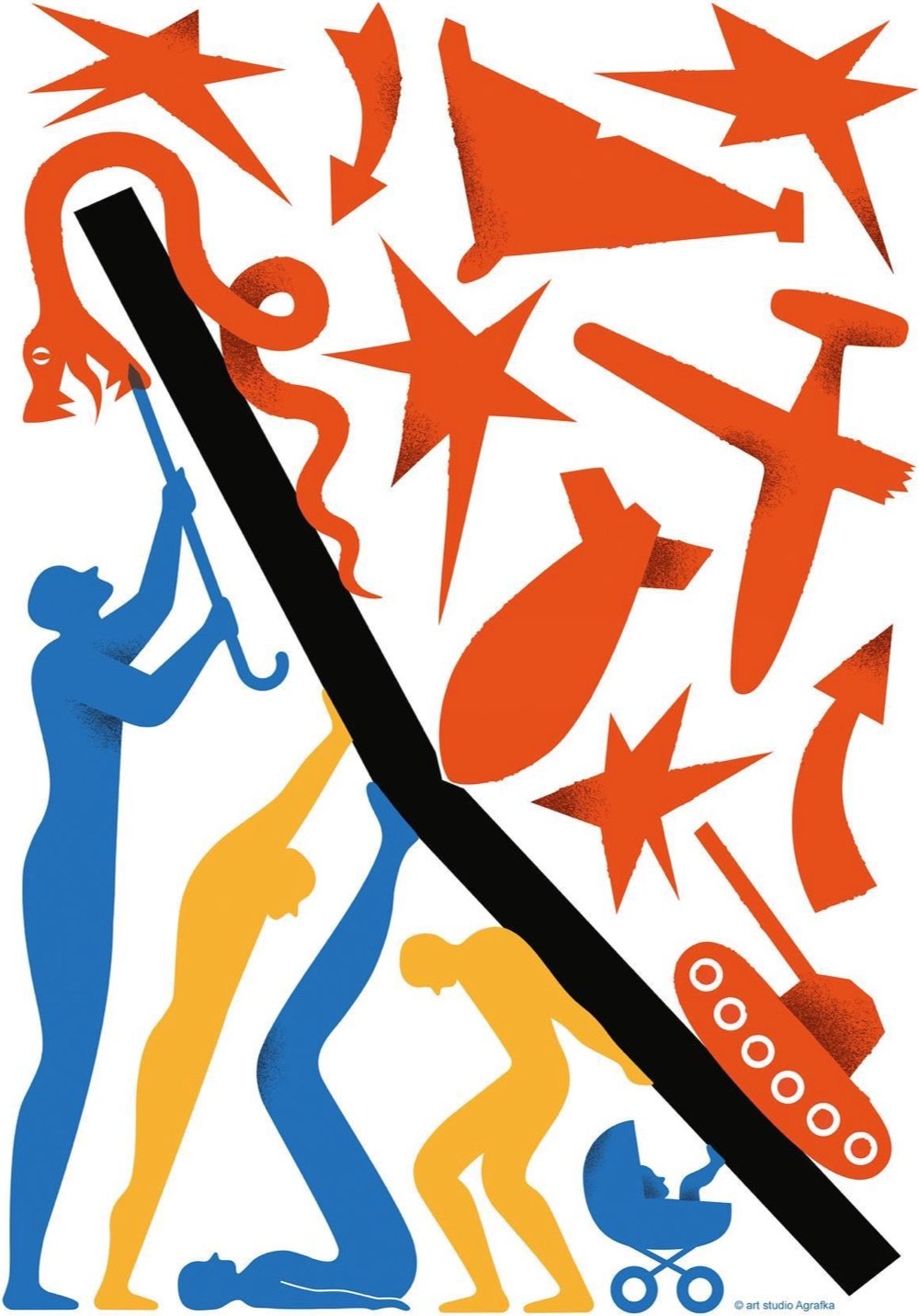
This is a poster for the 2023 International Book Arsenal Festival which recently took place in Kyiv, Ukraine. The poster was designed by Art Studio Agrafka from an illustration they originally did for the cover of Linkiesta Magazine.
A book festival. During a war. In a city under martial law. While schools and legislatures here in the US ban books about Black and LGBTQ+ experiences based on bad faith complaints of tiny fundamentalist parent groups. Tell me, who’s doing democracy better right now? (via @gray)
Elie Mystal writing for the Nation on the Supreme Court’s recent decision that declared affirmative action in college admissions unconstitutional.
But the death of affirmative action was not achieved merely through the machinations of Republican lawyers. While conservatives on the Supreme Court delivered the fatal blow, the policy has long been made vulnerable by the soft bigotry of parents, whose commitment to integration and equality turns cold the moment their little cherubs fail to get into their first choice of college or university. If you want to see a white liberal drop the pretense that they care about systemic racism and injustice, just tell them that their privately tutored kid didn’t get into whatever “elite” school they were hoping for. If you want to make an immigrant family adopt a Klansman’s view of the intelligence, culture, and work ethic of Black folks, tell them that their kid’s standardized test scores are not enough to guarantee entry into ivy-draped halls of power. Some of the most horribly racist claptrap folks have felt comfortable saying to my face has been said in the context of people telling me why they don’t like affirmative action, or why my credentials are somehow “unearned” because they were “given” to me by affirmative action.
That last bit is in some ways the most devastating: Black people are attacked and shamed simply because the policy exists, regardless of whether it benefited them or not. I’ve had white folks whom I could standardize-test into a goddamn coma tell me that I got into school only because of affirmative action. I once talked to a white guy — whose parents’ name was on one of the buildings on campus — who asked me how it felt to know I got “extra help” to get in. The sheer nerve of white folks is sometimes jaw-dropping.
I recommended this yesterday in a Quick Link, but Scene On Radio’s episode of their Seeing White series on White Affirmative Action is great.
This short video from Vox takes a look at the recent Supreme Court decision that struck down a gerrymandered congressional map in Alabama.
In 2013, a divided Supreme Court gutted one of the major pillars of the 1965 Voting Rights Act. In the 10 years since then, the court has moved even farther to the right. So when the Voting Rights Act came before the Supreme Court again in 2022, it didn’t look good for the law. But then something completely unexpected happened: in a 5-4 decision, two of the conservative justices voted with the 3 liberal justices to preserve the Voting Rights Act. And the effects could be huge.
At stake in the case was the way that Alabama divides up its Congressional districts. Alabama has seven districts, one of which is what’s called a “majority-minority district” in which Black Americans are the majority of the population. In 2022, a group of Black voters sued the state, saying that under the law, Alabama should actually have two majority-minority districts. And the Supreme Court agreed.
The decision could affect recently redrawn district maps in other states, which could in turn affect the balance of power in the House of Representatives. You can read more about these gerrymandering cases at the Brennan Center for Justice: Allen v. Milligan: Gerrymandering at the Supreme Court (Formerly Merrill v. Milligan) and Redistricting Litigation Roundup.
In a Memorial Day reflection, historian Heather Cox Richardson highlights a pamphlet distributed by the US War Department to Army soldiers during World War II on the topic of fascism: what it is and how to combat it.
The War Department thought it was important for Americans to understand the tactics fascists would use to take power in the United States. They would try to gain power “under the guise of ‘super-patriotism’ and ‘super-Americanism.’” And they would use three techniques:
First, they would pit religious, racial, and economic groups against one another to break down national unity. Part of that effort to divide and conquer would be a “well-planned ‘hate campaign’ against minority races, religions, and other groups.”
Second, they would deny any need for international cooperation, because that would fly in the face of their insistence that their supporters were better than everyone else. “In place of international cooperation, the fascists seek to substitute a perverted sort of ultra-nationalism which tells their people that they are the only people in the world who count. With this goes hatred and suspicion toward the people of all other nations.”
Third, fascists would insist that “the world has but two choices — either fascism or communism, and they label as ‘communists’ everyone who refuses to support them.”
It is “vitally important” to learn to spot native fascists, the government said, “even though they adopt names and slogans with popular appeal, drape themselves with the American flag, and attempt to carry out their program in the name of the democracy they are trying to destroy.”
See also The 14 Features of Eternal Fascism, How Fascism Works, Toni Morrison’s Ten Steps Towards Fascism, and Fighting Authoritarianism: 20 Lessons from the 20th Century.
For the NY Times, Jamelle Bouie takes a look at the legislation that Republicans around the country are pushing and, in the style of FDR’s Four Freedoms speech, outlines what goals they are attempting to achieve.
There is the freedom to control — to restrict the bodily autonomy of women and repress the existence of anyone who does not conform to traditional gender roles.
There is the freedom to exploit — to allow the owners of business and capital to weaken labor and take advantage of workers as they see fit.
There is the freedom to censor — to suppress ideas that challenge and threaten the ideologies of the ruling class.
And there is the freedom to menace — to carry weapons wherever you please, to brandish them in public, to turn the right of self-defense into a right to threaten other people.
That sounds about right, and it reminds me, as Republican “governance” often does these days, of Frank Wilhoit’s definition of conservatism:
Conservatism consists of exactly one proposition, to wit: There must be in-groups whom the law protects but does not bind, alongside out-groups whom the law binds but does not protect.
The folks at RuPublicans are having fun using AI to generate photorealistic imagery of prominent conservatives in drag. Here are Anita Filibust-Her McConnell, Claretta Corrupta, Rhonda Santy, serving looks:


From their Stories:
Oh honey, darlings, sugar pies! THANK YOU for following and sharing. Drag artists have brought me joy, laughter, helped heal old wounds, and given me permission to love myself — and I’m not the only one.
Now let’s get real kittens. Drag isn’t lip-syncing; it’s art, it’s heart, and oh honey, it’s protest. To those in power serving up false narratives like an overcooked wig at a drag brunch, listen up: we’re here, we’re queer, and we ain’t going anywhere.
(via @thoughtbrain)
I was keen to read that the debating method practiced by Trump, Putin, anti-vaxxers, and climate deniers of flooding the zone with a firehose of incorrect information has a name: the Gish Gallop. From Mehdi Hasan’s piece in The Atlantic, adapted from his new book, Win Every Argument: The Art of Debating, Persuading, and Public Speaking (ebook):
Trump may be the grand master of the Gish Gallop, but he is not its originator. That honor goes to the person who gave the method its name: Duane Tolbert Gish.
Gish was a biochemist at the Institute for Creation Research, a pseudo-scientific group that maintains all life on Earth was created in six days by the God of the Old Testament at some point in the past 10,000 years, with evolution playing no part. Gish publicized the ICR and its creed — and himself — by winning debates against evolutionists across the country.
During debates, after letting his opponent go first, Gish would “begin talking very quickly for perhaps an hour”, overwhelming his opponent with factual-sounding nonsense. According to Hasan, there are a few tactics you can use to counter the Gish Gallop, but you’ve got to be prepared. For instance, you can call them out:
Don’t let your audience be fooled into assuming that your opponent has special command of the subject because of all the “facts” they’ve just spouted. Explain to them what your opponent is doing, and that the Gallop is really just a sleight of hand.
Political cartoonist Jen Sorensen recently published this cartoon at The Nib about the harmful mischaracterization of human rights battles as mere “culture wars”.
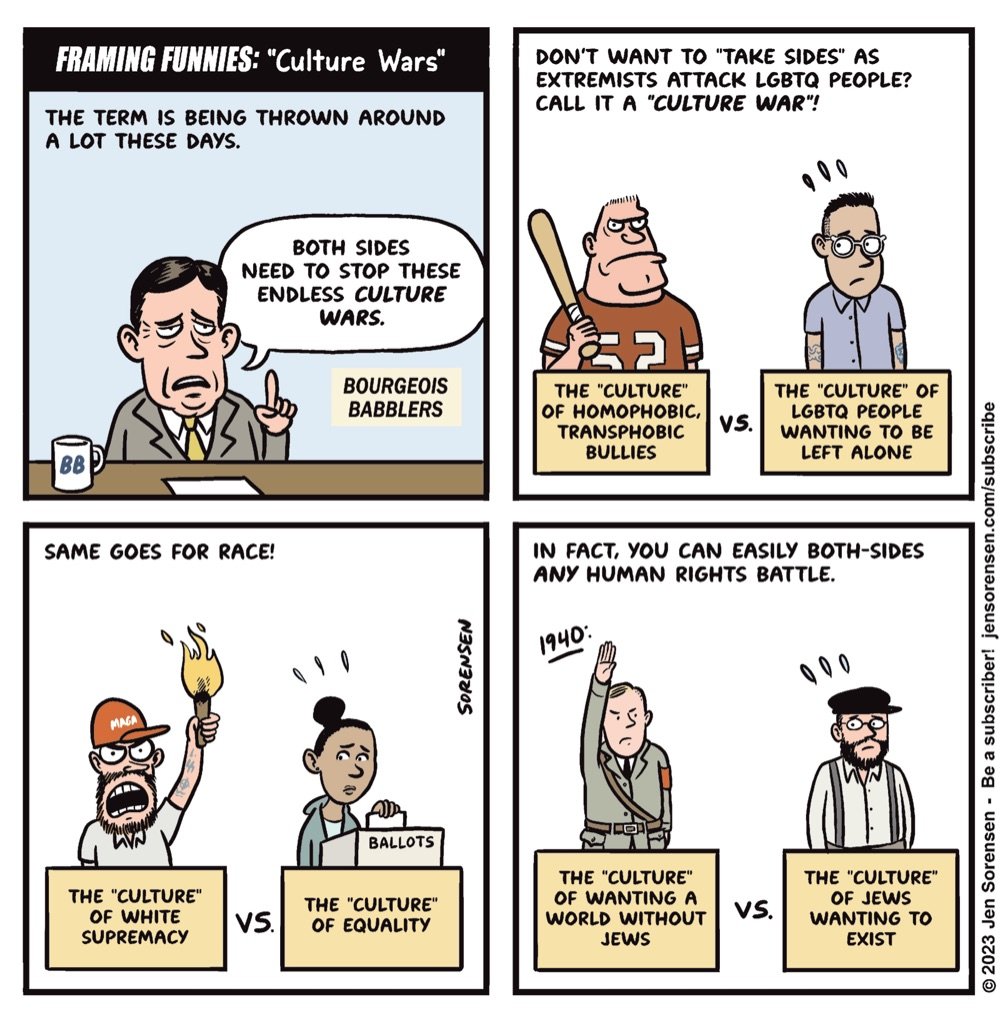
Here’s what she wrote about it:
The term “culture wars” is used by many well-meaning people, including many progressive writers and activists I admire. It’s a convenient way to refer to a number of issues. But in this current political moment, I think it’s a highly misleading euphemism. What we are experiencing in America right now is an asymmetrical attack on basic freedoms — a fascist movement that thrives on targeting certain groups, erasing history, and spreading dangerous falsehoods through a vast media apparatus. To call this a “culture war” is to legitimize the contemporary GOP and its extremist counterparts as a coherent and authentic “culture” worthy of respect. This is a misuse of the concept of culture, creating a false equivalence between marginalized groups and those who would harm or eliminate them in a quest for ever more power.
Yeah, spot on. You can follow Sorensen’s work on Mastodon, The Nib, Daily Kos, and Patreon.
*sigh* I get it. I get why people are so enthused about this Jon Stewart video. If you haven’t seen it, it’s a clip from Stewart’s show on Apple+ where he’s debating a Second Amendment purist gun nut who also happens to be a state senator from one of the states that’s trying to take away health care, reproductive rights, and persecute/prosecute LGBTQ+ people for daring to exist in public — basically a real “rights for me but not for thee” dickbag.
Anyway, I guess it’s fun to see Stewart dismantle this guy but arguing with a dimwitted ideologue in this manner is like that old saying: “What’s the sense of wrestling with a pig? You both get all over muddy…and the pig likes it.” Conservatives in America want what they want and don’t care about the arguments against it or facts or consensus or bipartisan anything. They only care about their radical ideology and their constituents who agree with them (and their constituents who don’t can go fuck themselves, I guess). In fact, they welcome arguments because it wastes the time and energy of people who would argue with them and they can’t lose because they don’t care about facts and they increasingly have no shame. See also Can You Really ‘Back The Blue’ If You’re Weak on Guns? from the same show.
Anyway, anyway, anyway…it’s gonna be a fun Monday here I guess.
Newer posts
Older posts





Socials & More