kottke.org posts about mathematics
Nicholas Rougeux is building an approximation of a Menger sponge, a 3-D fractal shape with no volume and infinite surface area, out of Post-It notes.

It looks about 90% complete…but as a Menger sponge, can you ever really call it finished? (thx, zach)
And in celebration, this is my new favorite fact about pi: we have calculated pi out to over 6.4 billion digits but only 39 of them are needed to calculate the circumference of a circle as big as the universe “with a precision comparable to the radius of a hydrogen atom”. (via @santheo)
Over at Boing Boing, Lee Billings has an interview with Greg Laughlin, an astrophysicist who recently came up with an equation for estimating the value of planets, a sort of Drake equation for cosmic economics.
This equation’s initial purpose, he wrote, was to put meaningful prices on the terrestrial exoplanets that Kepler was bound to discover. But he soon found it could be used equally well to place any planet-even our own-in a context that was simultaneously cosmic and commercial. In essence, you feed Laughlin’s equation some key parameters — a planet’s mass, its estimated temperature, and the age, type, and apparent brightness of its star — and out pops a number that should, Laughlin says, equate to cold, hard cash.
At the time, the exoplanet Gliese 581 c was thought to be the most Earth-like world known beyond our solar system. The equation said it was worth a measly $160. Mars fared better, priced at $14,000. And Earth? Our planet’s value emerged as nearly 5 quadrillion dollars. That’s about 100 times Earth’s yearly GDP, and perhaps, Laughlin thought, not a bad ballpark estimate for the total economic value of our world and the technological civilization it supports.
This is a wonderfully whimsical introduction to doodling by way of graph theory, snakes, Oroborous and mobius strips. Oh, and the Mobiaboros.
(via vulture)
Nothing in the news media yet, but many folks on Twitter and colleague Nassim Taleb are reporting that the father of fractal geometry is dead at age 85. We’re not there yet, but someday Mandelbrot’s name will be mentioned in the same breath as Einstein’s as a genius who fundamentally shifted our perception of how the world works.
Update: The NY Times has confirmation from Mandelbrot’s family. The cause of death was pancreatic cancer.
Originally written for mathematics students, this list of useful habits of mind is applicable to nearly anyone doing anything.
This 45-minute documentary on Andrew Wiles’ proof of Fermat’s Last Theorem is surprisingly powerful and emotional. Give it until 1:45 or so and you’ll want to watch the whole thing. The film is not really about math; it’s about all of those movie trailer cliches — “one man!”, “finds the truth!”, “fights the odds!”, etc. — except that this is actually true and poignant.
And not just broken but unrepairable without the addition of uncertainty. Gödel’s incompleteness theorems aren’t even the half of it.
With Friedman’s work, it seems Gödel’s delayed triumph has arrived: the final proof that if there is a universal grammar of numbers in which all facets of their behaviour can be expressed, it lies beyond our ken.
But don’t worry…”the most severe implications are philosophical”. Phew?
Here’s the entire text of a talk given at math, magic, and puzzle gathering (attendees included Stephen Wolfram and John Horton “Game of Life” Conway) by Gary Foshee:
I have two children. One is a boy born on a Tuesday. What is the probability I have two boys?
The first thing you think is “What has Tuesday got to do with it?” Well, it has everything to do with it.
The key word in the puzzle is “probability”, which is not a very well understood term outside of the mathematics community. The full answer is at the end of the article.
After analyzing dozens of Hollywood films, a team of researchers has found evidence that the visual rhythm of movies at the shot level matches a pattern called the 1/f fluctuation, the same pattern that is found in dozens of natually occurring phenomena, including the length of the human attention span.
These results suggest that Hollywood film has become increasingly clustered in packets of shots of similar length. For example, action sequences are typically a cluster of relatively short shots, whereas dialogue sequences (with alternating shots and reverse-shots focused sequentially on the speakers) are likely to be a cluster of longer shots. In this manner and others, film editors and directors have incrementally increased their control over the visual momentum of their narratives, making the relations among shot lengths more coherent over a 70-year span.
Modern action movies are particularly adept at matching the audience’s attention span in this manner. The full paper is available here.
I was really into fractals in college (I know…) when I was making rave flyers (I know!) for a friend’s parties in Iowa (I know! I know! Shut up already!). Anyway, the thing that I really used to love doing with this fractal application that I had on my computer was zooming in to different parts of the familiar Mandelbrot set as far as I could. I never got very far…between 5 or 6 zooms in, my Packard Bell 486/66 (running Windows 3.11) would buckle under the computational pressure and hang. Therefore, I absolutely love this extremely deep HD zoom into the Mandelbrot set:
Just how deep is this computational rabbit hole?
The final magnification is e.214. Want some perspective? a magnification of e.12 would increase the size of a particle to the same as the earths orbit! e.21 would make a particle look the same size as the milky way and e.42 would be equal to the universe. This zoom smashes all of them all away. If you were “actually” traveling into the fractal your speed would be faster than the speed of light.
After awhile, the self-similarity of the thing is almost too much to bear; I think I went into a coma around 5:00 but snapped to in time for the exciting (but not unexpected) conclusion. Full-screen in a dark room is recommended.
Update: This 46-minute video seems to be the deepest fractal zoom out there right now, with a zoom level of 10^10000.
The magnification factor is so much less in the video above but that one’s more fun/artistic. And 10^10000 is such an absurdly large number1 that there’s no way to think about it in physical terms…the zoom factor from the size of the universe to the smallest measurable distance (the Planck length) is only about 10^60.
Photographs of curves found in nature and the graphs and functions that go with them.
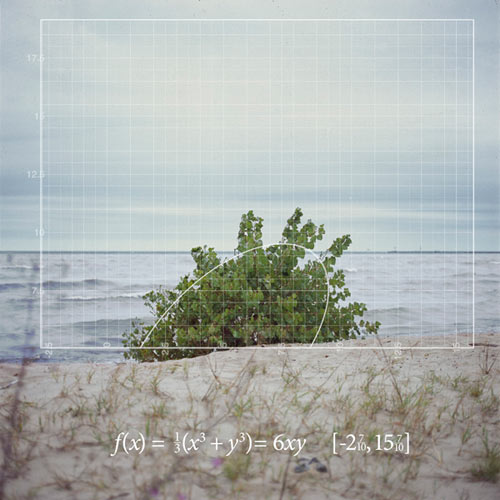
(via snarkmarket)
Mathematician Steven Strogatz is doing what sounds like a fascinating series of posts on mathematics for adults. From the initial post:
I’ll be writing about the elements of mathematics, from pre-school to grad school, for anyone out there who’d like to have a second chance at the subject — but this time from an adult perspective. It’s not intended to be remedial. The goal is to give you a better feeling for what math is all about and why it’s so enthralling to those who get it.
More subject blogs like this, please. There are lots of art, politics, technology, fashion, economics, typography, photography, and physics blogs out there, but almost none of them appeal to the beginner or interested non-expert. (thx, steve)
The ham sandwich theorem is sometimes called ham and cheese sandwich theorem, the pancake theorem, and the Stone-Tukey theorem but not the sandwich theorem.
The ham sandwich theorem is also sometimes referred to as the “ham and cheese sandwich theorem”, again referring to the special case when n = 3 and the three objects are
1. a chunk of ham,
2. a slice of cheese, and
3. two slices of bread (treated as a single disconnected object).
The theorem then states that it is possible to slice the ham and cheese sandwich in half such that each half contains the same amount of bread, cheese, and ham. It is possible to treat the two slices of bread as a single object, because the theorem only requires that the portion on each side of the plane vary continuously as the plane moves through 3-space.
No idea how this is related to the I Cut You Choose conundrum.
Newer posts
Older posts


Socials & More