kottke.org posts about legal
I’m surprised and mostly pleased that the Supreme Court has upheld President Obama’s Patient Protection and Affordable Care Act.
The Court’s ruling means, that unless Congress acts, in 2014 all Americans will be required to purchase health insurance in the most sweeping overhaul of the nation’s health care system since the Great Society. The Court, according to early analysis, redefined the mandate as a tax, skirting some Constitutional questions but offering a dramatic affirmation to Obama’s key initiative.
Update: Josh Marshall speaks for me here.
This is an imperfect law. But what’s most important is that it provides a structure under which the country can make a start not only on universal coverage — as an ethical imperative — but on doing away with the waste and inefficiencies created by the chronic market failure of the US health insurance system. Again, that matters. And I suspect that there’s no going back.
On Thursday, 80 lawsuits against the NFL related to brain injuries and concussions were combined into one complaint and filed in Philadelphia. The suit also names helmet maker Ridell, and if I’m reading the article correctly, 2100 former players are involved in the case.
Former running back Kevin Turner, now suffering from Lou Gehrig’s Disease, said:
The NFL must open its eyes to the consequences of its actions. The NFL has the power not only to give former players the care they deserve, but also to ensure that future generations of football players do not suffer the way that many in my generation have. For the longest time, about the first 10 years after I retired in January 2000, I thought I had just turned into a loser overnight. I couldn’t figure out what was wrong. It was a very scary proposition — until I found out there were a lot more guys just like me. I find they had been through some of the same struggles. I realized this is no longer a coincidence.
Back in February, we linked to a Grantland piece by economists Tyler Cowen and Kevin Grier about head injuries leading to the end of the NFL. In their version, injuries to high school and college students result in lawsuits making the sport prohibitively expensive to offer to their students (along with a perception that it’s too dangerous for kids to play).
Is this case the beginning of that timeline? Depending on what comes out in the lawsuit, one (unjust) popular opinion will be that the players should have known they were playing a dangerous game and they were handsomely rewarded to boot. It’s not really a fair opinion, but people love their football. (You can see evidence of this in the comments to the ESPN article linked at the top.) A best case scenario, I would think, would be for the NFL to settle with some sort of acknowledgement of the issue. Not lip-service, but actual changes to current policies and future support for former players.
In happier NFL news, Trick Shot Quarterback, Alex Tanney was signed yesterday by the KC Chiefs. Regardless of setting the NCAA Division III record for passing with 14,249 yards, the NCAA record for touchdowns with 157, and only throwing 30 interceptions in college, Tanney had gone undrafted.
Antonin Scalia once said that no one had ever been executed in the US for a crime they didn’t commit. Well, the Columbia Human Rights Law Review is devoting its entire spring issue to the case of Carlos DeLuna, who was executed by the state of Texas in 1989 for the murder of Wanda Lopez. Their investigation reveals that another Carlos, Carlos Hernandez, actually committed the murder.
Many other glaring discrepancies also stand out in the DeLuna case. He was put on death row largely on the eyewitness testimony of one man, Kevan Baker, who had seen the fight inside the Shamrock and watched the attacker flee the scene.
Yet when Baker was interviewed 20 years later, he said that he hadn’t been that sure about the identification as he had trouble telling one Hispanic person apart from another.
Then there was the crime-scene investigation. Detectives failed to carry out or bungled basic forensic procedures that might have revealed information about the killer. No blood samples were collected and tested for the culprit’s blood type.
Fingerprinting was so badly handled that no useable fingerprints were taken. None of the items found on the floor of the Shamrock - a cigarette stub, chewing gum, a button, comb and beer cans - were forensically examined for saliva or blood.
There was no scraping of the victim’s fingernails for traces of the attacker’s skin. When Liebman and his students studied digitally enhanced copies of crime scene photographs, they were amazed to find the footprint from a man’s shoe imprinted in a pool of Lopez’s blood on the floor - yet no effort was made to measure it.
“There it was,” says Liebman. “The murderer had left his calling card at the scene, but it was never used.”
Even the murder weapon, the knife, was not properly examined, though it was covered in blood and flesh.
Other photographs show Lopez’s blood splattered up to three feet high on the walls of the Shamrock counter. Yet when DeLuna’s clothes and shoes were tested for traces of blood, not a single microscopic drop was found. The prosecution said it must have been washed away by the rain.
Awful. See also Cameron Todd Willingham.
Matt Yglesias argues that because of the way copyright is viewed by the public and interpreted by lawmakers and the courts, making an album like The Beastie Boys’ Paul’s Boutique would be nearly impossible today.
The death on Friday of Adam Yauch, best known as the Beastie Boys’ MCA, surely sent many of us back to old albums we may not have heard for a while. And anyone who threw on Paul’s Boutique, the Boys’ best album, was surely struck by the sense that they don’t make records like that anymore. That’s not just because tastes and styles have changed. The entire album is based on lavish sampling of other recordings. “Shake Your Rump,” which leads Slate’s #MCATracks playlist, features samples of 14 songs by 12 separate artists. In all, the album is thought to have as many as 300 total samples. The sampling gave Paul’s Boutique a sound that remains almost as distinctive today as it was when it was released in 1989.
Perhaps the main reason-and certainly the saddest reason-that it still sounds distinctive is that a rapidly shifting legal and economic landscape made it essentially impossible to repeat.
Hyman Strachman is one of the biggest bootleggers of Hollywood movies. He’s also 92 years old, a WWII veteran, and gives his movies away to American troops serving overseas.
“Big Hy” — his handle among many loyal customers — would almost certainly be cast as Hollywood Enemy No. 1 but for a few details. He is actually Hyman Strachman, a 92-year-old, 5-foot-5 World War II veteran trying to stay busy after the death of his wife. And he has sent every one of his copied DVDs, almost 4,000 boxes of them to date, free to American soldiers in Iraq and Afghanistan.
With the United States military presence in those regions dwindling, Big Hy Strachman will live on in many soldiers’ hearts as one of the war’s more shadowy heroes.
“It’s not the right thing to do, but I did it,” Mr. Strachman said, acknowledging that his actions violated copyright law.
Twitter has developed something called the Innovator’s Patent Agreement, which is an agreement between the company and its employees that their patents won’t be used in offensive lawsuits (as opposed to defensive lawsuits).
The IPA is a new way to do patent assignment that keeps control in the hands of engineers and designers. It is a commitment from Twitter to our employees that patents can only be used for defensive purposes. We will not use the patents from employees’ inventions in offensive litigation without their permission. What’s more, this control flows with the patents, so if we sold them to others, they could only use them as the inventor intended.
This is a significant departure from the current state of affairs in the industry. Typically, engineers and designers sign an agreement with their company that irrevocably gives that company any patents filed related to the employee’s work. The company then has control over the patents and can use them however they want, which may include selling them to others who can also use them however they want. With the IPA, employees can be assured that their patents will be used only as a shield rather than as a weapon.
Red Hat has had a similar policy in place for many years.
The bulk of the Jan 27th episode of This American Life was about Alabama’s tough new immigration laws.
Last Summer, Alabama passed HB56, the most sweeping immigration bill in the country. It’s an example of a strategy called “attrition through enforcement” or, more colloquially, “self-deportation” — making life so hard on undocumented immigrants that they choose to leave the country. But as reporter Jack Hitt found, the new law has had lots of other unintended consequences.
It’s called Into the Abyss and it opens today. Trailer is here:
There’s an interview with Herzog about the film on the Tribeca Film Festival site and Ebert gave it four stars.
From Lapham’s Quarterly, Christopher Hitchens on capital punishment in America.
Since then no country has been allowed to apply for membership or association with the European Union without, as a precondition, dismantling its apparatus of execution. This has led states like Turkey to forego what was once a sort of national staple. The United Nations condemns capital punishment-especially for those who have not yet reached adulthood-and the Vatican has come close to forbidding if not actually anathematizing the business. This leaves the United States of America as the only nation in what one might call the West, that does not just continue with the infliction of the death penalty but has in the recent past expanded its reach. More American states have restored it in theory and carried it out in practice, and the last time the Supreme Court heard argument on the question it was to determine whether capital punishment should be inflicted for a crime other than first-degree murder (the rape of a child being the suggested pretext for extension).
Hitchens, as you may have guessed, pins much of the blame on religion…after all, the US is the most (or only?) fundamentalist country in the West. (via ★interesting-links)
Gothamist is trying something new: long-form articles available for a small fee ($2-3) on the Kindle or as a PDF. The first one in the series is a real corker…Confessions of a “Rape Cop” Juror, a piece written by a member of the jury that acquitted two NYPD officers charged with raping a young woman in her East Village apartment.
The former cop sprang from his chair and rushed toward me, and before I could step back, the stocky arms of the ex-boxer were curled around my shoulders. To my left, I saw a crowd of faces; to my right, a place setting. One knife, one fork, and one dull spoon wrapped in a white cloth napkin — not much help if he started strangling me. The arms tightened, and then the high-pitched, soft-spoken voice I recognized from the witness stand whispered, “Thank you.”
My chest sank with a long exhale, and a whirlwind of high-powered suits and smiles rose from their glasses of Cabernet. They floated toward me with outstretched hands and watery eyes, the aroma of freshly baked focaccia robiolas mixing with their cologne. One floor below, diners in this Murray Hill Italian restaurant chattered away ignorant of the strange encounter at the top of the back staircase. The man hugging me was supposed to be the monster I had spent seven weeks analyzing and seven days judging. This was Kenneth Moreno, Rape Cop.
I haven’t read the piece but The Awl’s Choire Sicha has:
It’s a fascinating read, and I mean that in a very honest sense. In large part it’s about how unbelievably important jury service is in America, and about how we treat those accused of crimes. Whether you like the verdict or not, or whether you like the case presented by prosecutors or not (SIGH), this view into the thinking and process of the jurors is really valuable.
Finally got around to listening to the excellent episode of This American Life on patents: When Patents Attack! The episode surveys the state of the US patent system, using Nathan Myhrvold’s smarmy Intellectual Ventures as a hook to tell the story.
In polls, as many as 80 percent of software engineers say the patent system actually hinders innovation. In other words, it does exactly the opposite of what it’s supposed to do. It doesn’t encourage them to come up with new ideas and create new products, it actually gets in their way.
The Economist chimed in as well, saying that the American patent system is “a travesty which threatens the wealth and welfare of the whole world”.
At a time when our future affluence depends so heavily on innovation, we have drifted toward a patent regime that not only fails to fulfil its justifying function, to incentivise innovation, but actively impedes innovation.
Swartz is known around these parts for being a programmer, long-time blogger, early employee of Reddit, and legal enthusiast. Nick Bilton, writing for the NY Times Bits blog:
Aaron Swartz, a 24-year-old programmer and online political activist, was indicted Tuesday in Boston on charges that he stole over four million documents from the Massachusetts Institute of Technology and JSTOR, an archive of scientific journals and academic papers. (Read the full indictment.)
The charges were filed by the United States Attorney for the District of Massachusetts, Carmen M. Ortiz, and could result in up to 35 years in prison and a $1 million fine.
In a press release, Ms. Ortiz’s office said that Mr. Swartz broke into a restricted area of M.I.T. and entered a computer wiring closet. Mr. Swartz apparently then accessed the M.I.T. computer network and stole millions of documents from JSTOR.
The full indictment is here (PDF, via @delfuego). Non-PDF version is here. The whole thing is worth a read for the technical detail of how the “hack” was allegedly perpetrated:
26. This time around, Swartz circumvented MIT’s guest registration process altogether when he connected to MIT’s computer network. By this point, Swartz was familiar with the IP addresses available to be assigned at the switch in the restricted network interface closet in the basement of MIT’s Building 16. Swartz simply hard-wired into the network and assigned himself two IP addresses. He hid the Acer laptop and a succession of external storage drives under a box in the closet, so that they would not be obvious to anyone who might enter the closet. January 4 through 6, 2011
27. On January 4, 2011, Aaron Swartz was observed entering the restricted basement network wiring closet to replace an external hard drive attached to his computer.
28 On January 6, 2011, Swartz returned to the wiring closet to remove his computer equipment. This time he attempted to evade identification at the entrance to the restricted area. As Swartz entered the wiring closet, he held his bicycle helmet like a mask to shield his face, looking through ventilation holes in the helmet. Swartz then removed his computer equipment from the closet, put it in his backpack, and left, again masking his face with the bicycle helmet before peering through a crack in the double doors and cautiously stepping out.
Here’s a statement from Demand Progress, an organization founded by Swartz, about the case (via @aaronsw). This is a very different take from the indictment.
Moments ago, Aaron Swartz, former executive director and founder of Demand Progress, was indicted by the US government. As best as we can tell, he is being charged with allegedly downloading too many scholarly journal articles from the Web. The government contends that downloading said articles is actually felony computer hacking and should be punished with time in prison.
“This makes no sense,” said Demand Progress Executive Director David Segal; “it’s like trying to put someone in jail for allegedly checking too many books out of the library.”
“It’s even more strange because the alleged victim has settled any claims against Aaron, explained they’ve suffered no loss or damage, and asked the government not to prosecute,” Segal added.
James Jacobs, the Government Documents Librarian at Stanford University, also denounced the arrest: “Aaron’s prosecution undermines academic inquiry and democratic principles,” Jacobs said. “It’s incredible that the government would try to lock someone up for allegedly looking up articles at a library.”
JSTOR, the document storage service allegedly accessed by Swartz, released a statement on the case (via @delfuego):
Last fall and winter, JSTOR experienced a significant misuse of our database. A substantial portion of our publisher partners’ content was downloaded in an unauthorized fashion using the network at the Massachusetts Institute of Technology, one of our participating institutions. The content taken was systematically downloaded using an approach designed to avoid detection by our monitoring systems.
The downloaded content included over 4 million articles, book reviews, and other content from our publisher partner’s academic journals and other publications; it did not include any personally identifying information about JSTOR users.
We stopped this downloading activity, and the individual responsible, Mr. Swartz, was identified. We secured from Mr. Swartz the content that was taken, and received confirmation that the content was not and would not be used, copied, transferred, or distributed.
The criminal investigation and today’s indictment of Mr. Swartz has been directed by the United States Attorney’s Office.
As for what Swartz was planning to do with all these documents, it’s not difficult to guess…he’s done something like this before (this isn’t actually a very good guess…see the update below):
Those courts, with the help of the Government Printing Office, had opened a free trial of Pacer at 17 libraries around the country. Mr. Malamud urged fellow activists to go to those libraries, download as many court documents as they could, and send them to him for republication on the Web, where Google could get to them.
Aaron Swartz, a 22-year-old Stanford dropout and entrepreneur who read Mr. Malamud’s appeal, managed to download an estimated 20 percent of the entire database: 19,856,160 pages of text.
Then on Sept. 29, all of the free servers stopped serving. The government, it turns out, was not pleased.
A notice went out from the Government Printing Office that the free Pacer pilot program was suspended, “pending an evaluation.” A couple of weeks later, a Government Printing Office official, Richard G. Davis, told librarians that “the security of the Pacer service was compromised. The F.B.I. is conducting an investigation.”
Lawyers for Mr. Malamud and Mr. Swartz told them that they appeared to have broken no laws, noting nonetheless that it was impossible to say what angry government officials might do.
Twice bitten, indictment? Is that how the saying goes?
Update: This is a more accurate guess as to what Swartz wanted with the JSTOR documents: analyse the documents as part of his on-going work with “the corrupting influence of big money on institutions”…and *not* to free non-copyrighted information from an inefficient gatekeeper as with the PACER data. From the front page of his web site.
He is the author of numerous articles on a variety of topics, especially the corrupting influence of big money on institutions including nonprofits, the media, politics, and public opinion. In conjunction with Shireen Barday, he downloaded and analyzed 441,170 law review articles to determine the source of their funding; the results were published in the Stanford Law Review. From 2010-11, he researched these topics as a Fellow at the Harvard Ethics Center Lab on Institutional Corruption.
The Stanford Law Review article is available here.
Wow. So remember the photo taken by the monkey and Techdirt’s subsequent musings about who owns the copyright a photo taken by a monkey? Today Techdirt is reporting that Caters News Agency sent a takedown notice to Techdirt asking them to remove the monkey’s photos. Totally not making this up.
We were a bit surprised to receive a notice on Monday from Caters News, telling us they represented David Slater with respect to the syndication of those photos, and asking us to take down the photos. The notice was not a DMCA takedown notice. It doesn’t even mention copyright, though that seems like the only basis upon which they would make such a takedown request. And, to be clear, it was not in the least bit threatening. There is no legal language and no threat at all in the note.
When asked for clarification by Techdirt, a representative from Caters replied:
Michael, regardless of the issue of who does and doesn’t own the copyright — it is 100% clear that the copyright owner is not yourself. You have blatantly ‘lifted’ these photographs from somewhere — I presume the Daily Mail online. On the presumption that you do not like to encourage copyright theft (regardless of who owns it) then please remove the photographs.
Onionesque. Please someone interview the monkey about his/her views on this.
Andy Baio got sued for using a pixel-art representation of Jay Maisel’s iconic photo of Miles Davis on the chiptune album of Davis’ music he commissioned in 2009. He settled with Maisel by paying him $32,500 and agreeing to stop using the artwork.
After seven months of legal wrangling, we reached a settlement. Last September, I paid Maisel a sum of $32,500 and I’m unable to use the artwork again. (On the plus side, if you have a copy, it’s now a collector’s item!) I’m not exactly thrilled with this outcome, but I’m relieved it’s over.
But this is important: the fact that I settled is not an admission of guilt. My lawyers and I firmly believe that the pixel art is “fair use” and Maisel and his counsel firmly disagree. I settled for one reason: this was the least expensive option available.
At the heart of this settlement is a debate that’s been going on for decades, playing out between artists and copyright holders in and out of the courts. In particular, I think this settlement raises some interesting issues about the state of copyright for anyone involved in digital reinterpretations of copyrighted works.
Unfortunately, Baio’s post does nothing to dissuade me that Maisel is a joyless putz. Seeing this kind of behavior from large clueless companies is almost expected but from a a fellow creative artist? Inexcusable. Surely some reasonable arrangement could have been made without visiting enormous stress and a $30K+ bill onto a man with a young family. Disgusting.
Paul Ford is writing on Ftrain.com again and it’s just super. Today’s post is a short story that extrapolates our present cultural preoccupation with lawsuits, privacy, and surveillance into a future where anyone can bring a lawsuit for copyright violations against a fetus.
We had gone to a baseball game at the beginning of the season. They had played a song on the public address system, and she sang along without permission. They used to factor that into ticket price — they still do if you pay extra or have a season pass — but now other companies handled the followup. And here was the video from that day, one of many tens of thousands simultaneously recorded from gun scanners on the stadium roof. In the video my daughter wore a cap and a blue T-shirt. I sat beside her, my arm over her shoulder, grinning. Her voice was clear and high; the ambient roar of the audience beyond us filtered down to static.
A gem of a Q&A from Quora: How valid is the implied legal advice in Jay-Z’s “99 Problems”? The lyrics, in part:
“Well do you mind if I look around the car a little bit?”
Well my glove compartment is locked, so is the trunk in the back
And I know my rights, so you gon’ need a warrant for that
And the answer:
Consenting to a voluntary search is never a good idea, especially if you have felony weight on you. The standard to search the glove compartment is actually fairly low in California, since it’s accessible to the driver. I’m not sure how the locked status interferes with it being a glove compartment. The trunk can be opened if the car is impounded, for inventory reasons, which is a common way to get evidence. However, a locked case inside the trunk will not be opened (depends on the state).
(via ★kellan)
A jury foreman in a criminal case describes his experience and what the jury ultimately decided (or actually, didn’t decide).
These are the facts we were given as a jury, facts upon which we were to decide if a boy was guilty of a crime that would put him in prison for 10 years. We were admonished to consider all of the facts but nothing outside of them. Don’t consider the sentence, or the age, or the race, or anything unrelated to what we heard while sitting in the juror box. Just focus on the facts that are presented. Yet, we were also told, time and again, that our Constitution is absolutely unwavering in its mission to protect the innocent, that no matter how clear-cut the evidence may seem, the burden of proof in criminal cases always, always, always falls on the prosecution. The boy sitting in that chair next to a pair of public defenders, possibly wearing borrowed clothes to look presentable in court, is innocent until he is proven guilty beyond a reasonable doubt.
Taryn Simon spent five days photographing items confiscated from people flying into New York’s JFK airport. This one is “mystery meat”:

These images are from a set of 1,075 photographs — shot over five days last year for the book and exhibition, “Contraband” — of items detained or seized from passengers or express mail entering the United States from abroad at the New York airport. The miscellany of prohibited objects — from the everyday to the illegal to the just plain odd — attests to a growing worldwide traffic in counterfeit goods and natural exotica and offers a snapshot of the United States as seen through its illicit material needs and desires.
Here’s more about the project, which will be released in book form and also put on display in galleries in LA and NYC.
Steve Jobs praised an iPad RSS reader called Pulse in his keynote yesterday. Then the NY Times complained about the app and Apple pulled it from the store later in the day.
The Pulse News Reader app, makes commercial use of the NYTimes.com and Boston.com RSS feeds, in violation of their Terms of Use*. Thus, the use of our content is unlicensed. The app also frames the NYTimes.com and Boston.com websites in violation of their respective Terms of Use.
Four things:
1. Why is there a comma after “The Pulse News Reader app” in the laywer’s note to Apple?
2. The very same NY Times ran a positive review of the very same Pulse a few days ago. Doh!
3. Seems like all the Pulse guys need to do is unbundle the NY Times feeds and open the actual nytimes.com pages into a generic browser window and all is good.
4. I wonder why the Times et al. haven’t complained about Instapaper yet. It might not technically infringe on copyright, but magazines and newspapers can’t be too happy about an app that strips out all the advertising from their articles…as much as we would all be sad to see it go.
The SEC has filed a lawsuit against Goldman Sachs for fraud. Specifically:
According to the complaint, Goldman created Abacus 2007-AC1 in February 2007, at the request of John A. Paulson, a prominent hedge fund manager who earned an estimated $3.7 billion in 2007 by correctly wagering that the housing bubble would burst.
Goldman let Mr. Paulson select mortgage bonds that he wanted to bet against — the ones he believed were most likely to lose value — and packaged those bonds into Abacus 2007-AC1, according to the S.E.C. complaint. Goldman then sold the Abacus deal to investors like foreign banks, pension funds, insurance companies and other hedge funds.
But the deck was stacked against the Abacus investors, the complaint contends, because the investment was filled with bonds chosen by Mr. Paulson as likely to default. Goldman told investors in Abacus marketing materials reviewed by The Times that the bonds would be chosen by an independent manager.
Goldman’s stock price is currently off about 12%.
In defending itself against a copyright lawsuit brought by Viacom, YouTube notes that the media company has been surreptitiously uploading its copyrighted content to YouTube for years.
For years, Viacom continuously and secretly uploaded its content to YouTube, even while publicly complaining about its presence there. It hired no fewer than 18 different marketing agencies to upload its content to the site. It deliberately “roughed up” the videos to make them look stolen or leaked. It opened YouTube accounts using phony email addresses. It even sent employees to Kinko’s to upload clips from computers that couldn’t be traced to Viacom. And in an effort to promote its own shows, as a matter of company policy Viacom routinely left up clips from shows that had been uploaded to YouTube by ordinary users. Executives as high up as the president of Comedy Central and the head of MTV Networks felt “very strongly” that clips from shows like The Daily Show and The Colbert Report should remain on YouTube.
This jibes with what I heard a couple of years ago:
I heard that the staff of the Daily Show and Colbert Report upload the shows to YouTube as soon as they can after the shows air and then the next day, lawyers from Comedy Central hit YouTube with takedown requests for the uploaded shows.
(thx, @peretti)
Congrats to Jen Bekman on getting funding for 20x2001.
“I love the idea of taking the friction out of the art world,” said Mr. Conrad. “A lot of people want to buy nice things, but don’t know how. Jen has built a business from that, which is growing very nicely and has a lot of repeat customers.”
[1] In light of the new FTC guidelines for disclosure by bloggers2, a few somewhat relevent statements. 1. 20x200 has in the past paid $1200 to sponsor the kottke.org RSS feed. 2. I have linked to 20x200 and Jen Bekman’s gallery several times on kottke.org, for which Jen Bekman has thanked me, which is a good feeling, to be thanked, and perhaps that subconsciously predisposes me towards future linking because who doesn’t like to be thanked? 3. Jen Bekman is a friend. 4. I also know Caterina Fake, Zach Klein, and Scott Heiferman socially; they are a few of 20x200’s angel investors. 5. I am a resident of New York City, in which 20x200 is headquartered. 6. I have purchased art from 20x200 in the past. 7. I may have received a 20x200 print from Jen Bekman herself, either as a straight-up gift or as a promotional item. Honestly, I can’t remember if she gave me anything, what it was, or the circumstances of the giving. 8. I have received 20x200 prints as gifts from others. They are thanked. 9. I know my wife and my wife knows Jen Bekman. 10. I may have unwittingly posed for photos next to 20x200 artwork hanging in my residence or in the residences of others, giving the impression that I am endorsing said artwork. Apologies. 11. I have agreed to, at some point in the future, curating a selection of artworks for 20x200 and then chatting casually with Jen Bekman about my choices, an edited transcript of which will appear on the 20x200 web site. As far as I know, no payment for this service is forthcoming and if it was, I would refuse it politely. 12. Jen Bekman’s dog’s name is Ollie. So is my son’s. ↩
[2] Why just for bloggers? Do New York Times book, music, and movie reviewers disclose that they received review copies for free? ↩
David Treuer, an American Indian, is writing a series of dispatches for Slate in which he visits Indian casinos. I’d never heard the story of how casinos on Indian lands came to be. It seems a state tax bill on a mobile home led to a lawsuit which led to a legal precedent that state and federal governments have no regulatory jurisdiction on Indian lands.
The Supreme Court ruling in the Bryan case was expansive. More than just a ruling on taxation, it declared that states and the feds had the right to police the reservation only in the interest of “law and order” and had no civil or regulatory jurisdiction over sovereign Indian nations. Until this time, tribes and states more or less assumed that states had civil and regulatory power on reservations. But the Supreme Court maintained that as sovereign nations, Indian tribes had always had the right to govern themselves (including civil and regulatory powers), just as all nations do, and that tribes should deal with the U.S. federal government, not with states. Kansas, for example, has no power to levy taxes in Luxembourg — and not only because Luxembourg is far away.
I often enjoy what Christopher Hitchens says and how he says it. Here he wades smartly into the Henry Louis Gates Jr. arrest.
It is the U.S. Constitution, and not some competitive agglomeration of communities or constituencies, that makes a citizen the sovereign of his own home and privacy. There is absolutely no legal requirement to be polite in the defense of this right.
(via gruber)
Here’s a new wrinkle in the ongoing battle with people that inline other people’s images: I stole your images, put them back or I will call a lawyer.
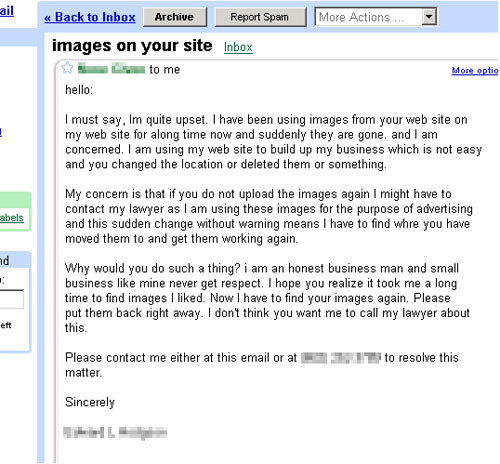
Why is business so hard? (thx, jillian)
Update: That image is from 2005…here’s the rest of the story and a couple more images. (thx, andy)
Yesterday I linked to a long piece by attorney Brock Shinen discussing whether individual posts to Twitter are copyrightable and asked:
Does this mean that nearly all of Twitter’s content is in the public domain? Or can you copyright a collection of tweets…the entire output of one person, for instance?
Brock sent along a short reply to my question, reprinted here with his kind permission:
This is information and not advice: It’s possible (and likely) that the majority of individual Tweets are in the public domain. But copyright protection may extend to a compilation of otherwise non-protectable Tweets. The question of whether ‘you’ can do that as opposed to the author of those Tweets is tricky and would depend on how it’s done. If the compilation is authored in such a way as to suggest a false designation of origin (i.e., that the person compiling the Tweets actually authored them), you might run into false designation claims. Also, as a practical matter, you may still get sued and forced to spend tens of thousands of dollars to defend a lawsuit you might otherwise win - if you can afford to get to trial. In the end, if you are a Tweet author and want to protect your Tweets, then you should probably compile them and seek protection with the US Copyright Office. If that works out for you, you’re set. If the Copyright Office denies your application for registration, you have your answer.
In the opinion of intellectual copyright attorney Brock Shinen, the short answer is “no”.
I admit, I think a protectable Tweet exists in theory. I have read hundreds if not thousands of Tweets and have yet to read one I believe would be protectable, but the possibility exists. The question is not: Are Tweets Copyrightable. The question is: Is This Tweet Copyrightable. The copyrightability of Tweets is not dependent on the fact that they are Tweets. Rather, it’s dependent on the analysis of the Tweet in question. The all-encompassing response that all Tweets are either protected or not protected is misguided. The real response is that it depends. However, when you analyze most Tweets, they would never individually pass copyright muster.
Does this mean that nearly all of Twitter’s content is in the public domain? Or can you copyright a collection of tweets…the entire output of one person, for instance? Let’s say I want to publish Tweatise: The Wit and Wisdom of Merlin Mann, an unabridged book of Merlin’s Twitter stream…can I do that?
Update: Another opinion: tweetCC.
tweetCC makes it easy for you to offer your tweets under a Creative Commons Public Domain Dedication or other Creative Commons licenses.
(thx, dan)
Update: Yet another perspective.
Reading two-week-old 13-page New Yorker articles about Rwanda probably isn’t your favorite thing to do, but if you’re a subscriber, I’d urge you to check out Philip Gourevitch’s fascinating article about what’s been happening in Rwanda in the fifteen years since the genocide. It’s a complicated situation (boldface mine):
On the fifteenth anniversary of the genocide, Rwanda is one of the safest and most orderly countries in Africa. Since 1994, per-capita gross domestic prduct has nearly tripled, even as the population has increased by nearly twenty-five per cent, to more than ten million. There is national health insurance, and a steadily improving education system. […] Most of the prisoners accused or convicted of genocide have been released. The death penalty has been abolished. And Rwanda is the only nation where hundred of thousands of people who took part in mass murder live intermingled at every level of society with the families of their victims.
Like I said, complicated. This is the best thing I’ve read in the New Yorker in a long while.
Update: As We Forgive is a documentary film about the Rwandan reconciliation.
Can survivors truly forgive the killers who destroyed their families? Can the government expect this from its people? And can the church, which failed at moral leadership during the genocide, fit into the process of reconciliation today? In As We Forgive, director Laura Waters Hinson and narrator Mia Farrow explore these topics through the lives of four neighbors once caught in opposite tides of a genocidal bloodbath, and their extraordinary journey from death to life through forgiveness.
(thx, misty)
The New Yorker is being sued for $10 million over a story written by Jared Diamond. The fascinating story, Vengeance Is Ours, tells of blood feuds in New Guinea and now two of the men described in the article as participating in those feuds say they have been falsely accused of “serious criminal activity” and “murder”.
When foreigners come to our culture, we tell stories as entertainment. Daniel’s stories were not serious narrative, and Daniel had no idea he was being interviewed for publication. He has never killed anyone or raped a woman. He certainly has never stolen a pig.
I get the impression that Diamond has spent a lot of time in Papua New Guinea and, as a result, might not be taken in so easily by locals telling tall tales. Indeed, a fact-checking research team was told by one of the men in question that “the stories he told Diamond were in fact true”.
More on the Saigon Grill saga: the owners were arrested yesterday on over 400 counts of “violating minimum-wage laws, falsifying business records and defrauding the state’s unemployment insurance system”.
“Like so many restaurants across New York City, Saigon Grill was run on the backs of its workers,” Mr. Cuomo said in a statement. “These workers allowed the business to thrive, and in exchange they were allegedly cheated out of wages, fined for ridiculous reasons” and, he said, “pulled into a painstaking ploy to cover it all up.”
(thx, nick)
Newer posts
Older posts





Socials & More