kottke.org posts about language
Due to its popularity, the Harry Potter series of books has been translated into dozens of different languages from around the world. Given the books’ setting in Britain, heavy use of wordplay & allusions, and all of the invented words, translating the books accurately and faithfully was difficult.
Translators weren’t given a head-start — they had to wait until the English editions came out to begin the difficult and lengthy task of adapting the books. Working day and night, translators were racing against intense deadlines. Harry Potter and the Order of the Phoenix, the longest book in the series at 870 pages for the US edition, was originally published on June 21, 2003. Its first official translation appeared in Vietnamese on July 21, 2003. Not long after, the Serbian edition was released in early September 2003.
Also not mentioned in the video is all of the foreshadowing Rowling uses in the first few books in the series that pays off in later books. Since the translators probably didn’t know the plot details of the later books, some of that foreshadowing might have been edited out, downplayed, or misinterpreted.
Stutterer by Benjamin Cleary won the 2016 Oscar for Best Live Action Short Film and is now available to view online for free courtesy of the New Yorker.
It’s a thirteen-minute movie about a young London typographer named Greenwood (Matthew Needham). Greenwood stutters, to the extent that verbal conversation is difficult. When he tries to resolve an issue with a service representative over the phone, he can’t get the words out; the operator, gruff and impatient, hangs up. (For surliness, she rivals the operator in the old Yaz song.) When a woman approaches Greenwood on the street, he uses sign language to avoid talking. But in his thoughts, which we hear, he does not stutter.
Great little film…my heart broke three separate times watching it. Here’s an alternate video if you can’t view the embed at the top of the page.
When the story about Donald Trump bragging about sexually assaulting women broke, the NY Times took the unusual step of publishing exactly what the presidential candidate said.
In the three-minute recording, which was obtained by The Washington Post, Mr. Trump recounts to the television personality Billy Bush of “Access Hollywood” how he once pursued a married woman and “moved on her like a bitch, but I couldn’t get there,” expressing regret that they did not have sex. But he brags of a special status with women: Because he was “a star,” he says, he could “grab them by the pussy” whenever he wanted.
“You can do anything,” Mr. Trump says.
He also said he was compulsively drawn to kissing beautiful women “like a magnet” — “I don’t even wait” — and talked about plotting to seduce the married woman by taking her furniture shopping. Mr. Trump, who was 59 at the time he made the remarks, went on to disparage the woman, whom he did not name, saying, “I did try and fuck her. She was married,” and saying, “She’s now got the big phony tits and everything.”
It was unusual because of the Times’ policy of not printing profanity, even if the profane words themselves are newsworthy. In this case, the editors felt they had no choice but to print the actual words spoken by Trump.
In piece published earlier the same day the Trump story broke, Blake Eskin, who has been tracking the Times’ non-use of profanity at Fit to Print, highlights the racial and classist implications of the policy.
As I’ve noticed over the years while documenting how the Times writes around profanity, a lot of the expletives the Times avoids come up around race: in stories about hip-hop, professional sports, and police shootings. (I’m getting all the data into a spreadsheet so I can back up this assertion.)
The Times seems compelled both to tell readers that people curse in these contexts and to frown upon it.
It’s as if profanity is like a sack dance or a bat flip, a classless flourish that the archetypal Times reader, who is presumably white, can take vicarious pleasure in without having to perform it himself.
You cannot tell authentic stories about people who are systematically discriminated against in our society without using their actual words and the actual words spoken against them related to that discrimination. Full stop.
Update: Eskin wrote a follow-up about his data analysis of the NY Times profanity avoidance for Quartz.
The “other” category includes faux-folksy formulations such as “a word more pungent than ‘slop,’” and “a stronger version of the phrase ‘gol darn,’” as well as the straightforward, “He swore.” When I began the Fit to Print project, I could enjoy the cleverness of some of these contortions. But after reading through hundreds of examples over several years, expletive avoidance no longer strikes me as an interesting puzzle for a writer to solve. The policy just seems prissy, arbitrary, and delusional.
The more I think about the Times’ policy, the more absurd it becomes. There seems to be a relatively simple solution: if the profanity does work in the service of journalism — particularly if the entire article is about the profanity in question — print it. It is doesn’t, don’t. I mean, are Times editors afraid their reporters will start handing in articles with ledes like “Well, this fucking election is finally winding down, thank Christ.”?
In a sketch from Monty Python called Argument Clinic, a character played by Michael Palin goes to a facility and pays to have an argument with John Cleese. That argument was recreated for this video using a pair of old school speech synthesizers. Palin’s part is played by the DECTalk Express (aka the voice of Stephen Hawking) and Cleese’s part is played by the Intex Talker. As you can probably hear, the Talker predates the DECTalk by a few years and is more difficult to understand. (via @303)
In June, ecologist Suzanne Simard gave a talk at TED about her 30 years of research into how trees talk to each other. Underneath the forest floor, there is a communications network on which trees — even those from different species — trade carbon with each other, send warnings, and trade messages. Simard described one of her first experiments (from the transcript):
I pulled on my white paper suit, I put on my respirator, and then I put the plastic bags over my trees. I got my giant syringes, and I injected the bags with my tracer isotope carbon dioxide gases, first the birch. I injected carbon-14, the radioactive gas, into the bag of birch. And then for fir, I injected the stable isotope carbon-13 carbon dioxide gas. I used two isotopes, because I was wondering whether there was two-way communication going on between these species.
The idea was to use the isotopes to track whether the trees were trading carbon when some of them were shaded and less able to make their own energy.
The evidence was clear. The C-13 and C-14 was showing me that paper birch and Douglas fir were in a lively two-way conversation. It turns out at that time of the year, in the summer, that birch was sending more carbon to fir than fir was sending back to birch, especially when the fir was shaded. And then in later experiments, we found the opposite, that fir was sending more carbon to birch than birch was sending to fir, and this was because the fir was still growing while the birch was leafless. So it turns out the two species were interdependent, like yin and yang.
Fascinating. German forester Peter Wohlleben came out with a book this week called The Hidden Life of Trees: What They Feel, How They Communicate (Simard contributed a note to the book). From a Guardian review:
Trees have friends, feel loneliness, scream with pain and communicate underground via the “woodwide web”. Some act as parents and good neighbours. Others do more than just throw shade — they’re brutal bullies to rival species. The young ones take risks with their drinking and leaf-dropping then remember the hard lessons from their mistakes. It’s a hard-knock life.
The Monthly, Maclean’s, and Scribd all have excerpts of Wohlleben’s book if you’re interested.
Update: See also this episode of Radiolab, From Tree to Shining Tree. (via @Chan_ing)
Did you ever wonder what the auctioneer is saying when they’re trying to get people to bid on things? They talk so quickly it’s hard to tell sometimes, so Barry Baker of Ohio Real Estate Auctions slows down the action to describe exactly what auctioneers are saying.
See also one of my favorite silly things from recent months: Auctioneer beats.
This Valley Girl contest that aired on Real People1 in 1982 is quite the time capsule of Reagan-era America. BAG YOUR FACE!!!! I had totally (LIKE, TOTALLY!!) forgotten about that super-80s insult. Is the Valley Girl thing the reason we, like, all say “like” and uptalk all the time now?
From Mark Forsyth’s The Elements of Eloquence, a reminder of the rules of adjective order that fluent English speakers follow without quite knowing why.
…adjectives in English absolutely have to be in this order: opinion-size-age-shape-colour-origin-material-purpose Noun. So you can have a lovely little old rectangular green French silver whittling knife. But if you mess with that word order in the slightest you’ll sound like a maniac. It’s an odd thing that every English speaker uses that list, but almost none of us could write it out.
The Cambridge Dictionary lists a slightly different order: opinion, size, physical quality, shape, age, colour, origin, material, type, purpose. A poem by Alexandra Teague explores the topic in a creative way:
That summer, she had a student who was obsessed
with the order of adjectives. A soldier in the South
Vietnamese army, he had been taken prisoner when
Saigon fell. He wanted to know why the order
could not be altered. The sweltering city streets shook
with rockets and helicopters. The city sweltering
streets.
Did anyone learn this in school? I sure didn’t. How do we all know then? My daughter’s kindergarten teacher had a great phrase she used when things got a bit tricky as her students learned to read: “the English language is a rascal”. (via @MattAndersonBBC)
Update: Language Log’s post on adjective order is worth reading. (thx, stephen & margaret)

In his new book The Kingdom of Speech, Tom Wolfe argues that speech and not evolution is responsible for the many achievements of humans. Wolfe, the author of The Right Stuff and The Electric Kool-Aid Acid Test, went on NPR the other day to talk about the book. This comment about Darwin’s view of speech stuck out (emphasis mine):
He could not figure out what it was. He assumed, because of his theory, that everything evolved from animals. And didn’t even include it in his theory, language, until he decided that it came from our imitation of the cries of birds. And I think it’s misleading to say that human beings evolved from animals — actually, nobody knows whether they did or not. There are very few physical signs, aside from the general resemblance of apes and humans. The big evolution, if you want to call it that, is that this one species, Homo sapiens, came up with this ingenious trick, which is language.
It’s one thing to say that speech did not evolve from the utterances of previous animals and was instead invented by humans, but it’s quite another to assert that humans did not evolve from animals at all.1 Gonna be fun to sit back and watch the controversy roil on this one. (via @JossFong who said “lazy saturday, just listening to @NPR when ….. WHAT”)
In addition to robots that run fast, can’t be knocked over, launch themselves 30 feet into the air, and climb up walls, Boston Dynamics also makes robots who move like people. Now, imagine if that robot swore like a longshoreman while going about its duties. This made me laugh super hard. (via @nickkokonas)
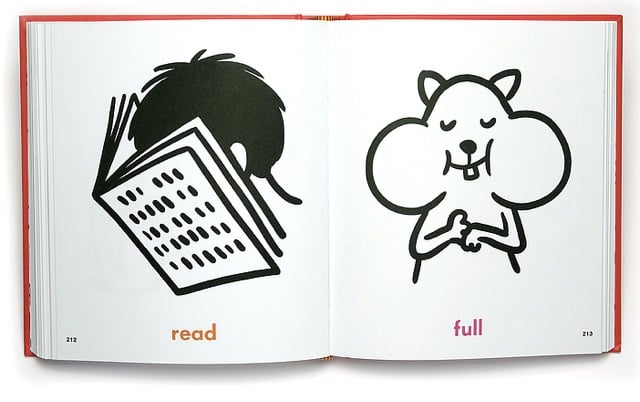
Ace illustrator Christoph Niemann has a new book coming out called Words, an illustrated compilation of 300+ sight words
What can you do with a word? Read it, spell it, say it, picture it, understand it, make a sentence with it, tell a story with it, share it with a friend. Everything starts with a love of words! More than 300 words inspired by Dr. Edward Fry’s list of sight words are paired with striking and playful illustrations by internationally renowned designer and artist Christoph Niemann to deepen understanding, to enrich, and to enlighten those learning to read and write English, whether they be children or adults.
To determine which words are the most “metal”, this data scientist wrote a program to sift through more than 22,000 albums to find the words most frequently used in heavy metal songs compared to their use in standard English. “Burn” is the most metal word, followed by “cries”, “veins”, “eternity”, “breathe”, and “beast”. The least metal words?
particularly
indicated
secretary
committee
university
relatively
noted
approximately
chairman
employees
If you were to run an analysis on what I’ve written at kottke.org, I doubt it would be particularly metal. \m/
Using a 5000-word dictionary of words rated on their happiness, the Hedonometer measures the average happiness on Twitter.
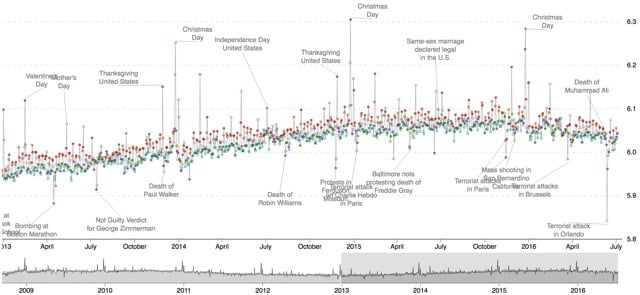
Christmas is always the happiest day of the year (“merry”, “happy”, and “joy” are all pretty positive) while shootings and terrorist attacks are Twitter’s saddest events. The recent mass shooting in Orlando seems to be the least happy Twitter has been over the past 7+ years.
The Hedonometer also analyzes the overall happiness of movies based on their scripts. The happiest movie is Sex in the City while the saddest is Omega Man (followed by The Bourne Ultimatum). Somehow, the fourth happiest movie is Lost in Translation, which might be reason for some overall skepticism about the project’s sensitivity to context.
The happiness over time of individual movie scripts has been analyzed by the Hedonometer too. Pulp Fiction’s happiest moment is when Vincent and Mia go to Jackrabbit Slim’s and the low point is “Bring out the Gimp”.
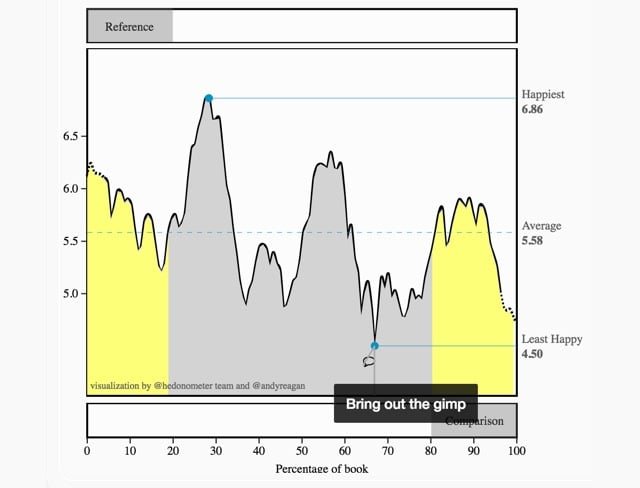
The system has analyzed books as well…the low point of the entire Harry Potter series seems to be the event at the end of The Half-Blood Prince.
Update: Grain of salt and all that, but the shootings of Alton Sterling, Philando Castile, and the Dallas police officers have pushed the happiness quotient on Twitter lower again so that the two least happy days have both occurred in the past month. There’s been a general feeling that 2016 has been a bad year, like George RR Martin is writing it. I wish the data were available for a closer analysis, but if you look at the chart, you can see that Twitter’s overall happiness starts to rise around the end of 2012 but starts to fall again right around the beginning of 2016…the effect is quite clear, even just from eyeballing it.

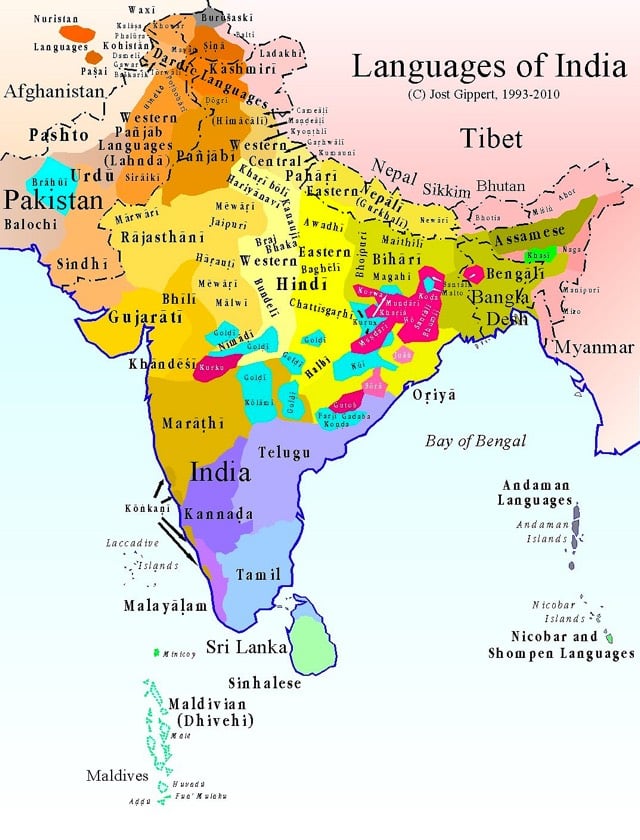

Tim Merrill is using Pinterest to collect maps showing where ethnic groups live and what languages are spoken in Asia.
In today’s post on “What is barbecue?” I skipped past “is a hot dog a sandwich?” so quickly that I forgot to answer the question. So in the same spirit in which someone can boldly declare that only smoked, slow-cooked pork is barbecue, here is my minimal definition of a sandwich:
A sandwich is any solid or semi-solid filling between two or more slices of bread. Not a roll, not a wrap, not a leaf of lettuce: sliced bread. What is inside far less than the container.
Consequently:
- A hot dog is not a sandwich.
- A burrito is not a sandwich.
- A wrap is not a sandwich.
- A cheeseburger on a roll is not a sandwich. Sliced bread only.
- A lobster roll is not a sandwich.
- A hoagie is not a sandwich.
- An ice cream sandwich is not a sandwich.
- A hot turkey sandwich is not a sandwich.
- An open-faced sandwich is not a sandwich.
- If you make a sandwich using one end of the bread and one proper slice, it’s kind of a sandwich still, but not really. See also folding over a single slice of bread for a half-sandwich.
- If you make a sandwich using both ends of the bread, it is no longer a sandwich at all.
- A peanut butter or grilled cheese sandwich is a sandwich.
- A mayonnaise, butter, or ketchup sandwich is probably a sandwich — I’m not sure whether those fillings are solid enough — just not a very good one.
- A sandwich made with crackers instead of bread is not a sandwich, but an imitation of a sandwich.
- A sandwich made with crackers between two slices of bread is a sandwich, but not a very good one.
Alternatively, “sandwich” is a family-resemblance concept and we can’t appeal to definitional consistency to get away from the fact that language is a complex organism and its rules don’t always make perfect sense.
(PS: I do not speak for Jason or Kottke.org on this matter, please do not argue with him about sandwiches)
Update (from Jason): Boy, you leave Tim to his own devices for a few hours and he establishes the official kottke.org stance on sandwiches. [That new emoji of the yellow smiley face grabbing its chin and looking skeptical that you might not have on Android IDK I’m Apple Man] I was just talking to my kids the other day about this important issue and Ollie, who is almost 9, told me that both hamburgers and hot dogs are sandwiches because “the meat is sandwiched in between the bread; it’s right there in the word”. When Ollie and Minna take over the family business in 2027, they can revisit this, but for now, Tim’s definition stands.
Update: Tim’s definition has been weakened further. In talking with Stephen Colbert, Justice Ruth Bader Ginsberg asserted that a hot dog is a sandwich.
Newer posts
Older posts




Socials & More