



15 ways to improve your newspaper business. “1. Go
15 ways to improve your newspaper business. “1. Go out in street, see news, write it up.”

This site is made possible by member support. 💞
Big thanks to Arcustech for hosting the site and offering amazing tech support.
When you buy through links on kottke.org, I may earn an affiliate commission. Thanks for supporting the site!
kottke.org. home of fine hypertext products since 1998.
Beloved by 86.47% of the web.
15 ways to improve your newspaper business. “1. Go out in street, see news, write it up.”
Gothamist Maps uses Google Maps to pinpoint news alerts (fires, robberies, car accidents, etc.) on a map of NYC. Pretty cool.
R.W. Apple, longtime and beloved political and food writer for the NY Times, died early this morning aged 71. “In the interests of efficiency, The New York Times recently equipped its main office with…a 185-pound, water-cooled, self-propelled, semi-automatic machine called R. W. Apple Jr.” Here’s Apple’s last piece for the Times, on the cuisine of Singapore.
Update: The NY Times put up a piece that Apple filed right before he entered the hosptial that they were going to run later in the fall: The Global Gourmand.
Update: Ed Levine wrote a nice personal remembrance of Apple. See also Trillin’s article on Apple from the New Yorker.
Michael Kinsley: do newspapers have a future? “Newspapers on paper are on the way out. Whether newspaper companies are on the way out too depends.”
Last month I covered the hubbub surrounding the still-potential proof of the Poincare conjecture. The best take on the situation was a New Yorker article by Sylvia Nasar and David Gruber, detailing the barest glimpse of the behind-the-scenes workings of the mathematics community, particularly those involving Grigory Perelman, a recluse Russian mathematician who unveiled his potential Poincare proof in 2002 and Shing-Tung Yau, a Chinese mathematician who, the article suggested, was out for more than his fair share of the credit in this matter.
After declining the Fields Medal, the Nobel Prize of mathematics, Perelman has quit mathematics and lives quietly in his native Russia. Yau, however, is upset at his portrayal (both literally and literary) in the New Yorker article and has written a letter to the New Yorker asking them to make a prominent correction and apologize for an illustration of Yau that accompanied the article. From the letter:
I write in the hope of enlisting your immediate assistance, as well as the assistance of The New Yorker, in undoing, to the extent possible, the literally world-wide damage done to Dr. Yau’s reputation as a result of the publication of your article. I also write to outline for you, on a preliminary basis, but in some detail, several of the more egregious and actionable errors which you made in the article, and the demonstrably shoddy “journalism” which resulted in their publication.
The letter, addressed to the two authors as well as the fact-checker on the article and CC’d to David Remnick and the New Yorker’s general counsel, runs 12 pages, so you may want to have a look at the press release instead. A webcast discussing all the details of the letter is being held at noon on September 20…information on how to tune in will be available at Dr. Yau’s web site. (thx, david)
Oh, rejoice and be glad…there will be a season five of The Wire. “Balancing small audiences again critical acclaim, HBO has picked up a fifth season of drama The Wire.” The season may focus on the media’s role in politics. (thx, mark)
State of Emergency photo shoot from the September 2006 issue of Vogue Italia. The editorial of these fashion photos exceeds that of much photography found in more conventional US news media. (via bb)
Adrian Holovaty, who works at the Washington Post, has some advice for how the news media should function: “newspapers need to stop the story-centric worldview”. Holovaty argues for more structured data to be offered, not just the typical written story. Matt Thompson previously argued that the press needs a new paradigm, a shift from searching for hidden information (a la Watergate) to interpreting the massive amounts of publicly available data for patterns and stories (a la Enron/WorldCom/etc).
A short interview with Grigory Perelman, the Russian mathematician who proved the Poincare conjecture and turned down the Fields Medal. “Newspapers should be more discerning over who they write about. They should have more taste.” (thx pedro)
Steven Johnson lists Five Things All Sane People Agree On About Blogs And Mainstream Journalism (So Can We Stop Talking About It Now?) Like Steven, I get frustrated with the rehashing of the same old points around this issue.
Henry Abbott: bloggers give credit, journalists typically don’t. “When Sports Illustrated breaks a story that blogs catch on to, SI gets its name and inbound links all over the blogosphere. When blogs break stories, I don’t see why mainstream media shouldn’t reciprocate.”
A couple of months ago, the Guardian ran an article about Timothy Leary that used a “factoid” from gullible.info, a site trafficking in fake facts. The editor of gullible.info alerted the Guardian to the error, but they still haven’t corrected the article claiming that Leary discovered a new primary color called gendale.
The Independent has a great infographic on its cover today depicting which countries support the immediate ceasefire in the Middle East demanded by the UN and which do not:
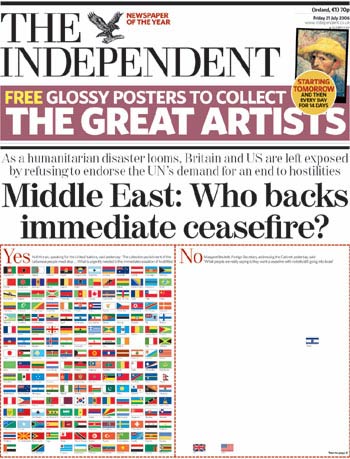
That message would take up less space as words, but somehow the impact wouldn’t be quite the same. (thx, g)
New York Times to redesign in 2008, each page will be 1.5 inches narrower.
David Remnick on the Bush Administration’s sustained assault on the press. “You begin to wonder if the Bush White House, in its urgent need to find scapegoats for the myriad disasters it has inflicted, is preparing to repeat a dismal and dismaying episode of the Nixon years.”
Nick Denton: the only good publicity is that on your own terms.
The front pages of some Italian and French newspapers on the day after the World Cup Final.
Study: the half-life of an online news item is 36 hours.
There’s a bit of a shout-out to citizen journalism in Superman Returns. Mid-movie, Daily Planet Editor in Chief White, Lois Lane, and Jimmy Olsen look at some photos of Superman spread across the chief’s desk. They’re great, iconic photos of the Man of Steel in action. White berates Olsen (and I’m paraphrasing here), “these are great and they were taken by a kid with a cameraphone. Whadda you got, Olsen?” Olsen throws his photos down on the desk; the one on top depicts a distant blurry streak across a blue sky.
“Look, in the sky, Chief.”
“It’s a bird.”
“It’s a plane.”
“No, look, it’s…”
Score one for the man on the scene.
Big 10th anniversary package from Slate. It’s interesting to see how it has evolved. Here’s a slideshow of the design through the years…the stuff about their failed subscription business model and how they lost marketshare because of it is relevent in the ongoing TimesSelect debate.
The changing face of journalism and a comparison of when the press succeeded (Watergate) and when it failed (Enron): “The plenitude of information, not its scarcity, defines the world we live in now. And journalism must change to accommodate that fact.”
Mark Glaser to the NY Times: “Chairman Sulzberger, if you seek peace in cyberspace, if you seek prosperity for your company, if you seek to spread ideas online: Come here to this TimesSelect gate! Mr. Sulzberger, tear down this pay wall!” A rebuttal. My take: TimesSelect is a perfectly good business decision for the Times. I just think the alternatives are better business decisions.
Press Photographers Year awards for the outstanding press photography of 2005. (thx joshua)
Writer Roger Angell on a leisurely approach to reporting. “Shawn didn’t have a sense of deadline. [David] Remnick now wants it next week, which is fine. It’s that sort of a magazine, and I try to oblige. Shawn thought, Everybody knows what the news is; now tell us something else about it.” More on William Shawn.
NPR interview with David Remnick. Here’s a newly-released collection of his recent writing, which includes his interview with Al Gore.
Paul notes that a lot of people and organizations are vowing to do things in the news these days. Here’s a current sampling from Google News:
Uganda: Museveni vows to fight corruption
Family vows to fight futile-care law
Blair vows smooth handover
Dumars vows to keep top defender Wallace in fold
Bush vows to boost efforts to end Darfur killings
Ontario vows full-time work for all nursing graduates
China Vows to Close Unsafe Coal Mines
Magician Vows to Complete Aquarium Stunt
Sutherland vows to keep making 24
Vodafone Vows to Slash Roaming Charges By 40%
China’s Pearl River Smells, but Mayor Vows to Swim
People are doing a lot of urging in the news too:
Prescott urges Labour to avoid “war”
China urges to repatriate “Eastern Turkistan” terrorist suspects
Brussels urges 2007 declaration to break EU constitution deadlock
Report urges support for parents with learning difficulties
Bush urges larger UN role in Darfur
Roche Urges Care Against Online Counterfeit Tamiflu
Day urges Canadians to stock up for crisis
Leave it to President Bush to both vow and urge in the same headline: “Bush urges UN role in peacekeeping and vows to expedite aid”.
Update: Nathaniel asks, where’s the slamming? Here it is:
Comptroller report slams health system, police and NII
Traffic chief slams taxi fare bungle
Bangla author slams Dhaka
Cardinal Slams ‘Da Vinci’ ‘Disrespect’
Navratilova slams Czech Pres. as anti-gay
UN slams attack on aid worker
Update: Matthew sends in word of “smacks” in the news:
Holliday smacks two homers to lead Rockies over St. Louis
SCOTUS smacks down anti-choicers
Warren Smacks Broadway
Venice smacks Seminole in region opener
Another Zero-Day Bug Smacks IE
Let’s be clear: Bypassing Bush smacks of stupidity
Cox’s recent Wal-Mart battle smacks of political posturing
Fish Jumps in Boat, Smacks Woman’s Face
And Chris offers “blasts” news:
Cameron blasts ‘sexy’ children’s clothes stores
Iran’s Leader Blasts US, Calls Democracy a Failure
Trade Group Blasts Massachusetts Call For Office Plug-In
McInally blasts new SFL play-offs
Dean McDermott’s Ex-Wife Blasts Him & Tori
Sheehan blasts war, Bush at Town Hall
Environmentalist blasts bug spray
Awaiting the invitable “vows urges blasts slams smacks” headline…
Stephen Baker lists some reasons why journalists should ask dumb questions, but it’s good advice for anyone really. My favorite professor in college, his mantra in classes was that there was no such thing as dumb questions.
Upon my return to civilization last week, Greg Knauss wrote up some thoughts he had after doing the remaindered links here for two weeks. His thoughts, reproduced in full:
Over the past two weeks, David Jacobs, Anil Dash and I have attempted to reproduce (in some halting way) Jason Kottke, while the actual Jason Kottke was
in rehabon his honeymoon. The attempt, on my part at least, has been an abject failure. Or haven’t you noticed all the crappy links with “GK” at the end of them? Go-kart magazines? What the hell?Like most of the disasters I’ve had a hand in, I’ve got a theory that both explains what happened and exonerates me. Ducking responsibility sounds better if you put on academic airs about it.
The theory: There are two kinds of bloggers, referential and experiential. Kottke is one. I, now two weeks too late in realizing this, am another.
The referential blogger uses the link as his fundamental unit of currency, building posts around ideas and experiences spawned elsewhere: Look at this. Referential bloggers are reporters, delivering pointers to and snippets of information, insight or entertainment happening out there, on the Intraweb. They can, and do, add their own information, insight and entertainment to the links they unearth — extrapolations, juxtapositions, even lengthy and personal anecdotes — but the outward direction of their focus remains their distinguishing feature.
The experiential blogger is inwardly directed, drawing entries from personal experience and opinion: How about this. They are storytellers (and/or bores), drawing whatever they have to offer from their own perspective. They can, and do, add links to supporting or explanatory information, even unique and undercited external sources. But their motivation, their impetus, comes from a desire to supply narrative, not reference it.
There’s nothing here to imply that one type of blogger is better than the other. There are literally thousands — OK, hundreds… OK, at least a dozen — of both kinds that are valuable additions to the on-going conversation/food-fight/furry-cuddle that is the Internet. My point is that Jason Kottke is a very, very good referential blogger and I am a very, very bad one. And I’m sure I wouldn’t have trouble finding a link that expresses this sentiment (many, many times over, with varying degrees of vehemence), but I’d rather say it from my own experience:
Welcome back, Jason. You’ve been missed.
After reading Greg’s thoughts, Meg reminded me that Rebecca Blood had made a distinction between filter-style and journal-style bloggers in Weblogs: A History and Perspective. If you want to generalize outside the realm of weblogs, they’re both talking about the difference between writers and editors1.
At a party a couple of years ago, I was talking to Nick Denton and he was puzzled by the number of bloggers who were getting book deals and told me that “the natural upgrade path for bloggers is from blogging to editing, not to writing”. As Greg and Rebecca note, that doesn’t apply to everyone, but it sure describes what I do here. kottke.org has always been more edited than written. I’ve never particularly thought of myself as a writer (I get by, but I wish I were better), but I do pay a lot of attention to how the writing is presented and contextualized…how the overall package “feels”.
[1] And if you want to go even further out on the metaphorical gangplank here, the writer/editor dichotomy compares well to that of the musician/DJ. ↩
Socials & More