kottke.org posts about fashion
I found this New York magazine profile of fashion photographer Juergen Teller pretty fascinating. For one thing, none of Teller’s photos are retouched.
But perhaps most rare for fashion photography, Teller’s pictures are absolutely never retouched. “I’m interested in the person I photograph,” he says. “The world is so beautiful as it is, there’s so much going on which is sort of interesting. It’s just so crazy, so why do I have to put some retouching on it? It’s just pointless to me.”
And then there’s this anecdote. After a bad encounter with a subject who didn’t like how old she looked in Teller’s photographs, he went to see his friend Charlotte Rampling.
Despondent, Teller called his friend Rampling, who offered to cook him dinner. They talked about how it feels to be photographed, and how it feels to age. “I just thought, Fuck this, I’m going to photograph myself,” he says. And then there the two of them were, in the Louis XV suite of the Hotel de Crillon, with Teller way too fat to fit into any of the Marc Jacobs samples save one terribly shiny pair of silver shorts.
“I thought, Fuck,” Teller says, “I don’t even fucking fit into these clothes. I’m really fucking stuck now.”
So he pulled on the shorts in the bathroom. “I came out and I had my socks on and I had these shorts on and no top, and I just said, ‘Ta-da!’ And she said, ‘Oh my God. What are we going to do?’ And I said, ‘Well, I don’t know. But really, honestly’-and I could hardly bring it out of my mouth-I said, ‘I just want to kiss you and fondle your breasts.’ And she didn’t say a word. She just leaned back in her armchair and went into her handbag and got a cigarillo out and lit it and the air was thick and I was mortified. And then she sort of dragged on her cigarette and said, ‘Okay. Let’s start. I’ll tell you when to stop.’”
Here are some of the images that resulted from that shoot (NSFW).
James Danziger notes that the issue of Vogue Italia following the acclaimed issue featuring only black models has zero black models in it.
How absolutely great, but now the August issue is out — themed around a faux funeral photo tribute to Yves Saint Laurent — and there’s apparently not one black model to be found. This is especially ironic given the fact that Yves Saint Laurent was one of the first major designers to regularly feature black models in his runway shows. You would have thought they could have found room to at least fit Naomi Campbell in somewhere. Wouldn’t she look chic in widow’s weeds? This kind of tokenism ultimately seems a step backwards to me.
A pair of Levi’s from the 1890s are up on eBay.
This old pair of LEVI’S were found in a mine in the Rand Mining District, on the Mojave Desert,. California. They are covered in candlewax from the candle’s the miner was using to light the tunnel he was working in. They were found with and old paper bag with the name of a mercantile store which operated between 1895 and 1898 in the town or Randsburg. Their was also a gunny sack with the initials A.P.K. and Randsburg marked on it. A.P.K. is through to be Adam P. Kuffel who was a partner in the mercantile store.
These pants have the cloth label vice the leather label. The label (pictured) indicates that they are size W34 x L33, They are copper riveted with the rivets marked L.S. & Co. S.F. They are buckle back (pictured) with suspender buttons. Buttons are silver in color and are all marked LEVI STRAUSS & CO. S.F.CAL. Tthe pants were made with just one back pocket on the right hand side.
With 2 days to go, the current high bid stands at $7300. (via reference library)
Update: Another seller is contemplating listing another old pair of pants.
The jeans were uncovered in an old miners cabin here in montana and have been dated between 1890 and 1901 by the rivets on the jeans. There was gold in the watch pocket of the blue jeans and has been saved in a vial, do you think we should include it in the auction? there is also the miners diaries and a couple of shaker boxes too.
The history of the hobble skirt.
The term ‘hobble skirt’ came into popular use in the early 1910s, when a European fashion trend started by French designer Paul Poiret introduced long skirts that were narrow at the hem, thus ‘hobbling’ the wearer. Some attribute one of Poiret’s inspiration to Mrs. Hart Berg, the first American woman to join the Wright Brothers in air. To keep her skirts from flying out of control while airborne, she tied a rope around them below the knees (Katherine Wright, sister of the flight innovators the Wright brothers, also did the same shortly afterwards).
For a short while, the tighter the skirt, the more fashionable it was. This also brought about accessories such as the hobble garter (you can see one in tbe PBS series The Manor House) designed to limit the wearer’s stride so that she would not cause the skirt to rip. This trend died shortly afterwards due to the impracticality of such a garment, particularly with the introduction of cars (the skirts making getting in and out of one a bit of an adventure).
Bill Cunningham casually mentioned the hobble skirt in a recent On the Street feature about pencil skirts.
I’ve not been paying enough attention to Bill Cunningham’s street fashion photography slideshows. Each week, Cunningham goes out on the streets of NYC to find out what people are wearing. Even better than the photos are his enthusiastic descriptions of what he’s found.
This week he looks at women’s handbags, which he calls “the engine carrying the fashion world”. Cunningham finds that bags are growing almost “cartoonishly large” and discovers a unique glove/bag combo. Last week, he looked at the glittery belts that some men are wearing with their saggy jeans. If this was the type of fashion that filled the pages of Vogue, I would subscribe in a second. (thx, alaina)
Update: Cunningham’s video journals are now available on YouTube for easy watching/embedding.
For its July 2008 issue, Vogue Italia is featuring only black models and feature articles about black women in arts and entertainment.
Having worked at one time with nearly all the models he chose for the black issue — Iman, [Naomi] Campbell, Tyra Banks, Jourdan Dunn, [Liya] Kebede, [Alek] Wek, Pat Cleveland, Karen Alexander — [photographer Steven] Meisel had his own feelings. “I thought, it’s ridiculous, this discrimination,” said Mr. Meisel, speaking by phone from his home in Los Angeles. “It’s so crazy to live in such a narrow, narrow place. Age, weight, sexuality, race — every kind of prejudice.”
Here’s a slideshow of some of the images from the magazine. As I’ve said before, Vogue Italia is doing some interesting things with the editorial nature of the magazine’s photography (see State of Emergency and Super Mods Enter Rehab, both by Steven Meisel).
Time reports on a group of folks who are trying to whittle down their possessions to 100 items.
Bruno keeps a running tally on his blog, guynameddave.com of what he has decided to hold on to and what he is preparing to sell or donate. For instance, as of early June, he was down to five dress shirts and one necktie but uncertain about parting with one of his three pairs of jeans. “Are two pairs of jeans enough?!,” he asked in a recent posting.
That’s not the only dilemma faced by this new wave of goal-oriented minimalists. One of the trickier questions is what counts as an item. Bruno considers a pair of shoes to be a single entity, which seems sensible but still pretty hard-core when you’re trying to jettison all but 100 personal possessions. Cait Simmons, 27, a waitress in Chicago, takes a different approach. Although she has pared down her footwear collection from 35 to 20 pairs, she says, “All my shoes count as one item.”
Bruno’s site is currently inaccessible…here’s the Google cache for his 100 Thing Challenge page.
A company called Cargo Cosmetics makes a line of makeup called blu_ray for use by people appearing on high-definition TV or film.
Developed in response to the needs of makeup artists shooting in high definition, these specialized products work for high-def and are ideal for perfecting the skin while still giving a natural look.
Available at Sephora. Has anyone used this? Does it work? Email me. (thx, doug)
Photos of pajamas as outerwear in Shanghai.
The prevalence of pyjamas, Guariglia explained to me, was due to both the extreme summer heat and the lack of plumbing. Most Shanghaians share outdoor communal toilets and thus the boundaries of what was considered one’s home have expanded past people’s houses to the public bathrooms. Once that relaxation of the dress code became acceptable (starting around the 1980s) the perimeter for p.j.-wear just kept expanding until many people were wearing them day in day out.
Fantastic collection of photos by James Mollison of music fans who tend to dress like their idols. A book featuring the photos is due out in October.
Over a three-year period, James Mollison attended pop concerts across Europe and the United States with a mobile photography studio, inviting fans of each music star or band to pose for a portrait on their way into the concert. The result is The Disciples, an original and highly entertaining series of fifty-seven panoramic images, each featuring eight to ten music fans mimicking the manners and dress of their particular heroes. Featuring fans of Dolly Parton, Iggy Pop, Madonna, Marilyn Manson, the Rolling Stones, Bob Dylan, Snoop Dogg, and Motorhead, among many others, The Disciples is a surprising, sharp, and hilarious take on popular culture.
(via waxy)
Michael Bierut celebrates the elegantly simple design of the Brannock Foot-Measuring Device.
Charles F. Brannock only invented one thing in his life, and this was it. The son of a Syracuse, New York, shoe magnate, Brannock became interested in improving the primitive wooden measuring sticks that he saw around his father’s store. He patented his first prototype in 1926, based on models he had made from Erector Set parts. As the Park-Brannock Shoe Store became legendary for fitting feet with absolute accuracy, the demand for the device grew, and in 1927 Brannock opened a factory to mass produce it. The Brannock Device Co., Inc., is still in business today. Refreshingly, it still only makes this one thing. They have sold over a million, a remarkable number when one considers that each of them lasts up to 15 years, when the numbers wear off.
Bierut also notes that Tibor Kalman was a big fan of the Brannock Device, once saying:
It showed incredible ingenuity and no one has ever been able to beat it. I doubt if anyone ever will, even if we ever get to the stars, or find out everything there is to find out about black holes.
The humble shoe horn is another well designed shoe-related device that may never be bettered.
An interview with the makers of a film about secondhand clothing in Haiti.
Shell says Haitians sometimes dress better than Americans because they are used to tailoring their secondhand clothes to fit. While the pepe market makes it difficult for Haitian tailors to sell their own designs or traditional fashions; the cheap cost means, as one woman in the documentary explains, they can “adopt the look that is on television without much effort.”
Most of the clothes come from the United States.
Update: Secondhand clothing imports to Zambia killed the clothing industry there:
Mark O’Donnell, spokesperson for Zambian Manufacturers, explains that in 1991, when the country’s markets were opened to free trade, container load after container load of used clothing began to arrive in Zambia, undercutting the cost of the domestic manufacturers and putting them out of business. The skills, the infrastructure and the capital of an entire industry are now virtually extinct, with not a single clothing manufacturer left in the country today.
(thx, tj)
Fashion photo retouching (i.e. high-brow Photoshopping) gets the New Yorker treatment with this story on retoucher Pascal Dangin, one of the best in the business.
In the March issue of Vogue Dangin tweaked a hundred and forty-four images: a hundred and seven advertisements (Estée Lauder, Gucci, Dior, etc.), thirty-six fashion pictures, and the cover, featuring Drew Barrymore. To keep track of his clients, he assigns three-letter rubrics, like airport codes. Click on the current-jobs menu on his computer: AFR (Air France), AMX (American Express), BAL (Balenciaga), DSN (Disney), LUV (Louis Vuitton), TFY (Tiffany & Co.), VIC (Victoria’s Secret).
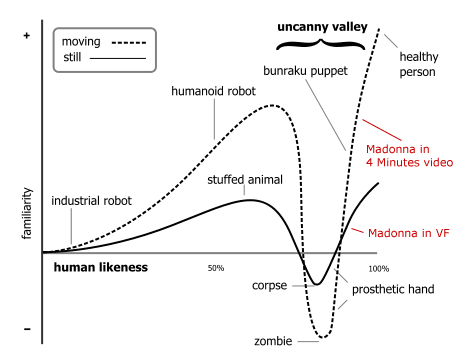
The article touches too briefly on the tension between reality and what ends up in the magazines and advertisements. As Errol Morris points out on his photography blog, it is often difficult to find truth in even the most vérité of photographs. Even so, the truth seems to be completely absent from Madonna’s recent photo spread in Vanity Fair that was retouched by Dangin, especially this one in which a 50-year-old Madonna looks like a recent college graduate who’s never lifted a weight in her life.
The uncanny valley comes into play here, which we usually think of in terms of robots, cartoon characters, and other pseudo anthropomorphic characters attempting and failing to look sufficiently human and therefore appearing creepy and scary. With an increasing amount of photo retouching, postproduction in film, plastic surgery, and increasingly effective makeup & skin care products, we’re being bombarded with a growing amount of imagery featuring people who don’t appear naturally human. People who appear often in media (film & tv stars, models, cable news anchors & reporters, miscellaneous celebrities, etc.) are creeping down into the uncanny valley to meet up with characters from The Polar Express. I don’t know about you but a middle-aged Madonna made to look 24 gives me the heebie-jeebies. Perhaps the familar uncanny valley graph needs revision:
The Sartorialist on headbands:
Headbands…what a tough accessory. When they are right, they are really right and when they are wrong you’re Loverboy.
Lipstick as economic indicator.
Ms. Stein’s rationale for buying lipstick echoes a theory once proposed by Leonard Lauder, the chairman of Estee Lauder Companies. After the terrorist attacks of 2001 deflated the economy, Mr. Lauder noticed that his company was selling more lipstick than usual. He hypothesized that lipstick purchases are a way to gauge the economy. When it’s shaky, he said, sales increase as women boost their mood with inexpensive lipstick purchases instead of $500 slingbacks.
More economic indicators: sushi, Big Macs, steakhouses, Starbucks coffee, Coca-Cola, cigarettes, and Jay-Z.
A list of responses to “The Question” asked of all kilt-wearing gentlement: What’s under your kilt?
The Velocouture group on Flickr collects photographs of bicycle fashion fashion, on a bicycle. The best ones are of people who try to coordinate their outfits with their bikes. This gal is particularly fashionable. See also this NY Times slideshow.
Hate couture.
Coming from five generations of Ku Klux Klan members, 58-year-old “Ms. Ruth” sews hoods and robes for Klan members seven days a week, blessing each one when it’s done. A red satin outfit for an Exalted Cyclops, the head of a local chapter, costs about $140. She uses the earnings to help care for her 40-year-old quadriplegic daughter, “Lilbit,” who was injured in a car accident 10 years ago.
(via delicious ghost)
The iconic Birkin bag made by Hermes is supposedly so difficult to find that there’s a two-year waiting list. In his book, Bringing Home the Birkin, Michael Tonello says the list is just a marketing ploy and that he was able to buy Birkin bags whenever he wanted.
“I would go into a store with a list in my Hermes Ulysse notebook and pile up scarves, shawls, bracelets, worth about $2,000. This made me seem a regular Hermes client,” Tonello told Reuters in a telephone interview. “Once I had that pile ready to buy at the last moment I’d ask for a Birkin and they would usually produce one of the back room. In 2005 I bought 130 Birkins in a three-month period — and you tell me there is a waiting list?”
The Birkin retails for thousands (and sometimes tens of thousands) of dollars and can be see here in situ, on the arms of celebrity millionaires. Lindsey Lohan looks like she can just about fit into hers. (via clusterflock)
A visual look at the top 10 trends in spring/summer 2008 fashion, including parachute silk, higher waistlines, and skinny belts.
As part of the the Takashi Murakami show at the Brooklyn Museum of Art, the artist is collaborating with Louis Vuitton to station street vendors — who typically sell counterfeit merchandise — outside the museum selling real LV bags designed by Murakami himself.
Clothing libraries loan clothes out for free (or a small fee) to unemployed people for job interviews or to expecting mothers so they don’t have to buy a whole bunch of maternity clothes. Great idea. (via magnetbox)
Related to last month’s post about monochromatic outfits, here’s some photos of children who do the same thing, pink for the girls and blue for the boys.
korean artist jeongmee yoon’s ‘pink and blue project’ was inspired by her daughter. she would only wear pink and buy pink toys.
I find it interesting/odd that the children, some of whom aren’t more than five years old, are the ones presumed to be making the color choice here. (via a.whole)
Around All-Star time a couple of weeks ago, Nike released a shoe called the Nike Trash Talk, “the first Nike performance basketball sneaker completely produced from manufacturing waste”. The shoe, worn by Steve Nash in a recent game, looks a bit like Frankenstein’s monster with all the exposed stitching; it’s a beautiful shoe and I want a pair. The problem is that it’s one of those limited edition deals…which means they’re already all sold out and sitting on the shelves of sneaker collectors next to hundreds of other boxes of shoes that will never be worn. I looked on eBay and found two pair but not in my size. What are my chances of getting a pair of these at approximately retail price? I’m not looking for a collectors item…I just want to wear them!
Profiles of 5 New Yorkers that dress in only one color.
Why gray?
I actually wore turquoise for eight years, but last September, I switched to gray. I’d had a bad year and needed to get out of it.
That’s a big switch.
I like everything to be clean, and gray is clean. Gray is between black and white, so it’s a noncolor, almost. I feel messy and unclean if I wear other colors.
Where do you shop?
I make all my own clothes. I can’t wear anyone else’s.
What about shoes?
That’s hard because even the soles of my shoes have to be gray or white. I get annoyed if the soles are black.
Buzzfeed has more on monochromatic outfits.
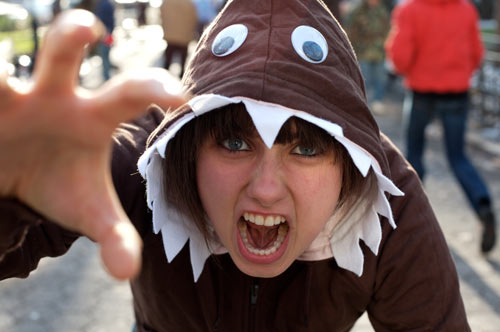
Monsterhoodies. When the hood is up, it looks like a shark, dinosaur, or monster is biting your head off. Rrwar!!
Newer posts
Older posts







Socials & More