kottke.org posts about economics
I think I’d heard the term “k-shaped economy” somewhere before but didn’t really know what it meant until I watched this video:
American Airlines is changing the layout of some of their aircraft to add 31 first class and premium seats while cutting out 73 economy seats. This is the hot new trend in air travel: pulling out all the stops to cater to the wealthy.
Airlines are adding suites with more bed space, privacy doors, an extra ottoman for guests. They’re offering caviar, free PJs, luxury skin care products, and multi-course meals with wine pairings made by gourmet chefs. They’re also building more airport lounges. Meanwhile, economy is getting more cramped and low-cost carriers are going bankrupt. It’s because wealthy passengers are where the money’s at.
For years, airlines have made more money from their credit cards than from actually flying passengers around. And these days, premium seating is bringing in more revenue than the economy cabin. It’s a perfect example of the K-shaped economy.
Here’s an AP article about the K-shaped economy from late last year.
Corporate executives are paying attention and in some cases explicitly adjusting their businesses to account for it. They are seeking ways to sell more high-priced items to the wealthy while also reducing package sizes and taking other steps to target struggling consumers.
Economist Thomas Piketty, writing for Le Monde (archive) on the success of Europe’s social democratic model and countering “the narrative of a ‘declining’ continent”:
If someone had told the European elites and liberal economists of 1914 that wealth redistribution would one day account for half of national income, they would have unanimously condemned the idea as collectivist madness and predicted the continent’s ruin. In reality, European countries have achieved unprecedented levels of prosperity and social well-being, largely due to collective investments in health, education and public infrastructure.
To win the cultural and intellectual battle, Europe must now assert its values and defend its model of development, fundamentally opposed to the nationalist-extractivist model championed by Donald Trump’s supporters in the United States and by Vladimir Putin’s allies in Russia. A crucial issue in this fight is the choice of indicators used to measure human progress.
For these indicators, Piketty mentions some of the same factors that economist Gabriel Zucman detailed in his Le Monde piece I posted in December:
More leisure time, better health outcomes, greater equality and lower carbon emissions, all with broadly comparable productivity: Europeans can be proud of their model, argues Gabriel Zucman, director of the EU Tax Observatory.
The main point of Adam Bonica’s post The Wall Looks Permanent Until It Falls is about the optimism of this moment: that the US could be ripe for a Berlin Wall-falling moment that opens the door for a better future. I’m not in the mood for that message these days (IMO, our Wall-falling is a ways off in the future), but Bonica’s analysis of how the US compares to 30 other wealthy democracies, our economic peers, is important.
Start with work and economic life. Americans work longer hours, pay more out-of-pocket for college and childcare, lack parental leave, and enjoy less economic mobility. The share of income going to the top 1 percent is nearly double the OECD average. American CEOs earn, on average, 354 times as much as their workers. More workers are trapped in poverty-wage jobs. Collective bargaining covers fewer workers. And social protections are less generous for those who fall on hard times, with the government raising less in taxes and spending more on the military.
The economy is just the beginning.
We spend nearly twice as much on healthcare as other wealthy countries do. Yet life expectancy is well below average, infant and maternal mortality rates are alarmingly high, and more Americans remain uninsured.
We suffer from overlapping public health crises — the highest rates of teenage births, drug overdoses, obesity, and gun deaths among peer nations.
His description of our unique exceptionalism goes on for several more paragraphs. But then he does something quite simple and revealing: he does the math and imagines, in concrete terms, what the US would be like if it were just an average country in its cohort. Bonica calls it “Latent America: the nation that would exist if our democracy functioned to serve the public rather than protect the already powerful”. Here’s part of his analysis:
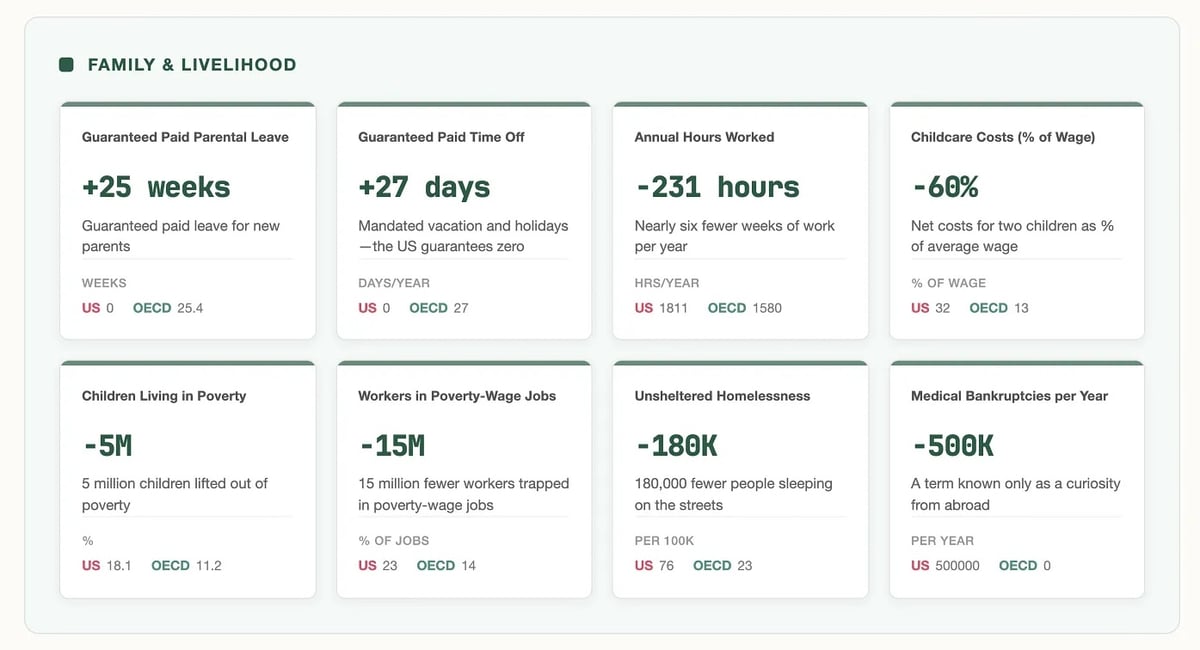
I don’t think I’ve seen this analysis done in quite this way before. You should click through to see the whole graphic, but some of the other stats are:
- $19,000 added income per household per year (and $96K more wealth)
- $2.1 trillion less spending on healthcare
- 4.1 more years of life expectancy at birth
- 51 million more Americans voting
- 1.4 million fewer Americans behind bars
- 60 more women serving in Congress
And this is just if the US were an average nation. Imagine if the US took its exceptionalism seriously and tried to maximally improve the lives of its citizens & residents instead of generating, as Bonica puts it, “enormous prosperity while deliberately withholding it from those who need it most”.
In this video, Maurice Moves highlights a pair of flashlights that are extremely useful & well-designed but also shockingly affordable.
Most people never think about flashlights, but as someone who uses one daily for work, it’s always top of mind, and the tech, value, and products are proof that modern flashlights are absolutely insane and defy logic and manufacturing economics.
The two flashlights he featured are the WUBEN G5 Rechargeable EDC Flashlight ($20) and the Nitecore EDC37 8000 ($140) — the Wuben in particular would be affordable at twice the price given how nicely designed and engineered it is.
I feel like this about Apple’s M4 Macbook Airs; as I wrote last week, “$800 is an absurdly low price for so much computer”.
See also No One Knows How to Make a Pencil. (thx, dunstan)
Ryan Broderick on how, with the trade war that Trump’s tariffs has unleashed, we are speedrunning Brexit and other hyper-inflationary financial crises (thread) and Americans may soon find out what happens when US dollars don’t buy anything.
So from my uniquely weird perspective after living in the UK through Brexit, being in India during Modi’s demonetization, and living in Brazil when the real tanked during the Bolsonaro administration, I can confidently say that Americans do not and can not understand how bad this is going to be.
To sort of broadly describe what is about to happen if the Trump admin doesn’t reverse course, we are quickly racing towards a world where not only does our money just not work correctly anymore day to day, but the background radiation of a crumbling economy will become impossible to ignore.
After the Brexit referendum, everything in London just got slightly worse. A year or two in, you could feel it. But that’s because it took five years for the country to actually leave the EU. We’re speedrunning that. In Brazil, prices would change overnight, stores just wouldn’t have stuff.
There’s more; read the whole thing. Broderick was reacting to this brief WSJ piece (archive):
The broad selloff in U.S. stocks and bonds, and the continuing decline in the dollar, represents a “simultaneous collapse in the price of all U.S. assets,” analysts at Deutsche Bank said Wednesday. They warned that “unchartered territory” lies ahead.
- Markets are dedollarizing, they said, citing the lack of evidence that investors are hoarding dollar liquidity— a dynamic that in previous market routs fueled Treasury and U.S. dollar rallies but this time is leading to declines in the prices of both.
- The administration is encouraging the Treasury selloff, they said, in a bid to bring down U.S. asset valuations—a decision they said now is exposing the fact that “reducing bilateral trade imbalances is functionally equivalent to lowering demand for U.S. assets as well.”
- A financial war with China could lie ahead, they conclude, contending that “there is little room now left for an escalation on the trade front” and that “there can be no winner to such a war.”
I’ve been saying since his election that Trump was going to drive the economy into the ditch. This is more like driving it off a cliff.

A broad range of Americans are organizing a 24-hour economic boycott on February 28th to protest the ongoing actions of the Trump administration and to send a message to corporate America. From The People’s Union USA website, here are the details:
- The boycott runs all day on February 28th.
- People are urged to not make any purchases that day. No online shopping or in person.
- Do not spend money on: fast food, gas, or at major retailers. “No Amazon, no Walmart, no Best Buy.”
- If you need to buy essentials (food, medicine, emergency supplies), do so at small, local businesses and try to pay cash.
The idea is to show corporate America, using the thing they best understand (money), how much power Americans have when collectively organized. Organizers have billed this as an initial move (“if they don’t listen…we make the next blackout longer”) and have planned follow-up economic actions.
Awesome rabbit illustration by Martha Rich.

In a 1953 speech called On the Future of the American Negro, W.E.B. Du Bois spoke about wealth inequality and his vision for measuring prosperity:
Work is service, not gain. The object of work is life, not income. The reward of production is plenty, not private fortune. We should measure the prosperity of a nation not by the number of millionaires but by the absence of poverty, the prevalence of health, the efficiency of the public schools, and the number of people who can and do read worthwhile books.
Democracy Now has a recording of part of Du Bois’ speech (starting at 5:48).
While listening to an episode of Scene on Radio’s excellent series on Capitalism, I learned about an economic measure called the labor share of national income. From The Guardian:
This week, the Bureau of Labor Statistics released its latest estimate for the share labor receives of national income for the first quarter of 2024. The statistics shows the income workers receive compared with the productivity their labor generates.
According to BLS, this income share has declined for non-farm workers from about two-thirds, 64.1% in the first quarter of 2001, to 55.8% in the first quarter of 2024.
Roughly speaking, in the first quarter of 2024, workers received ~56% of the income generated by their labor and 44% went to capital (ownership & shareholders).
Here’s a graph that shows the labor share of national income from 1947 to 2016 so you can get some idea of the decline that’s happened:

Scene on Radio hosts John Biewen and Ellen McGirt described labor share of national income like so:
Ellen McGirt: The labor share of national income. So, of all the income that businesses bring in, from sales of their goods and services, how much of that goes to workers. As opposed to, how much winds up as profits in the pockets of stockholders.
John Biewen: That number, according to the Federal Reserve, also went up significantly during the “thirty glorious years” in the United States. In the before times, in 1930, workers took home about 57% of the money that was generated by their labor. 57%. That labor share went up in the 1940s, to about 65% — almost two-thirds of corporate income was going to workers. It stayed over 60% for the next few decades, well into the 1970s.
Ellen McGirt: That doesn’t sound like a huge increase — from fifty-some percent to sixty-some percent. But the result, over those decades, was trillions of dollars in the pockets of people in the bottom 90-percent of the income scale — that’s money that would have gone to the wealthiest folks without those more progressive policies that reduced inequality. And then, guess what, starting in about 1975, the labor share of national income went down, and down. Until now, things are more like they were back in the days of Herbert Hoover.
This observation by McGirt is important but kind of hard to follow in text so I’ll restate it: when you’re talking about something as massive as the US economy, even a difference of a few percentage points in the labor share of national income over several years is trillions and trillions of dollars. And increasingly, those trillions are going to the wealthiest and not to the bottom 90%.
According to a groundbreaking new working paper by Carter C. Price and Kathryn Edwards of the RAND Corporation, had the more equitable income distributions of the three decades following World War II (1945 through 1974) merely held steady, the aggregate annual income of Americans earning below the 90th percentile would have been $2.5 trillion higher in the year 2018 alone. That is an amount equal to nearly 12 percent of GDP — enough to more than double median income — enough to pay every single working American in the bottom nine deciles an additional $1,144 a month. Every month. Every single year.
Price and Edwards calculate that the cumulative tab for our four-decade-long experiment in radical inequality had grown to over $47 trillion from 1975 through 2018. At a recent pace of about $2.5 trillion a year, that number we estimate crossed the $50 trillion mark by early 2020. That’s $50 trillion that would have gone into the paychecks of working Americans had inequality held constant — $50 trillion that would have built a far larger and more prosperous economy — $50 trillion that would have enabled the vast majority of Americans to enter this pandemic far more healthy, resilient, and financially secure.
From Adam Kovacs’ YouTube channel Adam Something comes this brisk 10-minute video essay on why European malls are doing better than their American progenitors. I thought his third point, about poor urban planning, was particularly interesting: malls tend to fail in America because they are not integrated into the fabric of towns and cities (because very little is integrated into the fabric of cities and towns in many places these days).
Malls, hell, all commerce has to be an organic part of towns and cities. People should be able to get to them by means other than a car, and conveniently. Such integrated commercial spaces are far more resilient. If your commercial spaces aren’t resilient — if you just plop a big box outside the town — don’t be surprised when it goes bust in a few years. And then it’s bulldozed for the next thing to be put up for it to go bust the same way and then get bulldozed and then the next thing and the next and the next so on and so forth.
For the past 13 years, former Secretary of Labor Robert Reich has taught a class called Wealth & Poverty at UC Berkeley. He retired from teaching this year and has uploaded his lectures from the course to YouTube.
Welcome to my final UC Berkeley course on Wealth and Poverty. Drawing on my 40+ years in politics, including my time as secretary of labor, I offer a deeper look at why inequalities of income and wealth have widened significantly since the late 1970s in the United States, and why this poses dangerous risks to our society.
This course also offers insights into the political and public-policy debates that have arisen in light of this inequality, as well as possible means of reversing it.
Here’s the first lecture, What’s Happened to Income & Wealth:
Reich has also published an abbreviated syllabus for each of the classes; links can be found in his course introduction (here’s class #1).
My pal Clive Thompson, who is in the midst of a two-part bicycle ride across the United States and is writing a book on micromobility, thinks local, state, and federal governments should start offering substantial subsidies for e-bikes in order to help reduce car usage, decrease urban pollution, and to lower the cost of transportation for lower-income families.
The thing is, we should lean heavily into subsidies for electric bikes — now.
If Denver’s experience is any guide, it’d be a huge boon for town, cities, and even many suburbs. Ebikes can’t be used to replace all car travel, of course; but as folks who experiment with them discover, wow, you start leaving your car at home a lot. If towns and cities are smart about how they organize and issue these credits, they can also help lower-income families add much cheaper mobility to their transportation options. Denver found that low-income-qualified folks who bought ebikes rode them almost 50% more than other voucher-getters, probably because the ebike became, hands-down, their most affordable way to travel.
We’re also not talking about a ton of money here. Ebike subsidies are considerably cheaper than those for cars or solar arrays. Even a few hundred bucks of subsidy per e-bike could help drop the price down to something competitive with a regular pedal bike. If all three levels of government worked together — federal, state, and local — the US could find the money for an absolute ton of ebike support, I suspect. (We could also consider reallocating some of the estimated $20 billion in annual subsidies that US taxpayers currently hand out to oil and gas companies.)
Hear, hear. I recently bought an e-bike (more on that in a future post) and went online looking for local subsidies. Vermont had an e-bike incentive program that ran for barely two months in 2022:
The eBike Incentive Program launched July 21, 2022, but closed shortly afterwards on September 16, 2022 when the $105,000 authorized in program funding was exhausted. Vermont residents aged 16 or older were eligible on a first-come, first-served basis for up to $400 towards the purchase of an electric bicycle, with higher incentives for households and individuals with lower incomes.
Bummer. The local power company offers $200 rebates though, which is nice.
Update: Vermont just refreshed their incentive program with an additional $150,000 a few days ago. Huzzah! (thx, rintze)
Expanding on his previous thoughts on the relationship between AI and capitalism — “I tend to think that most fears about A.I. are best understood as fears about capitalism” — Ted Chiang offers a useful metaphor for how to think about AI: as a management-consulting firm like McKinsey.
So, I would like to propose another metaphor for the risks of artificial intelligence. I suggest that we think about A.I. as a management-consulting firm, along the lines of McKinsey & Company. Firms like McKinsey are hired for a wide variety of reasons, and A.I. systems are used for many reasons, too. But the similarities between McKinsey — a consulting firm that works with ninety per cent of the Fortune 100 — and A.I. are also clear. Social-media companies use machine learning to keep users glued to their feeds. In a similar way, Purdue Pharma used McKinsey to figure out how to “turbocharge” sales of OxyContin during the opioid epidemic. Just as A.I. promises to offer managers a cheap replacement for human workers, so McKinsey and similar firms helped normalize the practice of mass layoffs as a way of increasing stock prices and executive compensation, contributing to the destruction of the middle class in America.
A former McKinsey employee has described the company as “capital’s willing executioners”: if you want something done but don’t want to get your hands dirty, McKinsey will do it for you. That escape from accountability is one of the most valuable services that management consultancies provide. Bosses have certain goals, but don’t want to be blamed for doing what’s necessary to achieve those goals; by hiring consultants, management can say that they were just following independent, expert advice. Even in its current rudimentary form, A.I. has become a way for a company to evade responsibility by saying that it’s just doing what “the algorithm” says, even though it was the company that commissioned the algorithm in the first place.
Good stuff — I especially enjoyed the mini You’re Wrong About on the Luddites — do read the whole thing.
From Vox, an inflation explainer video that sums up the three primary explanations for the current rise in prices worldwide — Too much money, supply shocks, massive markups (aka corporate price gouging) — and what governments can do about it.
Right now, inflation is inescapable. At the grocery store, the gas station, and in almost every country in the world, people are playing more — way more — than they did just a couple of years ago for everything.
In this video, we explore three explanations for why prices are rising, as well as different policy options for bringing them down.
Genetics determines most of how tall children will grow as adults, but environmental factors affect it too. As the wealth of many countries around the world has increased over the past 100 years, living conditions and access to nutrition have improved and people have gotten taller.
A century ago, humans were quite short. For example, the average South Korean woman was about 4-foot-7, or 142 centimeters, while the average American woman was about 5-foot-2, or 159 centimeters. Humans were fairly short by today’s standards, and that was true throughout nearly all of human history.
But in the past century, human heights have skyrocketed. Globally, humans grew about 3 inches on average, but in South Korea, women grew an astounding 8 inches and men grew 6 inches.
South Korea is almost unique in how quickly their population has gotten taller because they went from a relatively low-income country in the 1950s to well on their way to being a rich, industrialized country by the 90s. And the difference is particularly stark when you compare the heights of South Koreans with those of North Koreans, where the living standard is much lower and access to nutrition is restricted.
I really like the show-your-work vibe of this video, along with this recent one on the greatest unexpected performances in the NBA. These videos are not only relating something interesting to the audience, they’re showing us how the data analysis works: where the data is from, how it’s analyzed, and what it all means, which builds data and statistical literacy in a society that desperately needs it.
Eric Huang is the chef/owner/operator of Brooklyn’s lauded Pecking House fried chicken joint. In a recent Instagram post, Huang explains why tipping is a part of the experience at his restaurant.
We do NOT use a tip credit at Pecking House. If we do not take a tip credit that means we pay every employee at least $15/hour. We then pool the tips and divide them among the entire hourly staff, including all back-of-house employees. This helps to foster an equitable team culture where everyone feels they are participating in the restaurant’s success.
So far, we’ve been able to pay every front-line employee an average of an extra $7 per hour on top of their hourly wages. We’ve been managing that while collecting a tip average of 18% on a check average of $26. So even an entry-level employee at Pecking House is making $22/hour if not more.
Almost no one in New York City does this. This is pretty damn unique. And while people have been generally enthusiastic about supporting restaurants as they weather a furious storm of inflation, this is an easy way for us to take better care of our restaurant workers. Because the pandemic revealed quite painfully that we are a sizable, important and vulnerable population. And this is all perhaps even more relevant given that certain Best Restaurants have been outed about certain abhorrent business practices. Their example should be motivating us to take a look at how we can change the restaurant industry for the better.
So when you add a tip at Pecking House, you’re really helping to take care of the whole team and acknowledge their effort in creating your experience. I think we’ve all been guilty of having a great time and leaving a fat tip, but forgetting at that moment that the cook who made you that taglioni isn’t seeing an extra penny. So for those of you who have been helping us out with 18% on $26, an extra $4, know that it’s going to everyone. Except and rightfully so, the chef standing there pointing at stuff, not being terribly helpful, i.e. me.
From there, he goes on to explain why eliminating tipping doesn’t work from the standpoint of the restaurant (customers spend less), its employees (they make less than they could elsewhere), or, surprisingly, its customers (they want the illusion of control/agency). And there’s also a sort of tacit collusion that happens amongst restaurants — no one wants to eliminate this obviously unfair system because of the financial hit so none of them do. The whole thing is worth a read.
Back when I lived in NYC, a restaurant I frequented experimented for a few months with eliminating tipping. In practice, it meant that the bartenders and servers made less money and the chefs got paid more. As a regular customer who knew and liked everyone who worked there, I thought that was much more fair than front-of-the-house staff being paid more than the kitchen folks due to some antiquated racist bullshit. In the end, they had to revert to doing tips again because customers weren’t spending as much money and it eliminated the restaurant’s profit margin. Customers looked at the higher prices ($25 for the chicken instead of $21, $17 cocktails instead of $14) and ordered fewer and less-expensive items, even though they were paying exactly the same amount for them by tacking 20% onto the check at meal’s end. It’s just economic reality: lower posted prices with added fees will encourage people to spend more money because the posted price is what gets stuck in their heads.
It seems like the only way to get rid of tipping in the US is for every restaurant to do it simultaneously, either by mutual decision (ha!) or through some kind of legislation (double ha!). But because of the pandemic and the ubiquity of digital payment screens, tipping is more engrained in American commerce than ever so…??
See also The Failure of the Great Tip-Free Restaurant Experiment.
Older posts





Socials & More