kottke.org posts about astronomy
Bjorn Jonsson used the photos taken by NASA’s New Horizons spacecraft to make an animation of the probe’s flyby of Pluto.
The time covered is 09:35 to 13:35 (closest approach occurred near 11:50). Pluto’s atmosphere is included and should be fairly realistic from about 10 seconds into the animation and to the end. Earlier it is largely just guesswork that can be improved in the future once all data has been downlinked from the spacecraft. Light from Pluto’s satellite Charon illuminates Pluto’s night side but is exaggerated here, in reality it would be only barely visible or not visible at all.
Fantastic…and Pluto’s moons flying about in the background is the cherry on the top. (via @BadAstronomer)
This image was tweeted out by the NASA Europa Mission account the other day:
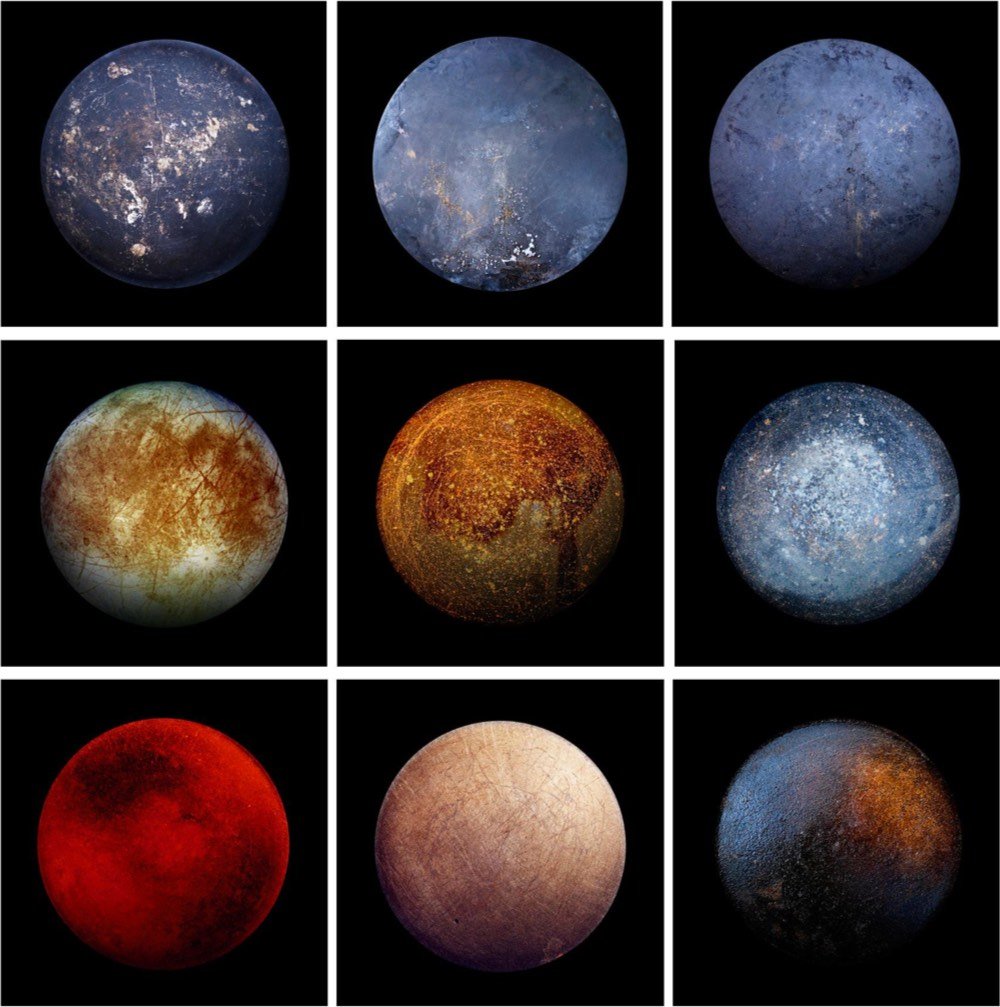
One of these images is of Europa, Jupiter’s icy moon, and the other eight are frying pans. Can you pick Europa out? Hint: frying pans tend not to have impact craters.
Update: The photos of the frying pans were taken by Christopher Jonassen, whose work I featured back in 2011 (which I had totally forgotten about). At the time, I even joked about the pans looking like a Jovian moon. kottke.org is a flat circle. (thx, tony)
How massive are they? The Sun is 1 solar mass and as wide as 109 Earths. Sagittarius A, the black hole at the center of the Milky Way, weighs 4.3 million solar masses and is as wide as Mercury is far from the Sun. The black hole at the center of the Phoenix Cluster is one of the largest known black holes in the Universe; it’s 73 billion miles across, which is 19 times larger than our entire solar system (from the Sun to Pluto). As for how much it weighs, check this out:
I also like that if you made the Earth into a black hole, it would be the size of a peanut. (thx, reidar)
Emily Lakdawalla provides an update on all of the exploration that’s going on in our solar system this month. Here’s a quick map view of the 20+ spacecraft exploring our solar system beyond Earth:
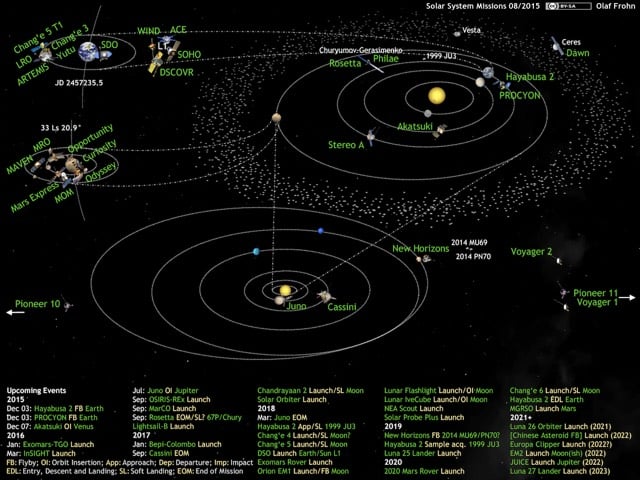
Mars remains the most active spot beyond Earth in the solar system. This week, Mars Reconnaissance Orbiter reaches its 10th anniversary of service in space, but it’s far from the oldest spacecraft in orbit at Mars; Mars Express and Mars Odyssey are still at work up there. Mars Orbiter Mission has ventured into an extended mission and is still returning photos, though apparently none of the full-disk images in a variety of phases that I had hoped for from its 4-Megapixel color camera. Even Mars’ newest resident, MAVEN, is three-quarters of the way through its one-year primary science mission, which began on November 16, 2014. MAVEN’s mission will undoubtedly be extended long beyond that, as it will be needed to support surface missions if and when Odyssey and Mars Reconnaissance Orbiter eventually fail.
Both Opportunity and Curiosity have been very active lately. Opportunity has finally reached Marathon Valley, a site identified from orbit to have signs of clay chemistry. The team is excited about the science prospects even though the rover’s memory problems persist.
This morning, the New Horizons probe zinged safely1 past Pluto. Before it did, it transmitted the best photo we’ve seen of Pluto so far…the last one we’ll get before we get the really good stuff. Look at this:
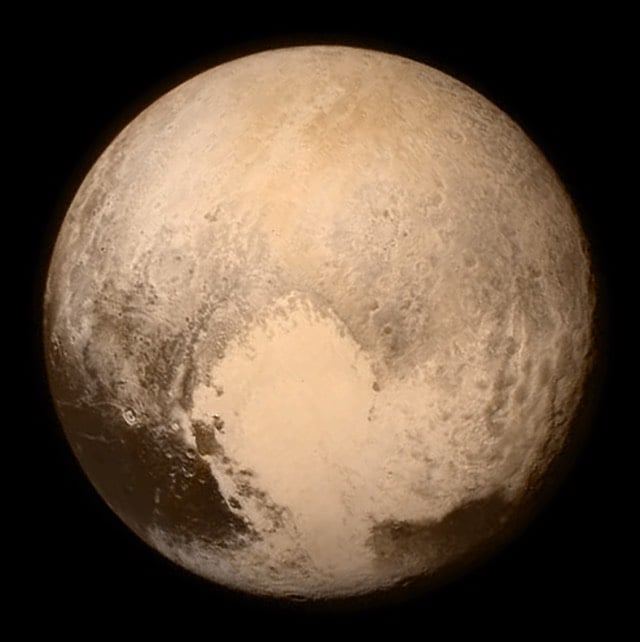
The probe’s “I’m OK!” message will reach Earth around 9pm ET tonight and we’ll start seeing photos from the flyby Wednesday afternoon…there’s a NASA press conference scheduled for 3pm ET on July 15. So exciting!
Update: The photo above is also the best full-disk image of Pluto that we will get…the rest will be close-ups and such. So that’s the official Pluto portrait from now on, folks.
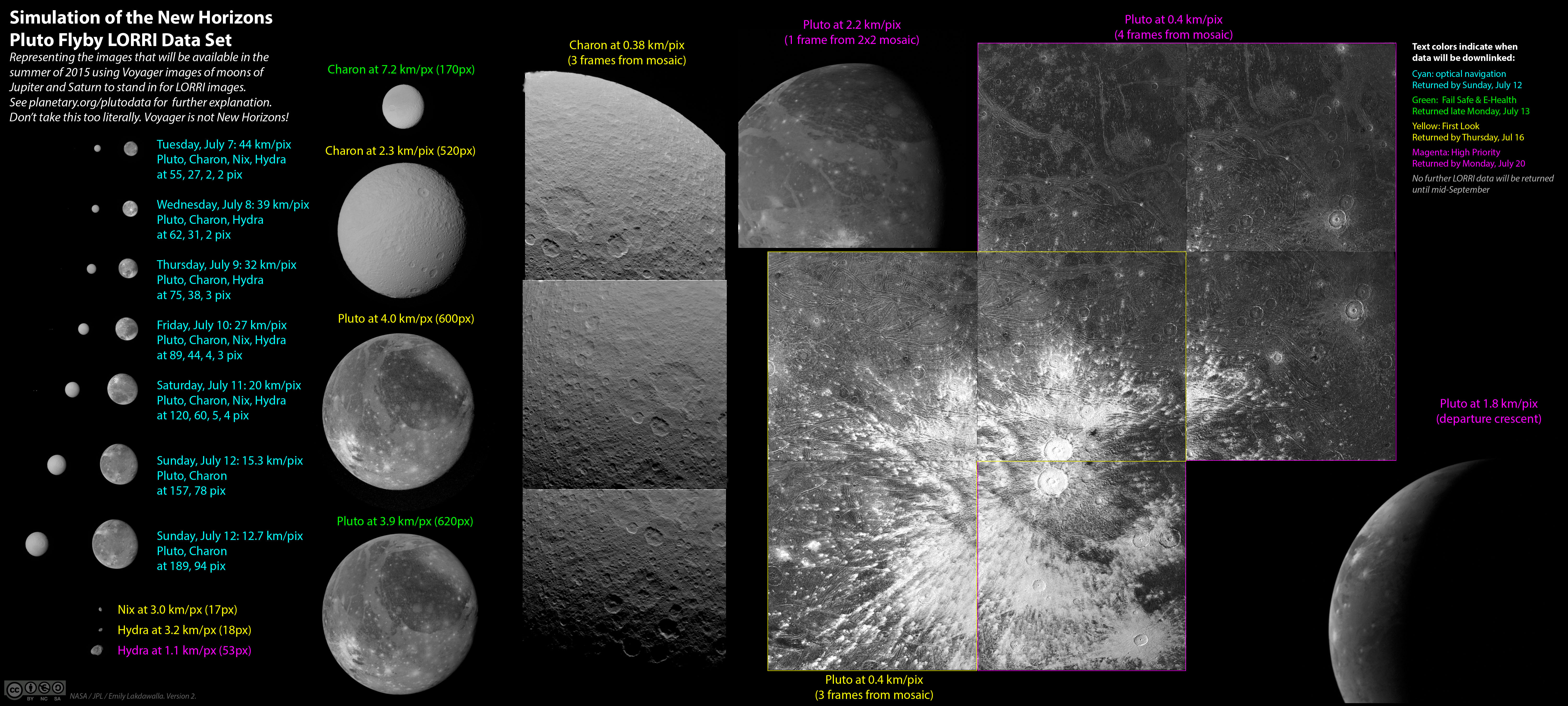
As the New Horizons probe nears Pluto, I’ve been reading a bit more about how it’s going to work and what sort of photos we’re going to get. Emily Lakdawalla has a comprehensive post about what to expect when you’re expecting a flyby of Pluto. The post contains an image of approximations of the photos New Horizon will take, using Voyager images of Jovian and Saturnian moons as stand-ins. The highest resolution photo of Pluto will be 0.4 km/pixel…it’ll have this approximate level of detail:
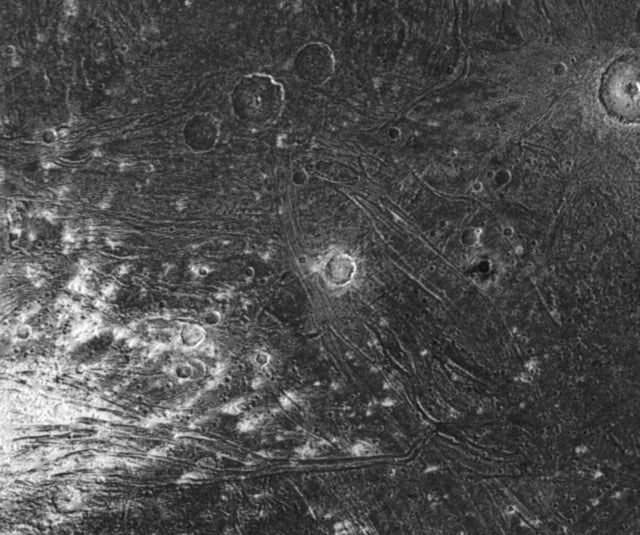
Which is pretty amazing and exciting considering that before the mission started this was our best view of Pluto:
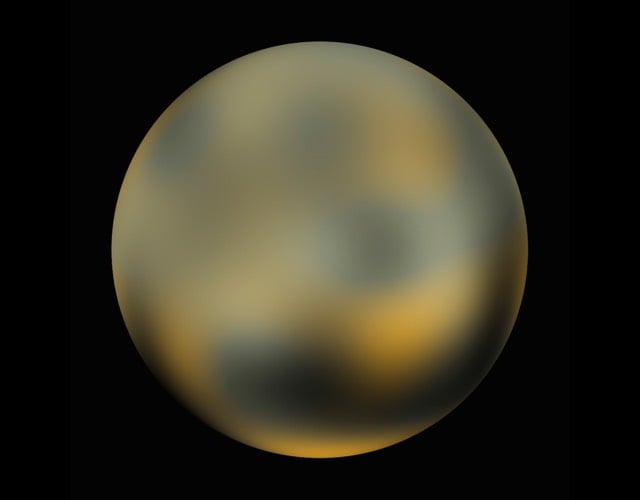
NASA’s Eyes app lets you see a simulation of the probe as it approaches Pluto, but if you don’t want to download anything, you can watch this video of the flyby instead:
I had no idea the probe spun around so much as it grabs photos & scans and then beams them back to Earth. And the flyby is so fast! New Horizons is currently moving at 32,500 mph relative to the Sun…it’s travelling just over 9 miles every second. (via @Tim_Meyer_ & @badastronomer)
Pluto is so far away that we haven’t even been able to get a good look at it, not even with the crazy-powerful Hubble telescope. But with NASA’s New Horizons mission closing in on our solar system’ ninth planet,1 we are getting a better and better view of Pluto every day.1 Here’s the latest, from just a few hours ago:
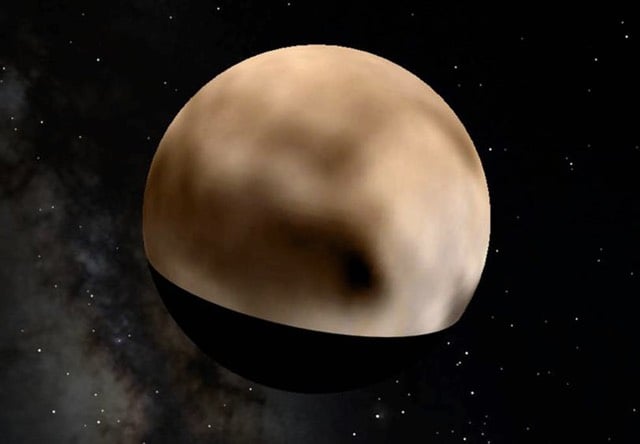
New Horizons will reach its closest approach to Pluto in just under 6 days, on July 14. The probe will pass within 7,800 miles of the surface…I can’t wait to find out what that day’s photos look like.
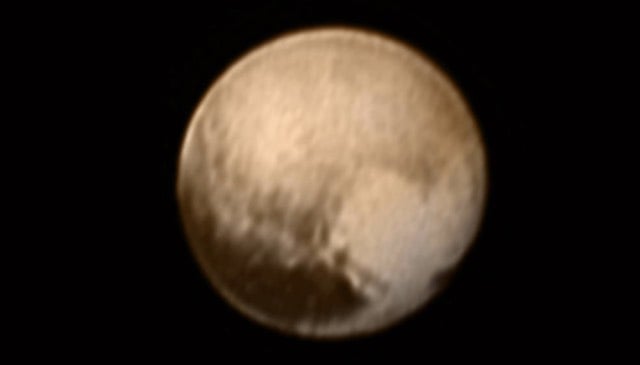
Update: You don’t even need to wait until tomorrow for that better image…here’s one that NASA released just a short while ago. Tune in tomorrow for an even better view.
Researchers using the Keck Observatory have discovered a new kind of galaxy that are large but filled with relatively few stars.
“If the Milky Way is a sea of stars, then these newly discovered galaxies are like wisps of clouds”, said van Dokkum. “We are beginning to form some ideas about how they were born and it’s remarkable they have survived at all. They are found in a dense, violent region of space filled with dark matter and galaxies whizzing around, so we think they must be cloaked in their own invisible dark matter ‘shields’ that are protecting them from this intergalactic assault.”
The night sky in such galaxies would look a lot like our skies do in large cities:
“If there are any aliens living on a planet in an ultra-diffuse galaxy, they would have no band of light across the sky, like our own Milky Way, to tell them they were living in a galaxy. The night sky would be much emptier of stars,” said team member Aaron Romanowsky, of San Jose State University.
(via gizmodo)
The Hubble Space Telescope was deployed into space on April 25, 1990 and began snapping images of the sky shortly thereafter. Phil Plait, the NY Times, NPR, and How We Get To Next have chosen some of their favorite Hubble images, and Taschen published a coffee table book of Hubble images called Expanding Universe.
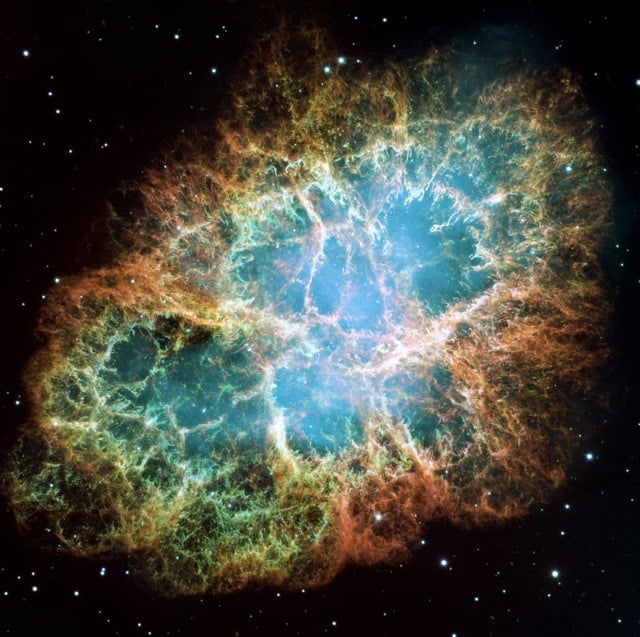
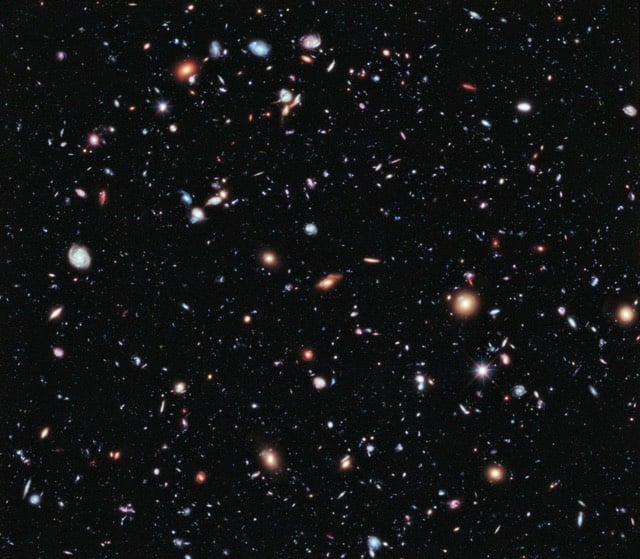
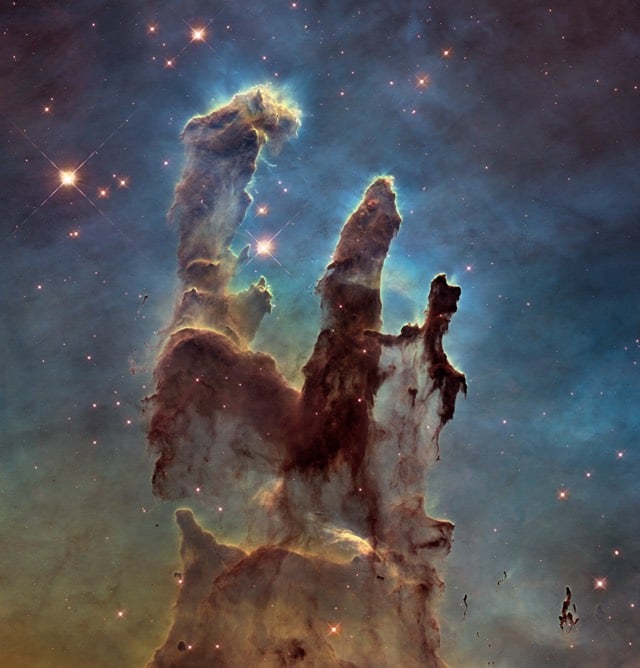
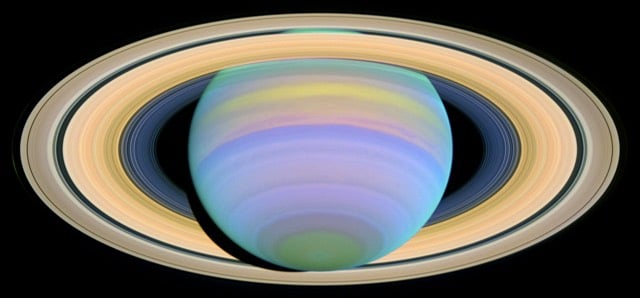
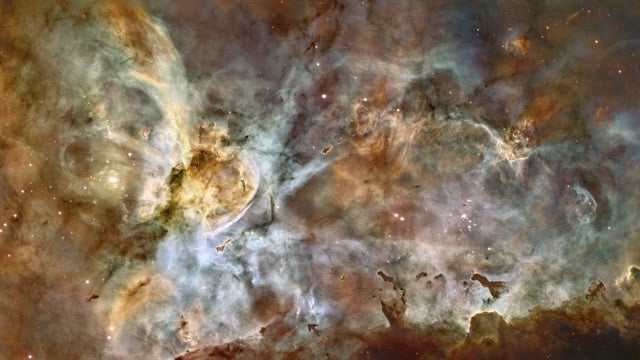
I still find it incredible that we have a telescope orbiting the Earth. Happy birthday, Hubble. Here’s to many more.
A group of astronomy enthusiasts rented a plane and flew through the shadow cast by the recent eclipse of the Sun. One passenger took the following video. Look at that shadow creeping across the cloud cover! So cool.
P.S. Still super excited for the 2017 eclipse! (via slate)
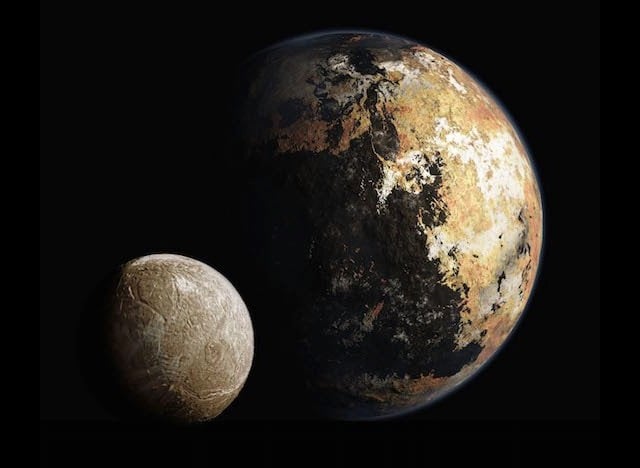
Ok, Pluto fans. They evicted Pluto from our solar system’s planetary pantheon, but a NASA mission launched in 2006 is nearing the dwarf planet with its cameras. We’ll soon have photos of Pluto that are much more high resolution than we currently have, which means scientists will need names for all the new geographic features. The Our Pluto site has been set up to help suggest and vote on names for these features. Naming themes include historic explorers, travelers to the underworld, and scientists and engineers. Go vote! (via slate)
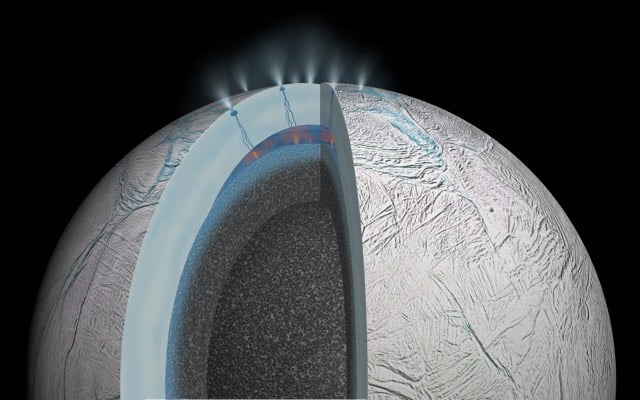
Two teams of NASA scientists have discovered evidence that hydrothermal vents on the Saturnian moon of Enceladus show signs of “active hot-water chemistry”. Why is that exciting? Because similar chemistry occurs deep in the Earth’s oceans *and* can support life. Phil Plait explains.
We see these vents in the ocean bottom on Earth, too. The water there is very hot, heated by tectonic processes inside Earth’s crust. It brings up minerals and nutrients, and life thrives there. A lot of the processes are the same as what’s imagined is happening on Enceladus; minerals are dissolved in hot water that spews up into the cold ocean, precipitating out. A lot of it is sulfur based, but amazingly life exists there anyway. The environment is highly toxic to humans-huge pressure, boiling water near the vents, freezing a bit farther away, and loaded with icky chemicals-but as a scientist once said, “Life finds a way.”
Between the evidence of past flowing water on Mars, Titan’s hydrocarbon lakes, Europa’s underground ocean, and Enceladus, it seems increasingly probable we’ll find life somewhere else in the solar system. That’s a pretty exciting prospect! (via @ericholthaus)
Update: It was also announced today that the Hubble has detected signs of a salty underground ocean on Jupiter’s moon Ganymede.
New observations of the moon using Hubble support this. Ganymede has a weak magnetic field, and, like on Earth, this generates an aurora-the glow created when high-speed subatomic particles slam into the extremely thin atmosphere. This glow is brightest in ultraviolet, and so astronomers used the Space Telescope Imaging Spectrograph (my old camera!) on Hubble to observe Ganymede. STIS is quite sensitive to UV and detected the aurora.
Now this part is a bit tricky: Jupiter has a powerful magnetic field as well, which interacts with Ganymede’s. As they do, the aurora changes position over time, moving up and down in latitude. However, the observations show that the aurorae do not change nearly as much as expected if Ganymede were solid. The best way to explain this is if the moon has a salty ocean under its surface. The ocean would have its own magnetic field and would resist the influence of Jupiter’s magnetic field, which in turn keeps the aurora steadier.
Turns out there’s water all over the place in the solar system. How about that?
Astronomers have been able to view the same supernova in a distant part of the Universe several times due to the gravitational lensing effect of a cluster of galaxies in-between here and there. From Dennis Overbye in the NY Times:
Supernovas are among the most violent and rare events in the universe, occurring perhaps once per century in a typical galaxy. They outshine entire galaxies, spewing elemental particles like oxygen and gold out into space to form the foundations of new worlds, and leaving behind crushed remnants called neutron stars or black holes.
Because of the galaxy cluster standing between this star and the Hubble, “basically, we got to see the supernova four times,” Dr. Kelly said. And the explosion is expected to appear again in another part of the sky in the next 10 years. Timing the delays between its appearances, he explained, will allow astronomers to refine measurements of how fast the universe is expanding and to map the mysterious dark matter that supplies the bulk of the mass and gravitational oomph of the universe.
Scientists expect the supernova to reappear in the next few years. Gravitational lensing was predicted by Einstein’s general theory of relativity and as Overbye writes, “the heavens continue to light candles for Albert Einstein.”
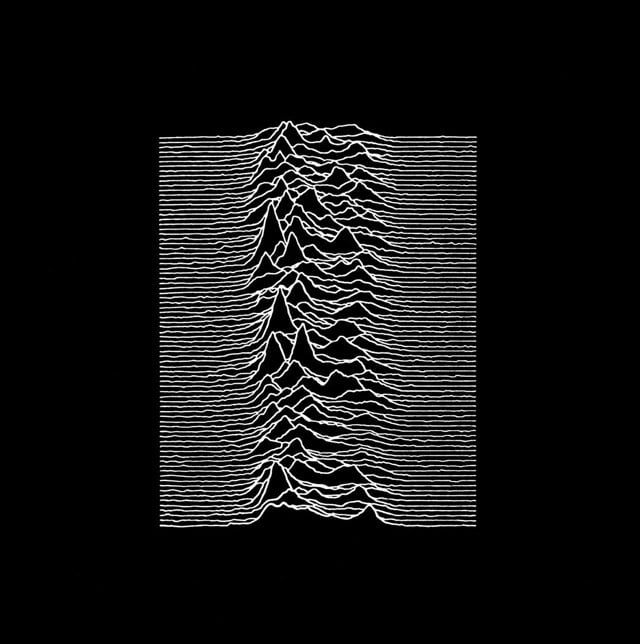
For Scientific American, Jen Christiansen tracks down where the iconic image on the cover of Joy Division’s Unknown Pleasures came from. Designer Peter Saville found the image, a stacked graph of successive radio signals from pulsar CP 1919, in a 1977 astronomy encyclopedia but it actually originated in a 1970 Ph.D. thesis.
By now I had also combed through early discovery articles in scientific journals and every book anthology on pulsars I could get my hands on to learn more about early pulsar visualizations. The more I learned, the more this descriptor in the 1971 Ostriker caption began to feel significant; “computer-generated illustration.” The charts from Bell at Mullard were output in real time, using analogue plotting tools. A transition in technology from analogue to digital seemed to have been taking place between the discovery of pulsars in 1967 to the work being conducting at Arecibo in 1968 through the early 1970’s. A cohort of doctoral students from Cornell University seemed to be embracing that shift, working on the cutting edge of digital analysis and pulsar data output. One PhD thesis title from that group in particular caught my attention, “Radio Observations of the Pulse Profiles and Dispersion Measures of Twelve Pulsars,” by Harold D. Craft, Jr. (September 1970).
When a star gets old and fat, it explodes in a supernova, leaving a neutron star in its wake. Neutron stars are heavily magnetized and incredibly dense, approximately two times the mass of the Sun packed into an area the size of the borough of Queens. That’s right around the density of an atomic nucleus, which isn’t surprising given that neutron stars are mostly composed of neutrons. A teaspoon of neutron star would weigh billions of tons.
A pulsar is a neutron star that quickly rotates. As the star spins, electromagnetic beams are shot out of the magnetic poles, which sweep around in space like a lighthouse light. Pulsars can spin anywhere from once every few seconds to 700 times/second, with the surface speed approaching 1/4 of the speed of light. These successive waves of electromagnetic pulses, arriving every 1.34 seconds, are what’s depicted in the stacked graph. Metaphorical meanings of its placement on the cover of a Joy Division record are left as an exercise to the reader.

The Spaceprob.es site tracks the active probes in operation in and around our solar system, from Voyager I (19.56 billion km from Earth) to the Artemis probes (358,000 km away). (via @BadAstronomer)
Update: Spaceprob.es now has a shop with posters, pillows, t-shirts, and stickers.
Nothing is faster than the speed of light. But compared to the unimaginable size of the Universe, light is actually extremely slow. This video is 45 minutes long and during that time, a photon emitted from the Sun1 will only travel through a portion of our solar system.
In our terrestrial view of things, the speed of light seems incredibly fast. But as soon as you view it against the vast distances of the universe, it’s unfortunately very slow. This animation illustrates, in realtime, the journey of a photon of light emitted from the sun and traveling across a portion of the solar system.
It takes light more than 43 minutes to travel to Jupiter and even to travel the diameter of the Sun takes 4.6 seconds. (thx, andy)
This is an ultra-HD time lapse of planet Earth in infrared. Infrared light is absorbed by clouds and water vapor, so the result is a sphere of roiling storms and trade winds.
Here’s a video with both hemispheres at once and another offering a closer view. If you’ve got a 4K display, this will look pretty incredible on it. James Tyrwhitt-Drake has done a bunch of other HD videos of the Earth and Sun, including Planet Earth in 4K and the Sun in 4K.
From the Russian Space Agency, a video of what the sky would look like if the Sun were replaced by some other stars. It starts off with the binary star system of Alpha Centuri, but watch until the end for Polaris, which has a radius 46 times that of the Sun.
See also the view from Earth of different planets replacing the Moon and imagining Earth with Saturn’s rings.
The Hubble Space Telescope was launched 25 years ago, and to start the celebration, NASA has released a pair of images that actually did make this space nerd’s jaw drop. The first is an update of a classic: a much sharper photo of the so-called Pillars of Creation:
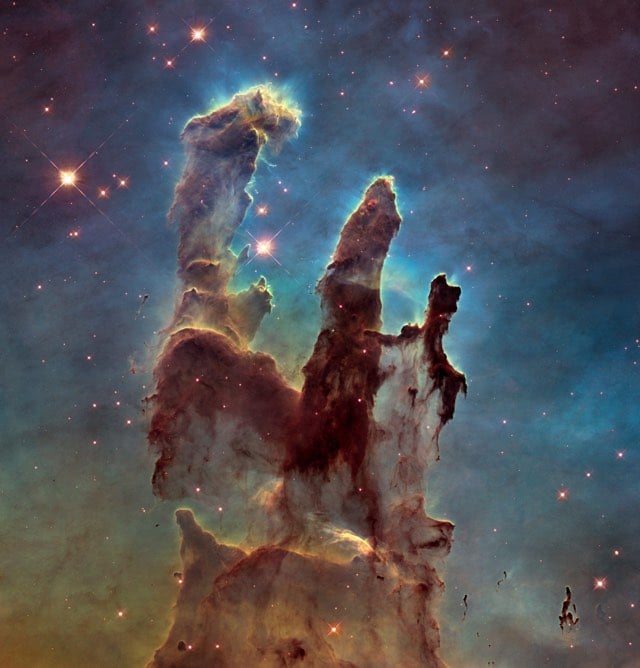
Although NASA’s Hubble Space Telescope has taken many breathtaking images of the universe, one snapshot stands out from the rest: the iconic view of the so-called “Pillars of Creation.” The jaw-dropping photo, taken in 1995, revealed never-before-seen details of three giant columns of cold gas bathed in the scorching ultraviolet light from a cluster of young, massive stars in a small region of the Eagle Nebula, or M16.
The second image isn’t so immediately amazing but is my favorite of the two. It’s a photo of half of the Andromeda galaxy, the big galaxy closest to our own in distance but also in rough size and shape. Here’s a very very scaled-down version of it:
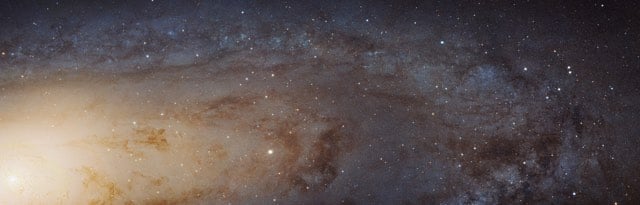
The largest NASA Hubble Space Telescope image ever assembled, this sweeping view of a portion of the Andromeda galaxy (M31) is the sharpest large composite image ever taken of our galactic neighbor. Though the galaxy is over 2 million light-years away, the Hubble telescope is powerful enough to resolve individual stars in a 61,000-light-year-long section of the galaxy’s pancake-shaped disk. It’s like photographing a beach and resolving individual grains of sand. And, there are lots of stars in this sweeping view — over 100 million, with some of them in thousands of star clusters seen embedded in the disk.
The original image is 1500 megapixels (1.5 gigapixels!), which is so big that you’d need 600 HD televisions to display the whole thing. But if you take the biggest reasonable size available for download (100 megapixels) and zoom in on it, you get this:
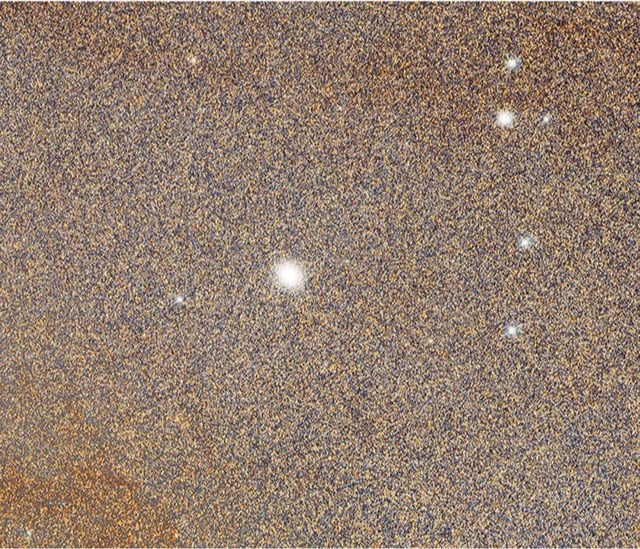
That looks like JPEG compression noise, right? Nope, each one of those dots is a star…some of the 100 million individual stars that can be seen in the full image.

That’s right, Keanu. Whoa. For an even closer look, check out this annotated close-up released by NASA:
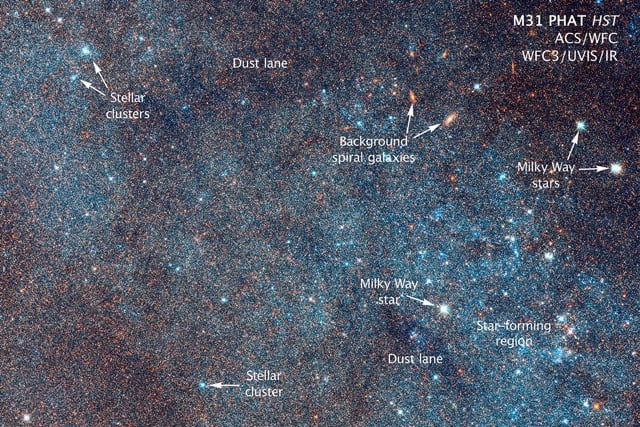
If you’re curious and feel like crashing your browser and/or Photoshop a bunch of times (I did not), the full-res Andromeda images are available here. And Phil Plait writes much more joyfully and knowledgeably about these images than I do…go take a look at his Pillars of Creation and Andromeda posts.
Update: Rob Griffiths took 50+ photos from the Hubble web site and made them into Retina iMac-sized wallpapers. (via @djacobs)
From astrophysicist Robert Simpson, a tour of the Universe from humans to the largest structure of the Universe. The piece is full of interesting little bits like:
The average female is 1.62 metres [tall] — that’s 5.4 light-nanoseconds.
If the Earth was a beach ball then all life on Earth exists within just 1mm around the surface.
Out by Pluto, the Sun itself is has dimmed to look like an other stars.
If the Sun was a blood cell then the Milky Way is the size of Europe.
See also Steven Strogatz on the Sagan Planet Walk in Ithaca, NY.
As you stroll from one to another, you can’t help noticing that the first four planets are really close together. It takes a few seconds, a few tens of steps, to walk from the Sun to Mercury and then on to Venus, Earth and Mars. By contrast, Jupiter is a full two-minute walk down the block, just past Moosewood Restaurant, waiting for someone to stop by and admire it. The remaining planets are even lonelier, each marooned in its own part of town. The whole walk, from the Sun to Pluto, is about three-quarters of a mile long and takes about 15 minutes.
My favorite detail: they added a new station to the Sagan Walk, the star nearest to our solar system. It’s in Hawaii.
This is a great way to think about how big the planets of our solar system are: in terms of fruits.
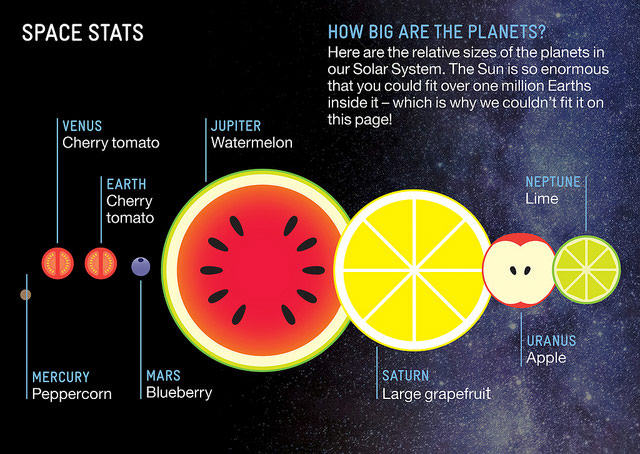
(via boing boing)
This is a time lapse of the surface of the Sun, constructed of more than 17,000 images taken by the Solar Dynamics Observatory from Oct 14 to Oct 30, 2014. The bright area that starts on the far right is sunspot AR 12192, the largest observed sunspot since 1990.
The sunspot is about 80,000 miles across (as wide as 10 Earths) and it’s visible from Earth with the naked eye. Best viewed as large as possible…I bet this looks amazing on the new retina iMac. (via @pageman)
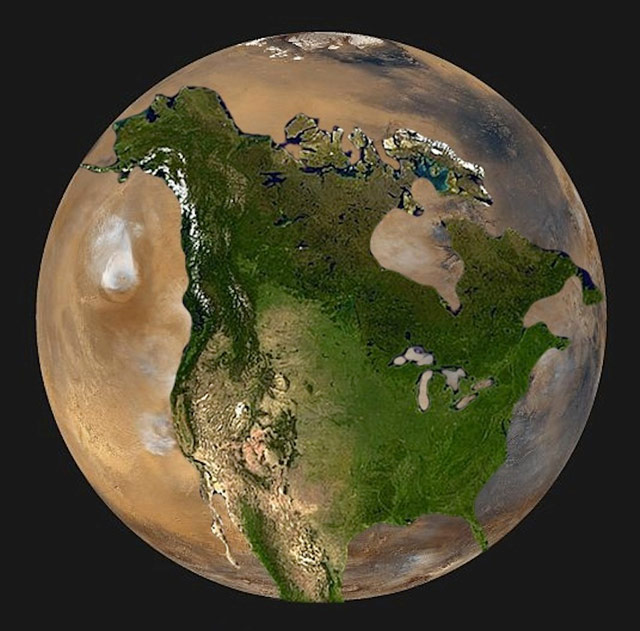
It can be difficult to understand how large (or small) astronomical objects are, so here are some handy comparisons to things on Earth. Here’s the size of Mars compared to the United States & Canada:
And here’s a neutron star nestled next to Liverpool on the northwest coast of England:
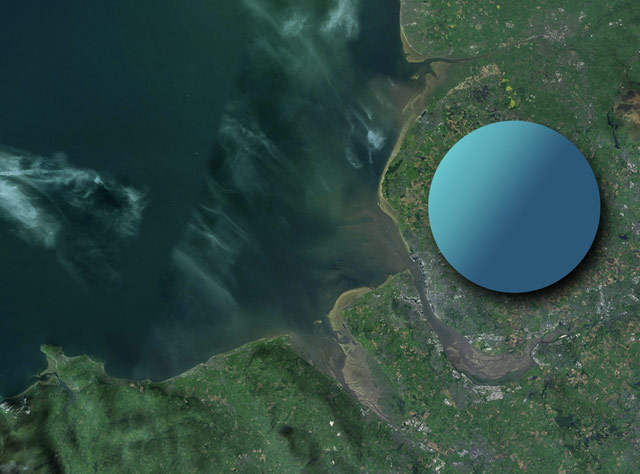
A neutron star also crams in over 1.5 times the mass of the Sun into a tiny ball maybe not much bigger than your daily commute to work, and the Sun is huge (see the size of the Sun later). So this thing is incredibly dense, so dense in fact that just a tea spoon of it would weigh over a billion tonnes, and if you could stand on its surface you’d feel the gravitational pull of 200 billion times that of our planet…not that you’d ever survive it of course.
(via @theclintmcleod)
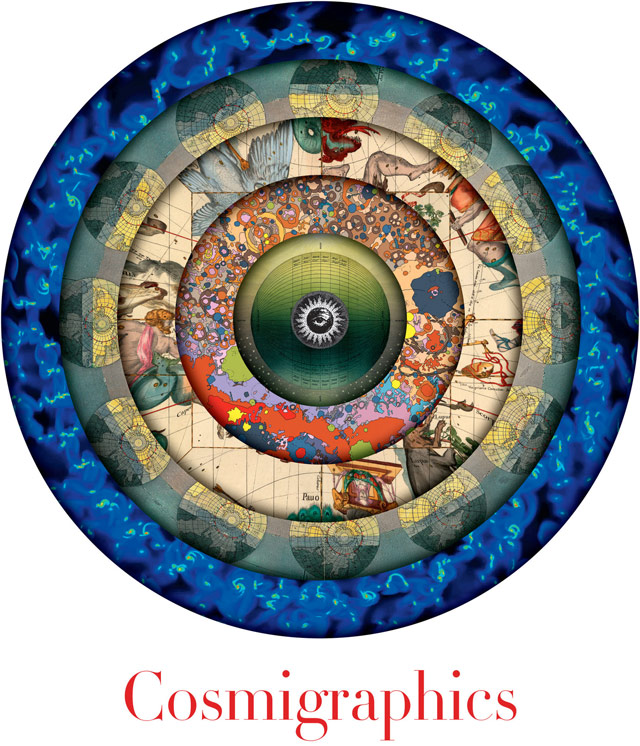
From Michael Benson comes Cosmigraphics, a survey of many ways in which humans have represented the Universe, from antiquity on up to the present day.
Selecting artful and profound illustrations and maps, many hidden away in the world’s great science libraries and virtually unknown today, he chronicles more than 1,000 years of humanity’s ever-expanding understanding of the size and shape of space itself. He shows how the invention of the telescope inspired visions of unimaginably distant places and explains why today we turn to supercomputer simulations to reveal deeper truths about space-time.
The NY Times has an adaptation of the introduction to the book.
Among the narrative threads woven into the book are the 18th-century visual meditations on the possible design of the Milky Way - including the astonishing work of the undeservedly obscure English astronomer Thomas Wright, who in 1750 reasoned his way to (and illustrated) the flattened-disk form of our galaxy. In a book stuffed with exquisite mezzotint plates, Wright also conceived of another revolutionary concept: a multigalaxy cosmos. All of this a quarter-century before the American Revolution, at a time when the Milky Way was thought to constitute the entirety of the universe.
This looks like a time lapse, but it’s not. It’s just a straight-up gorgeous video of the aurora borealis filmed in Yellowknife, Northwest Territories, Canada.
It is real time motion! NOT time-lapse. Brighter the Aurora, faster the movement.
(via the kid should see this)

Spanning from comets in the south to the termination shock zone in the northern part of the country, The Sweden Solar System is a scale model of the solar system that spans the entire country of Sweden, the largest such model in the world.
The Sun is represented by the Ericsson Globe in Stockholm, the largest hemispherical building in the world. The inner planets can also be found in Stockholm but the outer planets are situated northward in other cities along the Baltic Sea.
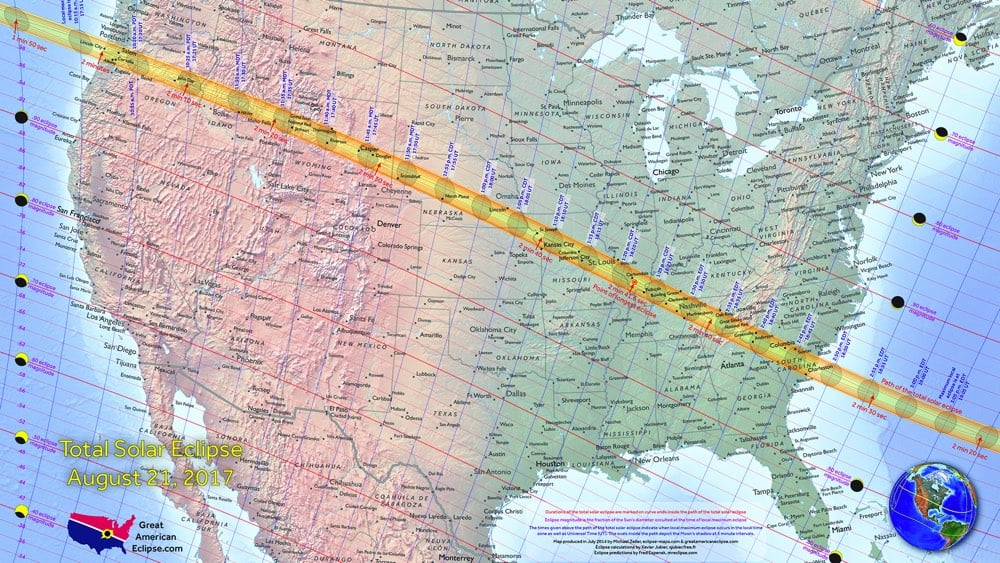
I do not officially have a bucket list1 but if I did have one, watching a total solar eclipse would be on it. Was just talking about it the other day in fact. Well. I am pretty damn excited for the Great American Eclipse of 2017!
In August 21, 2017, millions of people across the United States will see nature’s most wondrous spectacle — a total eclipse of the Sun. It is a scene of unimaginable beauty; the Moon completely blocks the Sun, daytime becomes a deep twilight, and the Sun’s corona shimmers in the darkened sky. This is your guide to understand, prepare for, and view this rare celestial event.
It goes right through the middle of the country too…almost everyone in the lower 48 is within a day’s drive of seeing it. Cities in the path of the totality include Salem, OR, Jackson, WY, Lincoln, NE, St. Louis, MO (nearly), Nashville, TN, and Charleston, SC.
Weather will definitely play a factor in actually seeing the eclipse, so I will be keeping an eye on Eclipser (“Climatology and Maps for the Eclipse Chaser”) as the event draws near. Early analysis indicates Oregon as the best chance for clear skies. Matt, I am hereby laying claim to your guest room in three years time. So excited!!
The black hole at the center of the Milky Way galaxy is estimated to have a mass of 4 million Suns. The largest black hole astronomers have found so far has a mass of 18 billion solar masses, or more than 4000 times as massive as the Milky Way’s.
Around 3.5 billion light-years away, this galaxy is estimated to contain the largest black hole presently known, at 18 billion solar masses. (Although, the error bars for this one and NGC 1277’s overlap substantially.) But the most spectacular part of this galaxy — and why we’re able to learn so much about it’s central region — is because there’s a 100 million Solar mass black hole (that’s 25 times larger than the one at the Milky Way’s core) that’s orbiting the even larger one!
Also, the largest know galaxy in the Universe is IC 1101, with a mass of 100 trillion solar masses.
There are a couple of different ways you can construct a stable solar system with a maximum number of habitable worlds. One includes 36 habitable worlds in a single solar system.
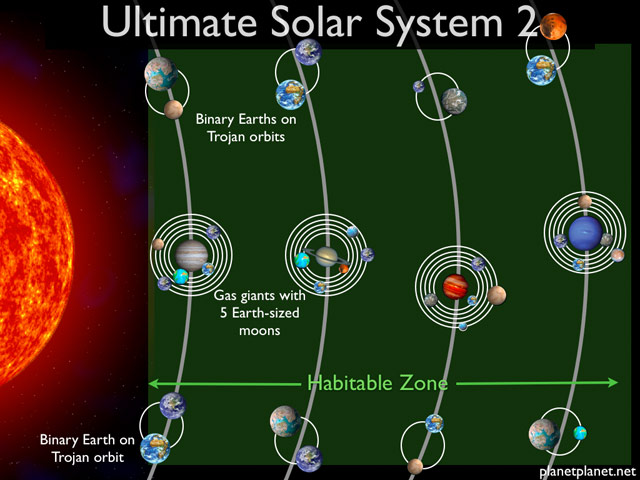
We can fit the orbits of four gas giants in the habitable zone (in 3:2 resonances). Each of those can have up to five potentially habitable moons. Plus, the orbit of each gas giant can also fit an Earth-sized planet both 60 degrees in front and 60 degrees behind the giant planet’s orbit (on Trojan orbits). Or each could be a binary Earth! What is nice about this setup is that the worlds can have any size in our chosen range. It doesn’t matter for the stability.
Let’s add it up. One gas giant per orbit. Five large moons per gas giant. Plus, two binary Earths per orbit. That makes 9 habitable worlds per orbit. We have four orbits in the habitable zone. That makes 36 habitable worlds in this system!
If the Moon orbited the Earth at the same distance as the International Space Station, it might look a little something like this:
At that distance, the Moon would cover half the sky and take about five minutes to cross the sky. Of course, as Phil Plait notes, if the Moon were that close, tidal forces would result in complete chaos for everyone involved.
There would be global floods as a tidal wave kilometers high sweeps around the world every 90 minutes (due to the Moon’s closer, faster orbit), scouring clean everything in its path. The Earth itself would also be stretched up and down, so there would be apocalyptic earthquakes, not to mention huge internal heating of the Earth and subsequent volcanism. I’d think that the oceans might even boil away due to the enormous heat released from the Earth’s interior, so at least that spares you the flood… but replaces water with lava. Yay?
Newer posts
Older posts





Socials & More