kottke.org posts about USA
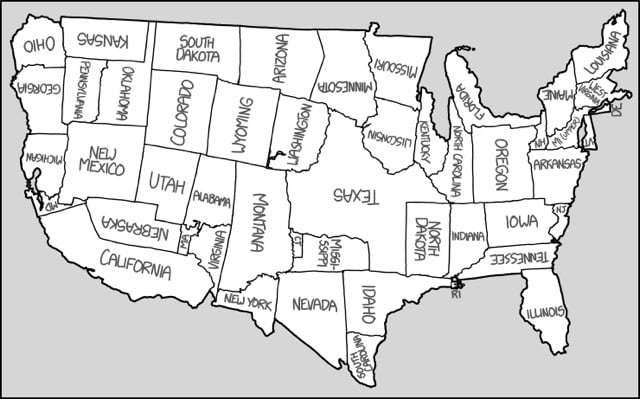
Randall Munroe has made a map of the United States with all of the states in different places but still retaining the same general shape. Particularly clever is the Michigan/Maryland combo to recreate the Bay Area.
One of the video’s main points:
It’s not that America has much more crime. It’s that crime in the US is much more lethal.
Similar to a sentiment I tweeted out a few months ago:
Easy access to guns turns bad moods, bad politics, bad religion, bad brain chemistry, and bad ideas into murder.
(via @atul_gawande)
On the most recent episode of Last Week Tonight, John Oliver argues against many US states’ anti-abortion laws. This was super funny and also made me really angry.
The Economist style guide’s section on Americanisms is just a tad catty.
Try not to verb nouns or to adjective them. So do not access files, haemorrhage red ink (haemorrhage is a noun), let one event impact another, author books (still less co-author them), critique style guides, pressure colleagues (press will do), progress reports, source inputs, trial programmes or loan money. Avoid parenting and, even more assiduously, parenting skills. Gunned down means shot. And though it is sometimes necessary to use nouns as adjectives, there is no need to call an attempted coup a coup attempt, a suspected terrorist a terrorist suspect or the Californian legislature the California legislature. Vilest of all is the habit of throwing together several nouns into one ghastly adjectival reticule: Texas millionaire real-estate developer and failed thrift entrepreneur Hiram Turnipseed…
(via @mccanner)
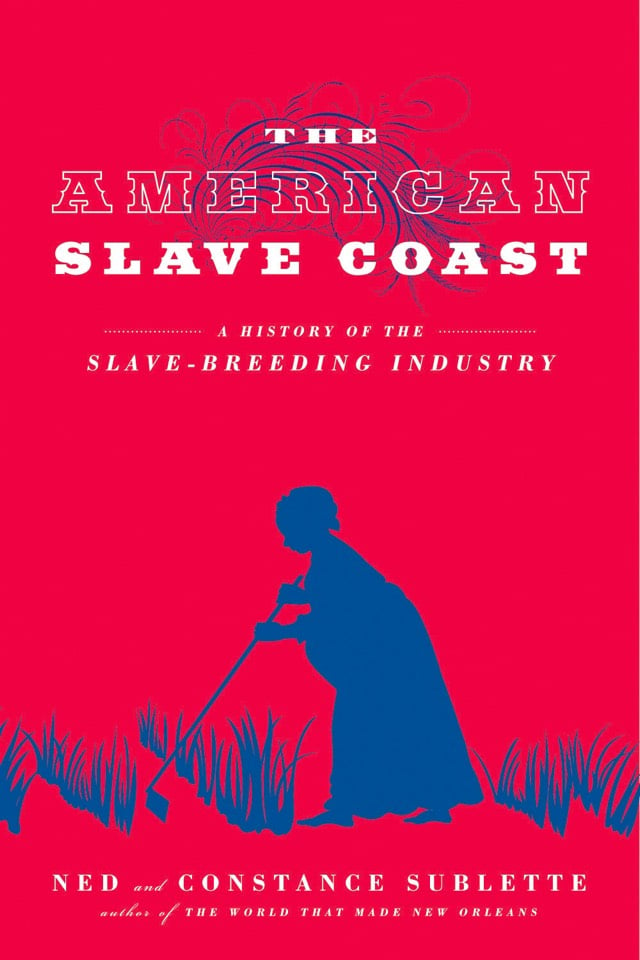
The American Slave Coast: A History of the Slave-Breeding Industry (Amazon) by Ned & Constance Sublette is a book which offers an alternate view of slavery in the United States. Instead of treating slavery as a source of unpaid labor, as it is typically understood, they focus on the ownership aspect: people as property, merchandise, collateral, and capital. From a review of the book at Pacific Standard:
In fact, most American slaves were not kidnapped on another continent. Though over 12.7 million Africans were forced onto ships to the Western hemisphere, estimates only have 400,000-500,000 landing in present-day America. How then to account for the four million black slaves who were tilling fields in 1860? “The South,” the Sublettes write, “did not only produce tobacco, rice, sugar, and cotton as commodities for sale; it produced people.” Slavers called slave-breeding “natural increase,” but there was nothing natural about producing slaves; it took scientific management. Thomas Jefferson bragged to George Washington that the birth of black children was increasing Virginia’s capital stock by four percent annually.
Here is how the American slave-breeding industry worked, according to the Sublettes: Some states (most importantly Virginia) produced slaves as their main domestic crop. The price of slaves was anchored by industry in other states that consumed slaves in the production of rice and sugar, and constant territorial expansion. As long as the slave power continued to grow, breeders could literally bank on future demand and increasing prices. That made slaves not just a commodity, but the closest thing to money that white breeders had. It’s hard to quantify just how valuable people were as commodities, but the Sublettes try to convey it: By a conservative estimate, in 1860 the total value of American slaves was $4 billion, far more than the gold and silver then circulating nationally ($228.3 million, “most of it in the North,” the authors add), total currency ($435.4 million), and even the value of the South’s total farmland ($1.92 billion). Slaves were, to slavers, worth more than everything else they could imagine combined.
Just reading that turns my stomach. The Sublettes also recast the 1808 abolition of the transatlantic slave trade as trade protectionism.
Virginia slaveowners won a major victory when Thomas Jefferson’s 1808 prohibition of the African slave trade protected the domestic slave markets for slave-breeding.
I haven’t read the book, but I imagine they touched on the fact that by growing slave populations, southern states were literally manufacturing more political representation due to the Three-Fifths clause in the US Constitution. They bred more slaves to help politically safeguard the practice of slavery.
Update: Because slaves were property, Southern slave owners could mortgage them to banks and then the banks could package the mortgages into bonds and sell the bonds to anyone anywhere in the world, even where slavery was illegal.
In the 1830s, powerful Southern slaveowners wanted to import capital into their states so they could buy more slaves. They came up with a new, two-part idea: mortgaging slaves; and then turning the mortgages into bonds that could be marketed all over the world.
First, American planters organized new banks, usually in new states like Mississippi and Louisiana. Drawing up lists of slaves for collateral, the planters then mortgaged them to the banks they had created, enabling themselves to buy additional slaves to expand cotton production. To provide capital for those loans, the banks sold bonds to investors from around the globe — London, New York, Amsterdam, Paris. The bond buyers, many of whom lived in countries where slavery was illegal, didn’t own individual slaves — just bonds backed by their value. Planters’ mortgage payments paid the interest and the principle on these bond payments. Enslaved human beings had been, in modern financial lingo, “securitized.”
Slave-backed securities. My stomach is turning again. (via @daveg)
Update: Tyler Cowen read The American Slave Coast and listed a few things he learned from it.
2. President James Polk speculated in slaves, based on inside information he obtained from being President and shaping policy toward slaves and slave importation.
3. In the South there were slave “breeding farms,” where the number of women and children far outnumbered the number of men.
Update: In his book The Half Has Never Been Told: Slavery and the Making of American Capitalism (Amazon), Edward Baptist details how slavery played a central role in the making of the US economy.
As historian Edward Baptist reveals in The Half Has Never Been Told, slavery and its expansion were central to the evolution and modernization of our nation in the 18th and 19th centuries, catapulting the US into a modern, industrial and capitalist economy. In the span of a single lifetime, the South grew from a narrow coastal strip of worn-out tobacco plantations to a sub-continental cotton empire. By 1861 it had five times as many slaves as it had during the Revolution, and was producing two billion pounds of cotton a year. It was through slavery and slavery alone that the United States achieved a virtual monopoly on the production of cotton, the key raw material of the Industrial Revolution, and was transformed into a global power rivaled only by England.
(via @alexismadrigal)
From Dave Pell at Nextdraft, who says that “rage is all the rage these days”, comes the results of an Esquire/NBC News poll about how angry Americans are these days. Americans are more angry, especially white Americans.
Half of all Americans are angrier today than they were a year ago. White Americans are the angriest of all. And black Americans are more optimistic about the future of the country and the existence of the American dream. There are depths and dimensions, dark corners and subtle contours to our national mood, and setting aside the issue of who actually has a right to be angry and about what — these pages are neutral territory; everyone is allowed their beef — we found three main factors shaping American rage.
I’ve been thinking about this issue a lot recently and I think part of the rage white Americans feel has to do with a perceived relative loss of power and status. I mean, look who’s in the Oval Office right now…a black Muslim man who wasn’t even born here!
In the New Yorker, Nicholas Lemann writes about “the Southernization of American politics”. In 1865, the United States won the Civil War against the South, but the current US has been significantly shaped by the ideals, politics, and values of the South.
In order to become the richest and most powerful country in the world, the United States had to include the South, and its inclusion has always come at a price. The Constitution (with its three-fifths compromise and others) awkwardly registered the contradiction between its democratic rhetoric and the foundational presence of slavery in the thirteen original states. The 1803 Louisiana Purchase-by which the U.S. acquired more slaveholding territory in the name of national expansion-set off the dynamic that led to the Civil War. The United States has declined every opportunity to let the South go its own way; in return, the South has effectively awarded itself a big say in the nation’s affairs.
(via @jimray)
This is an animated map of the lower 48 United States showing every boundary change (country, colony, state, and county) from 1629 to 2000. (via @ptak)
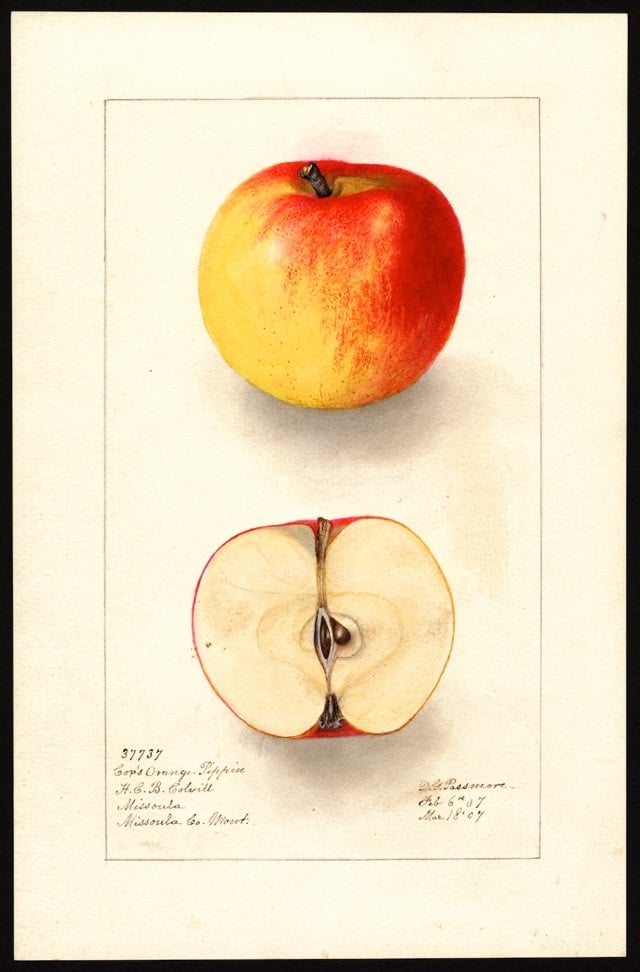
The U.S. Department of Agriculture’s National Agricultural Library contains around 3800 watercolor paintings, lithographs, and drawings of different apple varieties, most of which you will not find at the typical American grocery store. They also have another 3500 images of other fruits and nuts. (via slate)
Update: Until recently, the high-resolution images from this collection were not freely available to the public. After some agitation by Parker Higgins of the EFF, the Department of Agriculture decided to post high-res JPGs of each painting for free download. Higgins recently gave a talk about how it went down. This is a good example of the value of the public domain (and activists like Higgins)…without those images being available, neither Slate or I would have written about the collection, and who knows what someone who read them will do with that information. Maybe nothing! But maybe something cool! It’s worth putting it out there to find out…governments should be in the business of increasing the possibility space of their citizens. (via @stvnrlly)
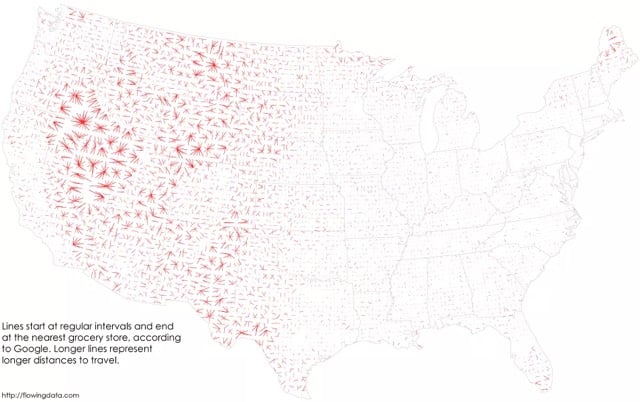
From Nathan Yau at FlowingData, a look at the places in the US where people need to make the longest drives to visit a grocery store.
The nearest grocery store is more than 10 miles away in about 36 percent of the country and the median distance is 7 miles. However, a lot of these areas are rural with few (if any) people who live there.
Wyoming contains very few grocery stores:
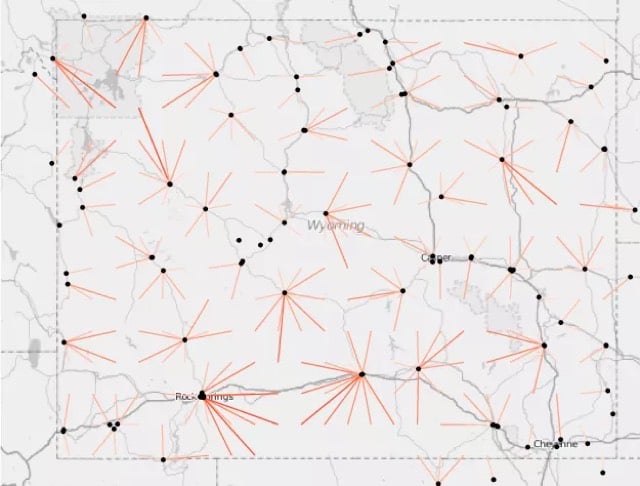
And Nevada is even more of a food desert. Looks like Massachusetts, Delaware, and New Jersey have plenty of grocery stores everywhere. (via feltron)
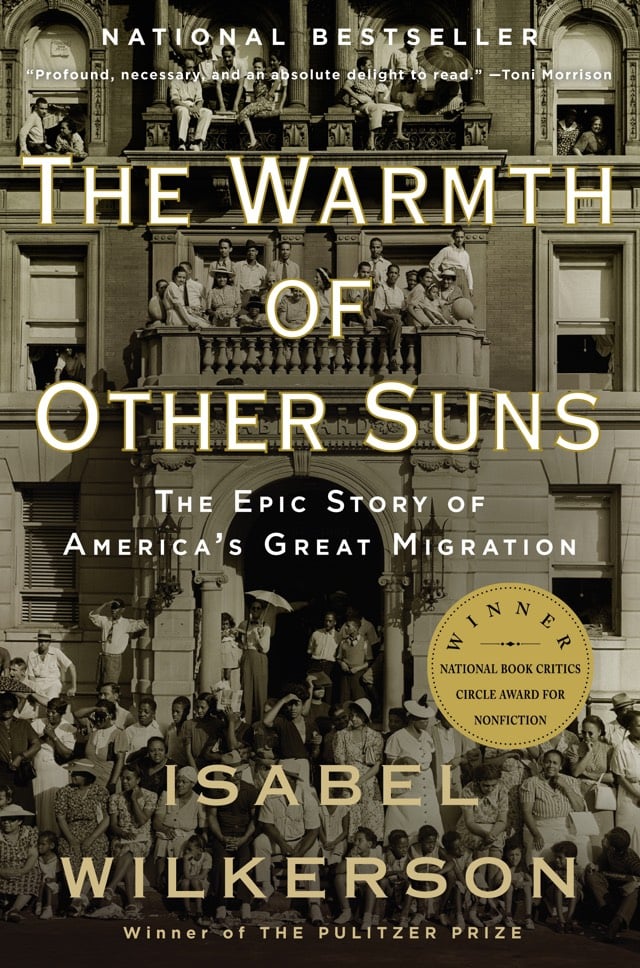
I read a lot of books by and about white men, many of them dead. So when a friend enthusiastically recommended The Warmth of Other Suns, I jumped at the chance to expand my reading horizons. I’m so glad I did…this is an amazing book.
Written by Pulitzer Prize-winning American journalist Isabel Wilkerson, The Warmth of Other Suns is about the Great Migration, the mass movement of African Americans from the Southern US to the Northeast, Midwest, and West between 1910 and 1970. During that time, roughly 6 million African Americans moved north and west to escape Jim Crow laws, discrimination, low wages, the threat of physical violence & death, and everyday humiliation & lack of freedom in the South. In the North, they found freedom, new opportunities, and better lives for their families, but they had less success escaping poverty, racism, and discrimination.
Wilkerson tells the story of the entire Migration by focusing on the paths of three people leaving the South:
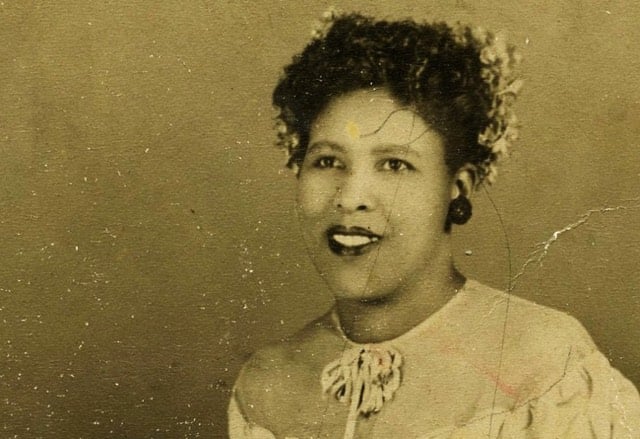
Ida Mae Gladney, a Mississippi sharecropper pictured above with flowers in her hair, moved to Chicago with her family in 1937 and lived to cast a vote for Barack Obama.
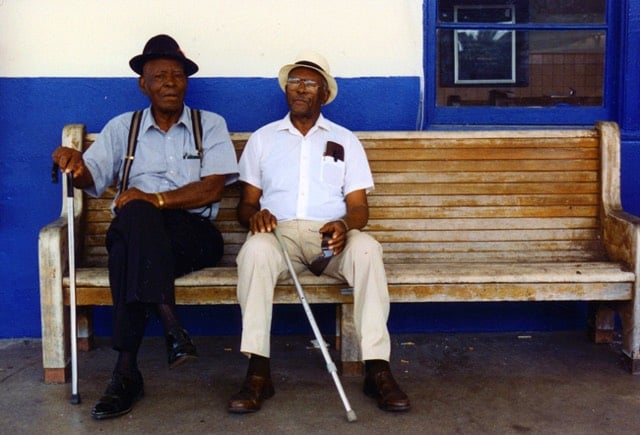
George Starling, pictured above on the left, worked in the citrus groves of Florida before leaving for New York in 1945. He found a job as a baggage handler (and unofficial welcoming committee member) on a train, working the north/south lines that ferried millions of black Southerners to their new homes in the North.
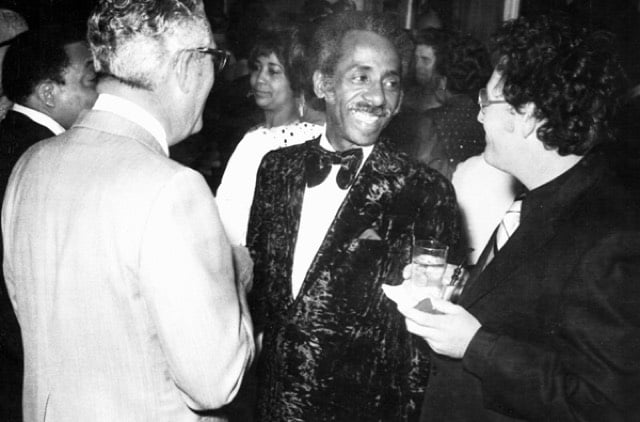
Robert Foster, the gentleman above in the bow tie, became a surgeon and moved from Louisiana to Los Angeles in 1953. There, he rose to the upper ranks of black society and became personal physician to Ray Charles. Foster left the South so thoroughly behind that his daughter didn’t know many of the details of his Louisiana childhood until she read it in Wilkerson’s book.
Through her compelling straight-forward prose, wonderful storytelling, and diligent journalism, Wilkerson more than convinces me that the Great Migration is the greatest untold, misunderstood, and largely unknown occurrence of the American 20th century. I don’t say this often, but The Warmth of Other Suns is a must-read, particularly if you want to begin to understand the racial issues still confronting the US today.
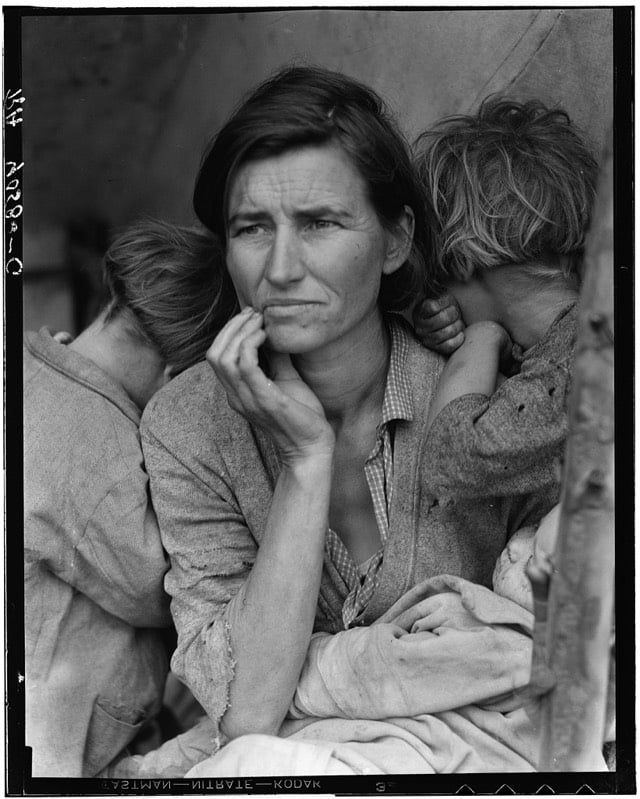
Yale has made 170,000 Library of Congress photos of the US from 1935 to 1945 available online, searchable and sortable in many different ways.
In order to build support for and justify government programs, the Historical Section set out to document America, often at her most vulnerable, and the successful administration of relief service. The Farm Security Administration-Office of War Information (FSA-OWI) produced some of the most iconic images of the Great Depression and World War II and included photographers such as Dorothea Lange, Walker Evans, and Arthur Rothstein who shaped the visual culture of the era both in its moment and in American memory. Unit photographers were sent across the country. The negatives were sent to Washington, DC. The growing collection came to be known as “The File.” With the United State’s entry into WWII, the unit moved into the Office of War Information and the collection became known as the FSA-OWI File.
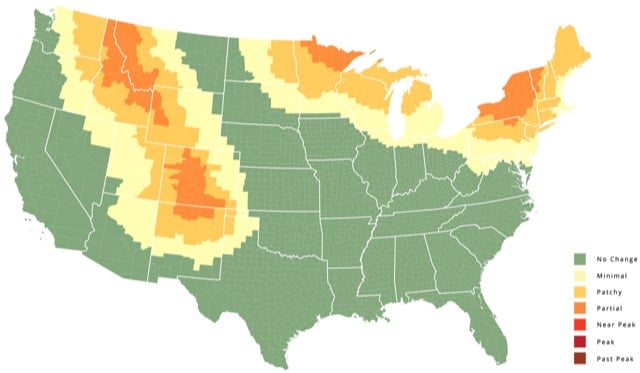
SmokyMountains.com has the best fall foliage map I’ve ever seen. It’s very simply designed and has a slider that lets you check the leaf peeping forecast across the entire US.
P.S. It’s decorative gourd season, motherfuckers.
Last month I shared a video showing the thousands of nuclear weapons that humans have detonated on Earth. I hadn’t really thought about it too much apart from the two dropped in Japan in WWII, but those weapons created some permanent physical changes in the landscape of the Earth. For instance, dozens of circular scars are visible at this testing range in Nevada near Area 51.
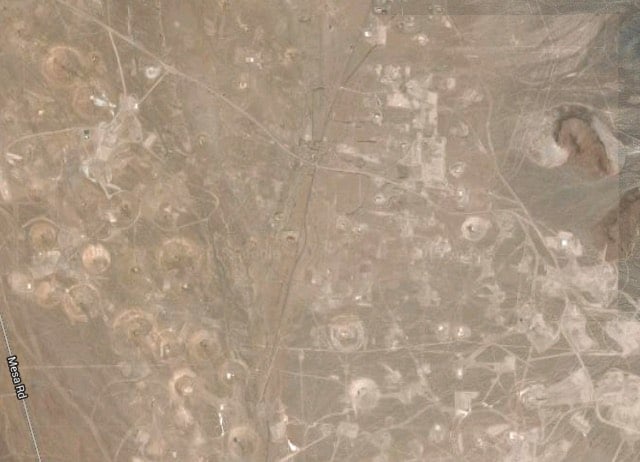
Also located in the same area is the Sedan Crater, the largest man-made crater in the United States. The crater is 320 feet deep, 1280 feet across, listed on the National Register of Historic Places, and was made by a thermonuclear device with a 104 kiloton yield detonated in 1962.

Now, I haven’t read a whole lot about nuclear tests, but this one seems particularly idiotic. The purpose of the Sedan shot was not to test a new kind of weapon or to determine the effects of the bomb, but to move earth. Yeah, no big deal, we’re just gonna use a fusion bomb like a big stick of dynamite. Sedan was part of Operation Plowshare, an effort to use nuclear devices for peaceful purposes like mining and moving earth. From Wikipedia:
Proposed uses for nuclear explosives under Project Plowshare included widening the Panama Canal, constructing a new sea-level waterway through Nicaragua nicknamed the Pan-Atomic Canal, cutting paths through mountainous areas for highways, and connecting inland river systems. Other proposals involved blasting underground caverns for water, natural gas, and petroleum storage. Serious consideration was also given to using these explosives for various mining operations. One proposal suggested using nuclear blasts to connect underground aquifers in Arizona. Another plan involved surface blasting on the western slope of California’s Sacramento Valley for a water transport project.
The Pan-Atomic Canal! This quaint US government video has more on Sedan:
In my post the other day, I said that the Soviets didn’t care about their citizenry when testing nuclear devices. Apparently the US didn’t either: the Sedan shot — the purpose of which, as a reminder, was to move a bunch of dirt — resulted in a significant amount of nuclear fallout, about 7% of the total radioactive fallout generated by all the nuclear tests in Nevada. Fallout from the test reached as far as West Virginia and was particularly high in counties in Iowa and Illinois. Buy hey, they moved 12 million tons of soil! (via @kyledenlinger)
The Whitney Plantation in Louisiana is the only US museum and memorial to slavery. The Atlantic has a video about the museum and its founder, John Cummings, who spent 16 years and $8 million of his own money on it.
From Pop Chart Lab, a beautiful poster showing 121 architectural styles of American houses.
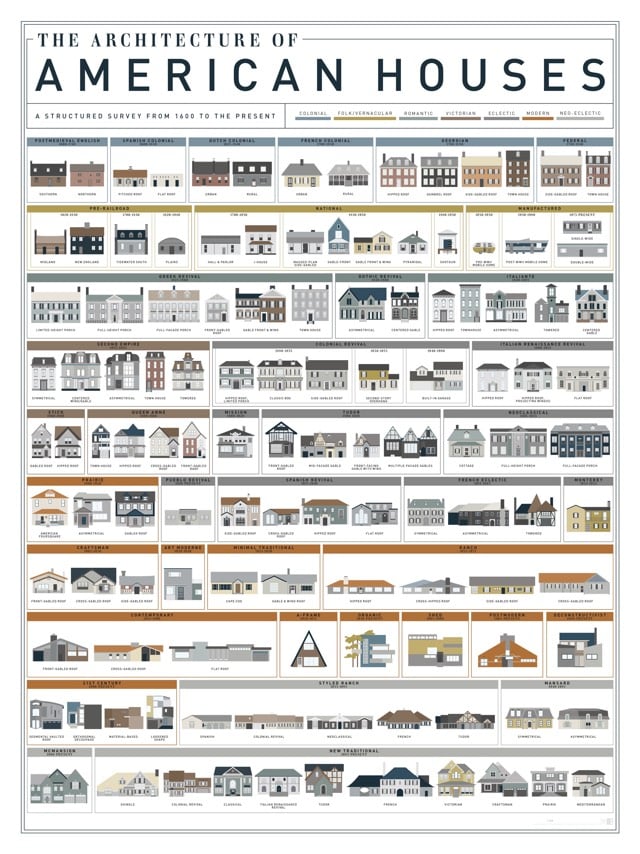
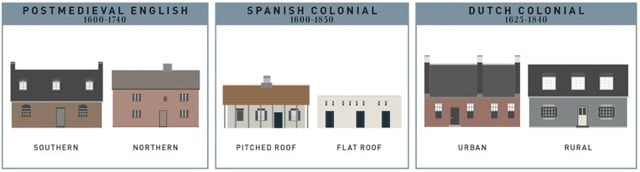
Useful if you don’t know your Victorian from your Tudor from your Greek revival.
The Jefferson Grid is an Instagram account which posts satellite photos picturing one square mile of land.
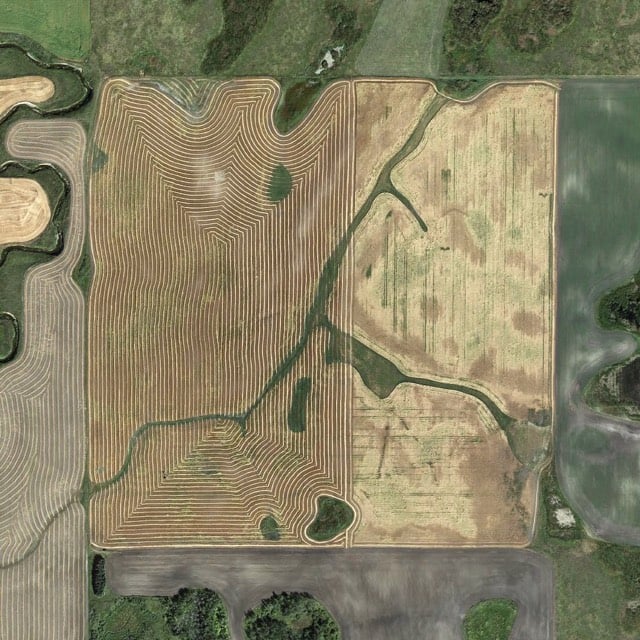
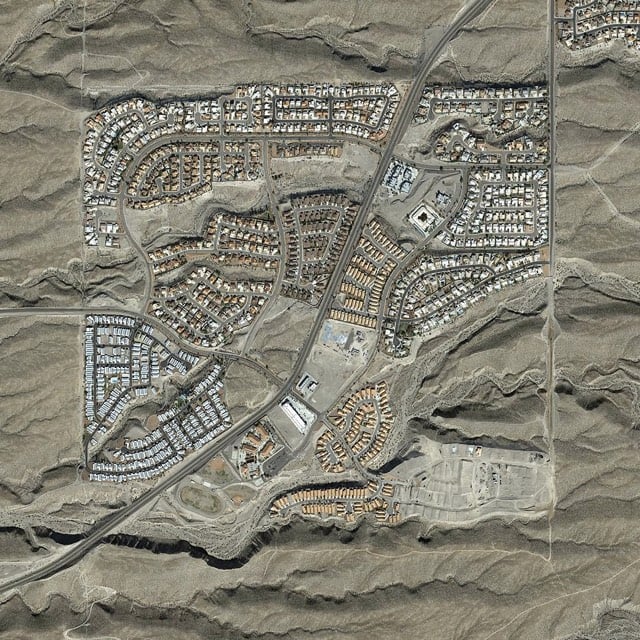
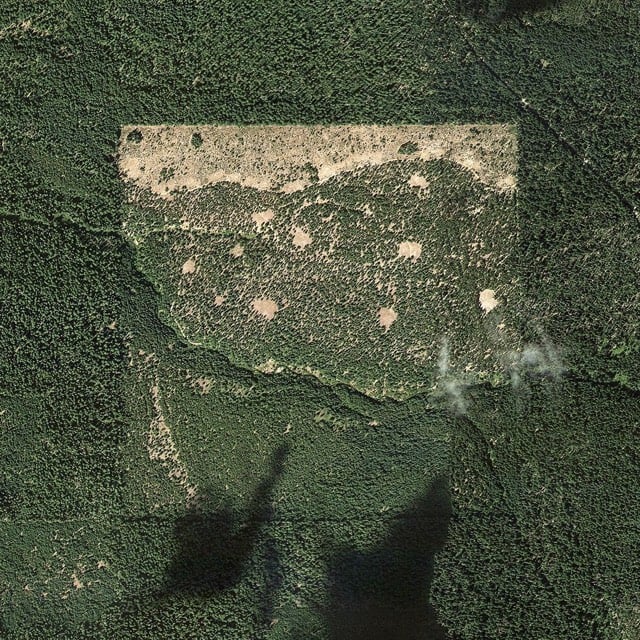
The account takes its name from the grid Thomas Jefferson used to divide up the growing United States.
The Land Ordinance of 1785, drafted by Thomas Jefferson, extended government authority over the Mississippi River and the Great Lakes regions. As a response to what he believed to be a confusing survey system already in use, Jefferson suggested a new grid system based on the rectangle. The grid divided land into plots one mile square, each consisting of 640 acres. The grid also placed a visible design upon a relatively untouched landscape. The ordinance was the first of its kind in America but would continue to affect urban, suburban and farmland planning to present day.
(via @bldgblog)
Oh man, this episode of This American Life on desegregation and the Normandy School District (aka the Missouri district that Michael Brown attended) just totally wrecked me. Tears of sadness and rage.
Right now, all sorts of people are trying to rethink and reinvent education, to get poor minority kids performing as well as white kids. But there’s one thing nobody tries anymore, despite lots of evidence that it works: desegregation. Nikole Hannah-Jones looks at a district that, not long ago, accidentally launched a desegregation program.
America likes to pride itself on its focus on the importance of education and everyone getting a crack at living the American Dream, but as this story makes clear, neither of those things are actually true. See also part two of the series and Hannah-Jones’ series on segregation at ProPublica.
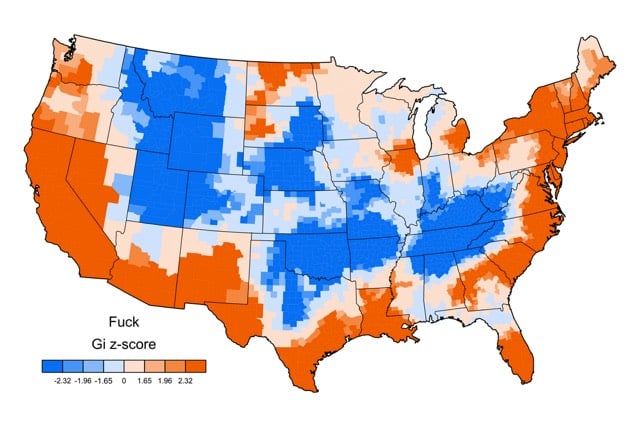
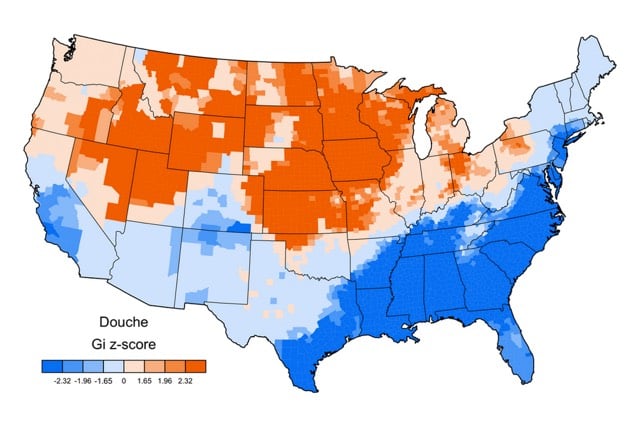
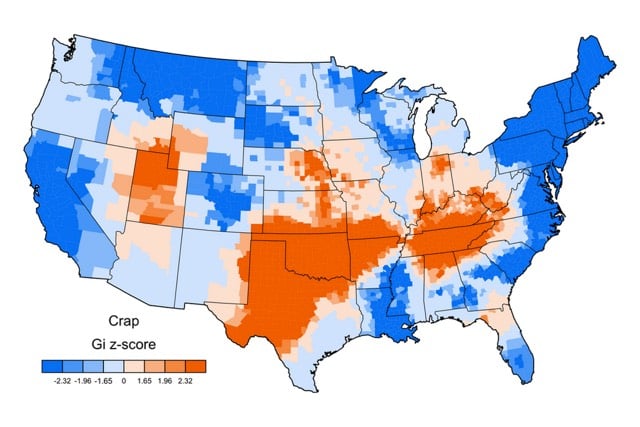
Most everyone in the United States swears, but the specific words used vary by region. For example, “fuck” is popular in California but not so much in Oklahoma, which is the “crap” epicenter of America. “Motherfucker” is unusually popular in Maine, as is “shit” in the Southeast, “douche” in Iowa, and “fuckboy” in Jersey.
I know I already posted this in my quick links early last week, but HOLY GOD is this Kathryn Schulz piece about the already-overdue Pacific Northwest earthquake is terrific and terrifying.
Flick your right fingers outward, forcefully, so that your hand flattens back down again. When the next very big earthquake hits, the northwest edge of the continent, from California to Canada and the continental shelf to the Cascades, will drop by as much as six feet and rebound thirty to a hundred feet to the west — losing, within minutes, all the elevation and compression it has gained over centuries. Some of that shift will take place beneath the ocean, displacing a colossal quantity of seawater. (Watch what your fingertips do when you flatten your hand.) The water will surge upward into a huge hill, then promptly collapse. One side will rush west, toward Japan. The other side will rush east, in a seven-hundred-mile liquid wall that will reach the Northwest coast, on average, fifteen minutes after the earthquake begins. By the time the shaking has ceased and the tsunami has receded, the region will be unrecognizable. Kenneth Murphy, who directs FEMA’s Region X, the division responsible for Oregon, Washington, Idaho, and Alaska, says, “Our operating assumption is that everything west of Interstate 5 will be toast.”
Update: Michelle Nijhuis interviewed Schulz about how this piece came about and its impact.
Probably the hardest thing about writing this piece was that from the beginning, this story was two stories for me. It’s the overt, obvious story, which is the story of the Cascadia subduction zone. On its own, that’s an incredible story, one of the best I’ve ever happened to chance upon. But, from the get go, in my mind, it was also really a parable about climate change. And then one level deeper than that, it’s not a parable, but an example about a really deep problem in our human existence, this kind of problem of scale. We are bound by certain temporal and geographic coordinates, and it’s very very hard to see beyond them.
Update: The Pacific Tsunami Warning Center recently posted a revised version of a paper on the link between an “orphan tsunami” that occurred in Japan in 1700 and a massive earthquake in the Pacific Northwest. An accompanying video shows a forecast model animation of the tsunami.
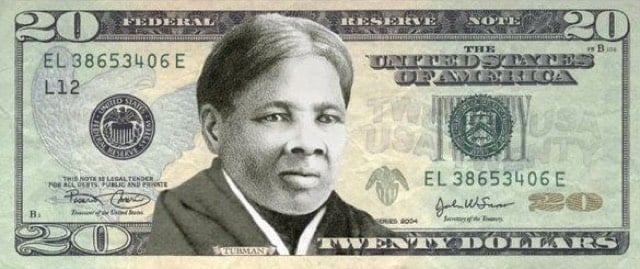
Adding her voice to a chorus of others, Amy Davidson makes a great case for putting Harriet Tubman on the US $20 bill and kicking Andrew Jackson to the curb.
On September 17, 1849, Araminta, who now called herself Harriet, ran away to freedom, along with two of her brothers. Their owner, Eliza Brodess-Pattison’s granddaughter-in-law-had been making moves to sell them, and the fear was that the family would be broken up. Brodess put an ad in the local newspaper, offering a hundred-dollar reward each for “Minty,” Harry, and Ben. (The only extant copy of the ad was found in 2003, in a dumpster.) Almost immediately, Tubman began making trips back to Maryland, organizing the escapes of relatives, friends, and scores of other slaves, often just ahead of armed men pursuing them. On one trip, she discovered that her husband, John Tubman, who was free himself, was living with another woman; he had no interest in going north. He is a man who seems not to have known Tubman’s worth.
When I was a kid, I read a lot of biographies1 on people like Ben Franklin, Thomas Edison, Abraham Lincoln, and the Wright brothers. My favorite, which I read at least three times, was Ann Petry’s Harriet Tubman: Conductor on the Underground Railroad. Tubman is one of history’s greatest badasses. Put her on the damn bill.

Artificial Killing Machine is an art installation that listens to a public database on US military drone strikes. When there’s a strike, a cap gun fires for every death.
This time based work accesses a public database on U.S. military drone strikes. When a drone strike occurs, the machine activates, and fires a children’s toy cap gun for every death that results. The raw information used by the installation is then printed. The materialized data is allowed to accumulate in perpetuity or until the life cycle of either the database or machine ends. A single chair is placed beneath the installation inviting the viewers to sit in the chair and experience the imagined existential risk.
The goal of the project is to breathe humanity back into data:
When individuals are represented purely as statistical data, they are stripped of their humanity and our connection to them is severed. Through the act of play and the force of imagination, this project aims to reconnect that which has been lost.
(via prosthetic knowledge)
The Freedmen’s Bureau Project is a new initiative to digitize and make available online the records collected by the The Freedmen’s Bureau near the end of the Civil War. The records detail the lives of about 4 million African Americans and will be available by the end of 2016.
FamilySearch is working in collaboration with the Smithsonian National Museum of African American History and Culture, the Afro-American Historical and Genealogical Society and the California African American Museum to make these records available and accessible by taking the raw records, extracting the information and indexing them to make them easily searchable online. Once indexed, finding an ancestor may be as easy as going to FamilySearch.org, entering a name and, with the touch of a button, discovering your family member.
The Freedmen’s Bureau was organized near the end of the American Civil War to assist newly freed slaves in 15 states and the District of Columbia. From 1865 to 1872, the Bureau opened schools, managed hospitals, rationed food and clothing and even solemnized marriages. In the process it gathered priceless handwritten, personal information including marriage and family information, military service, banking, school, hospital and property records on potentially million African Americans.
What an amazing resource this will be…many families out there will learn about the ancestors for the first time. The documents are currently 9% indexed and you can sign up to help at discoverfreedmen.org.
Tens of thousands of volunteers are needed to make these records searchable online. No specific time commitment is required, and anyone may participate. Volunteers simply log on, pull up as many scanned documents as they like, and enter the names and dates into the fields provided. Once published, information for millions of African Americans will be accessible, allowing families to build their family trees and connect with their ancestors.
(via open culture)
The completion of the US transcontinental railroad in 1869 in Utah was also the birthplace of the newsflash. The news was delivered via telegraph through a clever scheme: the famous golden spike and a silver hammer were each wired to the telegraph so that when hammer struck nail, the circuit completed and the news raced out along telegraph wires to the rest of the nation.1
Where were you when you heard the news of the completion of the transcontinental railroad?
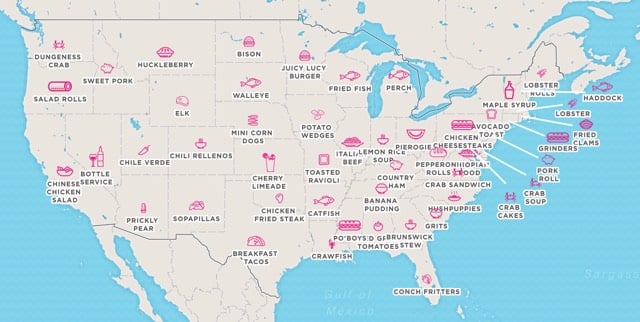
From a Foursquare and Mapbox collaboration, a map of the most popular tastes in each US state.
Every state in the U.S. has a unique flavor, from Chicken Cheesesteak to Chinese Chicken Salad. Foursquare analyzed the data to pinpoint which food or drink is most disproportionately popular in each destination, and worked with Mapbox to create the dynamic map.
Louisiana is crawfish, Vermont is maple syrup, and Texas is breakfast tacos. I love that Nevada is bottle service. All that state wants is to get you drunk in the least fiscally responsible way possible.
In The Plot Against Trains, Adam Gopnik muses about how infrastructure in America has become dilapidated in part because we (or at least much of we) believe little good can come from the government.
What an ideology does is give you reasons not to pursue your own apparent rational interest — and this cuts both ways, including both wealthy people in New York who, out of social conviction, vote for politicians who are more likely to raise their taxes, and poor people in the South who vote for those devoted to cutting taxes on incomes they can never hope to earn. There is no such thing as false consciousness. There are simply beliefs that make us sacrifice one piece of self-evident interest for some other, larger principle.
What we have, uniquely in America, is a political class, and an entire political party, devoted to the idea that any money spent on public goods is money misplaced, not because the state goods might not be good but because they would distract us from the larger principle that no ultimate good can be found in the state. Ride a fast train to Washington today and you’ll start thinking about national health insurance tomorrow.
The ideology of individual autonomy is, for good or ill, so powerful that it demands cars where trains would save lives, just as it places assault weapons in private hands, despite the toll they take in human lives. Trains have to be resisted, even if it means more pollution and massive inefficiency and falling ever further behind in the amenities of life — what Olmsted called our “commonplace civilization.”
The way he brings it back to trains at the end is lovely:
A train is a small society, headed somewhere more or less on time, more or less together, more or less sharing the same window, with a common view and a singular destination.
Well, except when you’re on that Snowpiercer train. Although in the end (spoiler!), Curtis brought the train’s segregated society back to “a common view and a singular destination” by crashing it and killing (almost) everyone on it. Hopefully America isn’t headed toward the same end.
A project by Michael Pecirno, Minimal Maps is a collection of US maps that each depict only a single subject with high-resolution data, from deciduous forest cover to cornfields. Here’s where grass grows in the US:
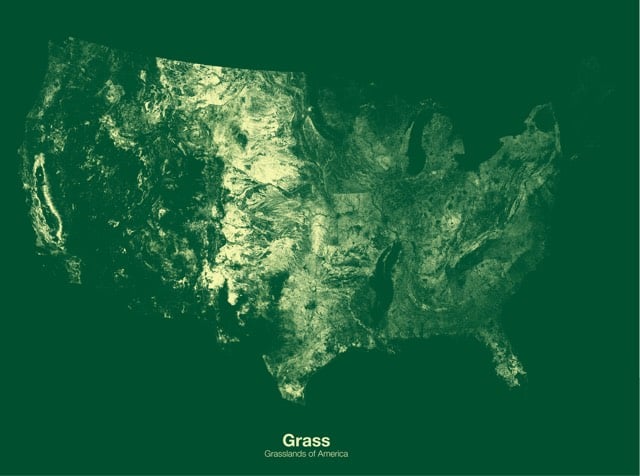
Very little grassland coverage in New England…that’s surprising. Prints are available.
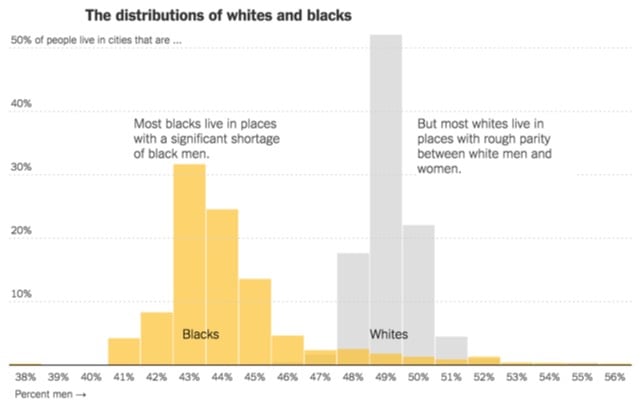
In Ferguson, for every 100 black women between the ages of 25 and 54, there are 60 black men. While Ferguson is extreme, it’s not exceptional. Across America, we see similar numbers. So the question arises: What happened to all the black men? The short answer to that question is incarceration and premature death. The longer answer is equally upsetting. From Upshot: 1.5 Million Missing Black Men.
The NY Times Magazine got Karl Ove Knausgaard (author of My Struggle) to “drive across America and write about it without talking to a single American”, like some sort of introverted Tocqueville. He came unprepared:
I dialed the number of the driver’s-license office at the Swedish Transport Agency, keyed in my personal identity number and sat down at the desk, scrolling through some Norwegian newspapers as I waited my turn.
A prerecorded voice came on and informed me about opening hours, then the line went dead.
What the hell?
Had they closed?
But it couldn’t be later than 1 p.m. in Sweden.
I looked at the Transport Agency website. To my dismay, I discovered that it was a holiday in Sweden tomorrow, Trettondagsafton, the Feast of the Epiphany, and a half-day today.
That meant I couldn’t get the driver’s-license confirmation letter until three days from now at the earliest, more likely four.
Oh, no.
I wasn’t even in the U.S. yet, I was just in Canada!
I lay back in bed and stared at the ceiling. I should email The Times and explain the situation. Maybe they had a solution. But I couldn’t. I just couldn’t bring myself to tell them that I’d undertaken this great road-trip assignment across the U.S. without my license. They’d think I was a complete idiot.
In any case, there was nothing I could do today.
And his thoughts on Detroit (emphasis mine):
I’d seen poverty before, of course, even incomprehensible poverty, as in the slums outside Maputo, in Mozambique. But I’d never seen anything like this. If what I had seen tonight - house after house after house abandoned, deserted, decaying as if there had been disaster - if this was poverty, then it must be a new kind poverty, maybe in the same way that the wealth that had amassed here in the 20th century had been a new kind of wealth. I had never really understood how a nation that so celebrated the individual could obliterate all differences the way this country did. In a system of mass production, the individual workers are replaceable and the products are identical. The identical cars are followed by identical gas stations, identical restaurants, identical motels and, as an extension of these, by identical TV screens, which hang everywhere in this country, broadcasting identical entertainment and identical dreams. Not even the Soviet Union at the height of its power had succeeded in creating such a unified, collective identity as the one Americans lived their lives within. When times got rough, a person could abandon one town in favor of another, and that new town would still represent the same thing.
Was that what home was here? Not the place, not the local, but the culture, the general?
Update: The Times has posted the second part of Knausgaard’s My Saga.
If there is something to be gained, if it is gainable, no power on earth can restrain the forces that seek to gain it. To leave a profit or a territory or any kind of resource, even a scientific discovery, unexploited is deeply alien to human nature.
On the intersection of Presidents’ Day and Black History Month, Erica Armstrong Dunbar highlights an uncomfortable truth about George Washington: he was a proud and fervent slave owner.
During the president’s two terms in office, the Washingtons relocated first to New York and then to Philadelphia. Although slavery had steadily declined in the North, the Washingtons decided that they could not live without it. Once settled in Philadelphia, Washington encountered his first roadblock to slave ownership in the region — Pennsylvania’s Gradual Abolition Act of 1780.
The act began dismantling slavery, eventually releasing people from bondage after their 28th birthdays. Under the law, any slave who entered Pennsylvania with an owner and lived in the state for longer than six months would be set free automatically. This presented a problem for the new president.
Washington developed a canny strategy that would protect his property and allow him to avoid public scrutiny. Every six months, the president’s slaves would travel back to Mount Vernon or would journey with Mrs. Washington outside the boundaries of the state. In essence, the Washingtons reset the clock. The president was secretive when writing to his personal secretary Tobias Lear in 1791: “I request that these Sentiments and this advise may be known to none but yourself & Mrs. Washington.”
(via mr)
Newer posts
Older posts





Socials & More