As part of this weekend’s New Yorker Festival, a parkour demonstration was held at Javits Plaza. Before the demonstration, Alex Wilkinson talked with David Belle, the inventor of parkour and the subject of Wilkinson’s NYer article about parkour from April. In the interview and the Q&A that followed the demonstration, Belle explained that parkour is not about competition or showing off or being reckless. It’s a test of self, of control, of deliberate practice. The journey is the point, not the sometimes spectacular results.
The demonstration consisted of a group of about 20-30 parkour practitioners, beginners and experts alike from all over the country. It seemed as though they included anyone with parkour experience who showed up and wanted to participate, and instead of a highly polished display of high skill (which is what I think the audience might have been expecting), we were treated to a more authenic look at the sport. The first five minutes were taken up with calisthenics and stretching in preparation of the jumps and vaults to come. After warming up properly, they began running through the course, each participant picking his way through the course according to desire and ability.
Experimentation was the rule of the day, not performance. With each pass, you could see the group learning the particulars of the course, where the good holds were, finding smoother combinations, and, much of the time, trying and failing. And then trying again until they got it. There was a single woman participant, one of several beginners in the group. When she had some trouble with an obstacle, Belle and his “lieutenant” stopped to show her some moves, a moment that revealed more about parkour than Belle’s jump across a ten-foot gap twenty feet off the ground. Belle himself didn’t do too much during the performance — a couple of high jumps — and had to be coaxed during the Q&A to perform one last big move for the audience. He shrugged off the applause and attention as he back-flipped down to the concrete, knowing that the true parkour had taken place earlier.
This past weekend, Tobias Frere-Jones led a typography tour of lower Manhattan for the AIGA, which I’m sad I missed (out of town guests + didn’t get a ticket in time). Luckily several people have uploaded photos from the tour (set 1, set 2, set 3, set 4), including a shot of one of my favorite lunchtime destinations, the Cup & Saucer. Love that sign (see close up).
Dr. Jay Parkinson M.D. emailed in to tell me about his new medical practice in Williamsburg. He’s got no office (housecalls only), takes appointment requests via SMS, email, or IM, handles some follow-ups over video chat, and specializes in the 18-40 age group without traditional health insurance. The goal, states Parkinson, is to “mix the service of an old-time, small town doctor with the latest technology to keep you and your bank account healthy”.
To give you an idea of how the practice operates, here’s a recap of his first day on the job:
Yesterday went quite well and I was very happy with the amount of money I kept out of the hands of companies that attempt to take advantage of how difficult it is to find prices for medications and healthcare services. For example, the first patient I saw needed a medication that Walgreens offered for $60. I called my tried and true Williamsburg mom-and-pop pharmacy only a few blocks from Walgreens and talked to Arthur the Pharmacist who said he sells it for $15. “Thanks Arthur.” “No thank you Jay.” The way it should be done.
My second patient was getting a certain medication for years every month by mail from Walgreens that costs $63 per month. I knew where she could get the same medication for $42 a month. I just saved her $252 per year. After she made her $200 down payment on my services via PayPal, her monthly fee for my services is now only $17 a month. But I just saved her $21 a month on her monthly mail order medication. She’s essentially getting the rest of the year of my services for free. Not bad.
Sounds fantastic. If only every doctor was this much of an advocate for his patients.
P.S. Parkinson also happens to be a heck of a photographer (@ Flickr). Some photos NSFW. I linked to this interview about his photography between him and Joerg Colberg last May.
Update: The WSJ Health blog has a short interview with Parkinson, followed by a lengthy comment thread.
In the 1970s, Japanese photograhper Kohei Yoshiyuki stumbled upon a couple in a park engaged in sexual activity in the darkness and, somewhat more curiously, two men creeping towards the couple, watching them. Over many months, he followed these voyeurs in the park, befriended them, and outfitted his camera with an infrared flash so as to blend into the crowded darkness. The result is a fantastic series of photos called The Park. As you can see in the photo below, Yoshiyuki even caught some of the peeping toms touching their “visual prey”.
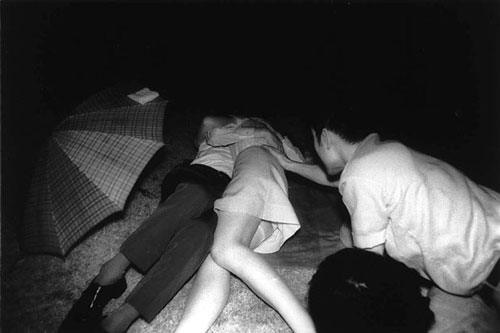
Yoshiyuki’s photographs explore the boundaries of privacy, an increasingly rare commodity. Ironically, we may reluctantly accommodate ourselves to being watched at the A.T.M., the airport, in stores, but our appetite for observing people in extremely personal circumstances doesn’t seem to wane.
The NY Times has an audio slideshow of some images from The Park, which is on display at the Yossi Milo gallery in NYC until October 20 (more photos). A book of Yoshiyuki’s photography is available at Amazon.
The Times article mentions several photographers whose work is similar to Yoshiyuki’s. Merry Alpern took photographs through a window of prostitutes plying their trade with Wall Street businessmen. Weegee used an infrared flash to capture kissing couples at the movie theater (although it seems that particular shot was staged) and on the beach at Coney Island (last photo here). Walker Evans photographed people on the subway without their knowledge.
Jane Jacobs and the Future of New York is an exhibition at The Municipal Art Society of New York.
Coming at a time of unprecedented growth and redevelopment in the city, this exhibit aims to encourage New Yorkers to observe the city closely and to empower them, with a combination of tools and resources, to take an active role in advocating for a more livable city.
The exhibit runs from Sept 25 through Jan 5, 2008.
Update: A review of the exhibition in the NY Times (slideshow). Among the artifacts at the show is a letter sent by Robert Moses to Jacobs’ publisher: “I am returning the book you sent me. Aside from the fact that it is intemperate and inaccurate, it is also libelous.”
Influential Italian filmmaker Michelangelo Antonioni listens to the sounds of Manhattan waking up in the morning. “The sheets of metal. A short clatter, like gunfire. A train passes, perhaps the elevated. A peal, prolonged, and then the siren, abrupt. Gone. The sounds change in a moment, they arise and die again immediately. The hum reasserts itself, advancing like a camouflaged army, approaches, closes in, on the alert, ready to take over completely.” The hum reasserts. I hear that one all the time as traffic ebbs and flows outside our apartment.
Raul Gutierrez tells a great NYC story about his late night adventure with a bunch of strangers.
After a few minutes a very tall girl with long brown hair who I would later learn was a Parsons design student, broke social convention, turned to her fellow benchmates, and said, “My God, wasn’t today beautiful.” At first she just got a few quiet affirmations,”yeah, gorgeous”, “best day yet” etc, but then a young woman in a business suit again broke social convention and revealed personal information: “It was so nice, when I woke up I decided I didn’t want to feel miserable about anything, and broke up with my boyfriend. I ditched him at 7:30 in the morning. He didn’t know what hit him.”
While poking around in the newly opened archives of the New York Times yesterday, I stumbled upon an article called How We Dine (full text in PDF) from January 1, 1859. I’m not well versed in the history of food criticism, but I believe this is perhaps the first restaurant review to appear in the Times and that the unnamed gentleman who wrote it (the byline is “by the Strong-Minded Reporter of the Times”) is the progenitor of the paper’s later reviewers like Ruth Reichl, Mimi Sheraton, and Frank Bruni.
The article starts off with a directive from the editor-in-chief to “go and dine”:
“Very well,” replied the editor-in-chief. “Dine somewhere else to-day and somewhere else to-morrow. I wish you to dine everywhere, — from the Astor House Restaurant to the smallest description of dining saloon in the City, in order that you may furnish an account of all these places. The cashier will pay your expenses.”
Before starting on his quest, the reporter differentiates eating from dining — noting that many believe “whereas all people know how to eat, it is only the French who know how to dine” — and defines what he means by an American dinner (as opposed to a French one). Here’s his list of the types of American dinner to be found in New York, from most comfortable to least:
1. The Family dinner at home.
2. The Stetsonian dinner.
3. The Delmonican, or French dinner.
4. The Minor dinner of the Stetsonian principle.
5. The Eating-house dinner, so called.
6. The Second-class Eating-house dinner.
7. The Third-class Eating-house feed.
The remainder of the article is devoted to descriptions of what a diner might find at each of these types of establishments. Among the places he dined was Delmonico’s, where dining in America is said to have originated:
Once let Delmonico have your order, and you are safe. You may repose in peace up to the very moment when you sit down with your guests. No nobleman of England — no Marquis of the ancienne nobless — was ever better served or waited on in greater style that you will be in a private room at Delmonico’s. The lights will be brilliant, the waiters will be curled and perfumed and gloved, the dishes will be strictly en règle and the wines will come with precision of clock-work that has been duly wound up. If you “pay your money like a gentleman,” you will be fed like a gentleman, and no mistake… The cookery, however, will be superb, and the attendance will be good. If you make the ordinary mistakes of a untraveled man, and call for dishes in unusual progression, the waiter will perhaps sneer almost imperceptibly, but he will go no further, if you don’t try his feelings too harshly, or put your knife into your mouth.
According to a series of articles by Joe O’Connell, Delmonico’s was the first restaurant in the US when it opened in 1830 and invented Eggs Benedict, Oysters Rockefeller, Baked Alaska, Lobster Newberg, and the term “86’d”, used when the popular Delmonico Steak (#86 on menu) was sold out, or so the story goes. O’Connell’s history of Delmonico’s provides us with some context for the How We Dine piece:
The restaurant was a novelty in New York. There were new foods, a courteous staff, and cooking that was unknown at the homes of even the wealthiest New Yorkers. The restaurant was open for lunch and dinner.
The restaurant featured a bill of fare, which was itself new. Those who dined at inns were fed on a set meal for a set price. As a result, everyone was fed the same meal and were charged the same price, whether they ate little or much. In Paris, however, restaurants offered their patrons a “bill of fare”, a carte, which listed separate dishes with individual prices. Each patron could choose a combination of dishes which was different from the other patrons. Each dish was priced separately. Thus, the restaurant was able to accommodate the tastes and hunger of each individual. The various dishes and their prices were listed on a carte or (the English translation) “bill of fare”. Today, we call it a menu.
And from Delmonico’s developed many different types of dining establishments, which the Strong-Minded Reporter set out to document thirty years later. Contrast his visit to Delmonico’s with the experience in the “sandwich-room” at Browne’s Auction Hotel, an eating-house:
The habitués of the place are rarely questioned at all. The man who has eaten a sandwich every day for the past ten years at the Auction Hotel no sooner takes his seat than a sandwich is set before him. The man who has for the same period indulged daily in pie or hard boiled eggs (there are some men with amazing digestion) is similarly treated. The occasional visitor, however, is briefly questioned by the attendant before whom he takes his place. “Sandwich?” or “Pie?” If he say “Sandwich,” in reply, the little man laconically inquires, “Mustard?” The customer nods, and is served. If his mission be pie, instead, a little square morsel of cheese is invariably presented to him. Why such a custom should prevail at these places, no amount of research has yet enabled me to ascertain. Nothing can be more incongruous to pie than cheese, which, according to rule and common sense, is only admissible after pie, as a digester. But the guests at the Auction Hotel invariably take them together, and with strict fairness — a bite at the pie, and a bite at the cheese, again the pie, and again the cheese, and so on until both are finished.
The experience of being a regular has barely changed in 150 years. And finally, our intrepid reporter visits an unnamed third class eating-house:
The noise in the dining hall is terrific. A guest has no sooner seated himself than a plate is literally flung at him by an irritated and perspiring waiter, loosely habited in an unbuttoned shirt whereof the varying color is, I am given to understand, white on Sunday, and daily darkening until Saturday, when it is mixed white and black — black predominating. The jerking of the plate is closely followed up by a similar performance with a knife and a steel fork, and immediately succeeding these harmless missiles come a fearful shout from the waiter demanding in hasty tones, “What do you want now?” Having mildly stated what you desire to be served with, the waiter echoes your words in a voice of thunder, goes through the same ceremony with the next man and the next, through an infinite series, and rushes frantically from your presence. Presently returning, he appears with a column of dishes whereof the base is in one hand and the extreme edge of the capital is artfully secured under his chin. He passes down the aisle of guests, and, as he goes, deals out the dishes as he would cards, until the last is served, when he commences again Da Capo. The disgusting manner in which the individuals who dine at this place, thrust their food into their mouths with the blades of their knives, makes you tremble with apprehensions of suicide…
The entire article is well worth the read…one of the most interesting things I’ve found online in awhile.
Update: According to their web site, a restaurant in New Orleans named Antoine’s claims that they invented Oysters Rockefeller. Another tidbit: from what I can gather, the Delmonico’s that now exists in lower Manhattan has little to do with the original Delmonico’s (even though they claim otherwise), sort of like the various Ray’s Pizza places sprinkled about Manhattan. (thx, everyone who sent this in)




Socials & More