kottke.org posts about NYC
Five ways to add real estate to Manhattan without tearing down existing buildings.
5. Fill in the Harlem River, which separates Manhattan and the Bronx. The Harlem River did not become a navigable waterway until 1895, when the Army Corps of Engineers dredged a shipping canal that provided direct passage for vessels from the East River to the Hudson. Nineteen years later, the creek that had served as the northern boundary of Manhattan was filled in, leaving the neighborhood of Marble Hill, still technically part of Manhattan, physically attached to the Bronx.
Here’s an unusual bit of NYC sightseeing for tomorrow morning. Between 7:30 and 8:30am tomorrow, a house designed by influential architect Robert Venturi will be floating under the Brooklyn Bridge.
In a bid to avoid the wrecking ball, Venturi’s Lieb House is traveling by barge from the New Jersey coast to the north shore of Long Island. During the two-day trip, the house will journey through the Atlantic Ocean, across New York Harbor, up the East River, and into Long Island Sound — a distance of about 75 miles, as the seagull flies.
The floating house will be shown in an upcoming documentary about Venturi, his wife, and their architectural practice. (thx, ed)
The NY Times has a nice interactive map showing the results from a city-wide poll that asked New Yorkers to evaluate how they feel about crime, education, the 311 service, and dozens of other things. Correlation is not causation but you can almost see the broken windows theory in effect here…high crime areas generally seem to correlate with neighborhoods that have graffiti, subpar trash pickup, and are unclean.
Long-time NYC cyclist Robert Sullivan writes that the city is a much better place for biking than it used to be and that the number of cyclists on the street are way up.
Today, the Transportation Department has gotten serious about biking, and in just three years, the agency has painted bike lanes (good), constructed bike lanes separated by parked cars (great) and bike lanes separated by medians or barriers (the best) and installed bike signals, bike signs and many bike symbols painted on the street.
Sullivan also notes that because of this increased use, pedestrians and car drivers (usually natural enemies) now share a dislike of bikers who run red lights, ride on sidewalks, weave through traffic, and blow through busy crosswalks. He offers four ways that bikers can improve their perception with the public.
NO. 1: How about we stop at major intersections? Especially where there are school crossing guards, or disabled people crossing, or a lot of people during the morning or evening rush. (I have the law with me on this one.) At minor intersections, on far-from-traffic intersections, let’s at least stop and go.
Suggestions for pedestrians (don’t cross against the light when a bike is coming, don’t stand in the bike lane while waiting to cross the street, etc.) and cars (don’t park in the bike lane, don’t wait to turn in the bike lane, etc.) would be helpful too.
A tantalizing 10-minute clip of an hour-long video called The Social Life of Small Urban Spaces.
The clip shows an analysis of the plaza of the Seagram Building in NYC and what makes it so effective as a small urban space.
A busy place for some reason seems to be the most congenial kind of place if you want to be alone. […] The number one activity is people looking at other people.
The video was adapted from a book of the same name by William H. Whyte, who is perhaps most well known as the author of The Organization Man. The video is largely out of print — which is a shame because that clip was fascinating — but I found a DVD copy for $95 (which price includes a license for public performance). (via migurski)
Due to the quirks of the NYC-area bridge toll system, truckers traveling between New Jersey and Long Island often take the Verrazano Bridge on the way into town (for free) but cut across downtown Brooklyn and lower Manhattan and out via the Holland or Lincoln Tunnels (for free) on the way out of town to avoid the steep toll on the Verrazano, creating a daily truck tsunami in areas of the city that aren’t equipped to handle it. (thx, david)
A Continuous Lean found some great Life magazine photos of Sherman Billingsley, the owner of a famous NYC nightclub called The Stork Club, which club was frequented by celebrities, artists, and the well-to-do from 1929 to 1965. In the photos, Billingsley is pictured at his club giving secret hand signals to his assistant while sitting with guests.
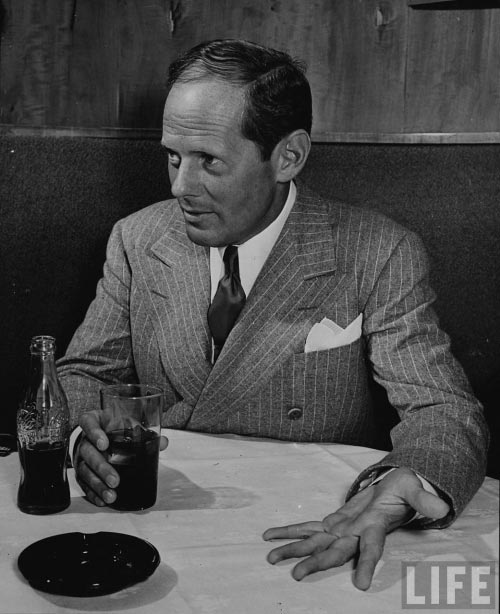
Closeup of Stork Club owner Sherman Billingsley [with his] palm up on table, one of his signals to nearby assistant which means “Bring a bottle of champagne,” while sitting w. patrons over his usual Coca Cola, in the Cub Room.
Billingsley’s signals cleverly allowed the club to provide seamless good service to his favored patrons while also letting him be the bad guy with less favorable customers without them knowing it. Billingsley went on to be the third base coach for the Yankees in the late 60s. (Untrue.)
After that great piece about how The Godfather got made was published, Vanity Fair got a call from the daughter of a reputed mobster who wanted to tell the magazine about the time the cast of The Godfather came over to her house for supper and some cultural exchange.
The doorbell rang at seven p.m. at the family house in Fort Lee, New Jersey, right across the Hudson River from Manhattan. “I opened the front door and there was Marlon Brando, James Caan, Morgana King [who played Don Corleone’s wife], Gianni Russo [who played Don Corleone’s son-in-law, Carlo], Al Ruddy [the film’s producer], and my uncle Al [Lettieri],” recalls Gio. “We all went downstairs into the family room, where the table was set and where we had the pool table and the bar.”
Hannah Emily Upp suffers from dissociative fugue, “a rare form of amnesia that causes people to forget their identity, suddenly and without warning, and can last from a few hours to years”, which caused her to disappear from her usual life for three weeks until she was found floating, alive, in New York Harbor.
Its most famous sufferer is the fictional Jason Bourne, the secret agent made flesh on film by Matt Damon. The Bourne character takes his name from Ansel Bourne, a Rhode Island preacher who suffered the earliest recorded case of the condition when he was en route to Providence in 1887. The preacher continued to Norristown, Pa., where he opened a store and lived with another family, until one day he “woke up.”
As an experiment, parts of Broadway near Times Square and Herald Square will be entirely closed to cars for most of the rest of the year.
Although it seems counterintuitive, officials believe the move will actually improve the overall flow of traffic, because the diagonal path of Broadway tends to disrupt traffic where it intersects with other streets.
The streets will become pedestrian malls instead. Love this.
When the money dries up, so too do the plans for tall buildings by big-name architects. In the late 1920s, a number of buildings in NYC were scrapped in the planning stage or built significantly lower than planned.
Which is safer, the Wild West or present-day New York City? A look at the murder statistics shows that you were less likely to be killed in the notorious cowboy towns of the 1870s and 80s than in NYC today.
In Abilene, Ellsworth, Wichita, Dodge City, and Caldwell, for the years from 1870 to 1885, there were only 45 total homicides. This equates to a rate of approximately 1 murder per 100,000 residents per year.
By contrast, the 2007 murder rate in NYC was 6 per 100,000 residents and Baltimore’s was 45 per 100,000 residents. (via david galbraith)
Photographer Jesse Chan-Norris caught the aftermath of an attempted murder in Manhattan this morning. From his Flickr page:
At 5:40am I was jolted out of sleep by a noise. BANG. BANG. BANG. BANG. BANG. I raced outside, I looked down, I saw the black car with its door open. I saw another car next to it. I saw the body in the middle of the street. I stood. I gawked.
The entire collection of Kim’s Video in the East Village, all 55,000+ hard-to-find films, is now headed to a formerly abandoned town in Italy that is now run entirely by artists.
In a notice pasted on a wall inside the front door [of his video store], he wrote, “We hope to find a sponsor who can make this collection available to those who have loved Kim’s over the past two decades.” He promised to donate all the films without charge to anyone who would meet three conditions: Keep the collection intact, continue to update it and make it accessible to Kim’s members and others.
(thx, cliff)
Newer posts
Older posts




Socials & More