kottke.org posts about Moon
The Apollo 11 Lunar Module landed on the surface of the Moon 43 years ago today. For the 40th anniversary of the landing in 2009, I put together a page where you can watch the original CBS News coverage of Walter Cronkite reporting on the Moon landing and the first Moon walk, synced to the present-day time. I’ve updated the page to work again this year: just open this page in your browser and the coverage will start playing at the proper time. Here’s the schedule:
Moon landing broacast start: 4:10:30 pm EDT on July 20
Moon landing shown: 4:17:40 pm EDT
Moon landing broadcast end: 4:20:15 pm EDT
{break}
Moon walk broadcast start: 10:51:27 pm EDT
First step on Moon: 10:56:15 pm EDT
Nixon speaks to the Eagle crew: approx 11:51:30 pm EDT
Moon walk broadcast end: 12:00:30 pm EDT on July 21
Here’s a post I wrote when I launched the project.
If you’ve never seen this coverage, I urge you to watch at least the landing segment (~10 min.) and the first 10-20 minutes of the Moon walk. I hope that with the old time TV display and poor YouTube quality, you get a small sense of how someone 40 years ago might have experienced it. I’ve watched the whole thing a couple of times while putting this together and I’m struck by two things: 1) how it’s almost more amazing that hundreds of millions of people watched the first Moon walk *live* on TV than it is that they got to the Moon in the first place, and 2) that pretty much the sole purpose of the Apollo 11 Moon walk was to photograph it and broadcast it live back to Earth.
Thanks to Dave Schumaker for the reminder.
This is a timelapse animation of the surprisingly wobbly Moon over a period of one year.
Note: this is an animation, not a timelapse video…i.e. there’s CG involved. More info here.
Indian lunar orbiter Chandrayaan-1 has discovered a large cave on the Moon. Aside from the hey, cool, there’s a cave on the Moon factor, the other big feature of the cave is its constant and temperate temperature.
Temperatures on the moon swing wildly, from a maximum of 262 degrees Fahrenheit to a minimum of -292. The cave holds steady at a (relatively) comfortable -4, since the moon’s weather can’t penetrate its 40-foot-thick wall. It could also protect astronauts from “hazardous radiations, micro-meteoritic impacts,” and dust storms, according to paper published by the journal Current Science.
(via @juliandibbell)
From physicist John Baez, a history of the major disasters that happened to the Earth: the Big Splat, the Late Heavy Bombardment, the Oxygen Catastrophe, and the Snowball Earth. The Big Splat is believed to have formed the Moon:
In 2004, the astrophysicist Robin Canup, at the Southwest Research Institute in Texas, published some remarkable computer simulations of the Big Splat. To get a moon like ours to form — instead of one too rich in iron, or too small, or wrong in other respects — she had to choose the right initial conditions. She found it best to assume Theia is slightly more massive than Mars: between 10% and 15% of the Earth’s mass. It should also start out moving slowly towards the Earth, and strike the Earth at a glancing angle.
The result is a very bad day. Theia hits the Earth and shears off a large chunk, forming a trail of shattered, molten or vaporized rock that arcs off into space. Within an hour, half the Earth’s surface is red-hot, and the trail of debris stretches almost 4 Earth radii into space. After 3 to 5 hours, the iron core of Theia and most of the the debris comes crashing back down. The Earth’s entire crust and outer mantle melts. At this point, a quarter of Theia has actually vaporized!
After a day, the material that has not fallen back down has formed a ring of debris orbiting the Earth. But such a ring would not be stable: within a century, it would collect to form the Moon we know and love. Meanwhile, Theia’s iron core would sink down to the center of the Earth.
Due to the Moon’s relative position in the sky as Neil Armstrong started his moonwalk, Australia was able to capture the first few minutes of his descent down the ladder before NASA was able to find a signal. But it was lost until recently; the restored footage will be shown next week at an event in Sydney.
From a typically excellent selection of photos taken from space curated by Alan Taylor over at The Big Picture, there’s this:
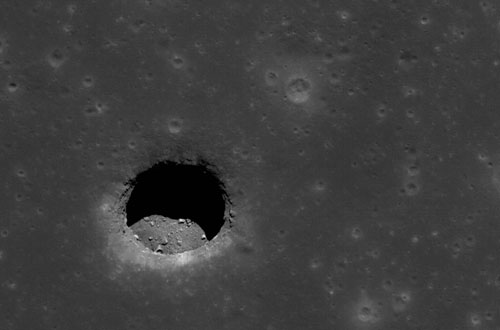
I don’t know why, but that freaks me right out. THERE’S A FREAKING HOLE IN THE MOON!!
Back in July, Ben Terrett wrote a post about how many instances of the word “helvetica” set in unkerned 100 pt Helvetica it would take to go from the Earth to the Moon:
The distance to the moon is 385,000,000,000 mm. The size of an unkerned piece of normal cut Helvetica at 100pt is 136.23 mm. Therefore it would take 2,826,206,643.42 helveticas to get to the moon.
But let’s say you wanted to stretch one “helvetica” over the same distance…at what point size would you need to set it? The answer is 282.6 billion points. At that size, the “h” would be 44,600 miles tall, roughly 5.6 times as tall as the Earth. Here’s what that would look like:

The Earth is on the left and that little speck on the right side is the Moon. Here’s a close-up of the Earth and the “h”:

And if you wanted to put it yet another way, the Earth is set in 50.2 billion point type — Helvetically speaking — while the Moon is set in 13.7 billion point type. (thx, @brainpicker)
I had so much fun with this last year, I’m doing it again: watch the original CBS News coverage of the Apollo 11 Moon landing and first Moon walk, reported live by Walter Cronkite exactly 41 years after it happened.
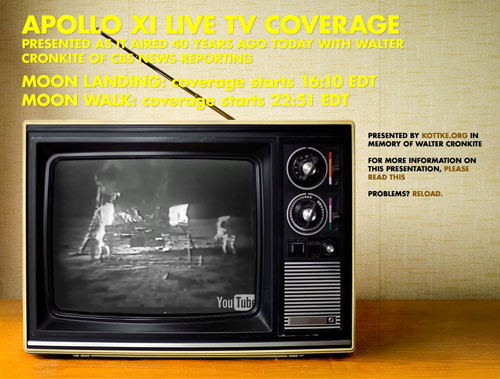
Just leave this page open in your browser and at the appointed times (schedule is below), the broadcast will begin (no manual page refresh necessary).
Schedule:
Moon landing broacast start: 4:10:30 pm EDT on July 20
Moon landing shown: 4:17:40 pm EDT
Moon landing broadcast end: 4:20:15 pm EDT
…
Moon walk broadcast start: 10:51:27 pm EDT
First step on Moon: 10:56:15 pm EDT
Nixon speaks to the Eagle crew: approx 11:51:30 pm EDT
Moon walk broadcast end: 12:00:30 am EDT on July 21
If you’ve never seen this coverage, I urge you to watch at least the landing segment (~10 min.) and the first 10-20 minutes of the Moon walk. I hope that with the old time TV display and poor YouTube quality, you get a small sense of how someone 40 years ago might have experienced it.
Please note that schedule times are approximate, based on your computer’s clock, and that the syncing of the videos might not be perfect. You need to have JS and Flash 8+ to view. This is just like real TV…if you miss the appointed time, there’s no rewind or anything…the video is playing “live”. I have not done extensive browser testing so it may not work perfectly in your browser. If you run into any problems, just reload the page. Thanks for tuning in.
Vincent Fournier has made a series of photos of astronauts training and of the interiors of the Chinese, Russian and US space agencies.
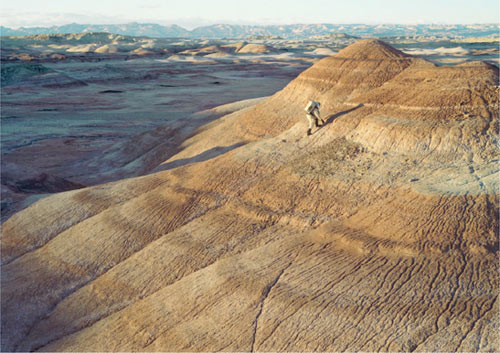
Looks alien, doesn’t it?
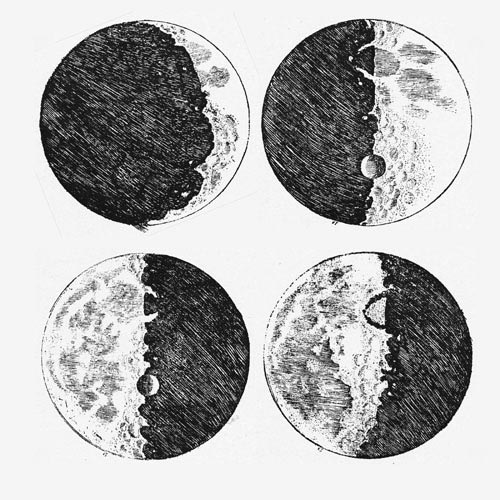
From an analysis of when and where these drawings were done.
Speaking of the Moon, the LRO snapped a new picture of Apollo 11 landing site from its orbital perch 50km above the surface.
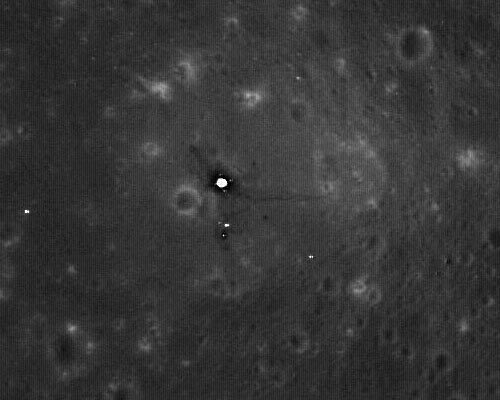
Previously.
NASA announced that it has found pretty hard evidence of significant amounts of water on the Moon.
“We are ecstatic,” said Anthony Colaprete, LCROSS project scientist and principal investigator at NASA’s Ames Research Center in Moffett Field, Calif. “Multiple lines of evidence show water was present in both the high angle vapor plume and the ejecta curtain created by the LCROSS Centaur impact. The concentration and distribution of water and other substances requires further analysis, but it is safe to say Cabeus holds water.”
I don’t have to tell you about the implications here. Just think of how much you could sell authentic Moon bottled water for.
Nothing like a little science on the Moon, I always say.
Astronaut David Scott in 1971, from the Apollo 15 Lunar Surface Journal. Scott was part of the Apollo 15 crew, and applied Galileo’s findings about gravity and mass by testing a falcon feather and a hammer. The film, shown in countless high school physics classes, is the nerdy, oft-neglected cousin of Neil Armstrong’s space paces.
For those of you who missed the show last night or if you just want a replay, the CBS News footage of the Apollo 11 Moon landing and Moon walk, presented by Walter Cronkite, is available on YouTube. The Moon landing video is here and the first of 7 videos of the Moon walk is here.
Inspired by the ApolloPlus40 Twitter account and We Choose the Moon, both of which are tracking the Apollo 11 mission as it happened 40 years ago, I’ve built a page where you can watch the CBS News coverage of Walter Cronkite reporting on the Moon landing and the first moon walk, 40 years to the second after it originally happened.
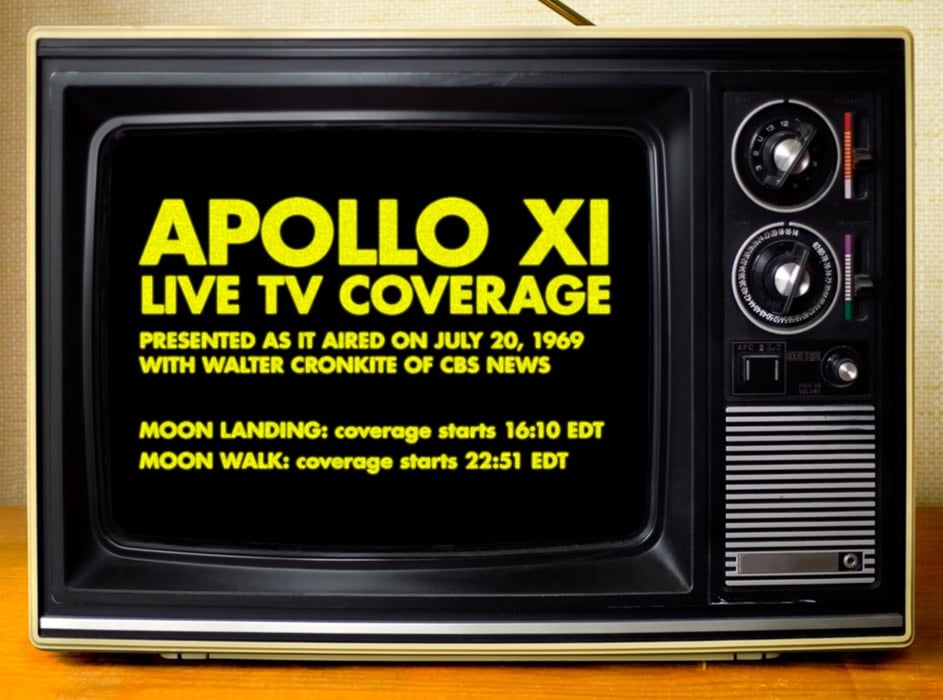
Just leave this page open in your browser and at the appointed times (schedule is below), the broadcast will begin (no manual page refresh necessary).
Schedule:
Moon landing broadcast start: 4:10:30 pm EDT on July 20
Moon landing shown: 4:17:40 pm EDT
Moon landing broadcast end: 4:20:15 pm EDT
Moon walk broadcast start: 10:51:27 pm EDT
First step on Moon: 10:56:15 pm EDT
Nixon speaks to the Eagle crew: approx 11:51:30 pm EDT
Moon walk broadcast end: 12:00:30 am EDT on July 21
If you’ve never seen this coverage, I urge you to watch at least the landing segment (~10 min.) and the first 10-20 minutes of the Moon walk. I hope that with the old time TV display and poor YouTube quality, you get a small sense of how someone 40 years ago might have experienced it. I’ve watched the whole thing a couple of times while putting this together and I’m struck by two things: 1) how it’s almost more amazing that hundreds of millions of people watched the first Moon walk *live* on TV than it is that they got to the Moon in the first place, and 2) that pretty much the sole purpose of the Apollo 11 Moon walk was to photograph it and broadcast it live back to Earth.
Thanks to Meg for her JS help…any errors or sloppy code are mine. Please note that schedule times are approximate, based on your computer’s clock, and that the syncing of the videos might not be perfect. You need to have JS and Flash 8+ to view. This is just like real TV…if you miss the appointed time, there’s no rewind or anything…the video is playing “live”. I have not done extensive browser testing so it may not work perfectly in your browser. Bug reports are welcome and I will try to fix things as they crop up. If you run into any problems, just reload the page. To ensure that you have the latest (hopefully bug-free) version before the broadcast begins, reload the page. Other than that, if you leave it open, the broadcast will happen automatically.
Update: If you missed the “live” show, you can watch all of the clips on YouTube.
Update: The Apollo broadcast no longer requires Flash. Big thanks to Geoff Stearns for helping me with the upgrade.
Newer posts
Older posts





Socials & More