kottke.org posts about Moon
I said yesterday that NASA would be taking some new photos of the Apollo landing sites with the Lunar Reconnaissance Orbiter. Turns out that happened pretty quickly…they just released photos of the Apollo 11, 14, 15, 16, and 17 sites. Here’s the Apollo 11 site:
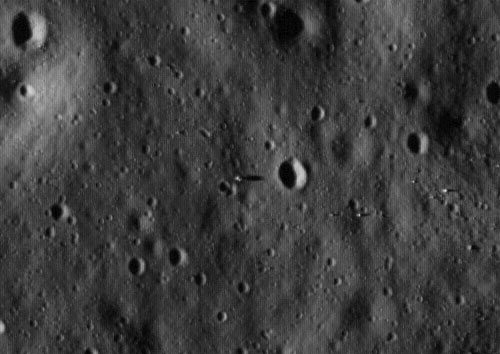
The lunar module is the small white bit in the middle casting the long shadow. The Apollo 14 site is the coolest…you can see the path the astronauts took out to some scientific instruments. The LRO hasn’t reached its final orbit yet so future images “will have two to three times greater resolution”. !!! See also my giant Apollo 11 post.
Hmm, I was just wondering about this the other day: NASA’s Lunar Reconnaissance Orbiter is going to take photos of some of the Apollo landing sites, including where Apollo 11 landed.
Lunar archaeologists, interested in making the Apollo 11 site a National Historic Landmark, hope the planned photos will answer some of these longstanding questions: What is the condition of Tranquility Base after 40 years? Was the American flag blown over on the Eagle’s ascent and is it now a bleached skeleton? What are the relatively long term effects of the lunar environment on human artifacts?
This should quiet the people who still think it was all a hoax…although NASA could be faking these photos as well.
NASA is restoring and improving the video footage of the Apollo 11 mission and this morning they released some of those videos, including Neil Armstrong’s first step on the Moon, Aldrin’s first step, and the raising of the American flag.
Update: The tapes containing the original footage were erased to record satellite data. The restorations are being sourced from broadcast TV footage.
Today is the 40th anniversary of the liftoff of Apollo 11. You can follow along on We Choose the Moon, on Twitter, and with a NASA audio program. (Is there a video launch being broadcast anywhere?)
NASA is also releasing “greatly improved video imagery” of the Apollo 11 moon walks. !!! So look for that later today.
Update: Someone should have synced up this video footage of the launch so that people could watch it in realtime.
We Choose the Moon is a site that tracks the activities of the Apollo 11 mission as it happened 40 years ago. Nice work. The transmissions from the spacecraft, CAPCOM, and the lunar lander are cleverly published to and pulled in from Twitter.
With all this 40th anniversary stuff, I’m having trouble getting my mind around that the first Moon landing is as far removed from the present as the low point of The Great Depression was from my birth (i.e. the Moon landing, culturally speaking, is Ollie’s Great Depression). See also timeline twins. (via jimray)
The Book Cover Archive Blog gets the skinny on using NASA images in creative work.
All of the media produced by NASA is public domain, meaning that anyone can use it any way (as long as they obey restrictions of publicity and privacy).
They also point to NASA Images, which is operated by Internet Archive and contains a copy of almost every image that NASA has ever produced. Just for the heck of it, here’s the first photo of the Moon taken by a US spacecraft.

I am hoping that Moon will be awesome and not just a mashup of 2001 and Solaris. The score is by Clint Mansell, who has scored all of Darren Aronofsky’s movies, most notably Requiem for a Dream. Moon opens on June 12 in NYC and LA. (via sarahnomics)
A classic from The Onion in way more than 96 pt. type: HOLY SHIT, MAN WALKS ON FUCKING MOON.
“Holy living fuck…. Are you fucking believing this? Over,” Armstrong radioed back to NASA headquarters nearly 250,000 miles away. “I abso-fucking-lutely am standing on the surface of the fucking moon. I am talking to you from the goddamned fucking moon. Jesus H. Christ in a chicken basket.”
“Holy mother of fuck,” the first man on the moon added.
A photograph of the newest possible moon, one that’s only about 15 hours old.
Finding the Moon when its slim crescent is still less than about 24 hours past the New Moon phase requires careful timing and planning, a challenging project even for experienced observers. In this sighting, only about 0.8 percent of the Moon’s disk appears illuminated.
(via airbag)
Did you know that there’s a teensy museum on the moon?
Now I find out there was already an entire Moon Museum, with drawings by six leading contemporary artists of the day: Andy Warhol, Robert Rauschenberg, David Novros, Forrest “Frosty” Myers, Claes Oldenburg, and John Chamberlain. The Moon Museum was supposedly installed on the moon in 1969 as part of the Apollo 12 mission.
I say supposedly, because NASA has no official record of it; according to Frosty Myers, the artist who initiated the project, the Moon Museum was secretly installed on a hatch on a leg of the Intrepid landing module with the help of an unnamed engineer at the Grumman Corporation after attempts to move the project forward through NASA’s official channels were unsuccessful.
On the origin of the Earth’s moon and how our planet would be different if we didn’t have a moon.
The Moon has been a stabilizing factor for the axis of rotation of the Earth. If you look at Mars, for instance, that planet has wobbled quite dramatically on its axis over time due to the gravitational influence of all the other planets in the solar system. Because of this obliquity change, the ice that is now at the poles on Mars would sometimes drift to the equator. But the Earth’s moon has helped stabilize our planet so that its axis of rotation stays in the same direction. For this reason, we had much less climatic change than if the Earth had been alone. And this has changed the way life evolved on Earth, allowing for the emergence of more complex multi-cellular organisms compared to a planet where drastic climatic change would allow only small, robust organisms to survive.
Earthrise and earthset movies made by Kaguya, a Japanese spacecraft currently orbiting the moon. Also available here at a higher quality. I’m hoping these are available in HD at some point.
Newer posts
Older posts






Socials & More