kottke.org posts about Moon

Seán Doran used images from the Lunar Reconnaissance Orbiter to create this 100-megapixel image of the Moon (full 10000x10000 pixel image here). Phil Plait explains how Doran made the image:
LRO WAC images have a resolution of about 100 meters per pixel over a swath of about 60 km of lunar surface (using what’s called the pushbroom technique, similar to how a flatbed scanner works). They are usually taken straight down, toward the spacecraft nadir (the opposite of the zenith). To get the correct perspective for the Moon as a globe, Doran took the images, along with altimeter data, and mapped them onto a sphere. That way features near the edge look foreshortened, as they really do when you look at the entire Moon. He also used Apollo images to make sure things lined up. So the image isn’t exactly scientifically rigorous, but it is certainly spectacular.
The image is also available at Gigapan for easier exploration.
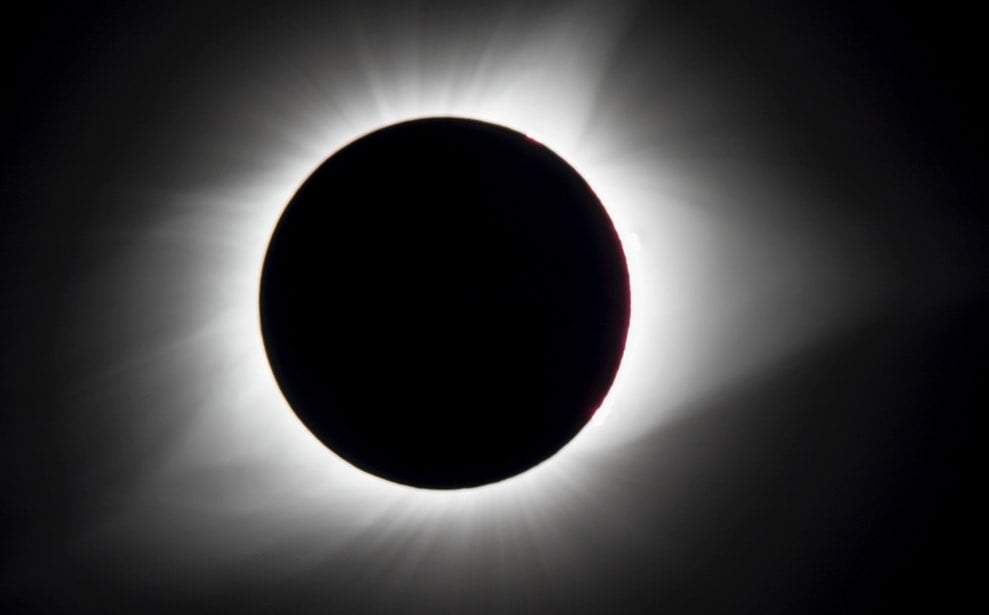
Even two months later, I’m still reeling from seeing the total solar eclipse. When I think about that day and those two minutes, a chill goes right down my spine. Vi Hart, who took part in Atlas Obscura’s eclipse festival in Oregon, wrote a beautifully poetic piece about witnessing the eclipse that took me right back there.
I’m not sure exactly what I expected, but this wasn’t it. I’d seen photos of coronas around suns, but this wasn’t that. And I’d expected that those photos, like many astronomical pictures, are long exposure, other wavelengths, and otherwise capturing things the naked eye can’t see. I thought there might be a glow of light in a circle, or nothing, or, I don’t know. What I did not expect was an unholy horror sucking the life and light and warmth out of the universe with long reaching arms, that what I’d seen in pictures was not an exaggeration but a failure to capture the extent of this thing that human eyes, and not cameras, are uniquely suited to absorb the horror of.
I protest the idea that the sun, or the moon, or the hole in the universe where the sun was ripped away from us, was black. It was not black. It was a new color, perceivable to the human eye only in certain conditions. I’ve read the literature on color perception and color philosophy. I’ve got the ontological chops. I feel qualified to make this statement, that this thing in the sky was not black. I could understand why people would describe it as black, just as without a word for red you might describe blood as black. But it wasn’t, and so no photograph could possibly capture what it’s like, and no screen can yet display it.
(thx, geoff)

For a pair of projects, Penelope Umbrico collected hundreds of photos of full Moons from Flickr and arranged them into massive wall-sized collages.
Everyone’s Photos Any License, looks at a purportedly more rarified photographic practice: taking a clear photograph of the full moon requires expensive specialized photographic equipment. However, when I searched Flickr for ‘full moon’ I was surprised to find 1,146,034 nearly identical, technically proficient images, most with the ‘All Rights Reserved’ license. Seen individually any one of these images is impressive. Seen as a group, however, they seem to cancel each other out. Everyone’s Photos Any License seeks to address the shifts in meaning and value that occur when the individual subjective experience of witnessing and photographing is revealed as a collective practice, seen recontextualized in its entirety.
For one of the project, Umbrico requested permission to display “Rights Reserved” photos from 654 photographers in exchange for 1/654 of the profit from any potential sale. Many of them were not into that arrangement, so she substituted images with Creative Commons licences instead.
See also Umbrico’s Sunset Portraits, Suns from Sunsets from Flickr, and TVs from Craigslist. (via austin kleon)
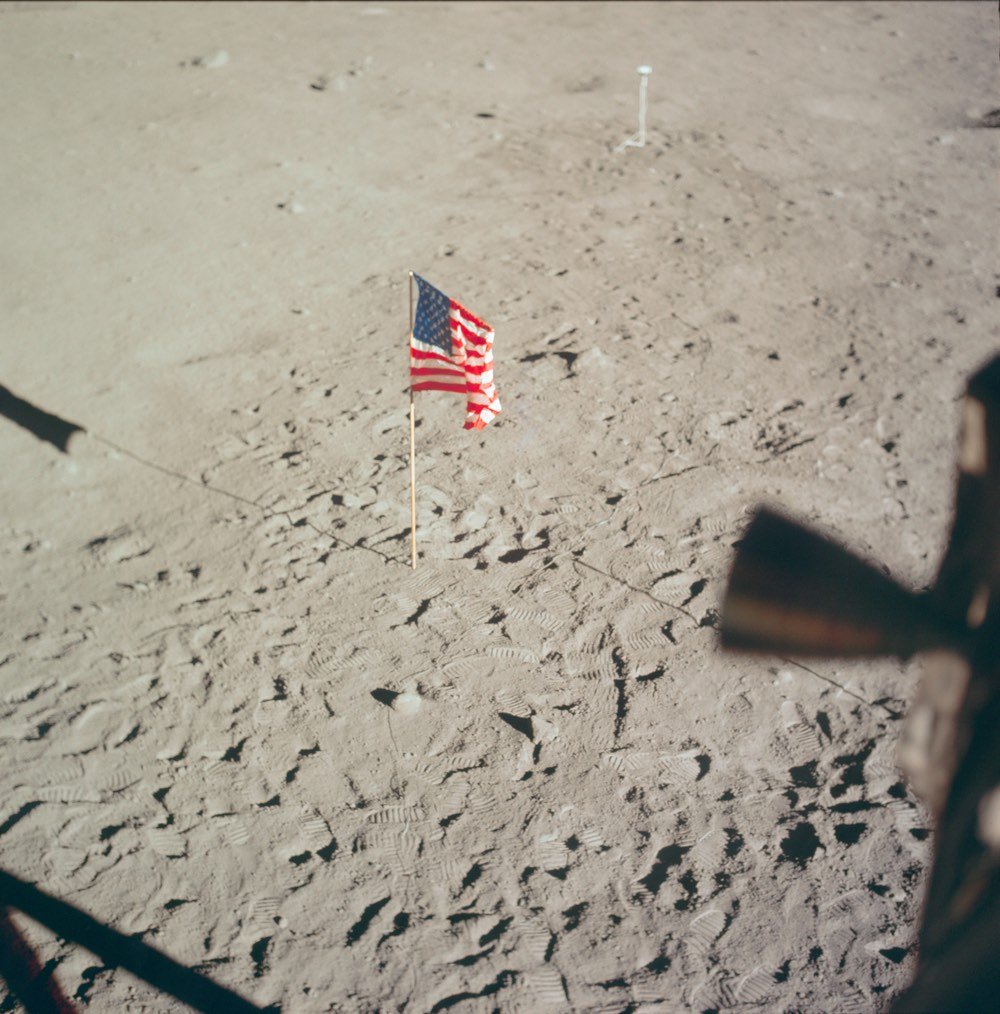
The Moon 1968-1972 is a slim volume of photographs from the Apollo missions to the Moon that took place over four short years almost 50 years ago. The book contains a passage by E.B. White taken from this New Yorker article about the Apollo 11 landing in 1969.
The moon, it turns out, is a great place for men. One-sixth gravity must be a lot of fun, and when Armstrong and Aldrin went into their bouncy little dance, like two happy children, it was a moment not only of triumph but of gaiety. The moon, on the other hand, is a poor place for flags. Ours looked stiff and awkward, trying to float on the breeze that does not blow. (There must be a lesson here somewhere.) It is traditional, of course, for explorers to plant the flag, but it struck us, as we watched with awe and admiration and pride, that our two fellows were universal men, not national men, and should have been equipped accordingly. Like every great river and every great sea, the moon belongs to none and belongs to all. It still holds the key to madness, still controls the tides that lap on shores everywhere, still guards the lovers who kiss in every land under no banner but the sky. What a pity that in our moment of triumph we did not forswear the familiar Iwo Jima scene and plant instead a device acceptable to all: a limp white handkerchief, perhaps, symbol of the common cold, which, like the moon, affects us all, unites us all.
I was not prepared for how incredible the total eclipse was. It was, literally, awesome. Almost a spiritual experience. I also did not anticipate the crazy-ass, reverse storm-chasing car ride we’d need to undertake in order to see it.
I’m not a bucket list sort of person, but ever since seeing a partial eclipse back in college in the 90s (probably this one), I have wanted to witness a total solar eclipse with my own eyes. I started planning for the 2017 event three years ago…the original idea was to go to Oregon, but then some college friends suggested meeting up in Nebraska, which seemed ideal: perhaps less traffic than Oregon, better weather, and more ways to drive in case of poor weather.
Well, two of those things were true. Waking up on Monday, the cloud cover report for Lincoln didn’t look so promising. Rejecting the promise of slightly better skies to the west along I-80, we opted instead to head southeast towards St. Joseph, Missouri where the cloud cover report looked much better. Along the way, thunderstorms started popping up right where we were headed. Committed to our route and trusting this rando internet weather report with religious conviction, we pressed on. We drove through three rainstorms, our car hydroplaning because it was raining so hard, flood warnings popping up on our phones for tiny towns we were about to drive through. Morale was low and the car was pretty quiet for awhile; I Stoically resigned myself to missing the eclipse.
But on the radar, hope. The storms were headed off to the northeast and it appeared as though we might make it past them in time. The Sun appeared briefly through the clouds and from the passenger seat, I stabbed at it shining through the windshield, “There it is! There’s the Sun!” We angled back to the west slightly and, after 3.5 hours in the car, we pulled off the road near the aptly named town of Rayville with 40 minutes until totality, mostly clear skies above us. After our effort, all that was missing was a majestic choral “ahhhhhh” sound as the storm clouds parted to reveal the Sun.
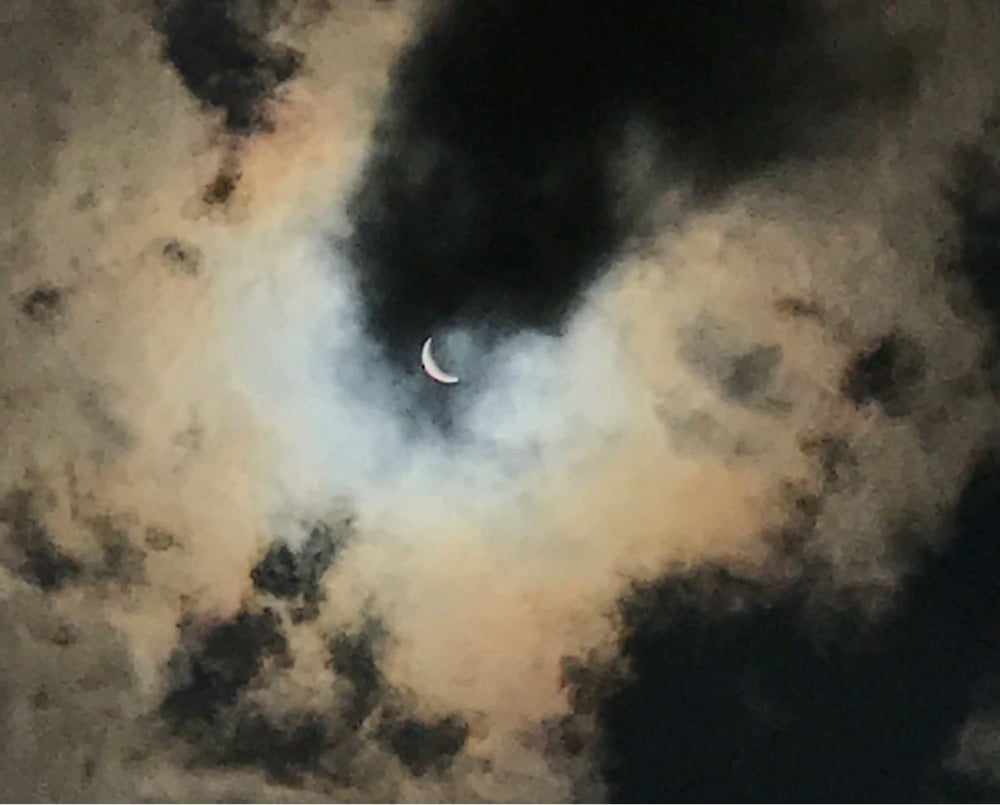
My friend Mouser got his camera set up — he’d brought along the 500mm telephoto lens he uses for birding — and we spent some time looking at the partial eclipse through our glasses, binoculars (outfitted with my homemade solar filter), and phone cameras. I hadn’t seen a partial eclipse since that one back in the 90s, and it was cool seeing the Sun appear as a crescent in the sky. I took this photo through the clouds:
Some more substantial clouds were approaching but not quickly enough to ruin the eclipse. I pumped my fist, incredulous and thrilled that our effort was going to pay off. As totality approached, the sky got darker, our shadows sharpened, insects started making noise, and disoriented birds quieted. The air cooled and it even started to get a little foggy because of the rapid temperature change.
We saw the Baily’s beads and the diamond ring effect. And then…sorry, words are insufficient here. When the Moon finally slipped completely in front of the Sun and the sky went dark, I don’t even know how to describe it. The world stopped and time with it. During totality, Mouser took the photo at the top of the page. I’d seen photos like that before but had assumed that the beautifully wispy corona had been enhanced with filters in Photoshop. But no…that is actually what it looks like in the sky when viewing it with the naked eye (albeit smaller). Hands down, it was the most incredible natural event I’ve ever seen.
After two minutes — or was it several hours? — it was over and we struggled to talk to each other about what we had just seen. We stumbled around, dazed. I felt high, euphoric. Raza Syed put it perfectly:
It was beautiful and dramatic and overwhelming — the most thrillingly disorienting passage of time I’ve experienced since that one time I skydived. It was a complete circadian mindfuck.
After waiting for more than 20 years, I’m so glad I finally got to witness a total solar eclipse in person. What a thing. What a wondrous thing.
Update: Here are some reports from my eclipse-chasing buddies: a photo of Mouser setting up his camera rig, Nina’s sharp shadow at 99% totality, and Mouser’s slightly out-of-focus shot of the Sun at totality (with an account of our travels that day).
On March 8-9, 2016, a total solar eclipse swept across the Pacific Ocean for more than 5 hours. About a year before the eclipse, Hayden Planetarium astronomer Joe Rao realized Alaska Airlines flight 870 from Anchorage to Honolulu would pass right through the path of totality…but 25 minutes too early. Rao called the airline and convinced them to shift the flight time.
Alaska’s fleet director, Captain Brian Holm, reviewed the proposed flight path and possible in-route changes to optimize for the eclipse. The schedule planning team pushed back the departure time by 25 minutes, to 2 p.m.
On the day of the flight, Dispatch will develop the specific flight plan, to find the most efficient route and account for weather and wind. Maintenance and maintenance control will help make sure the plane is ready to go — they even washed all the windows on the right side of the plane.
Captain Hal Andersen also coordinated with Oceanic Air Traffic Control, to make them aware that the flight might require a few more tactical changes then normal.
“The key to success here is meeting some very tight time constraints — specific latitudes and longitudes over the ocean,” Andersen said. “With the flight management computer, it’s a pretty easy challenge, but it’s something we need to pay very close attention to. We don’t want to be too far ahead or too far behind schedule.”
The video was shot by a very excited Mike Kentrianakis of the American Astronomical Society, who has witnessed 20 solar eclipses during his lifetime.
July 11, 2010. That was the eclipse over Easter Island, the one for which hotel room rates were so high that there was no way Kentrianakis could afford it. Instead, he considered attempting a trip to Argentina, where experts predicted there was a 5 percent chance of clear skies. His wife at the time, Olga, urged him not to go — it’s not worth the expense, she insisted. Reluctantly, Kentrianakis stayed home.
“It was the beginning of the end for us,” Kentrianakis says. There were problems in the marriage before that episode, “but it affected me that I felt that she didn’t really appreciate what I loved.” They were divorced the following year.
Kentrianakis doesn’t like to dwell on this, or the other things he’s given up to chase eclipses. He knows his bosses grumbled about the missed days of work. Friends raise their eyebrows at the extremes to which he goes. He’s unwilling to admit how much he’s spent on his obsession.
“There is a trade-off for everything, for what somebody wants,” he says.
A camera on the Deep Space Climate Observatory satellite captured the eclipse’s shadow as it moved across the Earth:
For this year’s eclipse, Alaska Airlines is doing a special charter flight for astronomy nerds and eclipse chasers. Depending on how this eclipse goes, seeing an eclipse from an airplane might be on my bucket list for next time. (via @coudal)
The Exploratorium in San Francisco has produced a great explainer video about the science of predicting total solar eclipses. Each eclipse belongs to a repeating series of eclipses called a Saros cycle that repeats every 18 years 11 days and 8 hours.
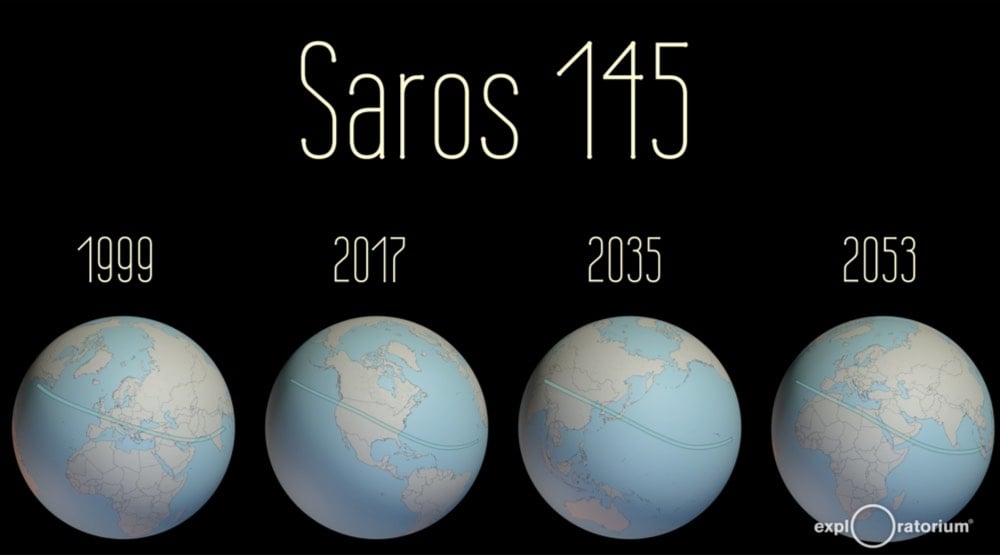
There are now 40 active Saros cycles and the August 2017 eclipse belongs to Saros 145, which produced its first total eclipse in June 1909 and will produce its last total eclipse in September 2648.
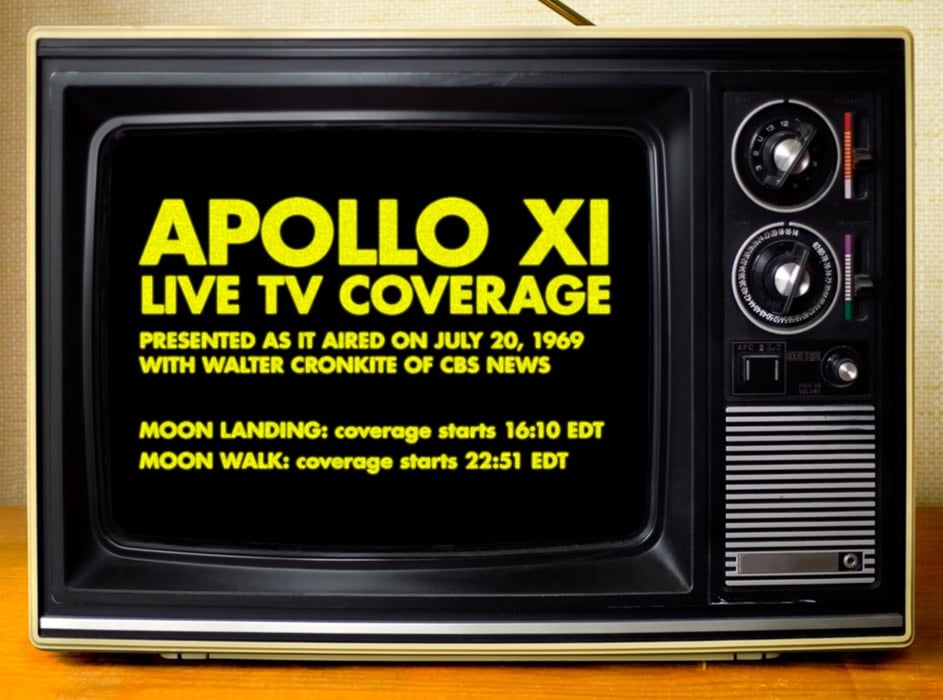
48 years ago today, the lunar module from the Apollo 11 mission landed on the Moon. Later that same day, Neil Armstrong and Buzz Aldrin stepped out of the module, set foot on the surface, and went for a walk. And the entire world watched them do it. Live.
For the 40th anniversary of the landing in 2009, I put together a page where you can watch the original CBS News coverage of Walter Cronkite reporting on the Moon landing and the first Moon walk, synced to the present-day time. Just open this page in your browser and the coverage will start playing at the proper time. Here’s the schedule (all times EDT):
4:10:30 pm: Moon landing broadcast starts
4:17:40 pm: Lunar module lands on the Moon
4:20:15 pm: Break in coverage
10:51:27 pm: Moon walk broadcast starts
10:56:15 pm: First step on Moon
11:51:30 pm: Nixon speaks to the Eagle crew
12:00:30 am: Broadcast end (on July 21)
Here’s what I wrote when I launched the project:
If you’ve never seen this coverage, I urge you to watch at least the landing segment (~10 min.) and the first 10-20 minutes of the Moon walk. I hope that with the old time TV display and poor YouTube quality, you get a small sense of how someone 40 years ago might have experienced it. I’ve watched the whole thing a couple of times while putting this together and I’m struck by two things: 1) how it’s almost more amazing that hundreds of millions of people watched the first Moon walk *live* on TV than it is that they got to the Moon in the first place, and 2) that pretty much the sole purpose of the Apollo 11 Moon walk was to photograph it and broadcast it live back to Earth.
This is one of my favorite projects I’ve ever done, and it almost didn’t happen this year. I woke up this morning assuming it was just going to work again, just like it had the previous 8 years, but a bit of testing revealed that YouTube had discontinued the API I was using to display and time the videos. I wasn’t sure I had the JavaScript chops to fix it in time for the big show this afternoon. Luckily, I was able to solicit some help on Twitter and as the internet continues to be absolutely amazing, Geoff Stearns fixed the problem. As he said in his tweet, Stearns works for Google and wrote the YouTube API that had been discontinued, which is a bit like Marshall McLuhan popping out from behind a poster in Annie Hall, but instead of saying “you know nothing of my work”, he says “I’m gonna fix this up real quick”. Reader, it took him 14 minutes from saying “I’ll help” to posting the solution, and I’d bet half of that time was spent running to the fridge for a LaCroix and selecting the proper coding playlist on Spotify. So big thanks to Geoff for making this happen today! And thanks also to Brian Seward, who landed a solution in my inbox a bit after Geoff’s.
Oh, and no more Flash! So it’ll work on any modern browser with no plugins. But I tested it on my phone and it still doesn’t seem to work properly there…the video loads but doesn’t autoplay. Something to improve for next year!

Lego has introduced an Apollo Saturn V rocket set, complete with lunar lander and 3 astronaut minifigs.
Packed with authentic details, it features 3 removable rocket stages, including the S-IVB third stage with the lunar lander and lunar orbiter. The set also includes 3 stands to display the model horizontally, 3 new-for-June-2017 astronaut microfigures for role-play recreations of the Moon landings, plus a booklet about the manned Apollo missions and the fan designers of this educational and inspirational LEGO Ideas set.
Three rocket stages! And look at this lander:

Amazing detail: the set contains 1969 pieces, which is the year that the Apollo 11 astronauts landed on the Moon. I typically leave the Lego building to my kids, but I might have to make an exception for this. (via mike)
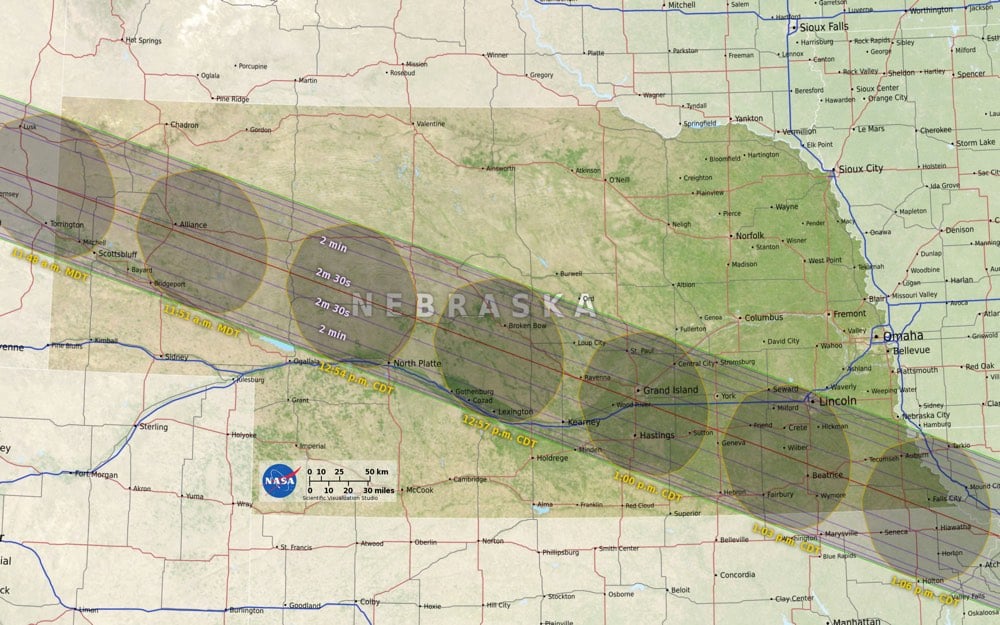
Using data about the Moon’s terrain from the Lunar Reconnaissance Orbiter as well as elevation data on Earth, NASA’s Ernie Wright created a very accurate map of where and when the August 2017 eclipse will occur in the United States.
Standing at the edge of the moon’s shadow, or umbra, the difference between seeing a total eclipse and a partial eclipse comes down to elevation — mountains and valleys both on Earth and on the moon — which affect where the shadow lands. In this visualization, data from NASA’s Lunar Reconnaissance Orbiter account for the moon’s terrain that creates a jagged edge on its shadow. This data is then combined with elevation data on Earth as well as information on the sun angle to create the most accurate map of the eclipse path to date.
You can download maps of your area from NASA’s official eclipse website…I will be studying the Nebraska map closely.
See also Eclipse Megamovie 2017, an eclipse simulator you can use to check what the eclipse will look like in the sky in your area, and what looks like an amazing eclipse watching festival put on by Atlas Obscura.
Using NASA still photographs and audio from the Apollo missions, Christian Stangl created this animated collage as a dedication “to all people who believe in peaceful expansion of our borders”.
In the year 1957 the cold war expands to space. The Soviet-Union sends Sputnik as the first manmade object into earth-orbit. 2 years later Yuri Gagarin enters space as the first man in space. The so called “Space Race” seems to be decided. But in 1961 President Kennedy promised to send American Astronauts to the moon. The Apollo Project was born. A space ship had to be built that is strong enough to escape earth’s gravitation, land on the moon and bring the crew safely back to earth.
I am a total sucker for everything Moon/Apollo related. To me, putting humans on the Moon is one of the best and most inspiring things we have ever done as a species, even though it’s the poster child for the right thing done for the wrong reason.
All but a few humans have seen no more than half of the Moon with their own eyes. For the rest of us stuck on Earth, we only get to see the side that always faces the Earth because the Earth & Moon are tidally locked; the Moon’s rotation about its axis and its orbit around the Earth take the same amount of time. But NASA’s LRO probe has taken high-resolution photos of all but 2% of the Moon’s surface, which have been stitched together into this video of the Moon’s full 360-degree rotation.
In May of 1961, President John F. Kennedy told Congress and the rest of the American public that the US was going to send a man to the Moon. Just over 11 years later, as part of the Apollo 17 mission in December 1972, humans set foot on the Moon for the last time.1 The Last Steps is a summary of that final mission, during which NASA accomplished the near-impossible yet again and was met with increasing public indifference about a journey that had taken on the ease of a car trip to grandma’s house.
Update: Perhaps humans will set foot on the Moon sooner than 2060. The European Space Agency is planning on a manned mission “by 2030” and China is shooting for 2036. (via @T_fabriek)
About a hundred years ago, a tiny asteroid making its way around the sun got caught in Earth’s gravity well. Now it’s locked in an irregular orbit far around our planet, between 38 and 100 times the distance between the Earth and its proper moon.
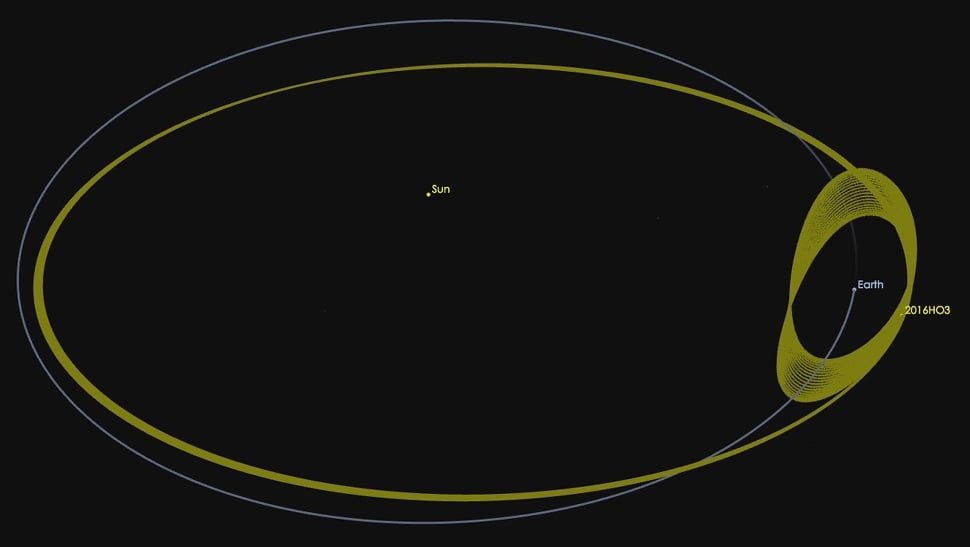
As it orbits the sun, asteroid 2016 HO3 spends about half of the time closer to the sun than Earth, and passes ahead of our planet. The other half of the time it falls behind.
It’s also in a tilted orbit, which causes it to weave up and down on the orbital plane like a bob on choppy waters. As NASA’s Paul Chodas put it in a press statement, “In effect, this small asteroid is caught in a little dance with Earth.”
In another couple of centuries, the asteroid will probably get far enough away that it’ll leave Earth behind forever. I wonder how many times this has happened — how many times the asteroids have been bigger, closer, but still not big or close enough to stay.
The Japanese satellite Himawari caught yesterday’s total solar eclipse as it moved across the Pacific Ocean.
Update: @paulmison sent along some better views of the eclipse: here and here. I tried to find a better YouTube embed, but no dice. This one, taken of the eclipse in Micronesia, is pretty amazing though…you can see the solar flares coming off the surface of the Sun as it reaches totality. Holy shit, I’m getting excited for Eclipsathon 2017!
Newer posts
Older posts





Socials & More