kottke.org posts about Donald Trump
Bloomberg Businessweek asked eight designers to design a logo for Trump’s proposed new branch of the military, Space Force. 89-year-old Milton Glaser, designer of the iconic I ❤ NY logo, can still bring the heat:

I really really *really* want this on a hat. (via df)
In his biography of Apple founder Steve Jobs, Walter Isaacson reports on some comments Jobs made over dinner to News Corp’s Rupert Murdoch about Fox News in 2010.
In return for speaking at the retreat, Jobs got Murdoch to hear him out on Fox News, which he believed was destructive, harmful to the nation, and a blot on Murdoch’s reputation. “You’re blowing it with Fox News,” Jobs told him over dinner. “The axis today is not liberal and conservative, the axis is constructive-destructive, and you’ve cast your lot with the destructive people. Fox has become an incredibly destructive force in our society. You can be better, and this is going to be your legacy if you’re not careful.” Jobs said he thought Murdoch did not really like how far Fox had gone. “Rupert’s a builder, not a tearer-downer,” he said. “I’ve had some meetings with James, and I think he agrees with me. I can just tell.”
Such an insightful comment by Jobs. As John Gruber notes:
This line from Jobs — “The axis today is not liberal and conservative, the axis is constructive-destructive” — is truly the best summary of Trumpism I’ve seen.
It’s been eight years since that conversation and the Republican Party & their voters have doubled down in destroying opportunities for people (particularly those with little power), driven by the likes of Fox News. This destruction will be felt for generations to come.
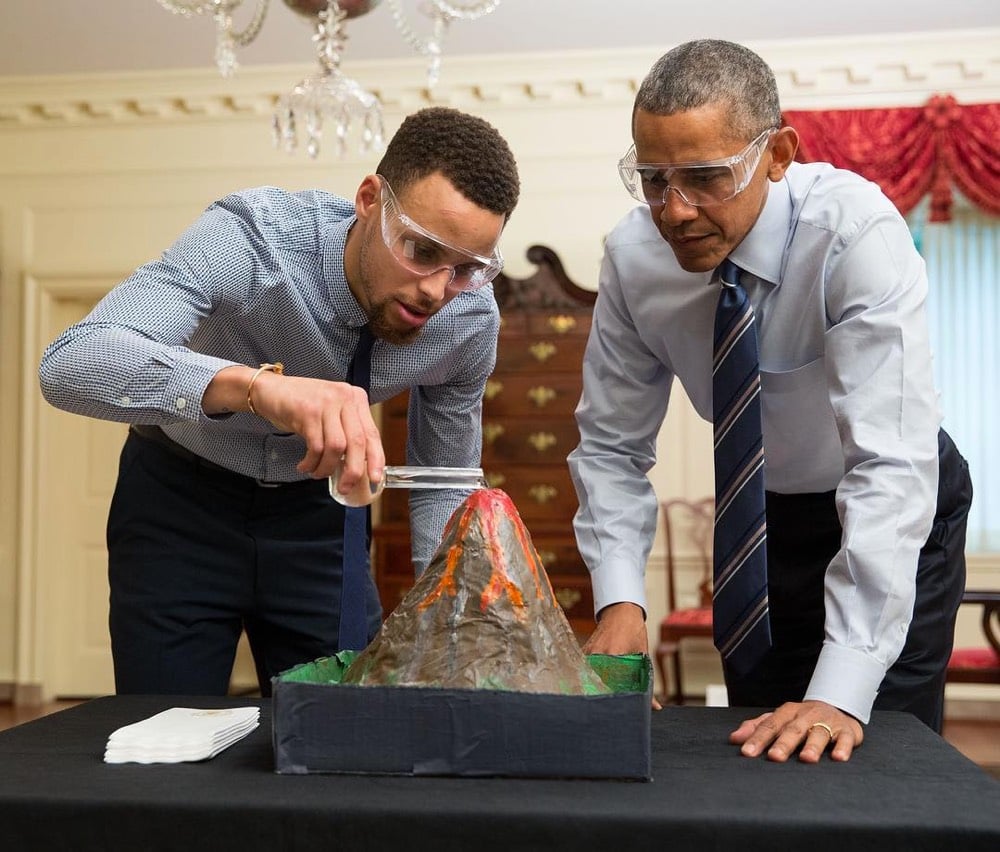
Pete Souza spent 8 years photographing President Obama as the official White House photographer. Souza compiled some of the best of those photos (including the ones with kids) into a book, Obama: An Intimate Portrait. Since Trump took office in January 2017, Souza has used his Instagram account to post photos of Obama in response to Trump’s actions — for instance, when Trump initiated the travel ban against Muslim nations, Souza posted a photo of Obama meeting with a refugee girl.
Souza has collected all of that shade into another book of Presidential photos: Shade: A Tale of Two Presidents.
Shade is a portrait in Presidential contrasts, telling the tale of the Obama and Trump administrations through a series of visual juxtapositions. Here, more than one hundred of Souza’s unforgettable images of President Obama deliver new power and meaning when framed by the tweets, news headlines, and quotes that defined the first 500 days of the Trump White House.
The book comes out in October, but you can preorder it now from Amazon.
Brian Stelter is known for media scoops, but sometimes, he can bring the insight too. On CNN and in his nightly newsletter, he briefly outlines what I think anyone has to agree is an unusual symbiosis of the Presidency and a single news outlet, Fox News. (Trump hiring Fox News’s Bill Shine to run his communications shop is just one symptom of the bigger entanglement.)
— No president has ever endorsed a network to this degree before: Promoting it, telling people when and where to tune in, while trashing all of its rivals…
— And no network has ever propped up a president quite like this before…
— The back-scratching benefits both sides. Trump benefits from the friendly segments and softball Q’s. Fox benefits from Trump’s preferential treatment and constant promos…
— The beating heart of this relationship is Sean Hannity, who reportedly golfed with Trump on Sunday. Hannity is an adviser, a booster, an attack dog, a friend. No TV host has ever had this kind of alliance with a US president…
— And no president has never treated a TV channel like it’s an intelligence agency the way Trump treats Fox…
My point: This is new. And weird. And we shouldn’t get used to it. There’s been almost a merger between a culture war TV station and a culture war president. In the essay, I asked, rhetorically, “What would Trump do without Fox?”
Is this the weirdest thing about the Trump presidency, or the most dangerous? Probably not. But it’s one of the legs that props up all the other legs. And it’s definitely weird, and I’d argue, dangerous.
Jessica Winter writing for the New Yorker:
In the final scene of Frederick Wiseman’s landmark documentary “Domestic Violence,” police in Tampa arrive late at night to the home of a man who is drunk and a woman who is sick. The man has called the police because he is angry that the woman, who is desperate to sleep, is “neglecting” him. Minute by minute, it becomes chillingly clear that the man wants her removed from the house before his anger turns into physical violence. In his mind, the woman’s misdeeds — to be ill; to need rest; to wish to remain in her own home — transform him into an instrument of pain, one that she is choosing to wield against herself. He raises his hands over his head in a gesture of surrender. It’s all her fault. He can’t help it. One of the abuser’s most effective tricks is this inversion of power, at the exact moment that his victim is most frightened and degraded: Look what you made me do.
Look what you made me do has emerged as the dominant ethos of the current White House. During the 2016 Presidential race, many observers drew parallels between the language of abusers and that of Trump on the campaign trail. Since his election, members of the Trump Administration have learned that language, too, and nowhere is this more vivid than in the rhetoric they use to discuss the Administration’s policies toward the Central American immigrants crossing the U.S. border.
As Tim tweeted the day after Inauguration Day in 2017, “The President is an abuser. A lot of us are (re)discovering, and (re)deciding, how we react to being abused.”
I’ve been thinking about Trump’s presidency in terms of a coup to come, but Rebecca Solnit makes a compelling case for that event already being in our rear view mirror.
A lot of people are waiting for something dramatic to happen, some line to be crossed, an epic event like the firing of special counsel Robert Mueller III that will allow them to say that now we have had a coup and now we are ready to do something about it.
We already had the coup.
It happened on November 8, 2016, when an unqualified candidate won a minority victory in a corrupted election thanks in part to foreign intervention. Any time is the right time to pour into the streets and demand that it all grinds to a halt and the country change direction. The evidence that the candidate and his goons were aided by and enthusiastically collaborating with a foreign power was pretty clear before that election, and at this point, they are so entangled there isn’t really a reason to regard the born-again alt-right Republican Party and the Putin Regime as separate entities.
Update: A site called No Package Deals argues that the coup took place earlier than the 2016 election and began with the obstruction by Senate Republicans in not seating any judges, including Scalia’s replacement to the Supreme Court.
In February of 2016, after the death of Associate Justice Antonin Scalia, Mitch McConnell announced that the President no longer had the power to appoint justices to the Supreme Court, period. For some years now the President has not had the power to appoint judges, but nobody much noticed because it wasn’t the Supreme Court. The Republicans just said, Nope. Not seating your judges. End of discussion.
When McConnell said, Nope, not seating your Supreme Court justice either, we’ve already told you we’re not seating your judges, most people noticed. President Obama nominated someone anyway. McConnell stood firm: Mr. President, we have stripped that power from you. You are not going to seat any judges. Nobody did anything. The coup stood.
There’s also this little tidbit concerning Iran:
On March 9th of that same year 47 Republican members of the Senate wrote a letter denying in plain terms the President’s power to negotiate with a specific foreign power. They sent their letter to the government of Iran. Paraphrased they said, Don’t make any deals with our President, because we’ll weasel out of them as soon as he’s not looking. Iran took a chance and made the deal with the President. We will see how it comes out.
Well, it turned out pretty much like No Package Deals expected. (via @heatherhollick)
It’s a common and (on its face) rhetorical move: take something that’s happening now and map it onto the past. Better yet, take something atrocious that’s happening now and show how it maps onto something atrocious in the past, ideally affecting the very people who are now supporting the atrocities. “See?” this trope says: “what you’re doing to other people is exactly what was done to you.”
That’s the basic structure of “resistance genealogy,” as seen in clashes over immigration. “Tomi Lahren’s great-great-grandfather forged citizenship papers; Mike Pence’s family benefited from “chain migration”; James Woods’ ancestors fled famine and moved to Britain as refugees,” etc.
Rebecca Onion argues, convincingly, that this doesn’t work:
The chasm between the life and experiences of a white American, even one who’s descended from desperate immigrants of decades past, and the life of this Honduran mother is the entire point of racist anti-immigration thought. Diminishment of the human qualities of entering immigrants (“unskilled” and “unmodern” immigrants coming from “shithole” countries) reinforces the distance between the two. People who support the Trump administration’s immigration policies want fewer Honduran mothers and their 18-month-olds to enter the country. If you start from this position, nothing you hear about illiterate Germans coming to the United States in the 19th century will change your mind.
Besides underestimating racism, it flattens out history, and assumes that if people only knew more about patterns of historical racism, they might be convinced or at least shamed into changing how they talk about it. Everything we’ve seen suggests that isn’t the case.
I’m going to take this one step further and say this is a weakness in most resorts to historical and political analogies deployed as a tool to understand or persuade people about the present.
For example, consider Donald Trump saying, regarding immigrants trying to enter the United States, “these aren’t people, these are animals.” This is a disgusting thing to say and way to think — and not just because German Nazis and Rwandan perpetrators of genocide used similar language in a different context, and regardless of whether he was using it to refer to immigrants in general or members of a specific gang. It’s bad, it’s racist, it’s shitty, and you really don’t need the added leverage of the historical analogy in order to see why. But that leverage is tempting, because it shows off how much we know, it underlines the stakes, and it converts bad into ultra-bad.
This hurts me to say, because I love history and analogies both. But there’s a limit to how much they can tell us and how well they work. And playing “gotcha!” is usually well beyond the limits of both.
In April 2015, Autistic Abby wrote on their Tumblr about how people mistakenly conflate two distinct definitions of “respect” when relating to and communicating with others.
Sometimes people use “respect” to mean “treating someone like a person” and sometimes they use “respect” to mean “treating someone like an authority”
and sometimes people who are used to being treated like an authority say “if you won’t respect me I won’t respect you” and they mean “if you won’t treat me like an authority I won’t treat you like a person”
and they think they’re being fair but they aren’t, and it’s not okay.
This is an amazing & astute observation and applies readily to many aspects of our current political moment, i.e. the highest status group in the US for the past two centuries (white males) experiencing a steep decline in their status relative to other groups. This effect plays out in relation to gender, race, sexual orientation, age, and class. An almost cartoonishly on-the-nose example is Trump referring to undocumented immigrants as “animals” and then whining about the press giving him a hard time. You can also see it when conservative intellectuals with abundant social standing and privilege complain that their ideas about hanging women or the innate inferiority of non-whites are being censored.
Men who abuse their partners do this…and then sometimes parlay their authoritarian frustrations & easily available assault weapons into mass shootings. There are ample examples of law enforcement — the ultimate embodiment of authority in America — treating immigrants, women, black men, etc. like less than human. A perfect example is the “incel” movement, a group of typically young, white, straight men who feel they have a right to sex and therefore treat women who won’t oblige them like garbage.
You can see it happening in smaller, everyday ways too: never trust anyone who treats restaurant servers like shit because what they’re really doing is abusing their authority as a paying customer to treat another person as subhuman.
Kanye West has a new solo album coming out soon (as well as a collaborative album with Kid Cudi) and so has been out in the world saying things, things like expressing his admiration for Donald Trump and suggesting that slavery was a choice. In a piece at The Atlantic, Ta-Nehisi Coates, an admitted fan of his music, writes that West’s search for white freedom — “freedom without consequence, freedom without criticism, freedom to be proud and ignorant” — is troubling.
Nothing is new here. The tragedy is so old, but even within it there are actors — some who’ve chosen resistance, and some, like West, who, however blithely, have chosen collaboration.
West might plead ignorance — “I don’t have all the answers that a celebrity is supposed to have,” he told Charlamagne [Tha God]. But no citizen claiming such a large portion of the public square as West can be granted reprieve. The planks of Trumpism are clear — the better banning of Muslims, the improved scapegoating of Latinos, the endorsement of racist conspiracy, the denialism of science, the cheering of economic charlatans, the urging on of barbarian cops and barbarian bosses, the cheering of torture, and the condemnation of whole countries. The pain of these policies is not equally distributed. Indeed the rule of Donald Trump is predicated on the infliction of maximum misery of West’s most ardent parishioners, the portions of America, the muck, that made the god Kanye possible.
Coates suggests that Kanye, also like Trump, has been telling us who he is all along:
Everything is darker now and one is forced to conclude that an ethos of “light-skinned girls and some Kelly Rowlands,” of “mutts” and “thirty white bitches,” deserved more scrutiny, that the embrace of a slaveholder’s flag warranted more inquiry, that a blustering illiteracy should have given pause, that the telethon was not wholly born of keen insight, and the bumrushing of Taylor Swift was not solely righteous anger, but was something more spastic and troubling, evidence of an emerging theme — a paucity of wisdom, and more, a paucity of loved ones powerful enough to perform the most essential function of love itself, protecting the beloved from destruction.
Watson is IBM’s AI platform. This afternoon I tried out IBM Watson’s Personality Insights Demo. The service “derives insights about personality characteristics from social media, enterprise data, or other digital communications”. Watson looked at my Twitter account and painted a personality portrait of me:
You are shrewd, inner-directed and can be perceived as indirect.
You are authority-challenging: you prefer to challenge authority and traditional values to help bring about positive changes. You are solemn: you are generally serious and do not joke much. And you are philosophical: you are open to and intrigued by new ideas and love to explore them.
Experiences that give a sense of discovery hold some appeal to you.
You are relatively unconcerned with both tradition and taking pleasure in life. You care more about making your own path than following what others have done. And you prefer activities with a purpose greater than just personal enjoyment.
Initial observations:
- Watson doesn’t use Oxford commas?
- Shrewd? I’m not sure I’ve ever been described using that word before. Inner-directed though…that’s pretty much right.
- Perceived as indirect? No idea where this comes from. Maybe I’ve learned to be more diplomatic & guarded in what I say and how I say it, but mostly I struggle with being too direct.
- “You are generally serious and do not joke much”… I think I’m both generally serious and joke a lot.
- “You prefer activities with a purpose greater than just personal enjoyment”… I don’t understand what this means. Does this mean volunteering? Or that I prefer more intellectual activities than mindless entertainment? (And that last statement isn’t even true.)
Watson also guessed that I “like musical movies” (in general, no), “have experience playing music” (definite no), and am unlikely to “prefer style when buying clothes” (siiiick burn but not exactly wrong). You can try it yourself here. (via @buzz)
Update: Ariel Isaac fed Watson the text for Trump’s 2018 State of the Union address and well, it didn’t do so well:
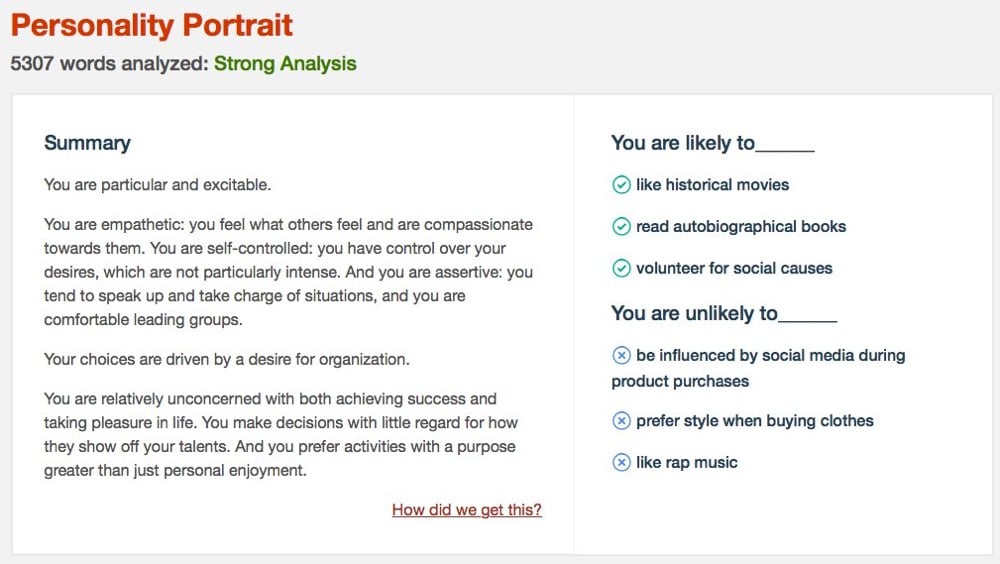
Trump is empathetic, self-controlled, and makes decisions with little regard for how he show off his talents? My dear Watson, are you feeling ok? But I’m pretty sure he doesn’t like rap music…
You might remember Yale historian Timothy Snyder from his 20 lessons on fighting authoritarianism (which he turned into a short bestselling book, On Tyranny). Snyder has a new book out called The Road to Unfreedom that covers the rebound of authoritarianism first in Russia and then in Europe and America.
According to this review from The Economist, the book goes into some detail about the ideological beliefs of Vladimir Putin in his quest to undermine Western democracy. A favorite thinker of Putin’s, a Revolution-era philosopher named Ivan Ilyin, advocated for a Russian monarchy while another, Lev Gumilev, believed that nations draw their power from cosmic rays?
Also present in Mr Putin’s thinking is an even more extreme anti-liberal ideology: that of Lev Gumilev, who thought that nations draw their collective drive, or passionarnost (an invented word), from cosmic rays. In this bizarre understanding of the world, the West’s will to exist is almost exhausted, whereas Russia still has the energy and vocation to form a mighty Slavic-Turkic state, spanning Eurasia.
The result, according to Snyder:
What these ways of thinking have in common, Mr Snyder argues, is a quasi-mystical belief in the destiny of nations and rulers, which sets aside the need to observe laws or procedures, or grapple with physical realities. The spiritual imperative transcends everything, rendering politics, and the pursuit of truth in the ordinary sense, superfluous or even dangerous.
You can see where the election of Donald Trump — with his own “quasi-mystical belief in the destiny” of himself and without “the need to observe laws or procedures” — is a welcome ally/patsy for Putin.
See also Putin’s playbook for discrediting America and destabilizing the West: “Just wanna make sure you all know there is a Russian handbook from 1997 on ‘taking over the world’ and Putin is literally crossing shit off.”
Writing in the NY Times, former Secretary of State Madeleine Albright writes that fascism and authoritarianism is once again on the rise in the world, bolstered by the autocratically inclined Donald Trump.
Today, we are in a new era, testing whether the democratic banner can remain aloft amid terrorism, sectarian conflicts, vulnerable borders, rogue social media and the cynical schemes of ambitious men. The answer is not self-evident. We may be encouraged that most people in most countries still want to live freely and in peace, but there is no ignoring the storm clouds that have gathered. In fact, fascism — and the tendencies that lead toward fascism — pose a more serious threat now than at any time since the end of World War II.
Albright’s book, Fascism: A Warning, comes out next week.
See also The 14 Features of Eternal Fascism and fighting authoritarianism: 20 lessons from the 20th century (which became this bestselling book).
I missed Andrew Sullivan’s review of Cass Sunstein’s Impeachment: A Citizen’s Guide and Can It Happen Here?: Authoritarianism in America (also edited by Sunstein) but I think Sullivan’s twin conclusions are spot on: Trump is likely unimpeachable1 and America is steadily headed towards an authoritarian government.
The result is that an unimpeachable president is slowly constructing the kind of authoritarian state that America was actually founded to overthrow.
There is nothing in the Constitution’s formal operation that can prevent this. Impeachment certainly cannot. As long as one major political party endorses it, and a solid plurality of Americans support such an authoritarian slide, it is unstoppable. The founders knew that without a virtuous citizenry, the Constitution was a mere piece of paper and, in Madison’s words, “no theoretical checks — no form of government can render us secure.” Franklin was blunter in forecasting the moment we are now in: He believed that the American experiment in self-government “can only end in despotism, as other forms have done before it, when the people become so corrupted as to need despotic government, being incapable of any other.” You can impeach a president, but you can’t, alas, impeach the people. They voted for the kind of monarchy the American republic was designed, above all else, to resist; and they have gotten one.
That is an astonishing passage, not only because of the allegation that 225+ years of American democracy is now effectively over because the Constitution does not include the necessary checks to prevent it, but also because it rings true.
According to writer G. Willow Wilson, living in an authoritarian society does not look like “something off the Syfy channel”.
It’s a mistake to think a dictatorship feels intrinsically different on a day-to-day basis than a democracy does. I’ve lived in one dictatorship and visited several others—there are still movies and work and school and shopping and memes and holidays.
The difference is the steady disappearance of dissent from the public sphere. Anti-regime bloggers disappear. Dissident political parties are declared “illegal.” Certain books vanish from the libraries.
How does a society go from a democracy to an autocracy? It’s like that line of Hemingway’s from The Sun Also Rises about how to go bankrupt: “Gradually and then suddenly.”
So if you’re waiting for the grand moment when the scales tip and we are no longer a functioning democracy, you needn’t bother. It’ll be much more subtle than that. It’ll be more of the president ignoring laws passed by congress. It’ll be more demonizing of the press.
Until one day we wake up and discover the regime has decided to postpone the 2020 elections until its lawyers are finished investigating something or other. Or until it can ‘ensure’ that the voting process is ‘fair.’
I don’t know about you, but Trump and the Republican Congress working to “postpone the 2020 elections until its lawyers are finished investigating something or other” seems like a completely plausible scenario. I would not be surprised if we see conservative pundits start floating this idea, slowly normalizing it over a matter of months until it seems like a plausible option. After all, it’s much easier for Republicans to remain in office if they got rid of those pesky elections (in lieu of gerrymandering and voter ID laws).
Update: In a poll from August 2017, 56% of Republicans polled said that they would support postponing the 2020 election if Trump and Republicans in Congress were in favor of it. (via @taestell)
There are many cultural and political lenses through which to view the Trump Presidency — reality TV, Mike Judge’s alarmingly prescient Idiocracy, the OJ Simpson case, Germany in the 1930s — but perhaps the most relevant is through the lens of Richard Nixon and the Watergate scandal. A lot of what I know about Watergate came through cultural osmosis (Johnny Carson and SNL were still doing Watergate jokes in the 80s when I started watching) and movies like All the President’s Men, and I suspect that’s true of many Americans who are too young to have lived through it. We may know the broad strokes, but that’s about it.
Enter Slow Burn, a podcast by Slate about some of the lesser known stories surrounding Watergate and what it felt like to experience it as the scandal unfolded. Here’s series host Leon Neyfakh describing what the show is about:
Why are we revisiting Watergate now? The connections between the Nixon era and today are obvious enough. But to me, the similarity that’s most striking is not between Donald Trump and Richard Nixon (although they’re both paranoid, vengeful, and preoccupied with “loyalty”), or their alleged crimes (although they both involved cheating to win an election), or the legal issues in the two cases (although they both center on obstruction of justice).
Rather, it’s that people who lived through Watergate had no idea what was going to happen from one day to the next, or how it was all going to end. I recognize that feeling. The Trump administration has made many of us feel like the country is in an unfamiliar, precarious situation. Some days it seems like our democratic institutions won’t survive, or that permanent damage has already been done. Pretty much every day, we are buffeted by news stories that sound like they’ve been ripped out of highly stressful and very unrealistic novels.
The point of Slow Burn is to look back on the most recent time Americans went through this en masse, and to put ourselves in their shoes.
Historical events like these make great podcast subjects; I’ve also listened to LBJ’s War recently. Reading articles or books about these topics is one thing, but actually listening to the investigators, journalists, lawyers, and Congressmen talk about about their roles in and perceptions of Watergate, both in contemporary interviews and recordings from that period, adds a lively and engaging aspect to these stories. I mean, just hearing Nixon on those secret tapes and then in press conferences saying that he had done nothing wrong…it’s completely gripping. I’ve been thinking up excuses to go for drives this past week just so I can get my Slow Burn fix.
Newer posts
Older posts





Socials & More