kottke.org posts about Apollo
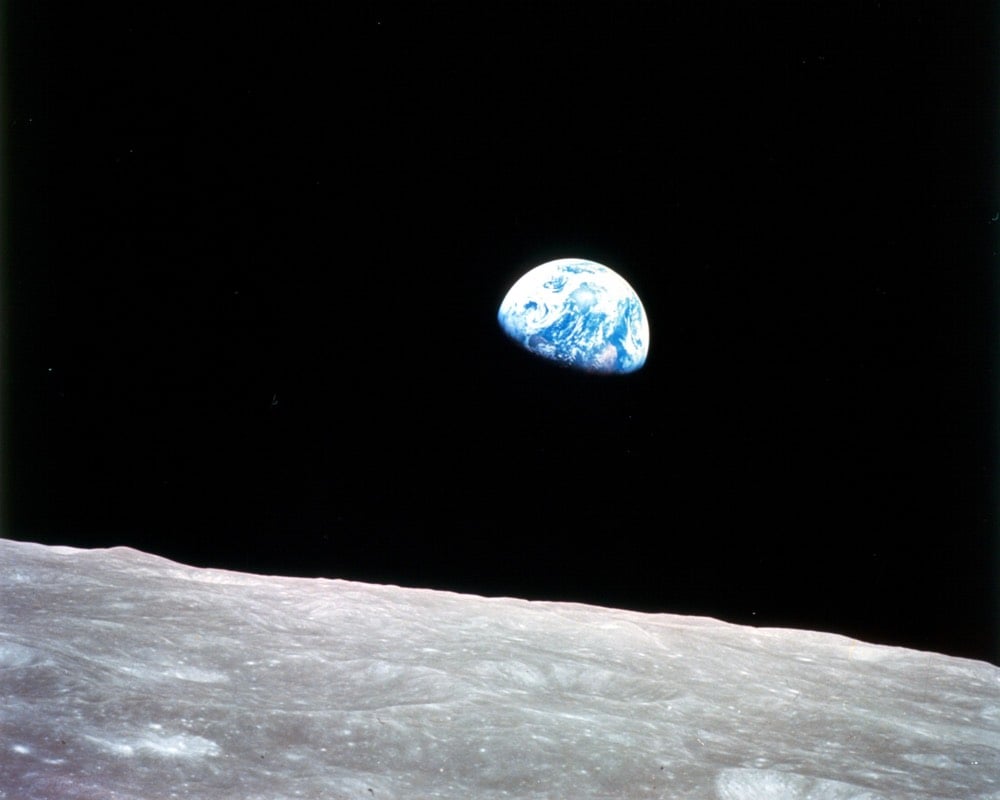
In 1968, the crew of Apollo 8 became the first ever humans to leave the cozy confines of Earth orbit. From Wikipedia:
The three-astronaut crew — Commander Frank Borman, Command Module Pilot James Lovell, and Lunar Module Pilot William Anders — became the first humans to travel beyond low Earth orbit; see Earth as a whole planet; enter the gravity well of another celestial body (Earth’s moon); orbit another celestial body (Earth’s moon); directly see the far side of the Moon with their own eyes; witness an Earthrise; escape the gravity of another celestial body (Earth’s moon); and re-enter the gravitational well of Earth.
That’s a substantial list of firsts. But before setting out on the mission, neither the crew or anyone else at NASA gave much thought to perhaps the most significant and long-lasting achievements on that list: “see Earth as a whole planet” and “witness an Earthrise”. In this gem of a short film by Emmanuel Vaughan-Lee, Anders, Borman, and Lovell recall what it was like for them to be the first of only 24 people to see, with their own eyes, the Earth from that distance, a blue marble hanging in the inky blackness of space.
What they should have sent was poets, because I don’t think we captured the grandeur of what we’d seen.
The day after Apollo 8 orbited the Moon, a poem by Archibald Macleish published on the front page of the NY Times tried to capture that grandeur: Riders on Earth Together, Brothers in Eternal Cold.
Men’s conception of themselves and of each other has always depended on their notion of the earth. When the earth was the World — all the world there was — and the stars were lights in Dante’s heaven, and the ground beneath men’s feet roofed Hell, they saw themselves as creatures at the center of the universe, the sole, particular concern of God — and from that high place they ruled and killed and conquered as they pleased.
And when, centuries later, the earth was no longer the World but a small, wet spinning planet in the solar system of a minor star off at the edge of an inconsiderable galaxy in the immeasurable distances of space — when Dante’s heaven had disappeared and there was no Hell (at least no Hell beneath the feet) — men began to see themselves not as God-directed actors at the center of a noble drama, but as helpless victims of a senseless farce where all the rest were helpless victims also and millions could be killed in world-wide wars or in blasted cities or in concentration camps without a thought or reason but the reason — if we call it one — of force.
Now, in the last few hours, the notion may have changed again. For the first time in all of time men have seen it not as continents or oceans from the little distance of a hundred miles or two or three, but seen it from the depth of space; seen it whole and round and beautiful and small as even Dante — that “first imagination of Christendom” — had never dreamed of seeing it; as the Twentieth Century philosophers of absurdity and despair were incapable of guessing that it might be seen. And seeing it so, one question came to the minds of those who looked at it. “Is it inhabited?” they said to each other and laughed — and then they did not laugh. What came to their minds a hundred thousand miles and more into space — “half way to the moon” they put it — what came to their minds was the life on that little, lonely, floating planet; that tiny raft in the enormous, empty night. “Is it inhabited?”
The medieval notion of the earth put man at the center of everything. The nuclear notion of the earth put him nowhere — beyond the range of reason even — lost in absurdity and war. This latest notion may have other consequences. Formed as it was in the minds of heroic voyagers who were also men, it may remake our image of mankind. No longer that preposterous figure at the center, no longer that degraded and degrading victim off at the margins of reality and blind with blood, man may at last become himself.
To see the earth as it truly is, small and blue and beautiful in that eternal silence where it floats, is to see ourselves as riders on the earth together, brothers on that bright loveliness in the eternal cold — brothers who know now they are truly brothers.
I don’t know why I’m so skeptical about First Man, the upcoming biopic about Neil Armstrong and the first Moon landing. Oh wait, yes I do: Apollo 11 holds a special place in my heart, as does Armstrong and his role in the historic landing, and I’m very protective of it. It would be so easy and, in my opinion, wrong to load this story up with unnecessary drama when there’s already so much there in the story, even though it might not be naturally cinematic.
On the other hand, the trailer looks great, Ryan Gosling is a terrific actor, director Damien Chazelle’s previous films are really good (Whiplash and La La Land), and the film is based on the authorized and well-received biography by James Hansen. Ok fine, I just talked myself into it!
In May 1961, President John F. Kennedy stood before Congress and said:
I believe that this nation should commit itself to achieving the goal, before this decade is out, of landing a man on the moon and returning him safely to the earth.
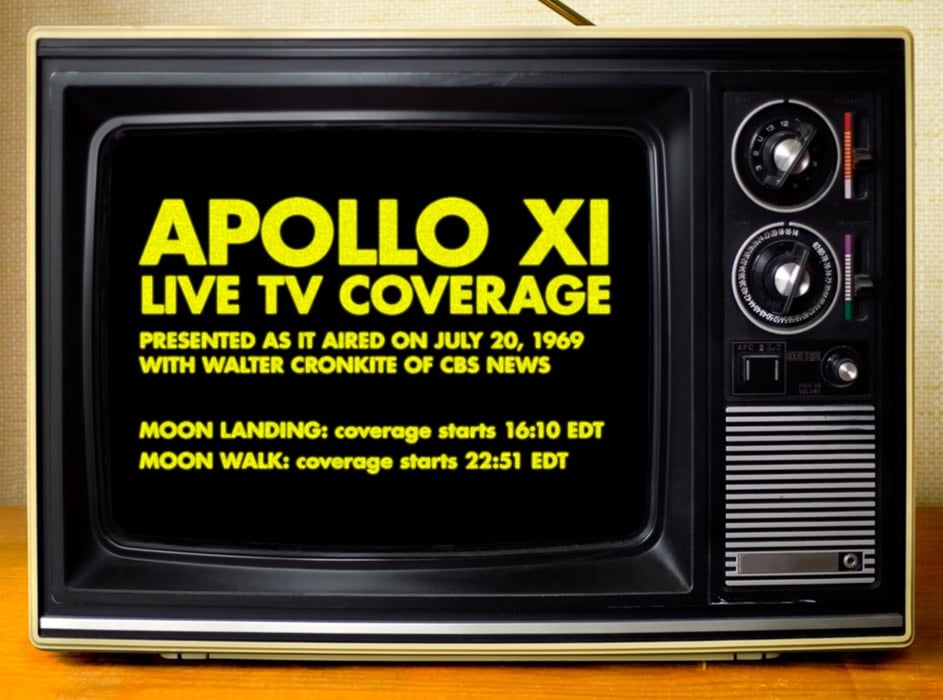
A little more than 8 years later, it was done. On July 20, 1969, 49 years ago today, Neil Armstrong and Buzz Aldrin landed on the Moon, took a walk, and returned safely to Earth a few days later. And the whole thing was broadcast live on television screens around the world.
For the 40th anniversary of the landing in 2009, I put together a page where you can watch the original CBS News coverage of Walter Cronkite reporting on the Moon landing and the first Moon walk, synced to the present-day time. Just open this page in your browser and the coverage will start playing at the proper time. Here’s the schedule (all times EDT):
4:10:30 pm: Moon landing broadcast starts
4:17:40 pm: Lunar module lands on the Moon
4:20:15 pm: Break in coverage
10:51:27 pm: Moon walk broadcast starts
10:56:15 pm: First step on Moon
11:51:30 pm: Nixon speaks to the Eagle crew
12:00:30 am: Broadcast end (on July 21)
You can add these yearly recurring events to your calendar: Moon landing & Moon walk.
Here’s what I wrote when I launched the project, which is one of my favorite things I’ve ever done online:
If you’ve never seen this coverage, I urge you to watch at least the landing segment (~10 min.) and the first 10-20 minutes of the Moon walk. I hope that with the old time TV display and poor YouTube quality, you get a small sense of how someone 40 years ago might have experienced it. I’ve watched the whole thing a couple of times while putting this together and I’m struck by two things: 1) how it’s almost more amazing that hundreds of millions of people watched the first Moon walk *live* on TV than it is that they got to the Moon in the first place, and 2) that pretty much the sole purpose of the Apollo 11 Moon walk was to photograph it and broadcast it live back to Earth.
I’ve been listening to the audiobook of Andrew Chaikin’s account of the Apollo program, A Man on the Moon, and the chapter about Apollo 11’s Moon landing was riveting.1 I’ve watched the TV footage & listened to the recordings dozens of times and I was still on the edge of my seat, sweating the landing alongside Armstrong and Aldrin. And sweating they were…at least Armstrong was. Take a look at his heart rate during the landing; it peaked at 150 beats per minute at landing (note: the “1000 ft altitude” is mislabeled, it should be “100 ft”):

For reference, Armstrong’s resting heart rate was around 60 bpm. There are a couple of other interesting things about this chart. The first is the two minutes of missing data starting around 102:36. They were supposed to be 10 minutes from landing on the Moon and instead their link to Mission Control in Houston kept cutting out. Then there were the intermittent 1201 and 1202 program alarms, which neither the LM crew nor Houston had encountered in any of the training simulations. At the sign of the first alarm at 102:38:26, Armstrong’s heart rate actually appears to drop. And then, as the alarms continue throughout the sequence along with Houston’s assurances that the alarm is nothing to worry about, Armstrong’s heart rate stays steady.
Right around the 2000 feet mark, Armstrong realizes that he needs to maneuver around a crater and some rocks on the surface to reach a flat landing spot and his heart rate steadily rises until it plateaus at the landing. At the time, he thought he’d landed with less than 30 seconds of fuel remaining. That Neil Armstrong was able to keep his cool with unknown alarms going off while avoiding craters and boulders with very little fuel remaining and his heart rate spiking while skimming over the surface OF THE FREAKING MOON doing something no one had ever done before is one of the most totally cold-blooded & badass things anyone has ever done. Damn, I get goosebumps just reading about it!
Update: The landing broadcast just aired and I wanted to explain a little about what you saw (you can relive it here).
The shots of the Moon you see during the landing broadcast are animations…there is obviously no camera on the Moon watching the LM descend to the surface. There was a camera recording the landing from the LM but that footage was not released until later. This is in contrast to the footage you’ll see later on the Moon walk broadcast…that footage was piped in live to TV screens all over the world as it happened.
The radio voices you hear are mostly Mission Control in Houston (specifically Apollo astronaut Charlie Duke, who acted as the spacecraft communicator for this mission) and Buzz Aldrin, whose job during the landing was to keep an eye on the LM’s altitude and speed — you can hear him calling it out, “3 1/2 down, 220 feet, 13 forward.” Armstrong doesn’t say a whole lot…he’s busy flying and furiously searching for a suitable landing site. But it’s Armstrong that says after they land, “Houston, Tranquility Base here. The Eagle has landed.”. Note the change in call sign from “Eagle” to “Tranquility Base”. :)
Two things to listen for on the broadcast: the 1201/1202 program alarms I mentioned above and two quick callouts by Charlie Duke about the remaining fuel towards the end: “60 seconds” and “30 seconds”. Armstrong is taking all this information in through his earpiece — the 1202s, the altitude and speed from Aldrin, and the remaining fuel — and using it to figure out where to land.
The CBS animation shows the fake LM landing on the fake Moon before the actual landing — when Buzz says “contact light” and then “engine stop”. The animation was based on the scheduled landing time and evidently couldn’t be adjusted. The scheduled time was overshot because of the crater and boulders situation mentioned above.
Cronkite was joined on the program by former astronaut Wally Schirra. When Armstrong signaled they’d landed, Schirra can be seen dabbing his eyes and Cronkite looks a little misty as well as he rubs his hands together.
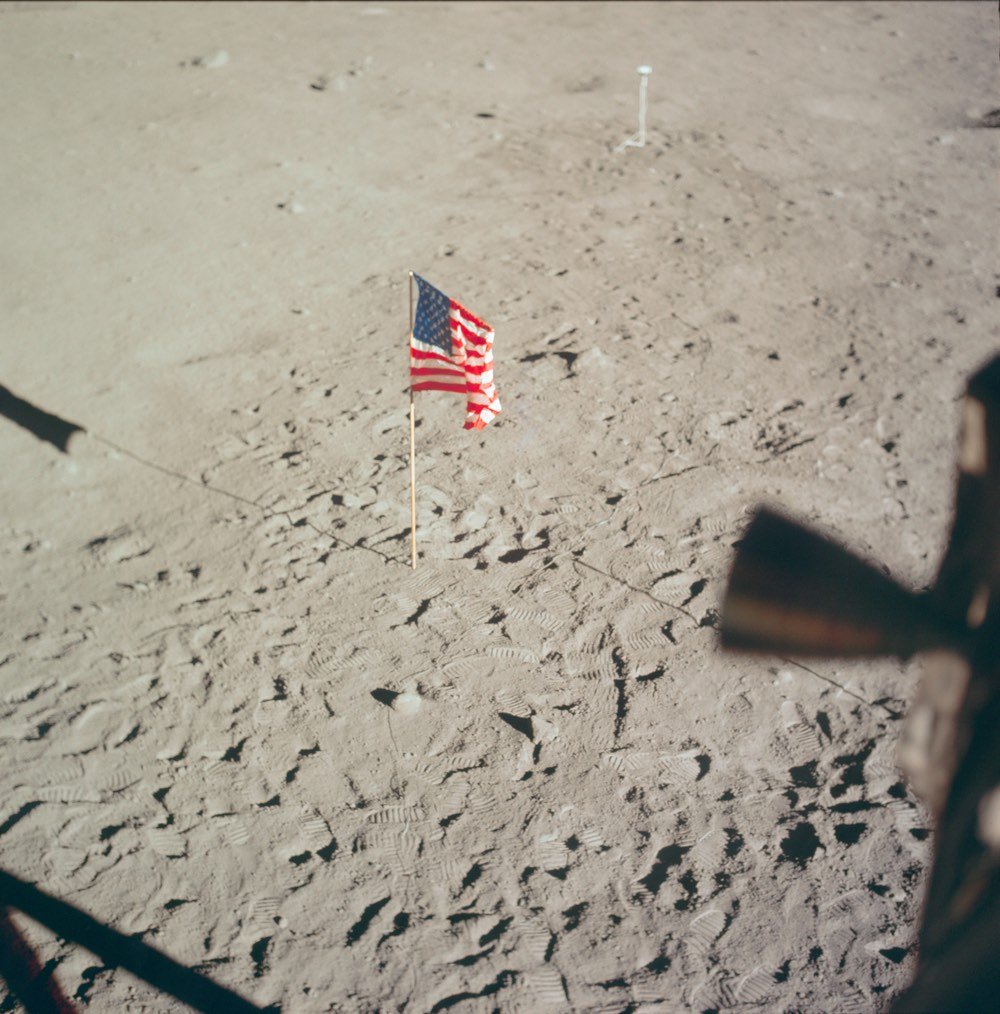
The Moon 1968-1972 is a slim volume of photographs from the Apollo missions to the Moon that took place over four short years almost 50 years ago. The book contains a passage by E.B. White taken from this New Yorker article about the Apollo 11 landing in 1969.
The moon, it turns out, is a great place for men. One-sixth gravity must be a lot of fun, and when Armstrong and Aldrin went into their bouncy little dance, like two happy children, it was a moment not only of triumph but of gaiety. The moon, on the other hand, is a poor place for flags. Ours looked stiff and awkward, trying to float on the breeze that does not blow. (There must be a lesson here somewhere.) It is traditional, of course, for explorers to plant the flag, but it struck us, as we watched with awe and admiration and pride, that our two fellows were universal men, not national men, and should have been equipped accordingly. Like every great river and every great sea, the moon belongs to none and belongs to all. It still holds the key to madness, still controls the tides that lap on shores everywhere, still guards the lovers who kiss in every land under no banner but the sky. What a pity that in our moment of triumph we did not forswear the familiar Iwo Jima scene and plant instead a device acceptable to all: a limp white handkerchief, perhaps, symbol of the common cold, which, like the moon, affects us all, unites us all.
48 years ago today, the lunar module from the Apollo 11 mission landed on the Moon. Later that same day, Neil Armstrong and Buzz Aldrin stepped out of the module, set foot on the surface, and went for a walk. And the entire world watched them do it. Live.
For the 40th anniversary of the landing in 2009, I put together a page where you can watch the original CBS News coverage of Walter Cronkite reporting on the Moon landing and the first Moon walk, synced to the present-day time. Just open this page in your browser and the coverage will start playing at the proper time. Here’s the schedule (all times EDT):
4:10:30 pm: Moon landing broadcast starts
4:17:40 pm: Lunar module lands on the Moon
4:20:15 pm: Break in coverage
10:51:27 pm: Moon walk broadcast starts
10:56:15 pm: First step on Moon
11:51:30 pm: Nixon speaks to the Eagle crew
12:00:30 am: Broadcast end (on July 21)
Here’s what I wrote when I launched the project:
If you’ve never seen this coverage, I urge you to watch at least the landing segment (~10 min.) and the first 10-20 minutes of the Moon walk. I hope that with the old time TV display and poor YouTube quality, you get a small sense of how someone 40 years ago might have experienced it. I’ve watched the whole thing a couple of times while putting this together and I’m struck by two things: 1) how it’s almost more amazing that hundreds of millions of people watched the first Moon walk *live* on TV than it is that they got to the Moon in the first place, and 2) that pretty much the sole purpose of the Apollo 11 Moon walk was to photograph it and broadcast it live back to Earth.
This is one of my favorite projects I’ve ever done, and it almost didn’t happen this year. I woke up this morning assuming it was just going to work again, just like it had the previous 8 years, but a bit of testing revealed that YouTube had discontinued the API I was using to display and time the videos. I wasn’t sure I had the JavaScript chops to fix it in time for the big show this afternoon. Luckily, I was able to solicit some help on Twitter and as the internet continues to be absolutely amazing, Geoff Stearns fixed the problem. As he said in his tweet, Stearns works for Google and wrote the YouTube API that had been discontinued, which is a bit like Marshall McLuhan popping out from behind a poster in Annie Hall, but instead of saying “you know nothing of my work”, he says “I’m gonna fix this up real quick”. Reader, it took him 14 minutes from saying “I’ll help” to posting the solution, and I’d bet half of that time was spent running to the fridge for a LaCroix and selecting the proper coding playlist on Spotify. So big thanks to Geoff for making this happen today! And thanks also to Brian Seward, who landed a solution in my inbox a bit after Geoff’s.
Oh, and no more Flash! So it’ll work on any modern browser with no plugins. But I tested it on my phone and it still doesn’t seem to work properly there…the video loads but doesn’t autoplay. Something to improve for next year!

Lego has introduced an Apollo Saturn V rocket set, complete with lunar lander and 3 astronaut minifigs.
Packed with authentic details, it features 3 removable rocket stages, including the S-IVB third stage with the lunar lander and lunar orbiter. The set also includes 3 stands to display the model horizontally, 3 new-for-June-2017 astronaut microfigures for role-play recreations of the Moon landings, plus a booklet about the manned Apollo missions and the fan designers of this educational and inspirational LEGO Ideas set.
Three rocket stages! And look at this lander:

Amazing detail: the set contains 1969 pieces, which is the year that the Apollo 11 astronauts landed on the Moon. I typically leave the Lego building to my kids, but I might have to make an exception for this. (via mike)
Using NASA still photographs and audio from the Apollo missions, Christian Stangl created this animated collage as a dedication “to all people who believe in peaceful expansion of our borders”.
In the year 1957 the cold war expands to space. The Soviet-Union sends Sputnik as the first manmade object into earth-orbit. 2 years later Yuri Gagarin enters space as the first man in space. The so called “Space Race” seems to be decided. But in 1961 President Kennedy promised to send American Astronauts to the moon. The Apollo Project was born. A space ship had to be built that is strong enough to escape earth’s gravitation, land on the moon and bring the crew safely back to earth.
I am a total sucker for everything Moon/Apollo related. To me, putting humans on the Moon is one of the best and most inspiring things we have ever done as a species, even though it’s the poster child for the right thing done for the wrong reason.
In May of 1961, President John F. Kennedy told Congress and the rest of the American public that the US was going to send a man to the Moon. Just over 11 years later, as part of the Apollo 17 mission in December 1972, humans set foot on the Moon for the last time.1 The Last Steps is a summary of that final mission, during which NASA accomplished the near-impossible yet again and was met with increasing public indifference about a journey that had taken on the ease of a car trip to grandma’s house.
Update: Perhaps humans will set foot on the Moon sooner than 2060. The European Space Agency is planning on a manned mission “by 2030” and China is shooting for 2036. (via @T_fabriek)


From NASA, the operations manual for the lunar rover. Rovers were used on the final three Apollo missions: 15, 16, and 17. (thx, daniel)
For whatever reason, when Buzz Aldrin and Neil Armstrong left the surface of the Moon after their historic space walk, they collected “a bunch of trash that we want to take back” in a small white bag. Upon their return to Earth, Armstrong put the bag in a closet and there it sat for more than 40 years, until Armstrong’s widow discovered it shortly after his death. Among other items, the bag contained the camera that recorded The Eagle’s landing on the Moon and Armstrong’s first step, which was presumed to have been lost or left on the Moon.

As far as we know, Neil has never discussed the existence of these items and no one else has seen them in the 45 years since he returned from the Moon. (I asked James Hansen, Neil’s authorized biographer if he had mentioned the items, and he had not.) Each and every item has its own story and significance, and they are described with photographs in extraordinary detail in an addendum to the Apollo Lunar Surface Journal. But two of the items are especially timely. Both have been placed on display as part of the recently opened temporary exhibition Outside the Spacecraft: 50 Years of Extra-Vehicular Activity.
The first is the 16mm Data Acquisition Camera that was mounted in the window of the lunar module Eagle to record the historic landing and “one small step” made by Armstrong as humankind first set foot on another world.
If you believe in gravity, then you know that if you remove air resistance, a bowling ball and a feather will fall at the same rate. But seeing it actually happen, in the world’s largest vacuum chamber (122 feet high, 100 feet in diameter), is still a bit shocking.
In the late 1500s, Galileo was the first to show that the acceleration due to the Earth’s gravity was independent of mass with his experiment at the Leaning Tower of Pisa, but that pesky air resistance caused some problems. At the end of the Apollo 15 mission, astronaut David Scott dropped a hammer and a feather in the vacuum on the surface of the Moon:
Science!

45 years ago today, the lunar module from the Apollo 11 mission landed on the Moon. For the 40th anniversary of the landing in 2009, I put together a page where you can watch the original CBS News coverage of Walter Cronkite reporting on the Moon landing and the first Moon walk, synced to the present-day time. I’ve updated the page to work again this year: just open this page in your browser and the coverage will start playing at the proper time. Here’s the schedule:
Moon landing broadcast start: 4:10:30 pm EDT on July 20
Moon landing shown: 4:17:40 pm EDT
Moon landing broadcast end: 4:20:15 pm EDT
{break}
Moon walk broadcast start: 10:51:27 pm EDT
First step on Moon: 10:56:15 pm EDT
Nixon speaks to the Eagle crew: approx 11:51:30 pm EDT
Moon walk broadcast end: 12:00:30 pm EDT on July 21
Here’s what I wrote when I launched the project:
If you’ve never seen this coverage, I urge you to watch at least the landing segment (~10 min.) and the first 10-20 minutes of the Moon walk. I hope that with the old time TV display and poor YouTube quality, you get a small sense of how someone 40 years ago might have experienced it. I’ve watched the whole thing a couple of times while putting this together and I’m struck by two things: 1) how it’s almost more amazing that hundreds of millions of people watched the first Moon walk *live* on TV than it is that they got to the Moon in the first place, and 2) that pretty much the sole purpose of the Apollo 11 Moon walk was to photograph it and broadcast it live back to Earth.
(FYI, I didn’t test it, but I’m almost positive this will *not* work on mobile…it uses YouTube’s Flash player to show the video. Sorry.)
There’s art on the Moon, a small sculpture called Fallen Astronaut. Artist Paul van Hoeydonck made it. Commander David Scott of Apollo 15 placed it on the Moon in 1971. Instead of a triumph, the whole thing fell into scandal and was forgotten.
In reality, van Hoeydonck’s lunar sculpture, called Fallen Astronaut, inspired not celebration but scandal. Within three years, Waddell’s gallery had gone bankrupt. Scott was hounded by a congressional investigation and left NASA on shaky terms. Van Hoeydonck, accused of profiteering from the public space program, retreated to a modest career in his native Belgium. Now both in their 80s, Scott and van Hoeydonck still see themselves unfairly maligned in blogs and Wikipedia pages-to the extent that Fallen Astronaut is remembered at all.
And yet, the spirit of Fallen Astronaut is more relevant today than ever. Google is promoting a $30 million prize for private adventurers to send robots to the moon in the next few years; companies such as SpaceX and Virgin Galactic are creating a new for-profit infrastructure of human spaceflight; and David Scott is grooming Brown University undergrads to become the next generation of cosmic adventurers.
Governments come and go, public sentiment waxes and wanes, but the dream of reaching to the stars lives on. Fallen Astronaut does, too, hanging eternally 238,000 miles above our heads. Here, for the first time, we tell the full, tangled tale behind one of the smallest yet most extraordinary achievements of the Space Age.
Great story from the memoirs of William Moore, an Electrical Systems expert for the Apollo program in the 1960s. Moore writes about the time that he and his team had to take a trip out to the launchpad to fix something on the first unmanned launch of the Saturn V rocket.
Our goal was to enter this two level hermetically sealed, all welded steel coffin called the Mobil Launcher Base topped by a fully loaded 363 ft. high Saturn V, weighing 6.2 million pounds, and the permanently attached 380 ft. high Umbilical Tower, weighing 500k pounds. We finally stopped and left our van to walk up and into the second level of the Mobile Launcher Base. About this time, it came to my mind that during one of our training sessions we were told that one of the fully fueled prototype S11 rocket stages had been exploded out in the desert. The results showed that all buildings better be at least three miles from the launch lads — which they are. We were now within 25 feet of this 363ft tall bomb that sounded like it’s giant fuse had been lit, and we were soon going to get much closer.
(via hacker news)
An amateur astronomer discovered asteroid J002E3 orbiting the Earth in 2002. By observing how the object was moving and measuring its spectrum, it was determined that the asteroid was man-made and probably the third stage of Apollo 12’s Saturn V rocket.
In early September 2002, spectral and photometric observations of J002E3 were made at IRTF and Mt. Biglow in an effort to determine whether the object was an asteroid or a human-made. Early observations yielded a possible spin-rate and orientation. Additional spectral observations were completed in May 2003 at the Air Force Maui Optical Supercomputing (AMOS) site. Through the modeling of common spacecraft materials, the observations of J002E3 show a strong correlation of absorption features to a combination of human-made materials including white paint, black paint, and aluminum. Absorption features in the near IR show a strong correlation with paint containing a titanium-oxide semiconductor. Using the material model and the orbital information, it was concluded that J002E3 is a human-made object from an Apollo rocket upperstage, most likely Apollo 12.
Here’s a cool animation showing how the Earth’s gravity temporarily captured J002E3.
Newer posts
Older posts





Socials & More