

How Will the Miracle Happen Today? “Kindness is like a breath. It can be squeezed out, or drawn in. You can wait for it, or you can summon it. To solicit a gift from a stranger takes a certain state of openness.”

Advertise here with Carbon Ads
This site is made possible by member support. 💞
Big thanks to Arcustech for hosting the site and offering amazing tech support.
When you buy through links on kottke.org, I may earn an affiliate commission. Thanks for supporting the site!
kottke.org. home of fine hypertext products since 1998.
Beloved by 86.47% of the web.
Entries for January 2026
Montreal’s Ice Surfer
There’s a guy named Orion who surfs the St Lawrence River in the winter, sometimes dodging massive chunks of ice and sometimes riding them downstream, looking for waves. If you’ve ever been in Montreal near the river, even in the summer, you know how scary the water looks — churning & choppy with many eddies; I’m gobsmacked that someone goes out in that in freezing temperatures. The footage in this short film is incredible, otherworldly.
Thoughtful lessons from a Google software engineer. “The punchline isn’t ‘never innovate.’ It’s ‘innovate only where you’re uniquely paid to innovate.’ Everything else should default to boring, because boring has known failure modes.”

Recently I’ve been thinking a lot about this 2015 observation on Tumblr about the dangerous conflation of respect of personhood and the respect of authority.
The America That Could Be
The main point of Adam Bonica’s post The Wall Looks Permanent Until It Falls is about the optimism of this moment: that the US could be ripe for a Berlin Wall-falling moment that opens the door for a better future. I’m not in the mood for that message these days (IMO, our Wall-falling is a ways off in the future), but Bonica’s analysis of how the US compares to 30 other wealthy democracies, our economic peers, is important.
Start with work and economic life. Americans work longer hours, pay more out-of-pocket for college and childcare, lack parental leave, and enjoy less economic mobility. The share of income going to the top 1 percent is nearly double the OECD average. American CEOs earn, on average, 354 times as much as their workers. More workers are trapped in poverty-wage jobs. Collective bargaining covers fewer workers. And social protections are less generous for those who fall on hard times, with the government raising less in taxes and spending more on the military.
The economy is just the beginning.
We spend nearly twice as much on healthcare as other wealthy countries do. Yet life expectancy is well below average, infant and maternal mortality rates are alarmingly high, and more Americans remain uninsured.
We suffer from overlapping public health crises — the highest rates of teenage births, drug overdoses, obesity, and gun deaths among peer nations.
His description of our unique exceptionalism goes on for several more paragraphs. But then he does something quite simple and revealing: he does the math and imagines, in concrete terms, what the US would be like if it were just an average country in its cohort. Bonica calls it “Latent America: the nation that would exist if our democracy functioned to serve the public rather than protect the already powerful”. Here’s part of his analysis:
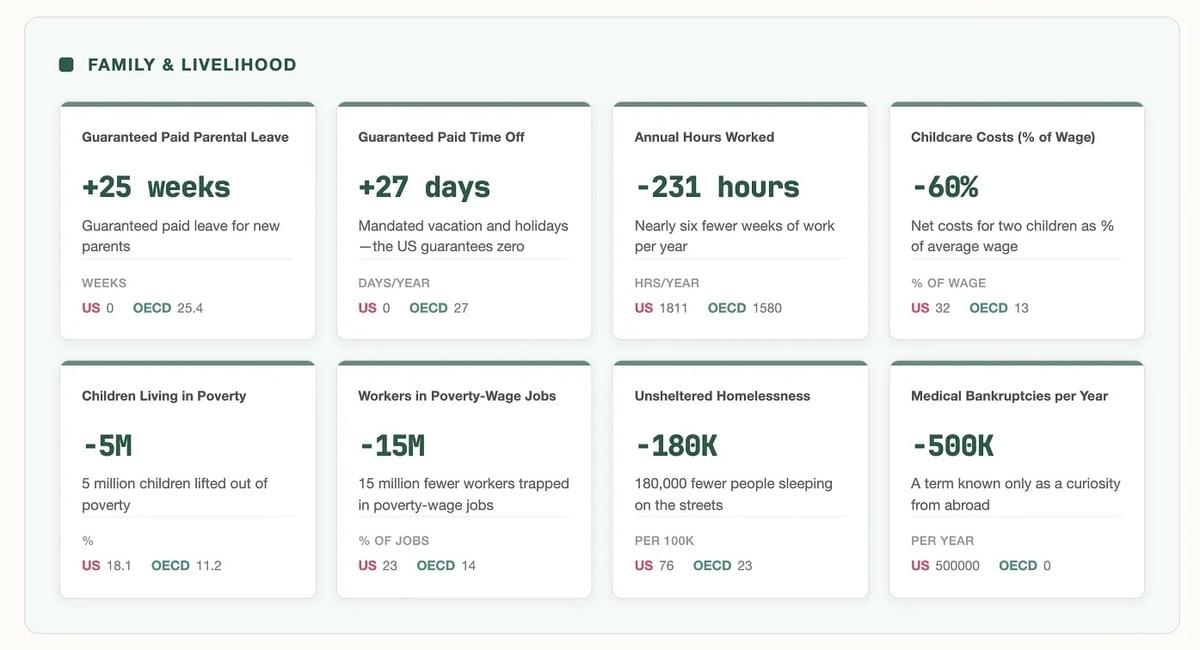
I don’t think I’ve seen this analysis done in quite this way before. You should click through to see the whole graphic, but some of the other stats are:
- $19,000 added income per household per year (and $96K more wealth)
- $2.1 trillion less spending on healthcare
- 4.1 more years of life expectancy at birth
- 51 million more Americans voting
- 1.4 million fewer Americans behind bars
- 60 more women serving in Congress
And this is just if the US were an average nation. Imagine if the US took its exceptionalism seriously and tried to maximally improve the lives of its citizens & residents instead of generating, as Bonica puts it, “enormous prosperity while deliberately withholding it from those who need it most”.
Astronomers have discovered an “almost-galaxy” called Cloud-9 (no, really), a failed galaxy that contains no stars. “There’s nothing like this that we’ve found so far in the universe.”

Condé Nast forgot to renew the trademark for Gourmet and so a group of journalists grabbed it and are relaunching the food magazine as a worker-owned co-op. Love it.

Discover the 100-Year-Old Self-Playing Violin, One of the Most Complex Music Players Ever Made. “It featured three vertically mounted violins, each with a single active string, played by a rotating bow of 1,300 horsehairs.”

An Optical Compass Inspired by Bee Vision
Bees use polarized sunlight scattered by the atmosphere in order to navigate; they always know where the sun is, even if it’s cloudy or behind a mountain. Then they waggle dance to inform their hive-mates about food source locations.
So if a bee wants to fly straight towards the sun, it waggles straight up the hive. If the food is 30° away from that polarization line, it waggles 30° away from vertical. If the food is directly away from the sun, it waggles downward.
And the distance they should fly is encoded on how long the waggle lasts. It depends on the species of bee, but a waggle of about 1 second means about a kilometer away. So a 45° waggle for about 0.6 seconds means fly at 45° angles from the sun polarization line for about 600 meters.
The bee repeats this waggle dance over and over. And the more excited the dance, the better the food source. And if other bees verify it and perform the same dance, the signal gets amplified until the whole hive knows where to go.
As shown in this video, it’s possible to construct an optical compass using polarized filters in order to wayfind like the bees. Pretty cool! (via damn interesting)
Simon Tatham’s Portable Puzzle Collection. “This page contains a collection of small computer programs which implement one-player puzzle games.”

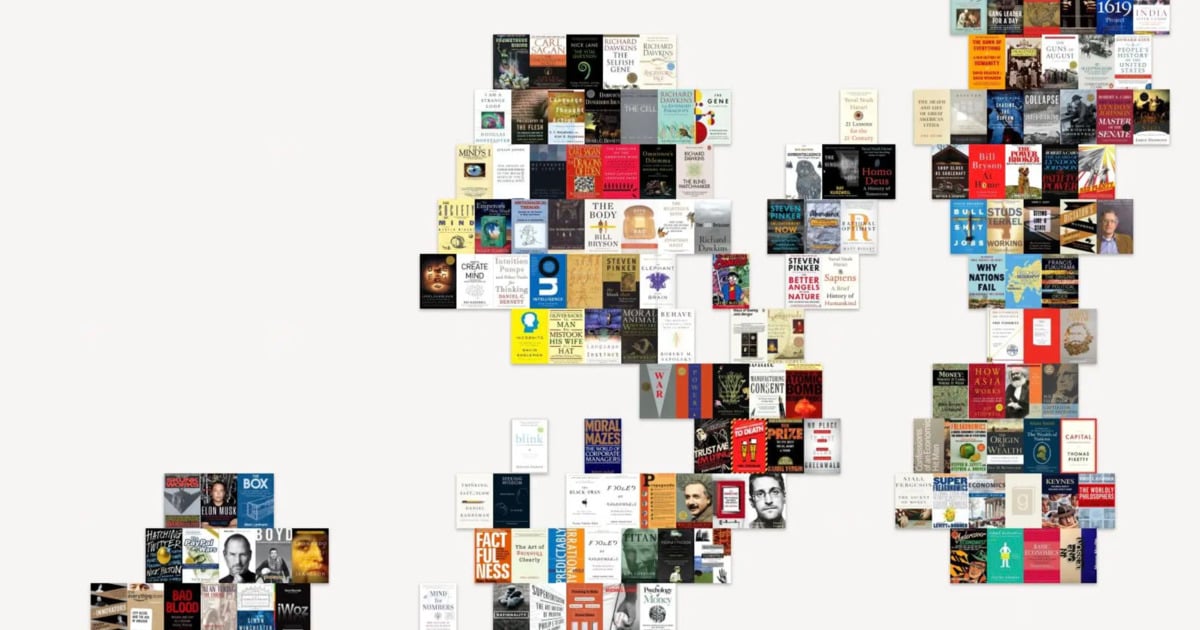
Out of the 1000 most-discussed books on Hacker News, it looks like around 50 of them were written by women.
A Logistical Matter
Just wanted to drop a quick note to say that kottke.org moved servers over the weekend. You shouldn’t have noticed anything, except perhaps that the site is faster now. There was a small issue with the RSS feed after the migration, but that’s been resolved. If you notice anything amiss, drop me a line?
As always, big thanks to the crew at Arcustech for their rock-solid hosting and prompt tech support expertise.

I loved watching this quick video recap of how Penguin designer Elisha Zepeda made the book covers for 10 books that came out in 2025. Zepeda has a much longer look at his process on YT.

Using lidar, scientists discovered a 400-foot-long wall composed of “60 massive granite monoliths, set directly onto the bedrock in pairs at regular intervals”. The wall is 30 feet underwater and was built 7000+ years ago.

words.zip is “an infinite collaborative word search where anyone can find and submit words — no account required.”
There’s a shark called the cookiecutter shark because it leaves bite marks the shape of “neat, circular holes resembling the cut of a cookie cutter”.

Burn Harry Burn: Reckoning With My Harry Potter Fandom as a Trans Person. “I dug a fire pit in my backyard and burned my complete set of hardcover Harry Potters.”

A soaring US vs a stagnant EU? “Europeans benefit from more leisure time than Americans, higher life expectancy & lower inequality levels, all w/ comparable productivity rates. However one looks at it, this is a considerably better economic performance.”

Alexandra Petri: I Tried to Be the Government. It Did Not Go Well. “I have just driven six and a half hours to Ohio in order to forecast my own weather. From a hot-air balloon.” She also inspects milk & does lawn work on National Park land.

What You’re Watching Isn’t What You’re Really Watching. “You think you’re watching an innocent woman being shot and killed in cold blood by the federal government, but what you’re really watching is the death of the United States of America.”
Abolish ICE
Abolish ICE. Abolish ICE. Abolish ICE. Abolish ICE. Abolish ICE. Abolish ICE. Abolish ICE. Abolish ICE. Abolish ICE. Abolish ICE. Abolish ICE. Abolish ICE. Abolish ICE. Abolish ICE. Abolish ICE. Abolish ICE. Abolish ICE. Abolish ICE. Abolish ICE.
An ICE agent murdered a woman in Minneapolis today. Mayor Jacob Frey to ICE: “Get the fuck out of Minneapolis.”

How Did We Map the World Before Satellites?
In 1375, a Spanish mapmaker made a world map we now refer to as the Catalan Atlas. For its time, the atlas was remarkably accurate and comprehensive. This video explains how such a map was made in medieval times. From Open Culture:
The upshot is an answer to the very reasonable question, “how were (sometimes) accurate world maps created before air travel or satellites?” The explanation? A lot of history — meaning, a lot of time. Unlike innovations today, which we expect to solve problems near-immediately, the innovations in mapping technology took many centuries and required the work of thousands of travelers, geographers, cartographers, mathematicians, historians, and other scholars who built upon the work that came before. It started with speculation, myth, and pure fantasy, which is what we find in most geographies of the ancient world.
See also How Leonardo Constructed a Satellite-View Map in 1502 Without Ever Leaving the Ground and The Oldest World Map in the World.
WikiFlix is a streaming site for movies in the public domain, including Metropolis, It’s a Wonderful Life, All Quiet on the Western Front, and Charade.

“South Korea imports more kimchi than it exports, and the gap has widened as cheaper Chinese-made products take hold in the domestic market.”

A group of students at a New Mexico college (mostly) gave up their phones & computers for a week. What did they learn? “Most students said they had gotten to know themselves better without their phones butting in all day long.”

MTV Rewind

MTV Rewind is an interface through which you can watch music videos from the 70s to the 20s, organized by decade. There are also “channels” for 120 Minutes, MTV Unplugged, Yo! MTV Raps, Headbangers Ball, and the first full day of MTV programming.
All of the music videos, more than 33,000 of them, are hosted on YouTube and the lists of videos come from The Internet Music Video Database. Great idea and execution…this is the closest you’ll get to watching MTV back in the 80s.
The proliferation of hummingbird feeders has become a “major evolutionary force” for the Anna’s hummingbird species in the western US. “Over just a few generations, their beaks have dramatically changed in size and shape.”

Lost episodes of Star Trek from the 70s. They were going to do a reboot of the TV series (without Spock!) but the project morphed into the first movie. There are 19 episode scripts & treatments from the project; a few were adapted for ST:TNG.

Robin Sloan asserts (provocatively) that AGI is already here (and has been for a few years). “We’ve got this ubiquitous term, Artificial General Intelligence, & it appears that the Artificial Intelligence has become Really Very General, so … ?”

The Story of Czech Graphic Design
Identity — The Story of Czech Graphic Design is a seven-part series available on YouTube.
In seven parts, the Identita series introduces viewers to the history of Czech graphic design. We will not only explore together the development of the visual face of the Czechoslovak Republic, we will also reveal what is hidden behind the symbols, signs and colors that represent it.
“Norman Rockwell was antifa”, says Daisy Rockwell, Norman’s granddaughter. “So you’ll understand her indignation when President Trump began hijacking her grandfather’s legacy to promote what she considers modern-day fascism.”

A Collection of Unreleased Boards of Canada Tracks
A couple of weeks ago, someone uploaded to YouTube and Google Drive eleven unreleased tracks from Boards of Canada (made from 1985-1996). This seems to be a legit, high-quality leak, judging from the excitement in the YT comments and on Reddit. I’ve heard a couple of these before, courtesy of some long-ago Kazaa/Limewire crate-digging, but most of these are new to me. (via the morning news)
This sucks: the Corporation for Public Broadcasting is no more. “Its board of directors chose Monday to shutter CPB completely instead of keeping it in existence as a shell.” GOP ghouls finally killed it.

The Detectorists — A Short Film About Otters and Detection Dogs.
An ecologist in Wales uses tracking dogs to help track & protect the endangered wild otter population; meet The Detectorists.
Set against the serene backdrop of rural Wales, this short documentary follows wildlife ecologist Lee Jenkins and his two German Pointers — Neo and pup-in-training Cariad — as they search for elusive otters. Using scent detection to guide camera trap placement, the team gathers crucial evidence to protect these endangered animals. Shot from a dog’s-eye view with immersive cinematography, the film offers a poetic glimpse into conservation through the nose and eyes of a canine detective.
Tiled.art: “Discover great tessellation art, understand how it works, and create your own.”

Anna’s Archive (“the largest truly open library in human history”) is backing up the entirety of Spotify. “We have archived around 86 million songs from Spotify. While this only represents 37% of songs, it represents around 99.6% of listens.”

When Two Filmmakers Make the Same Movie — and One of Them Is Werner Herzog. A comparison of the two 2022 documentaries about volcanologists Maurice & Katia Krafft, Herzog’s The Fire Within, and Sara Dosa’s Fire of Love.

From Book Riot’s Zero to Well-Read podcast: How to Read More (and Better) in 2026. “They dig into when to push through, when to quit a book, how to choose books outside the algorithm, and how small shifts in attention can enrich your reading life.”

The Mystery Of The Samurai In Venice
Until the late 19th century, Japan’s relations with Europe were relatively limited. So when a pair of letters written by a Japanese man in the early 1600s were discovered in Venice, a mystery was born. Who was this man, why was he in Italy, and why was there little previous evidence that he’d been there? In part one of a new series, Evan Puschak sets the geopolitical stage and introduces us to the samurai who travelled to Rome to treat with the Pope.
A Year of Clean Energy Milestones. “Wind, solar, and electric vehicles made huge strides globally in 2025. For the first time, wind & solar supplied more power than coal worldwide, while plug-in vehicles accounted for more than 1/4 of new car sales.”

A number of studies show that various vaccines (shingles, RSV, flu) are associated with “off-target” benefits like reduced cardiovascular risk, lower rates of dementia, and lower Alzheimer’s risk for older people.

Why I Left Substack. A combination of “a good deal of gross misogyny, transphobia, and hard-right stuff” plus Substack “trying to deny this responsibility [as a publisher], to pretend that their decisions weren’t decisions at all”.
What We Will Use as Weapons: A List of School Supplies
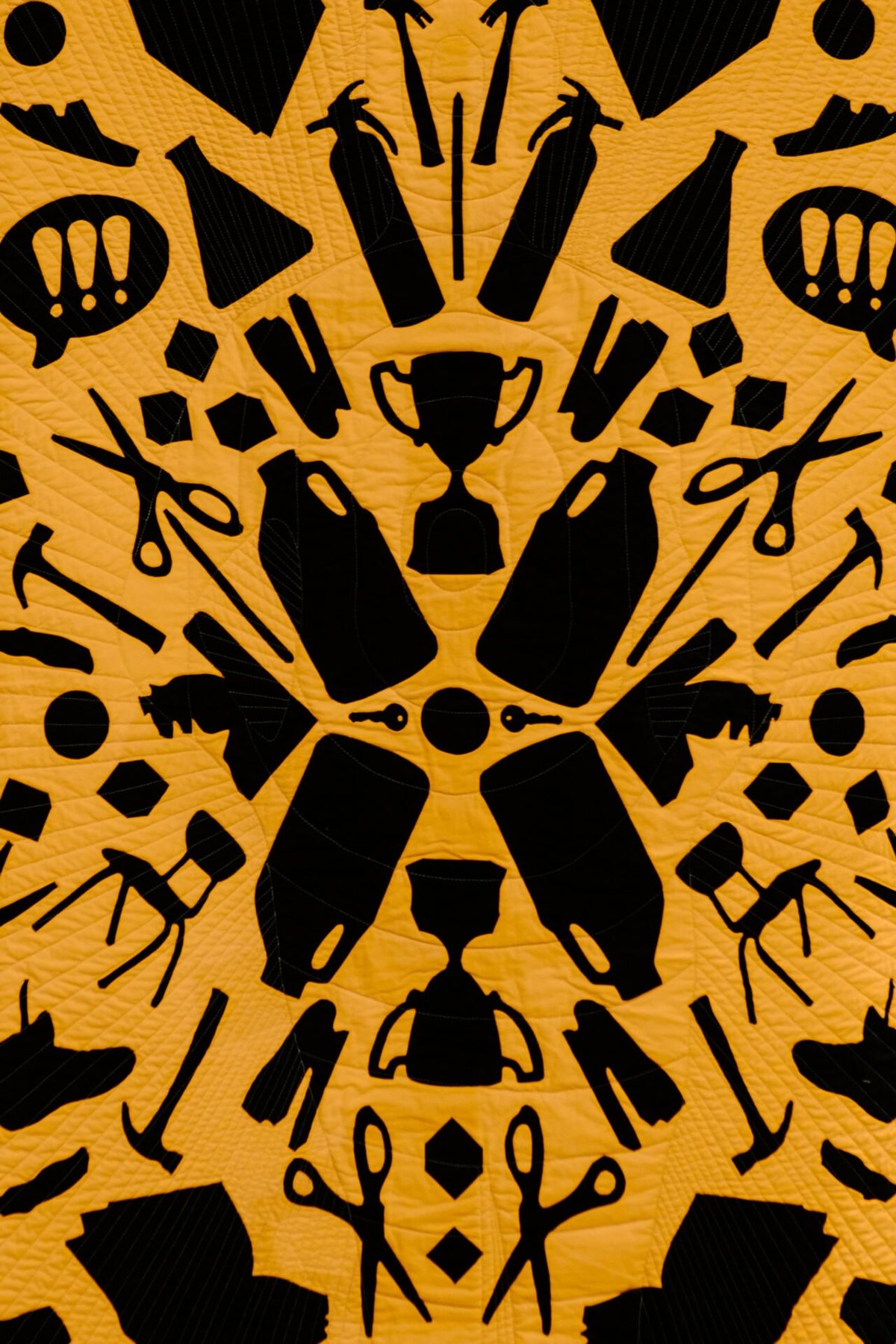
In 2024, schoolteacher Ginny Robinson won the Best in Show award at a quilting convention for her quilt called What We Will Use as Weapons: A List of School Supplies.
This is a protest quilt. It was made by an artist whose day job puts her on the front lines of one of the most grotesque realities in America today. She is a teacher.
What We Will Use as Weapons: A List of School Supplies is the title for this provocative work of art that features school supplies hurling toward the center on the front and an assault rifle on the back. This long, narrow quilt is the actual size and shape of a door. An outline of a human is stitched through the layers. On the front, the person is meant to represent a shooter, and on the reverse side, a teacher.
Robinson’s quilt is now part of the collection at the International Quilt Museum.
M. Gessen on the new world order the Trump regime seems eager to bring about. “If Trump can take Venezuela and Putin can take Ukraine, surely President Xi Jinping of China can take Taiwan.”

The Media Refuses to Call Trump’s Venezuela Attack an Act of War. “Overwhelmingly, the US media and its purportedly straight reporters have adopted wholesale the White House’s pseudo-legalistic, limited framework of an ‘operation’ to ‘arrest’ Maduro.”

We Are the Bad Guys. “What do we call it when a stronger person decides to rob a weaker person because he can? It is just gangsterism. We are the most dangerous gangsters in the world today.”

Isaac Chotiner interviews Oona Hathaway, an expert in international law, about the “brazen illegality” of the Trump regime’s invasion of Venezuela to kidnap president Nicolás Maduro.

Socials & More