Entries for November 2016

The tire tracks in this parking lot make a tree pattern in the snow, a self-producing infographic of the cars’ collective pathway to their parking spaces. It’s fun to trace individual tracks — I’m fascinated by the one that comes in, starts right, turns back to the left, then heads back down before turning toward the left again into a space.
The photo was taken in a Shell Centre parking lot near Waterloo Station in 1963. Photographer unknown. (via @robnitm)
Update: Nicholas Felton shared an annotated single-car version of a car’s tracks in the snow.
Update: A reader randomly picked up a copy of a book recently called The World From Above, “a pretty brilliant collection of aerial photographs, mostly black and white, published in the mid 60’s” and the parking lot photo was in it. No photographer listed, but the photo is credited to dpa, the German Press Agency. (thx, david)
A company called Intralox makes omni-directional conveyor belts than can push objects in any direction, which allows for some unique capabilities.
If I had access to a time machine, I’d love to fetch Henry Ford and a few other assembly line innovators from the past and watch their reactions to these conveyor systems. (via @ThomasintVeld)
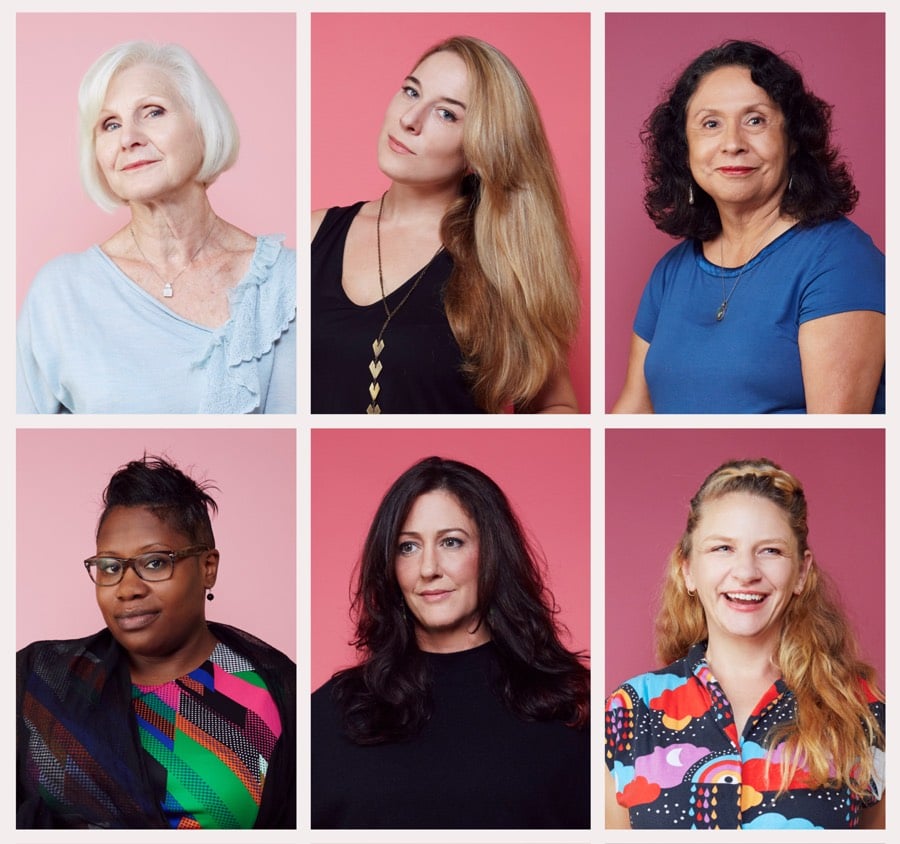
Photographer Helena Price, who you may recall from the Techies project earlier this year, has created a project called The Pussy Project about “women’s perspectives on the significance of this election and its ramifications on society.”. Photos of women are paired with each person’s thoughts on the election. Price explains how the project came about on Medium:
The name is a trigger for all of us. For many it represents the moment in the Trump campaign that incited so many women to finally get angry, get involved and speak out. That shift — the sudden activation of women across America to vocalize their feelings about this election — is what I set out to explore with this project.
Happy to see several women I know and admire interviewed for this…plus Jessica Hische did the logo and Maggie Mason edited the interviews.
On Conan last night, Louis C.K. had some things to say about the 2016 presidential election.
If you vote for Hillary you’re a grownup; if you vote for Trump you’re a sucker; if you don’t vote for anyone, you’re an asshole.
If you are a regular reader and appreciate what I do here, please support kottke.org by purchasing an annual membership. It only takes a minute (or about 20 seconds on iOS w/ Apple Pay) and your collective support will mean a lot to the future of kottke.org. This has been in the works for a while now and I have a lot to say about it, but go check it out first, subscribe, and then come back. I’ll wait.
All set? Ok. A couple of recent catalysts have set this into motion, but I’ve been thinking about it for the last few years. So here’s why I feel this is necessary now, in four interconnected main points.
Focus on dedicated readers. Anyone who relies on an audience of some kind — artists, writers, businesses, etc. — has to focus on serving regulars while keeping an eye on attracting new readers/customers/users. As much as I feel that everyone in the world would enjoy reading the world’s best blog — I mean, who wouldn’t? — it’s difficult for me to take time out from writing the site to reach out to potential new readers.1 I love being a regular myself and at this point in the site’s evolution, it makes sense to focus mostly on the people who read and love the site. Part of that focus is building up the financial link between us. In an ideal world: I write for you, you pay me, I write some more. No middlemen. I’m not sure that’s an entirely feasible arrangement at this point, but we can get part of the way there and work on the rest.
Revisiting an old idea. Some of you may remember that I’ve asked for support directly from readers before.2 A few months ago, I went out to lunch with Tim Urban from Wait But Why. We’d hardly said hello when he said something like “my goal for this lunch is by the end of the meal, you’ll agree to ask your readers to financially support kottke.org”. Tim was very clear that asking his readers for support on Patreon had been game-changing for his site. Project creators and potential backers have become comfortable with directly funding creative efforts online, particularly through Kickstarter & Patreon and I’m curious to see how it works for kottke.org in 2016.3
A changed media landscape. It’s been 11+ years since I quit my job to do kottke.org full-time. Online media has changed a lot since then. Hell, it’s changed a lot in the past few years. Blogs are dead — long live blogs! — and the open web is struggling. If you ask around to the creators of other established independent sites on the web (and I have talked to many of them), you’ll hear that traffic and display ad revenue have been falling for the last few years. Many factors have contributed — Facebook, readers switching to mobile, the rise of apps, social overtaking search for discovery, ad blockers, Google Reader’s shutdown, VC money flooding into online media — and smaller sites without dedicated content marketing and mobile/social development teams can’t keep up. Other strategies are necessary.
Diversification. The site currently has two main sources of revenue: advertising via The Deck & the We Work Remotely job board and affiliate income from Amazon & iTunes. In an effort to diversify revenue, I’ve tried several things — RSS sponsorships, sponsored posts for Kickstarter projects, consulting for startups, and speaking — and none of them have stuck. I’ve thought about writing a book, putting on a conference, or doing a podcast. But that all feels like it’s beside the point and not what I really want to do, which is just to write here, for you. A recent (hopefully temporary) hiccup in one of these revenue sources4 has driven home the need for not putting all my eggs in one basket. I would love for reader support to become a healthy third leg on the ol’ revenue stool.
I could go on — and in several previous drafts, boy, did I! — but here’s what it boils down to for me: I’m proud of what I’ve built here at kottke.org over the past 18 years and I’m committed to publishing here regularly and operating independently as long as I am able. Even though the site is primarily a one-person operation, I’ve never done it alone. You have always been an essential part of this site — providing me with feedback, counsel, encouragement, pushback, and many great links and ideas for posts — and I’d love your help in taking this next step. As always, thanks for reading and thanks for the support!
Stanford biophysicist Manu Prakash is the inventor of the Foldscope, a small microscope that folds like origami, costs around a dollar, and provides “700 nanometer imaging”. Watch the video for examples — 700 nm is very small and the level of detail is incredible. Why do this? Prakash says:
It’s not just for scientists to figure out how the world works…We all start by being curious about the world. We are born with this and we really need to culture this, because fundamentally curiosity needs to be nurtured and kept alive forever.
You can read more about the Foldscope at the New Yorker or watch Prakash’s TED Talk.
He calls it the Foldscope, and it comes in a kit. (Mine arrived in a nine-by-twelve-inch envelope.) The paper is printed with botanical illustrations and perforated with several shapes, which can be punched out and, with a series of origami-style folds, woven together into a single unit. The end result is about the size of a bookmark. The lens — a speck of plastic, situated in the center — provides a hundred and forty times magnification. The kit includes a second lens, of higher magnification, and a set of stick-on magnets, which can be used to attach the Foldscope to a smartphone, allowing for easy recording of a sample with the phone’s camera. I put my kit together in fifteen minutes, and when I popped the lens into place it was with the satisfaction of spreading the wings of a paper crane.
You can’t currently buy a Foldscope but the website says that their Kickstarter campaign launches sometime this month, so stay tuned for that.
Update: You can now get your very own Foldscope on Kickstarter.
Photographer and filmmaker Mike Olbinski shot 85,000 frames at 8K resolution to make this 7-minute time-lapse film of storms of all shapes and sizes doing their thing. Just slip on the headphones, put the video on fullscreen, and then sit back & watch. A tonic for these troubled times. (via slate)
Andy Baio has redesigned his long-running blog Waxy.
After 14 years of blogging, I switched from MovableType to WordPress. The design is finally responsive, though pretty minimalist for now with lots of rough edges. It took some effort, but I preserved the links to everything I’ve ever written — 472 posts and 15,891 links.
In his post about the redesign, he notes why he still continues to publish on his own site:
Ultimately, it comes down to two things: ownership and control.
Last week, Twitter announced they’re shutting down Vine. Twitter, itself, may be acquired and changed in some terrible way. It’s not hard to imagine a post-Verizon Yahoo selling off Tumblr. Medium keeps pivoting, trying to find a successful revenue model. There’s no guarantee any of these platforms will be around in their current state in a year, let alone ten years from now.
Here, I control my words. Nobody can shut this site down, run annoying ads on it, or sell it to a phone company. Nobody can tell me what I can or can’t say, and I have complete control over the way it’s displayed. Nobody except me can change the URL structure, breaking 14 years of links to content on the web.
I might have said “freedom” instead of “control” but there’s some hard nodding from me right here. I’d also add something about the freedom to pursue revenue in whatever way you want. Publishing on YouTube or Facebook or Medium or Instagram or Twitter limits how you can do that.
But given the state of the open web these days, Andy rightly notes that going it alone is much more difficult now than it used to be:
But the ecosystem for independent publications is fundamentally broken. Getting discovered, building a readership, and profiting from your work as an independent writer are all much, much harder than they used to be.
I also have lots of thoughts about this, and I’m glad Andy has decided to join me in sticking it out and remaining independent. Waxy is one of my favorite sites in the world and I’m happy to see it looking so smart this morning.
Newer posts




Socials & More