kottke.org posts about working
Dan Pink argues that businesses should engage their employees’ third drive, our “inherent tendency to seek out novelty and challenges, to extend and exercise their capacities, to explore and to learn”.
Management is the ideal technology if you’re seeking compliance — getting people to do what you want them to do, the way you want them to do it. But in today’s workforce, which demands much more in the way of creative and conceptual capabilities, we don’t want compliance. We want engagement. And self-direction is a far better technology for engagement.
(via bobulate)
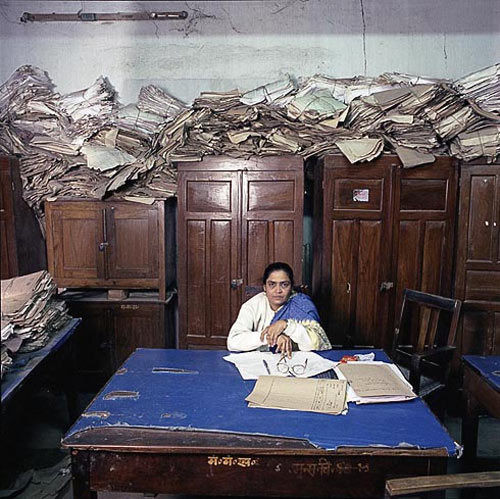
From Jan Banning’s series entitled Bureaucratics.
Career advice from Charlie Hoehn:
Therein lies the best career advice I could possibly dispense: just DO things. Chase after the things that interest you and make you happy. Stop acting like you have a set path, because you don’t. No one does. You shouldn’t be trying to check off the boxes of life; they aren’t real and they were created by other people, not you. There is no explicit path I’m following, and I’m not walking in anyone else’s footsteps. I’m making it up as I go.
People throw away thousands of losing tickets at off-track betting parlors every day. Except that some of those losing tickets are actually winners. This is where the stoopers come in.
For the past 10 years, Jesus Leonardo has been cleaning up at an OTB parlor in Midtown Manhattan, cashing in, by his own count, nearly half a million dollars’ worth of winning tickets from wagers on thoroughbred races across the country. “It is literally found money,” he said on a recent night from his private winner’s circle. He spends more than 10 hours a day there, feeding thousands of discarded betting slips through a ticket scanner in a never-ending search for someone else’s lost treasure.
How Aaron Swartz hires programmers.
To find out whether someone’s smart, I just have a casual conversation with them. I do everything I can to take off any pressure off: I meet at a cafe, I make it clear it’s not an interview, I do my best to be casual and friendly. Under no circumstances do I ask them any standard “interview questions” — I just chat with them like I would with someone I met at a party. (If you ask people at parties to name their greatest strengths and weaknesses or to estimate the number of piano tuners in Chicago, you’ve got bigger problems.) I think it’s pretty easy to tell whether someone’s smart in casual conversation. I constantly make judgments about whether people I meet are smart, just like I constantly make judgments about whether people I see are attractive.
(via df)
In The Gervais Principle, Or The Office According to “The Office” and the followup The Gervais Principle II: Posturetalk, Powertalk, Babytalk and Gametalk, Venkatesh Rao dissects and analyzes the American version of The Office to a degree I hadn’t thought was possible.
After four years, I’ve finally figured the show out. The Office is not a random series of cynical gags aimed at momentarily alleviating the existential despair of low-level grunts. It is a fully-realized theory of management that falsifies 83.8% of the business section of the bookstore.
Even if you’re only an occasional viewer of the show, this is worth reading through, especially if you work in an office environment. (thx, zach)
Some folks from the web magazine Double X wondered what it would be like to drink as much in the workplace as the characters do on Mad Men. So they spent the day getting hammered and tried to do some work. The results are somewhat different than on the show.
Every seven years, Stefan Sagmeister closes his design studio for a year of focused R&D.
Every seven years, designer Stefan Sagmeister closes his New York studio for a yearlong sabbatical to rejuvenate and refresh their creative outlook. He explains the often overlooked value of time off and shows the innovative projects inspired by his time in Bali.
So says Caterina Fake:
We agreed that a lot of what we then considered “working hard” was actually “freaking out”. Freaking out included panicking, working on things just to be working on something, not knowing what we were doing, fearing failure, worrying about things we needn’t have worried about, thinking about fund raising rather than product building, building too many features, getting distracted by competitors, being at the office since just being there seemed productive even if it wasn’t — and other time-consuming activities. This time around we have eliminated a lot of freaking out time. We seem to be working less hard this time, even making it home in time for dinner.
I would likely give the same advice, but I wonder if it’s actually true. Perhaps working hard/freaking out was exactly what was needed at the time, whether or not it seems efficient or correct in retrospect. You need to travel that road so you can find a better way the second time around.
That was the question asked over on Clusterflock, with the following anecdote offered as a starter:
I increased [my boss’s] sugar intake by one spoon at a time and generally left a couple of days in between changes. I kept going until I was bored. I guess part of me wanted her to notice, but she never did. Not even the amount of sugar we were getting through. Anyway, I eventually got her up to 23 spoons of sugar in a cup of tea — yeah, 23! She never said a word and always finished the cup.
Reminds me of some of the stuff that Jim does to Dwight on The Office. At my first job out of college, some coworkers of mine and I found a Mac OS extension that decreased the size of the screen by a pixel or two each time the computer booted. I don’t think we ever installed it on anyone’s computer; just imagining the reaction was good enough.
Paul Graham on the difference between the “maker’s schedule” and the “manager’s schedule”.
When you’re operating on the maker’s schedule, meetings are a disaster. A single meeting can blow a whole afternoon, by breaking it into two pieces each too small to do anything hard in. Plus you have to remember to go to the meeting. That’s no problem for someone on the manager’s schedule. There’s always something coming on the next hour; the only question is what. But when someone on the maker’s schedule has a meeting, they have to think about it.
Graham is right on about this.
Update: Gina Trapani adds:
As a freelancer, I get lots of requests to “grab coffee” (as Graham describes) with folks who are just interested in seeing if working together is a possibility. Whenever that happens, my heart sinks. If I’m on deadline or deep in a programming project, grabbing coffee midday with someone I don’t know and might not have any good business reason to talk to changes the tenor of the entire day. When I can, I usually I turn down these types of speculative meetings because the costs are too high-but I always feel bad about it, and never know how to word my response. (Generally I say, “Sorry I’m just too busy.”)
A common misconception about freelancers is that they can do whatever they want whenever they want, but that’s not actually true if you want to get anything done. Large chunks of uninterrupted time is the only thing that works.
CNNMoney tells us about seven great companies to work for. For instance, a Colorado brewing company gives their employees free beer and company ownership.
After one year of work, each employee receives an ownership stake in the company and a free custom bicycle. After five years every employee enjoys an all-expenses-paid trip to Belgium — the country whose centuries-old beer tradition serves as a model for the Fort Collins, Colo., brewery. Oh yeah, and employees get two free six-packs of beer a week.
Tyler Cowen on how to keep your job. Click through to see which of the following is most effective:
1. Make your boss aware of all your recent accomplishments at work.
2. Butter up your boss with compliments.
3. Tell your boss you’d be willing to accept a pay cut to keep your job.
Cliff Kuang traces the evolution of office designs from the open factory-like floors of Frederick Taylor to the present era of semi-private pods.
Scott Berkun shares how great managers get that way.
8. Self aware, including weaknesses. This is the kicker. Great leaders know what they suck at, and either work on those skills or hire people they know make up for their own weaknesses, and empower them to do so. This tiny little bit of self-awareness makes them open to feedback and criticism to new areas they need to work on, and creates an example for movement in how people should be growing and learning about new things.
(via world airmail links)
Newer posts
Older posts





Socials & More