




Advertise here with Carbon Ads

This site is made possible by member support. 💞

Big thanks to Arcustech for hosting the site and offering amazing tech support.

When you buy through links on kottke.org, I may earn an affiliate commission. Thanks for supporting the site!

kottke.org. home of fine hypertext products since 1998.

Beloved by 86.47% of the web.

🍔  💀  📸  😭  🕳️  🤠  🎬  🥔

kottke.org posts about working

Working in solitude on the decline

Susan Cain argues that the lack of privacy and freedom from interruption in modern offices might not be the best way for those office employees to be creative…particularly for introverts.

The New Groupthink has overtaken our workplaces, our schools and our religious institutions. Anyone who has ever needed noise-canceling headphones in her own office or marked an online calendar with a fake meeting in order to escape yet another real one knows what I’m talking about. Virtually all American workers now spend time on teams and some 70 percent inhabit open plan offices, in which no one has “a room of one’s own.” During the last decades, the average amount of space allotted to each employee shrank 300 square feet, from 500 square feet in the 1970s to 200 square feet in 2010.

The new offices of Foursquare and Buzzfeed (where I work from) are a perfect example of the New Groupthink Cain refers to….rows and rows of people sitting next to each other in open spaces. Much of this is because of NYC’s insane rental market, but Fog Creek’s offices are a nice counterexample:

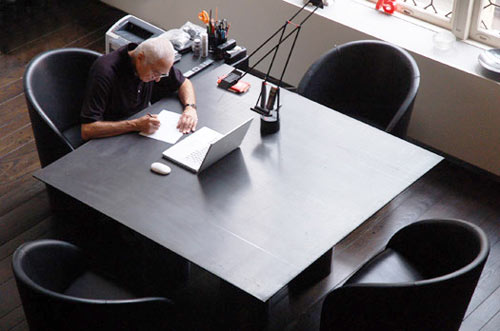
Every developer, tester, and program manager is in a private office; all except two have direct windows to the outside (the two that don’t get plenty of daylight through two glass walls).
Fave · 0

Job misunderstandings

The Atlantic asked their readers to tell them what other people don’t get or appreciate about their jobs. Here’s what they said, from Army Soldier to Zookeeper.

What people don’t understand about my job [as an IRS employee] is that chances are you are not the person I’m examining. I examine doctors who expense three Cadillacs, insurance brokers who claim jet skis for business use only, and real estate agents who haven’t paid taxes in eight years. The public doesn’t realize that tax auditors are the only people between a balanced effective tax rate among all social classes and the bourgeoisie stealing what isn’t bolted down. Don’t kid yourself; these people are stealing from you. This money helps pay for schools, roads and with any luck can keep mortgage interest deduction alive for a few more years. I read a report on NPR that Italy has 40% of its population evading taxes. Imagine our debt crisis if we had the same problem. (Our tax evasion rate is estimated between 8-18%).

So if you’re one of those “Joe the Plumber” people who take time out of work to throw teabags at me on my way into the office in the morning: You are the middle class! I’m helping you!

(thx, jonathan)

Fave · 0

Beyond the cubicle

Allison Arieff argues that companies and their workers should worry less about office design and focus more on how people want to work.

Two other factors often undervalued (and often ignored) in the workplace? Family and time. Architect Iris Regn and artist Rebecca Niederlander have been working to bring these into the conversation by exploring the intersection between creativity and family life in an ongoing collaborative effort they call Broodwork.

Don’t be put off by the awkward name. Broodwork suggests that, far from being the hindrance it’s often presented as, incorporating family into work can have overwhelmingly positive effects. Regn is trained as an architect but is open enough in her thinking to understand that in the scheme of things, the adjustability of her desk isn’t going to have an impact on her creative process nearly as much as what her daughter might say tonight at the dinner table.

“The first impetus [of Broodwork] was to get people to acknowledge interweaving of creative practice and family life,” she told me. “Not to have to hide [your family] when you have to go pick up your kid while at a meeting, for example. That raised eyebrow is going away. Yes, you’re juggling. That’s just part of the deal. When you talk to other parents, everyone knows the deal so why is it that in a professional setting that can’t be brought to the table?

Fave · 0

Google’s unusual job interview question

I feel like I’ve heard this before, but in the early days of Google, Sergey Brin ended his job interviews in an unusual manner.

Finally, he leaned forward and fired his best shot, what he came to call “the hard question.”

“I’m going to give you five minutes,” he told me. “When I come back, I want you to explain to me something complicated that I don’t already know.” He then rolled out of the room toward the snack area. I looked at Cindy. “He’s very curious about everything,” she told me. “You can talk about a hobby, something technical, whatever you want. Just make sure it’s something you really understand well.”

I wonder if Mark Zuckerberg asks similar sorts of questions on his walks in the woods.

Fave · 0

Crazy job interview questions

CBS MoneyWatch recently posted a list of unusual questions asked in job interview at companies like Google, Facebook, and Pottery Barn. Over at The Morning News, Giles Turnbull decided to answer them all.

UBS: If we were playing Russian roulette and had one bullet, I randomly spun the chamber and fired but nothing was fired. Would you rather fire the gun again or respin the chamber and then fire on your turn?

I’d rather get the fuck out of your office and run away very fast. What the hell are you people on? Haven’t you heard of email? Or official dispute procedures? Jesus.

Based on his answer to P&G’s “sell me an invisible pen”, I’d hire Turnbull in a second if I were selling invisible pens.

Fave · 0

Playboy Bunny manual

Here’s a Playboy Bunny employee manual from 1969.

Bunnies must allow enough time before going to their assigned rooms to report to the Bunny Mother for appearance inspection. The Bunnies’ hair, nails, shoes, makeup and costume must be “Bunny-perfect” and no Bunny is permitted to begin working unless appearance specifications are met. Demerits may be issued for carelessness in this regard. When the Bunny reports to her scheduled room, the Room Director, too, will note her appearance and suggest improvements if necessary.

NSFW if having “PLAYBOY BUNNY” on your screen in huge pink letters is not safe in your workplace.

Fave · 0

Pit crews and not cowboys needed in hospitals

In his recent commencement address at Harvard Medical School, Atul Gawande argued that medical practitioners need to shift from thinking of themselves as cowboys to thinking of themselves as pit crews.

Two million patients pick up infections in American hospitals, most because someone didn’t follow basic antiseptic precautions. Forty per cent of coronary-disease patients and sixty per cent of asthma patients receive incomplete or inappropriate care. And half of major surgical complications are avoidable with existing knowledge. It’s like no one’s in charge-because no one is. The public’s experience is that we have amazing clinicians and technologies but little consistent sense that they come together to provide an actual system of care, from start to finish, for people. We train, hire, and pay doctors to be cowboys. But it’s pit crews people need.

Fave · 0

Tech startup CEO has no idea what he’s doing

Ben Pieratt is the CEO of Svpply, a social shopping startup. He recently wrote a great post subtitled “I have no idea what I’m doing” that reveals the rarely seen flipside to the macho show-no-weakness tech startup scene.

My situation is blessed and I rarely let a day go by that I don’t say a silent prayer in thanks for the position in which I’ve found myself, but good gracious is this hard.

The most frustrating part is that it is difficult to get into a rhythm in your work when you have no real understanding of the next steps you need to take. There’s no opportunity for flow if both outcome and process are foreign experiences. There’s just a lot of poking around and mystery and inadvertent negligence.

Svpply has been open to the public for six months now. Our progress has been slow for a variety of reasons. We have not launched as many new features as I would expect, or even drastically improved the ones we launched with. I own these problems, they can be traced directly back to my inabilities and inexperience, sometimes directly, other times in the form of my not having anticipated or recognized situations for what they were as soon as I could have.

Fave · 0

When nothing else works, try this

From Dale Carnegie’s How to Win Friends and Influence People (found here), an anecdote about how Charles Schwab wordlessly motivated the workers in one of his steel mills.

Charles Schwab had a mill manager whose people weren’t producing their quota of work.

“How is it,” Schwab asked him, “that a manager as capable as you can’t make this mill turn out what it should?”

“I don’t know,” the manager replied. “I’ve coaxed the men, I’ve pushed them, I’ve sworn and cussed, I’ve threatened them with damnation and being fired. But nothing works. They just won’t produce.”

This conversation took place at the end of the day, just before the night shift came on. Schwab asked the manager for a piece of chalk, then, turning to the nearest man, asked: “How many heats did your shift make today?”

“Six.”

Without another word, Schwab chalked a big figure six on the floor, and walked away.

When the night shift came in, they saw the “6” and asked what it meant.

“The big boss was in here today,” the day people said.

“He asked us how many heats we made, and we told him six. He chalked it down on the floor.”

The next morning Schwab walked through the mill again. The night shift had rubbed out “6” and replaced it with a big “7.”

When the day shift reported for work the next morning, they saw a big “7” chalked on the floor. So the night shift thought they were better than the day shift did they? Well, they would show the night shift a thing or two. The crew pitched in with enthusiasm, and when they quit that night, they left behind them an enormous, swaggering “10.” Things were stepping up.

Shortly this mill, which had been lagging way behind in production, was turning out more work than any other mill in the plant.

The principle?

Let Charles Schwab say it in his own words: “The way to get things done,” says Schwab, “is to stimulate competition. I do not mean in a sordid, money-getting way, but in the desire to excel.”

The desire to excel! The challenge! Throwing down the gauntlet! An infallible way of appealing to people of spirit.

(thx, marko)

Fave · 0

Winning at the game of money

James Somers noticed that his equity derivative-trading roommate was the only one of his young professional friends who comes home from work “buoyant and satisfied”, so he accompanied him to work one day to see what his job entailed. Turns out he basically plays video games all day.

A trader’s job is to be smarter than the market. He converts a mess of analysis and intuition into simple bets. He makes moves. If his predictions are better than everyone else’s, he wins money; if not, he loses it. At every moment he has a crystalline picture of his bottom line, the “P and L” (profit and loss) that determines how much of a bonus he’ll get and, more importantly, where he stands among his peers. As my friend put it, traders are “very, very, very competitive.” At the end of the day they ask each other “how did you do today?” Trading is one of the few jobs with an actual leaderboard, which, if you’ve ever been on one, or strived to get there, you’ll recognize as being perhaps the single most powerful driver of a gamer’s engagement.

That seems to be the core of it, but no doubt there are other game-like features in play here: the importance of timing and tactile dexterity; the clear presence of two abstract levels of attention and activity, one long-term and strategic, the other fiercely tactical, localized in bursts a minute or two long; the need for teams and ceaseless chatter; and so on.

Athleticism and competitiveness are often downplayed when we talk about white collar careers but are essential in many disciplines. Doctors (surgeons in particular) have both those traits, founding a startup company is definitely competitive and can be as physically demanding as running, teachers are standing or walking all day long, and even something like programming requires manual dexterity with the mouse & keyboard and the stamina to sit in a chair paying single-minded attention to a task for 10-12 hours a day. (via @tcarmody)

Fave · 0

A short film about desks

From Imaginary Forces, a short documentary about the desks of creative people.

We talked to experts Alice Twemlow, Eric Abrahamson, Massimo Vignelli, David Miller, Kurt Andersen, Soren Kjaer, Alfred Stadler, Jennifer Lai, and Ben Bajorek and creates an historical and relevant film about the relationship between the worker and the desk and how this reflects on personality and habits.

I too love Massimo Vignelli’s desk.

Massimo Vignelli's desk

Fave · 0

For some people, work is personal

From Ben Pieratt’s blog, In praise of quitting your job.

I think it comes down to the fact that, for some people, work is personal. Personal in the same way that singing or playing the piano or painting is personal.

As a creative person, you’ve been given the ability to build things from nothing by way of hard work over long periods of time. Creation is a deeply personal and rewarding activity, which means that your Work should also be deeply personal and rewarding. If it’s not, then something is amiss.

Creation is entirely dependent on ownership.

Ownership not as a percentage of equity, but as a measure of your ability to change things for the better. To build and grow and fail and learn. This is no small thing. Creativity is the manifestation of lateral thinking, and without tangible results, it becomes stunted. We have to see the fruits of our labors, good or bad, or there’s no motivation to proceed, nothing to learn from to inform the next decision. States of approval and decisions-by-committee and constant compromises are third-party interruptions of an internal dialog that needs to come to its own conclusions.

Fave · 0

Hunter S. Thompson’s unusual job request

In 1958, Hunter S. Thompson sent a job request to the editor of the Vancouver Sun. Like much of Thompson’s writing, it was unconventional.

By the time you get this letter, I’ll have gotten hold of some of the recent issues of The Sun. Unless it looks totally worthless, I’ll let my offer stand. And don’t think that my arrogance is unintentional: it’s just that I’d rather offend you now than after I started working for you.

I didn’t make myself clear to the last man I worked for until after I took the job. It was as if the Marquis de Sade had suddenly found himself working for Billy Graham. The man despised me, of course, and I had nothing but contempt for him and everything he stood for. If you asked him, he’d tell you that I’m “not very likable, (that I) hate people, (that I) just want to be left alone, and (that I) feel too superior to mingle with the average person.” (That’s a direct quote from a memo he sent to the publisher.)

Nothing beats having good references.

Fave · 0

Decoupling with the iPad

This is exactly why I bought an iPad:

In this profession, it’s critical to have a break-out area where you can think without the computer looking over your shoulder; where you can do your most valuable work without the siren song of an IDE. For the same reason that getting up and even walking to the bathroom can provide new perspective on a heretofore intractable problem, it’s in your own best professional interests to do as much of your work as possible before you handcuff yourself to your desk each day.

And:

The potential of iPad is to decouple as many tasks as possible from my work environment — and to keep me away from that environment when I’m doing things that don’t actually require me to be there other than to use a computer.

I do a lot of reading and light writing for this site and I’m hoping that the iPad will allow me to do that somewhere that’s not my desk. At least for a few hours a week. (via jb)

Fave · 0

Finding awesome jobs

Kevin Fanning has worked in HR for the past 9 years so he’s dispensed a lot of job search advice to friends over the years. Now he’s collected all that knowledge into a new book called Let’s All Find Awesome Jobs.

Whenever someone I knew was engaged in a job search, I would do whatever I could to be helpful. Tell them about the mistakes I’d seen, tell them what common pitfalls to avoid. They said my feedback was helpful, so I started writing it down. I collected it into a PDF that circulated amongst my friends for a few years. I kept adding to it, and eventually it became this book.

Eight bucks via Paypal. See also Job Interview Questions I Hope They Don’t Ask Tomorrow and A Great Job Opportunity.

Fave · 0