kottke.org posts about politics
Kanye West has a new solo album coming out soon (as well as a collaborative album with Kid Cudi) and so has been out in the world saying things, things like expressing his admiration for Donald Trump and suggesting that slavery was a choice. In a piece at The Atlantic, Ta-Nehisi Coates, an admitted fan of his music, writes that West’s search for white freedom — “freedom without consequence, freedom without criticism, freedom to be proud and ignorant” — is troubling.
Nothing is new here. The tragedy is so old, but even within it there are actors — some who’ve chosen resistance, and some, like West, who, however blithely, have chosen collaboration.
West might plead ignorance — “I don’t have all the answers that a celebrity is supposed to have,” he told Charlamagne [Tha God]. But no citizen claiming such a large portion of the public square as West can be granted reprieve. The planks of Trumpism are clear — the better banning of Muslims, the improved scapegoating of Latinos, the endorsement of racist conspiracy, the denialism of science, the cheering of economic charlatans, the urging on of barbarian cops and barbarian bosses, the cheering of torture, and the condemnation of whole countries. The pain of these policies is not equally distributed. Indeed the rule of Donald Trump is predicated on the infliction of maximum misery of West’s most ardent parishioners, the portions of America, the muck, that made the god Kanye possible.
Coates suggests that Kanye, also like Trump, has been telling us who he is all along:
Everything is darker now and one is forced to conclude that an ethos of “light-skinned girls and some Kelly Rowlands,” of “mutts” and “thirty white bitches,” deserved more scrutiny, that the embrace of a slaveholder’s flag warranted more inquiry, that a blustering illiteracy should have given pause, that the telethon was not wholly born of keen insight, and the bumrushing of Taylor Swift was not solely righteous anger, but was something more spastic and troubling, evidence of an emerging theme — a paucity of wisdom, and more, a paucity of loved ones powerful enough to perform the most essential function of love itself, protecting the beloved from destruction.
As I said recently in the newsletter and in my media diet post for March, I’ve been listening to the audiobook of Consider the Lobster, David Foster Wallace’s 2005 collection of nonfiction. Each story I listen to is somehow been better than the last, and Wallace’s piece on John McCain’s failed run for the Republican nomination in 2000 was no exception. You can the as-published article in Rolling Stone, but it’s worth seeking out the much longer unabridged version in Consider the Lobster or stand-alone in McCain’s Promise.
While the piece is a time capsule of circa 2000 Republican politics — which politics seem totally quaint by today’s standards; for instance, Wallace describes McCain as one of the most right-wing members of Congress — what makes it so great and relevant is the timelessness of Wallace’s conclusions about politics, why politicians run, why people vote (and don’t vote), and why anyone should care about all of this in the first place.
There are many elements of the McCain2000 campaign — naming the bus “Straight Talk,” the timely publication of Faith of My Fathers, the much-hyped “openness” and “spontaneity” of the Express’s media salon, the message-disciplined way McCain thumps “Always. Tell you. The truth” — that indicate that some very shrewd, clever marketers are trying to market this candidate’s rejection of shrewd, clever marketing. Is this bad? Or just confusing? Suppose, let’s say, you’ve got a candidate who says polls are bullshit and totally refuses to tailor his campaign style to polls, and suppose then that new polls start showing that people really like this candidate’s polls-are-bullshit stance and are thinking about voting for him because of it, and suppose the candidate reads these polls (who wouldn’t?) and then starts saying even more loudly and often that polls are bullshit and that he won’t use them to decide what to say, maybe turning “Polls are bullshit” into a campaign line and repeating it in every speech and even painting Polls Are Bullshit on the side of his bus….Is he a hypocrite? Is it hypocritical that one of McCain’s ads’ lines South Carolina is “Telling the truth even when it hurts him politically,” which of course since it’s an ad means that McCain is trying to get political benefit out of his indifference to political benefits? What’s the difference between hypocrisy and paradox?
That’s just one of the many passages that reminded me of the 2016 election and the appeal to voters of Donald Trump and Bernie Sanders (and also of a certain Barack Obama in 2008 & 2012) but also makes you think deeply about how and why millions of people decide to put their support and faith and trust into a single person to represent their interests and identity in our national government.
See also Why’s This So (Damn) Good (and Topical)? David Foster Wallace and “McCain’s Promise”.
You might remember Yale historian Timothy Snyder from his 20 lessons on fighting authoritarianism (which he turned into a short bestselling book, On Tyranny). Snyder has a new book out called The Road to Unfreedom that covers the rebound of authoritarianism first in Russia and then in Europe and America.
According to this review from The Economist, the book goes into some detail about the ideological beliefs of Vladimir Putin in his quest to undermine Western democracy. A favorite thinker of Putin’s, a Revolution-era philosopher named Ivan Ilyin, advocated for a Russian monarchy while another, Lev Gumilev, believed that nations draw their power from cosmic rays?
Also present in Mr Putin’s thinking is an even more extreme anti-liberal ideology: that of Lev Gumilev, who thought that nations draw their collective drive, or passionarnost (an invented word), from cosmic rays. In this bizarre understanding of the world, the West’s will to exist is almost exhausted, whereas Russia still has the energy and vocation to form a mighty Slavic-Turkic state, spanning Eurasia.
The result, according to Snyder:
What these ways of thinking have in common, Mr Snyder argues, is a quasi-mystical belief in the destiny of nations and rulers, which sets aside the need to observe laws or procedures, or grapple with physical realities. The spiritual imperative transcends everything, rendering politics, and the pursuit of truth in the ordinary sense, superfluous or even dangerous.
You can see where the election of Donald Trump — with his own “quasi-mystical belief in the destiny” of himself and without “the need to observe laws or procedures” — is a welcome ally/patsy for Putin.
See also Putin’s playbook for discrediting America and destabilizing the West: “Just wanna make sure you all know there is a Russian handbook from 1997 on ‘taking over the world’ and Putin is literally crossing shit off.”
Writing in the NY Times, former Secretary of State Madeleine Albright writes that fascism and authoritarianism is once again on the rise in the world, bolstered by the autocratically inclined Donald Trump.
Today, we are in a new era, testing whether the democratic banner can remain aloft amid terrorism, sectarian conflicts, vulnerable borders, rogue social media and the cynical schemes of ambitious men. The answer is not self-evident. We may be encouraged that most people in most countries still want to live freely and in peace, but there is no ignoring the storm clouds that have gathered. In fact, fascism — and the tendencies that lead toward fascism — pose a more serious threat now than at any time since the end of World War II.
Albright’s book, Fascism: A Warning, comes out next week.
See also The 14 Features of Eternal Fascism and fighting authoritarianism: 20 lessons from the 20th century (which became this bestselling book).
In response to unrest and riots in urban areas across the US in the mid-to-late 1960s, President Lyndon Johnson formed a commission to find out why it was happening. As Ariel Aberg-Riger’s illustrated piece relates, the resulting report, the Report of the National Advisory Commission on Civil Disorders (more commonly known as the Kerner Report), was blunt in its conclusions: “Our Nation is moving toward two societies, one black, one white — separate and unequal.”

Dr. Martin Luther King, Jr. endorsed the report, calling it “a physician’s warning of approaching death, with a prescription for life”. You can read the entire report here (or just the summary…it’s 13 pages long) and more on its impact (or lack thereof) at the NY Times, Smithsonian Magazine, and The Atlantic.
Fifteen years ago, the United States invaded Iraq. In the NY Times, Sinan Antoon laments what has become of his country since then: Fifteen Years Ago, America Destroyed My Country. This is a damning final paragraph about George W. Bush and the Republican hawks who used the events of 9/11 to manufacture a war that killed hundreds of thousands of people.
No one knows for certain how many Iraqis have died as a result of the invasion 15 years ago. Some credible estimates put the number at more than one million. You can read that sentence again. The invasion of Iraq is often spoken of in the United States as a “blunder,” or even a “colossal mistake.” It was a crime. Those who perpetrated it are still at large. Some of them have even been rehabilitated thanks to the horrors of Trumpism and a mostly amnesiac citizenry. (A year ago, I watched Mr. Bush on “The Ellen DeGeneres Show,” dancing and talking about his paintings.) The pundits and “experts” who sold us the war still go on doing what they do. I never thought that Iraq could ever be worse than it was during Saddam’s reign, but that is what America’s war achieved and bequeathed to Iraqis.
I missed Andrew Sullivan’s review of Cass Sunstein’s Impeachment: A Citizen’s Guide and Can It Happen Here?: Authoritarianism in America (also edited by Sunstein) but I think Sullivan’s twin conclusions are spot on: Trump is likely unimpeachable1 and America is steadily headed towards an authoritarian government.
The result is that an unimpeachable president is slowly constructing the kind of authoritarian state that America was actually founded to overthrow.
There is nothing in the Constitution’s formal operation that can prevent this. Impeachment certainly cannot. As long as one major political party endorses it, and a solid plurality of Americans support such an authoritarian slide, it is unstoppable. The founders knew that without a virtuous citizenry, the Constitution was a mere piece of paper and, in Madison’s words, “no theoretical checks — no form of government can render us secure.” Franklin was blunter in forecasting the moment we are now in: He believed that the American experiment in self-government “can only end in despotism, as other forms have done before it, when the people become so corrupted as to need despotic government, being incapable of any other.” You can impeach a president, but you can’t, alas, impeach the people. They voted for the kind of monarchy the American republic was designed, above all else, to resist; and they have gotten one.
That is an astonishing passage, not only because of the allegation that 225+ years of American democracy is now effectively over because the Constitution does not include the necessary checks to prevent it, but also because it rings true.
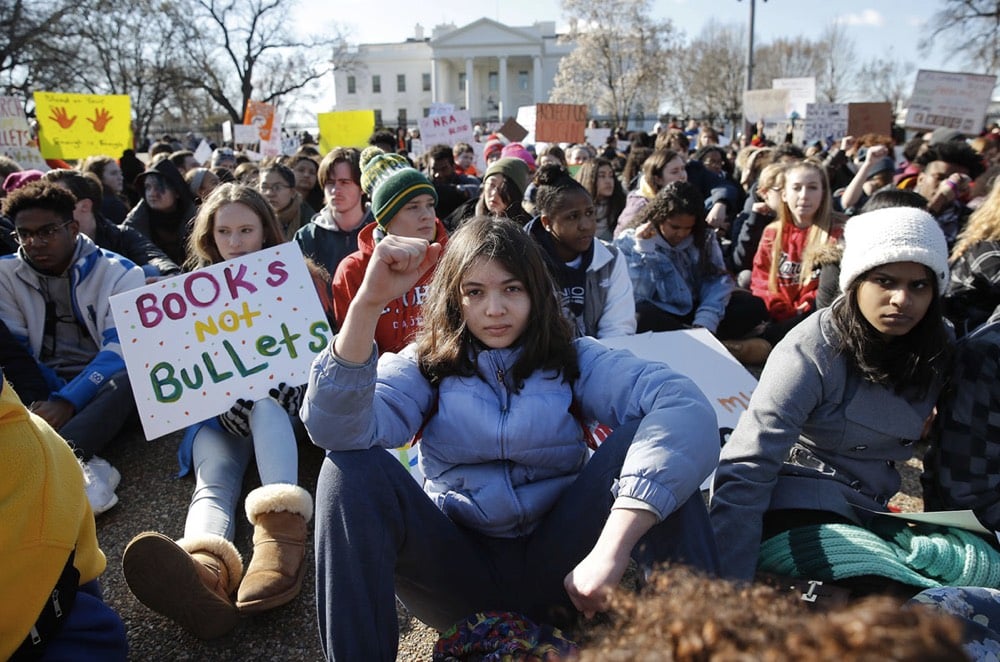
I didn’t get to follow National School Walkout Day as closely as I wanted to yesterday, but I just wanted to say on the morning after that I am very much in support of these kids, very proud of them, and deeply ashamed that ours is a country that has to regularly lean so hard on some of our most vulnerable members of society to get people and politicians to react to gross social injustice.
Buzzfeed has a great roundup of action from around the country, including 16-year-old Justin Blackman, who was the only one to walk out at his school…and ended up with millions of people supporting his efforts online. The Atlantic’s In Focus has gathered 35 photos of the walkout from around the nation.
Dina Leygerman is a high school teacher who teaches George Orwell’s novel 1984 to her students every year. Before she does, with the assistance of other teachers and the school’s administration, she turns her classroom into a totalitarian regime to give the kids a taste of life in Oceania. Rules are strict and favor is given to students who report on rule-breaking by their classmates.
I tell my seniors that in order to battle “Senioritis,” the teachers and admin have adapted an evidence-based strategy, a strategy that has “been implemented in many schools throughout the country and has had immense success.” I hang posters with motivational quotes and falsified statistics, and provide a false narrative for the problem that is “Senioritis.” I tell the students that in order to help them succeed, I must implement strict classroom rules.
However, when Leygerman tried the experiment this year, the students weren’t having it. They rebelled. They protested. They fought harder as the rules became more onerous.
The President of the SGA, whom I don’t even teach, wrote an email demanding an end to this “program.” He wrote that this program is “simply fascism at its worst. Statements such as these are the base of a dictatorship rule, this school, as well as this country cannot and will not fall prey to these totalitarian behaviors.” I did everything in my power to fight their rebellion. I “bribed” the President of the SGA. I “forced” him to publicly “resign.” And, yet, the students did not back down. They fought even harder. They were more vigilant. They became more organized. They found a new leader. They were more than ready to fight. They knew they would win in numbers.
An upcoming book edited by Cass Sunstein asks if authoritarianism can happen in America. The experiment in Leygerman’s classroom and the inspiring movement started by the students of Marjory Stoneman Douglas High School in Parkland, FL suggest perhaps not. The nation’s youth, raised on The Hunger Games and Harry Potter, are reminding the baby boomers that considering what their own parents went through in the Great Depression and World War II, they should fucking know better than to slam the door on succeeding generations.
According to writer G. Willow Wilson, living in an authoritarian society does not look like “something off the Syfy channel”.
It’s a mistake to think a dictatorship feels intrinsically different on a day-to-day basis than a democracy does. I’ve lived in one dictatorship and visited several others—there are still movies and work and school and shopping and memes and holidays.
The difference is the steady disappearance of dissent from the public sphere. Anti-regime bloggers disappear. Dissident political parties are declared “illegal.” Certain books vanish from the libraries.
How does a society go from a democracy to an autocracy? It’s like that line of Hemingway’s from The Sun Also Rises about how to go bankrupt: “Gradually and then suddenly.”
So if you’re waiting for the grand moment when the scales tip and we are no longer a functioning democracy, you needn’t bother. It’ll be much more subtle than that. It’ll be more of the president ignoring laws passed by congress. It’ll be more demonizing of the press.
Until one day we wake up and discover the regime has decided to postpone the 2020 elections until its lawyers are finished investigating something or other. Or until it can ‘ensure’ that the voting process is ‘fair.’
I don’t know about you, but Trump and the Republican Congress working to “postpone the 2020 elections until its lawyers are finished investigating something or other” seems like a completely plausible scenario. I would not be surprised if we see conservative pundits start floating this idea, slowly normalizing it over a matter of months until it seems like a plausible option. After all, it’s much easier for Republicans to remain in office if they got rid of those pesky elections (in lieu of gerrymandering and voter ID laws).
Update: In a poll from August 2017, 56% of Republicans polled said that they would support postponing the 2020 election if Trump and Republicans in Congress were in favor of it. (via @taestell)
There are many cultural and political lenses through which to view the Trump Presidency — reality TV, Mike Judge’s alarmingly prescient Idiocracy, the OJ Simpson case, Germany in the 1930s — but perhaps the most relevant is through the lens of Richard Nixon and the Watergate scandal. A lot of what I know about Watergate came through cultural osmosis (Johnny Carson and SNL were still doing Watergate jokes in the 80s when I started watching) and movies like All the President’s Men, and I suspect that’s true of many Americans who are too young to have lived through it. We may know the broad strokes, but that’s about it.
Enter Slow Burn, a podcast by Slate about some of the lesser known stories surrounding Watergate and what it felt like to experience it as the scandal unfolded. Here’s series host Leon Neyfakh describing what the show is about:
Why are we revisiting Watergate now? The connections between the Nixon era and today are obvious enough. But to me, the similarity that’s most striking is not between Donald Trump and Richard Nixon (although they’re both paranoid, vengeful, and preoccupied with “loyalty”), or their alleged crimes (although they both involved cheating to win an election), or the legal issues in the two cases (although they both center on obstruction of justice).
Rather, it’s that people who lived through Watergate had no idea what was going to happen from one day to the next, or how it was all going to end. I recognize that feeling. The Trump administration has made many of us feel like the country is in an unfamiliar, precarious situation. Some days it seems like our democratic institutions won’t survive, or that permanent damage has already been done. Pretty much every day, we are buffeted by news stories that sound like they’ve been ripped out of highly stressful and very unrealistic novels.
The point of Slow Burn is to look back on the most recent time Americans went through this en masse, and to put ourselves in their shoes.
Historical events like these make great podcast subjects; I’ve also listened to LBJ’s War recently. Reading articles or books about these topics is one thing, but actually listening to the investigators, journalists, lawyers, and Congressmen talk about about their roles in and perceptions of Watergate, both in contemporary interviews and recordings from that period, adds a lively and engaging aspect to these stories. I mean, just hearing Nixon on those secret tapes and then in press conferences saying that he had done nothing wrong…it’s completely gripping. I’ve been thinking up excuses to go for drives this past week just so I can get my Slow Burn fix.
National political opinion polls are usually fairly staid affairs involving Presidential approval ratings, healthcare, and religious beliefs. Over the course of a year in partnership with a professional research firm, Cards Against Humanity is running a different sort of opinion poll with more unusual questions. The early results are at Pulse of the Nation.
They asked people if they’re rather be “dumb and happy” or “smart and sad”. The “dumb and happy” respondents were more likely to say human-caused climate change is not real:

The majority of black people surveyed believe a second civil war is likely within the next decade:

65% of Democrats surveyed would rather have Darth Vader as President than Donald Trump:

And one’s approval of Donald Trump correlates to a belief that rap is not music:

And farts. They asked people about farting. Jokes aside, the results of this poll bummed me out. Many of the responses were irrational — Darth Vader would be much worse than Trump and Democrats believe that the top 1% of richest Americans own 75% of the wealth (it’s actually 39%)…and people with more formal education guessed worse on that question. The divide on rap music is racial and generational but also points to a lack of curiosity from many Americans about what is perhaps the defining art form of the past 30 years. But the worst is what Americans thought of each other…Democrats think Republicans are racist and Republicans don’t think Democrats love America. The polarization of the American public continues.
From Umair Haque, a provocative question: Why Don’t Americans Understand How Poor Their Lives Are?
In London, Paris, Berlin, I hop on the train, head to the cafe — it’s the afternoon, and nobody’s gotten to work until 9am, and even then, maybe not until 10 — order a carefully made coffee and a newly baked croissant, do some writing, pick up some fresh groceries, maybe a meal or two, head home — now it’s 6 or 7, and everyone else has already gone home around 5 — and watch something interesting, maybe a documentary by an academic, the BBC’s Blue Planet, or a Swedish crime-noir. I think back on my day and remember the people smiling and laughing at the pubs and cafes.
In New York, Washington, Philadelphia, I do the same thing, but it is not the same experience at all. I take broken down public transport to the cafe — everybody’s been at work since 6 or 7 or 8, so they already look half-dead — order coffee and a croissant, both of which are fairly tasteless, do some writing, pick up some mass-produced groceries, full of toxins and colourings and GMOs, even if they are labelled “organic” and “fresh”, all forbidden in Europe, head home — people are still at work, though it’s 7 or 8 — and watch something bland and forgettable, reality porn, decline porn, police-state TV. I think back on my day and remember how I didn’t see a single genuine smile — only hard, grim faces, set against despair, like imagine living in Soviet Leningrad.
Haque places the blame on our inability as a society to look outward and learn from ourselves, from history, and from the rest of the world.
So just as Americans don’t get how bad their lives really are, comparatively speaking — which is to say how good they could be — so too Europeans don’t fully understand how good their lives are — and how bad, if they continue to follow in America’s footsteps, austerity by austerity, they could be. Both appear to be blind to one another’s mistakes and successes.
Reading it, I noticed a similarity to Ted Chiang’s essay on the unchecked capitalism of Silicon Valley (which I linked to this morning). Chiang notes that corporations lack insight:
In psychology, the term “insight” is used to describe a recognition of one’s own condition, such as when a person with mental illness is aware of their illness. More broadly, it describes the ability to recognize patterns in one’s own behavior. It’s an example of metacognition, or thinking about one’s own thinking, and it’s something most humans are capable of but animals are not. And I believe the best test of whether an AI is really engaging in human-level cognition would be for it to demonstrate insight of this kind.
Haque is saying that our societies lack insight as well…or at least the will to incorporate that insight into practice.
I don’t know when this ran, but I liked this brief article published in Private Eye magazine called Zuckerberg Announces Revolutionary New Foundation to Eliminate Disease.
The genius founder of Facebook, Mark Zuckerberg, has announced an inspiring new foundation to which he and his wife will donate huge amounts of their fortune in a bid to defeat all disease over the next century.
“It’s called the government,” said Mr. Zuckerberg. “For such a long time I’ve been pondering how I can make a real difference with the enormous fortune I’ve amassed by concocting clever tax structures that minimise any tax liability from my firm.
“Imagine my shock when it turned out that this ‘government’ is devoted to ending disease. Not only that, it also has side projects dedicated to running schools, hospitals, a road system, parks, a national infrastructure, and lots of other worthy projects which make this planet a decent place to live.
I’m proud to announce that I’ll be giving lots of money to the ‘government’, as I’ve decided to call it, and I fully expect to get a lot of really fantastic publicity out of it.”
This reminded me of a pair of similar essays: I am an American conservative shitheel and I am an American liberal shitheel. (via @paulpod)
Newer posts
Older posts






Socials & More