For his piece The 3 Weeks That Changed Everything in The Atlantic, James Fallows talked to many scientists, health experts, and government officials about the US government’s response to the pandemic. In the article, he compares the pandemic response to how the government manages air safety and imagines what it would look like if we investigated the pandemic catastrophe like the National Transportation Safety Board investigates plane crashes.
Consider a thought experiment: What if the NTSB were brought in to look at the Trump administration’s handling of the pandemic? What would its investigation conclude? I’ll jump to the answer before laying out the background: This was a journey straight into a mountainside, with countless missed opportunities to turn away. A system was in place to save lives and contain disaster. The people in charge of the system could not be bothered to avoid the doomed course.
And he continues:
What happened once the disease began spreading in this country was a federal disaster in its own right: Katrina on a national scale, Chernobyl minus the radiation. It involved the failure to test; the failure to trace; the shortage of equipment; the dismissal of masks; the silencing or sidelining of professional scientists; the stream of conflicting, misleading, callous, and recklessly ignorant statements by those who did speak on the national government’s behalf. As late as February 26, Donald Trump notoriously said of the infection rate, “You have 15 people, and the 15 within a couple of days is going to be down close to zero.” What happened after that — when those 15 cases became 15,000, and then more than 2 million, en route to a total no one can foretell — will be a central part of the history of our times.
But he rightly pins much of the blame for the state we’re in on the Trump administration almost completely ignoring the plans put into place for a viral outbreak like this that were developed by past administrations, both Republican and Democratic alike.
In cases of disease outbreak, U.S. leadership and coordination of the international response was as well established and taken for granted as the role of air traffic controllers in directing flights through their sectors. Typically this would mean working with and through the World Health Organization — which, of course, Donald Trump has made a point of not doing. In the previous two decades of international public-health experience, starting with SARS and on through the rest of the acronym-heavy list, a standard procedure had emerged, and it had proved effective again and again. The U.S, with its combination of scientific and military-logistics might, would coordinate and support efforts by other countries. Subsequent stages would depend on the nature of the disease, but the fact that the U.S. would take the primary role was expected. When the new coronavirus threat suddenly materialized, American engagement was the signal all other participants were waiting for. But this time it did not come. It was as if air traffic controllers walked away from their stations and said, “The rest of you just work it out for yourselves.”
From the U.S. point of view, news of a virulent disease outbreak anywhere in the world is unwelcome. But in normal circumstances, its location in China would have been a plus. Whatever the ups and downs of political relations over the past two decades, Chinese and American scientists and public-health officials have worked together frequently, and positively, on health crises ranging from SARS during George W. Bush’s administration to the H1N1 and Ebola outbreaks during Barack Obama’s. As Peter Beinart extensively detailed in an Atlantic article, the U.S. helped build China’s public-health infrastructure, and China has cooperated in detecting and containing diseases within its borders and far afield. One U.S. official recalled the Predict program: “Getting Chinese agreement to American monitors throughout their territory — that was something.” But then the Trump administration zeroed out that program.
Americans, and indeed everyone in the world, should be absolutely furious about this, especially since the situation is actively getting worse after months (months!) of inactivity by the federal government.
My God, this aerial photo of dozens of recent graves in the Nossa Senhora Aparecida cemetery in Manaus, Brazil:

The photo is one of several from In Focus’s look at the Thousands of Burials Across Latin America. Brazil has 1.2 million confirmed Covid-19 cases, second most in the world (but only half the total of the US) and 55,000 confirmed deaths, though the number is likely much higher when you take excess mortality rates into account. Way back in April, when the reported death toll in Brazil was only (only!) ~3300, NPR reported on the mass graves and modified funeral procedures that were necessary due to Covid-19 and the Brazilian government’s disastrous response to it.
Yet the coronavirus has introduced a new kind of horror. The Nossa Senhora Aparecida cemetery has begun using backhoes to dig mass graves.
This has become “the only option” because it is “humanly impossible” to dig the required number of graves, says Viana, who runs a funeral company and is president of the Syndicate of Funeral Businesses in Amazonas.
According to Viana, the city’s daily average of deaths has risen from 30 to more than 100. The mayor’s office confirmed to NPR that there have been 340 burials just in the past three days. In most cases, the cause of death was listed as unknown, said a city hall spokeswoman.
City authorities are in little doubt that COVID-19 victims account for most of the spike. This means the virus is taking a far deadlier toll on Manaus than the official count of 172 virus-related deaths suggests. The reported death toll throughout Brazil is 3,313.
Video footage has appeared online showing the collapse of Manaus’ burial services and public hospitals. In one, corpses lie on beds in a hospital alongside live patients undergoing treatment. Another shows a line of vans waiting to deliver bodies for burial at the Nossa Senhora Aparecida cemetery.
The many layers of trauma from the pandemic are going to resonate for decades in places like Brazil and the US. Decades.
Since the early days of Donald Trump’s presidency, the editors at McSweeney’s have been keeping track of his various “misdeeds”. With the election coming up, they’ve published the full list: Lest We Forget the Horrors: A Catalog of Trump’s Worst Cruelties, Collusions, Corruptions, and Crimes: The Complete Listing (So Far).
We called this list a collection of Trump’s cruelties, collusions, and crimes, and it felt urgent then to track them, to ensure these horrors — happening almost daily — would not be forgotten. This election year, amid a harrowing global health, civil rights, humanitarian, and economic crisis, we know it’s never been more critical to note these horrors, to remember them, and to do all in our power to reverse them.
I know we know who this guy is by now (we knew who he was before he was elected), but the categories they’re using for a sitting US President is still shocking and upsetting — including “Sexual Misconduct, Harassment, & Bullying” and “White Supremacy, Racism, & Xenophobia”. I read through the 739 items in the list (so far) and pulled out some of the lowlights.
June 16, 2015 — In his speech announcing his candidacy for President of the United States, Donald Trump said, “When Mexico sends its people, they’re not sending their best. They’re sending people that have lots of problems. They’re bringing drugs. They’re bringing crime. They’re rapists. And some, I assume, are good people.”
October 7, 2016 — In the 2005 Access Hollywood tape, Donald Trump bragged to Billy Bush about grabbing women by their genitals without consent. In the video published by the Washington Post, Trump said, “I don’t even wait. And when you’re a star, they let you do it, you can do anything… grab them by the pussy.” Trump said his statements were “locker room banter” and apologized “if anyone was offended.” He later issued a further response to the tape’s release, saying, “I’ve never said I’m a perfect person.”
October 7, 2016 — Donald Trump reiterated his false claim that the young men known as the “Central Park Five” were guilty of sexually assaulting a jogger in 1989, despite DNA evidence that exonerated them.
February 1, 2017 — In a rollback of an Obama-era protection, Donald Trump’s White House withdrew the Mercury Effluent Rule, which regulated the safe use and disposal of mercury in American dental offices. The Natural Resource Defense Council estimated the repeal would discharge five tons of the neurotoxic substance into water supplies each year. Even trace amounts of mercury can harm brain function and damage the human nervous system, particularly in pregnant women and infants.
March 10, 2017 — Donald Trump abruptly ordered 46 Obama-era prosecutors to tender their resignations. Among the dismissed prosecutors was Preet Bharara, an attorney renowned for his work uprooting government corruption. Bharara served as the U.S. attorney in New York City and, at the time of his removal, had jurisdiction over Trump Tower in New York. When he was fired, Bharara was reportedly building a case against Rupert Murdoch and Fox News executives for a variety of indiscretions related to violations of privacy.
October 23, 2017 — When asked about gay rights while in the company of Mike Pence, Donald Trump joked, “Don’t ask that guy — he wants to hang them all!”
February 5, 2018 — During a speech at a factory in Ohio, Trump wondered aloud whether Democrats had committed treason against the United States for withholding their applause during his State of the Union Address. “Can we call that treason? Why not? I mean, they certainly didn’t seem to love our country very much.”
Ok, I can’t read any more of these. Look, I get that if you compile a list of anyone’s worst moments, they’re not going to come out looking good. But this list is overwhelming — even if you just consider the (many!) sexual assaults or just the stuff that he’s said, plainly and unapologetically, in public. Hell, Trump likely thinks that a lot of this is the good stuff. That a) around 40% of Americans either approve of or are comfortable ignoring his behavior, and b) that paltry 40% might be enough to get him reelected (as Republicans around the country continue to try their damnedest to take away citizens’ voting rights) should SCARE THE ABSOLUTE SHIT out of all of us.
In his 2018 review of several books about Nazism and Adolf Hitler, Alex Ross notes that Hitler took inspiration for the Third Reich’s anti-Semitism and the Holocaust from the United States’ genocide against indigenous peoples, treatment of African Americans (both during and after slavery), and restrictive immigration policies.
The Nazis were not wrong to cite American precedents. Enslavement of African-Americans was written into the U.S. Constitution. Thomas Jefferson spoke of the need to “eliminate” or “extirpate” Native Americans. In 1856, an Oregonian settler wrote, “Extermination, however unchristianlike it may appear, seems to be the only resort left for the protection of life and property.” General Philip Sheridan spoke of “annihilation, obliteration, and complete destruction.” To be sure, others promoted more peaceful-albeit still repressive-policies. The historian Edward B. Westermann, in “Hitler’s Ostkrieg and the Indian Wars” (Oklahoma), concludes that, because federal policy never officially mandated the “physical annihilation of the Native populations on racial grounds or characteristics,” this was not a genocide on the order of the Shoah. The fact remains that between 1500 and 1900 the Native population of U.S. territories dropped from many millions to around two hundred thousand.
America’s knack for maintaining an air of robust innocence in the wake of mass death struck Hitler as an example to be emulated. He made frequent mention of the American West in the early months of the Soviet invasion. The Volga would be “our Mississippi,” he said. “Europe — and not America — will be the land of unlimited possibilities.” Poland, Belarus, and Ukraine would be populated by pioneer farmer-soldier families. Autobahns would cut through fields of grain. The present occupants of those lands — tens of millions of them — would be starved to death. At the same time, and with no sense of contradiction, the Nazis partook of a long-standing German romanticization of Native Americans. One of Goebbels’s less propitious schemes was to confer honorary Aryan status on Native American tribes, in the hope that they would rise up against their oppressors.
Jim Crow laws in the American South served as a precedent in a stricter legal sense. Scholars have long been aware that Hitler’s regime expressed admiration for American race law, but they have tended to see this as a public-relations strategy — an “everybody does it” justification for Nazi policies. Whitman, however, points out that if these comparisons had been intended solely for a foreign audience they would not have been buried in hefty tomes in Fraktur type. “Race Law in the United States,” a 1936 study by the German lawyer Heinrich Krieger, attempts to sort out inconsistencies in the legal status of nonwhite Americans. Krieger concludes that the entire apparatus is hopelessly opaque, concealing racist aims behind contorted justifications. Why not simply say what one means? This was a major difference between American and German racism.
In recent weeks as antiracism and anti-police violence protests continue around the country, the movement to defund and abolish policing in America has rapidly gained momentum. As Black communities have asserted for decades, people have begun to wonder in earnest what purpose police serve. They’re asking when there’s a problem in our communities, do we really need a person with a gun showing up to solve it? What would a system oriented around public safety look like if it was designed from scratch rather than just piling more responsibility onto and funding into increasingly militarized and unaccountable police departments?
There are a lot of resources out there about police abolition right now, so here are some that I’ve found helpful in understanding it.
Alex Vitale’s The End of Policing, which came out in 2017, is a well-reviewed critique of modern policing.
This book attempts to spark public discussion by revealing the tainted origins of modern policing as a tool of social control. It shows how the expansion of police authority is inconsistent with community empowerment, social justice — even public safety. Drawing on groundbreaking research from across the world, and covering virtually every area in the increasingly broad range of police work, Alex Vitale demonstrates how law enforcement has come to exacerbate the very problems it is supposed to solve.
In contrast, there are places where the robust implementation of policing alternatives—such as legalization, restorative justice, and harm reduction — has led to a decrease in crime, spending, and injustice. The best solution to bad policing may be an end to policing.
Verso, the book’s publisher, is offering the ebook version for free for a limited time. The Paris Review has an excerpt that addresses the difficulties with reforms (such as the #8cantwait initative):
This does not mean that no one should articulate or fight for reforms. However, those reforms must be part of a larger vision that questions the basic role of police in society and asks whether coercive government action will bring more justice or less. Too many of the reforms under discussion today fail to do that; many further empower the police and expand their role. Community policing, body cameras, and increased money for training reinforce a false sense of police legitimacy and expand the reach of the police into communities and private lives. More money, more technology, and more power and influence will not reduce the burden or increase the justness of policing. Ending the War on Drugs, abolishing school police, ending broken-windows policing, developing robust mental health care, and creating low-income housing systems will do much more to reduce abusive policing.
The Intercept interviewed Vitale in October 2017.
We should understand policing as the most coercive form of state power … and the reason is that policing has historically and inherently been at the root of reproducing fundamental inequalities of race, class, and immigration status. Trump, the police, ICE — this is just a continuation of a history of exclusion and repression going back to the exclusion of Chinese immigrants in the 19th century, Texas Rangers driving out Mexican landholders and indigenous populations to make room for white settlers, the transformation of slave patrols and urban slave management systems into what became Jim Crow policing in the South and ghetto policing in the North. Police have historical origins in relation to both the formation and disciplining of the industrial working class; early 19th century forms of policing in Europe and the United States shaped rural agricultural workers into urban industrial workers, and then suppressed their movements to form labor unions and win better living conditions.
The point of all this is to fundamentally question this liberal notion that police exist primarily as a tool for public safety and therefore, we should embrace their efforts uncritically, when in fact, there are lots of different ways to produce safety that don’t come with the baggage of colonialism, slavery, and the suppression of workers’ movements.
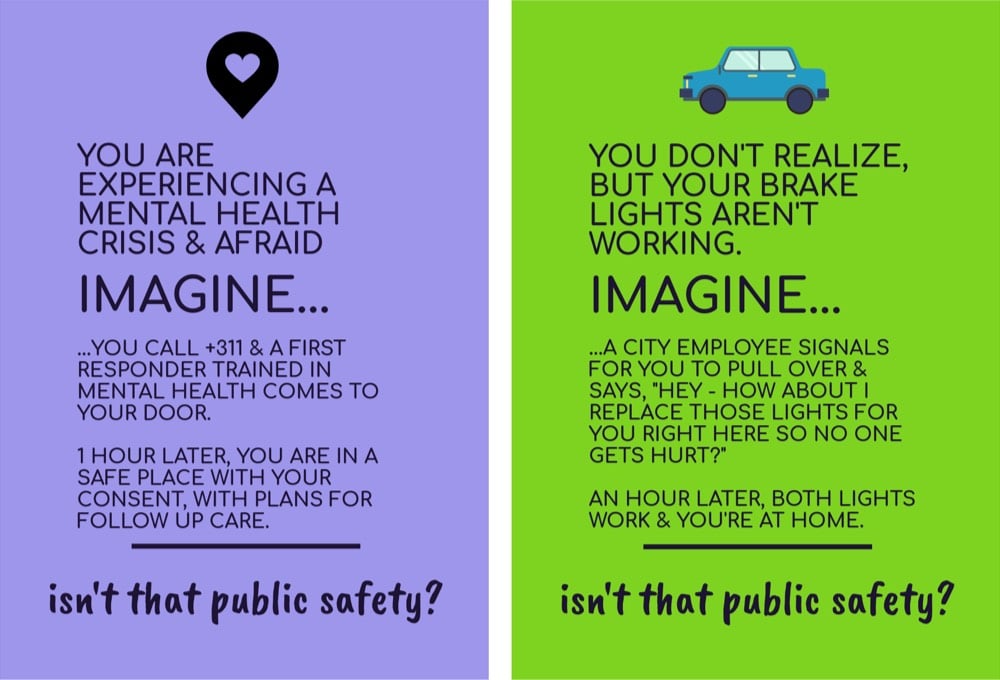
In 2018, Amber Hughson designed a series of flyers outlining some alternatives to policing. The “Isn’t this public safety?” question at the end of each flyer is really compelling.
Christy Lopez (co-director of Georgetown Law School’s Innovative Policing Program) writing in The Washington Post: Defund the police? Here’s what that really means.
To fix policing, we must first recognize how much we have come to over-rely on law enforcement. We turn to the police in situations where years of experience and common sense tell us that their involvement is unnecessary, and can make things worse. We ask police to take accident reports, respond to people who have overdosed and arrest, rather than cite, people who might have intentionally or not passed a counterfeit $20 bill. We call police to roust homeless people from corners and doorsteps, resolve verbal squabbles between family members and strangers alike, and arrest children for behavior that once would have been handled as a school disciplinary issue.
Police themselves often complain about having to “do too much,” including handling social problems for which they are ill-equipped. Some have been vocal about the need to decriminalize social problems and take police out of the equation. It is clear that we must reimagine the role they play in public safety.
MPD150, a grassroots organization working towards a police-free Minneapolis, has a bunch of resources on their website, including What are we talking about when we talk about “a police-free future?” and an 8-page FAQ zine for folks trying to get up to speed on police abolition.
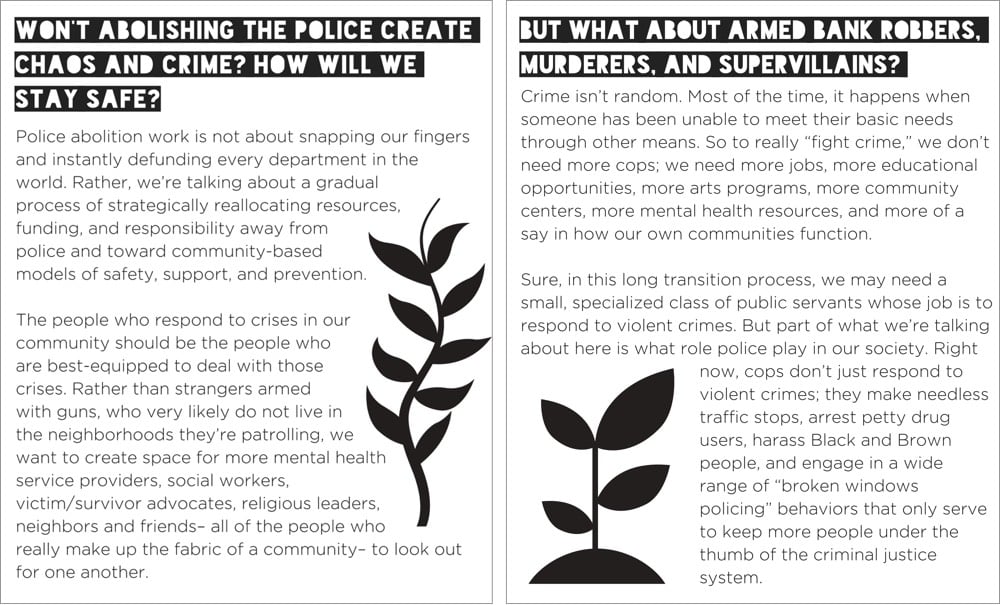
Many people already live in a world without police. If you grew up in a well-off, predominantly white suburb, how often did you interact with cops? Communities with lots of good jobs, strong schools, economies, and social safety nets are already, in some ways, living in a world without police.
Annie Lowrey makes a fiscal argument in Defund the Police.
A thin safety net, an expansive security state: This is the American way. At all levels of government, the country spends roughly double on police, prisons, and courts what it spends on food stamps, welfare, and income supplements. At the federal level, it spends twice as much on the Pentagon as on assistance programs, and eight times as much on defense as on education. The wars in Iraq and Afghanistan will ultimately cost something like $6 trillion and policing costs $100 billion a year. But proposals to end homelessness ($20 billion a year), create a universal prekindergarten program ($26 billion a year), reduce the racial wealth gap through baby bonds ($60 billion a year), and eliminate poverty among families with children ($70 billion a year) somehow never get financed. All told, taxpayers spend $31,286 a year on each incarcerated person, and $12,201 a year on every primary- and secondary-school student.
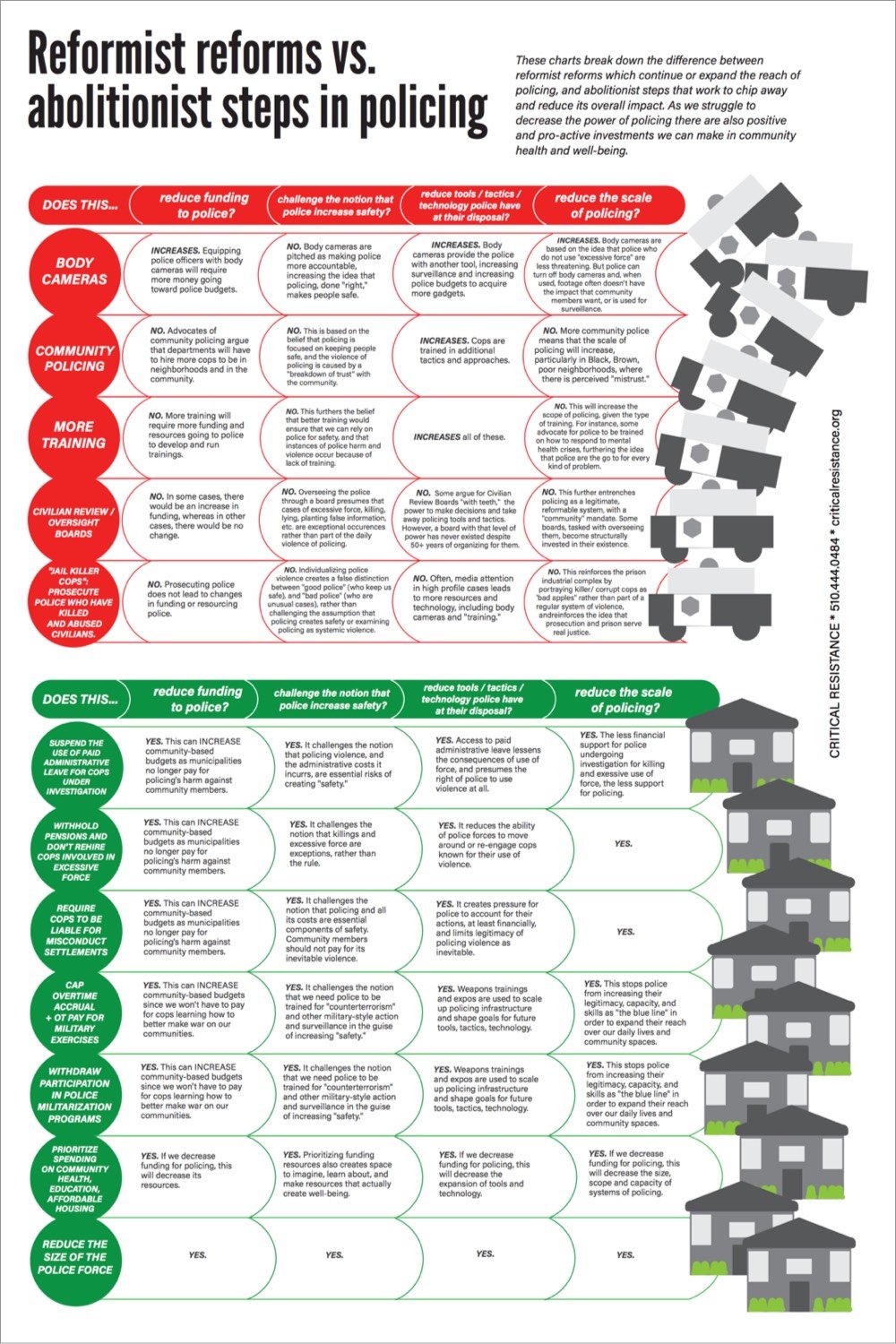
Critical Resistance has a police abolition resources page that many activists are recommending, including this toolkit and this chart comparing reforms vs abolition.
The Marshall Project is maintaining a collection of links about police abolition.
I liked the framing of this Twitter thread by Gabrielle Blair:
This is how I, a 45-year-old white woman and mother of 6, currently at her peak Karen power, went from assuming police work was a necessary part of functional communities, to becoming a passionate advocate for #abolishthepolice #defundthepolice, over the course of one week.
She continues:
“I suppose it is tempting, if the only tool you have is a hammer, to treat everything as if it were a nail.” Do you know that saying? Apply it to police. If you’re always prepared to easily inflict violence, then the chances of inflicting unwarranted violence go way up.
Cat in a tree? Got locked out of your car? Kids prank called 911? Found a brutally murdered body? When called, police will arrive at all four of these scenes equally armed to the teeth. Why would we ever be okay with that? It is INSANE.
Vox’s podcast Today, Explained did an episode on What “abolish the police” means. From the transcript:
SEAN: And for the people who are worried about how this you know, how this might affect the way our society functions, like, let’s just say, you know, it’s a Friday night, 4th of July or something like that, like like the Fourth of July. That’s coming up real soon. And, you know, you’re worried about drunk drivers on the road. Who’s getting your back on drunk drivers?
BRANDON: You’re going to be able to call the police. The police are still going to be out there enforcing traffic violations, maybe not with weapons, though, maybe they have some other tools to de-escalate situations.
SEAN: And what about, like, you’re scared that this jilted ex lover of yours is going to come after you and kill you? Same situation?
BRANDON: You know, we can continue to go through these hypotheticals. I want to be very clear here. Police don’t listen to black women as it exists today. Black women are often the victims of sexual assault, sexual violence, and they are not listened to. They’re not deemed credible by police officers. So we’ve got to ask yourself, is policing working? Maybe it’s working for certain communities, white communities in particular. Now, police are going to be there when you call and say, hey, look, there’s someone harassing me. They’re going to have the better trained police officer come and diffuse the situation if the perpetrator is still there.
I have not listened to this yet, but next up in my podcast queue is a two-episode series of Intercepted with host Chenjerai Kumanyika and long-time prison abolitionist Ruth Wilson Gilmore.
Journalist and lawyer Josie Duffy Rice:
many people in america already exist in a world where police and prisons do not exist. go to any middle to upper class suburb in america. cops arent wandering the streets. people aren’t being arrested. neighbors aren’t being sent to prison. and generally everyone is….fine.
many people say they cannot imagine this world. what most of them cannot imagine is someone not policing black brown and poor people. THAT is what is unimaginable to them. not the absence of law enforcement. if you are lucky, you already functionally live with that absence.
Garrett Felber details the history of the police and prison abolition movements that stretch back for decades: The Struggle to Abolish the Police Is Not New.
Although abolition was not a central demand of the midcentury civil rights movement — despite informing the activism of many of its key figures — it took hold in the 1970s. This revolutionary ethos — what Chicano poet Raul Salinas called the “prison rebellion years” — was linked to mass uprisings in the streets; the state repression, jailing, and murder of black and brown radicals; and opposition to the Vietnam War and imprisonment of conscientious objectors. Quaker Fay Honey Knopp’s pivotal 1976 Instead of Prisons: A Handbook for Prison Abolitionists, for example, had its genesis in her visits to conscientious objectors in prison during the Vietnam War and her participation in feminist, civil rights, gay rights, and prisoners’ rights struggles.
Update: Abolition activist Mariame Kaba writes in a NY Times opinion piece: Yes, We Mean Literally Abolish the Police.
Minneapolis had instituted many of these “best practices” but failed to remove Derek Chauvin from the force despite 17 misconduct complaints over nearly two decades, culminating in the entire world watching as he knelt on George Floyd’s neck for almost nine minutes.
Why on earth would we think the same reforms would work now? We need to change our demands. The surest way of reducing police violence is to reduce the power of the police, by cutting budgets and the number of officers.
But don’t get me wrong. We are not abandoning our communities to violence. We don’t want to just close police departments. We want to make them obsolete.
We should redirect the billions that now go to police departments toward providing health care, housing, education and good jobs. If we did this, there would be less need for the police in the first place.
In The Atlantic, epidemiologists Julia Marcus and Gregg Gonsalves explain why public health officials are not being hypocritical in their support of the antiracism protests around the country.
At its core, the argument being leveled against public-health experts is that the reason for the protests shouldn’t matter. The coronavirus doesn’t care whether it’s attending an anti-lockdown protest or an anti-racism one. But these two kinds of protests are not equivalent from a public-health perspective. Some critics might argue that the anti-lockdown protests promoted economic activity, which can help stave off the health implications of poverty. (On this count, public-health experts were ahead of the curve: Many — including one of us — were advocating for a massive infusion of assistance to individual Americans as early as March.) But these protests were organized by pro-gun groups that believe the National Rifle Association is too compromising on gun safety. Egged on by the president to “save your great 2nd Amendment,” anti-lockdown protesters stormed government buildings with assault rifles and signs reading COVID-19 IS A LIE. The anti-lockdown demonstrations were explicitly at odds with public health, and experts had a duty to oppose them. The current protests, in contrast, are a grassroots uprising against systemic racism, a pervasive and long-standing public-health crisis that leads to more than 80,000 excess deaths among black Americans every year.
If “conservative commentators” cared at all about keeping people safe from Covid-19 infection, they would have denounced the I-Need-A-Haircut protests as reckless and they didn’t. Instead, they engage in these bad faith arguments that are just designed to stir up outrage.
Gonsalves wrote a thread on Twitter a few days ago that’s relevant here as well.
The risk to all of us was inflamed by an absolute decision at the highest levels that this epidemic was not worth an all-out, coordinated, comprehensive national mobilization. It took weeks for the President to even agree that the epidemic wouldn’t go away on its own.
The US, the richest nation in the world, then couldn’t get it together to scale-up the number of tests we needed to understand what was going on in our communities with SARS-COV-2, and in the end said it was up to the states to figure it all out.
And then this is the last word as far as I’m concerned:
We’ve all been put at far more jeopardy during this pandemic by our political leaders than by the people on the streets over the past week or so.
In 1971, Richard Nixon kicked off America’s “war on drugs”, focusing not on the societal problems that lead to drug abuse but on categorizing drug users as criminals.
In Nixon’s eyes, drug use was rampant in 1971 not because of grand social pressures that society had a duty to correct, but because drug users were law-breaking hedonists who deserved only discipline and punishment.
Over the next several decades, the US government (and particularly Ronald Reagan) took Nixon’s lead and imprisoned millions of people for drug offenses, including a disproportionate number of Black men. Michelle Alexander wrote about this in her 2010 book The New Jim Crow. From the about page:
Alexander shows that, by targeting black men through the War on Drugs and decimating communities of color, the U.S. criminal justice system functions as a contemporary system of racial control, even as it formally adheres to the principle of colorblindness.
In 1994, former Nixon aide and Watergate co-conspirator John Ehrlichman proudly told writer Dan Baum that racial control and discrimination was in fact the purpose of the war on drugs.
At the time, I was writing a book about the politics of drug prohibition. I started to ask Ehrlichman a series of earnest, wonky questions that he impatiently waved away. “You want to know what this was really all about?” he asked with the bluntness of a man who, after public disgrace and a stretch in federal prison, had little left to protect. “The Nixon campaign in 1968, and the Nixon White House after that, had two enemies: the antiwar left and black people. You understand what I’m saying? We knew we couldn’t make it illegal to be either against the war or black, but by getting the public to associate the hippies with marijuana and blacks with heroin, and then criminalizing both heavily, we could disrupt those communities. We could arrest their leaders, raid their homes, break up their meetings, and vilify them night after night on the evening news. Did we know we were lying about the drugs? Of course we did.”
An astonishing thing to admit but hardly a rare tactic for the cynical Republican Party. See also how they decided to champion abortion as an issue to attract the support of white evangelical Christians and shifted from indifference to scientific denialism on climate change in order to oppose the Obama administration and advance the interests of wealthy donors.
Thanks to Ibram X. Kendi’s How to Be an Antiracist for reminding me of Ehrlichman’s admission.
Nick Baumann on the militarization of the American police:
“You create this world where you’re not just militarizing the police — you equip the police like soldiers, you train the police like soldiers. Why are you surprised when they act like soldiers?” Rizer, a former police officer and soldier, said. “The mission of the police is to protect and serve. But the premise of the soldier is to engage the enemy in close combat and destroy them. When you blur those lines together with statements like that … It’s an absolute breakdown of civil society.”
American police officers generally believe that carrying military equipment and wearing military gear makes them feel like they can do more, and that it makes them scarier, Rizer’s research has found. Officers even acknowledge that acting and dressing like soldiers could change how the public feels about them. But “they don’t care,” he said.
In 2015, after the militarized police response to the protests in Ferguson, Mo., President Obama restricted the sales of military equipment by the Pentagon to police departments.
Mr. Obama ordered a review of the Pentagon program in late 2014 after the police responded to protests with armored vehicles, snipers and riot gear. The images of police officers with military gear squaring off against protesters around the country angered community activists who said law enforcement agencies were reacting disproportionately.
In addition to the prohibitions on certain military surplus gear, he added restrictions on transferring some weapons and devices, including explosives, battering rams, riot helmets and shields.
The Pentagon said 126 tracked armored vehicles, 138 grenade launchers and 1,623 bayonets had been returned since Mr. Obama prohibited their transfer.
In 2017, Donald Trump fully restored the practice of transferring military goods to police, grenade launchers and all.
Update: Would just like to note that the 1033 Program was signed into law by Bill Clinton, has historically enjoyed bipartisan support, and was greatly expanded under Obama.
A recent study show that, under the Pentagon’s 1033 program, enacted in 1997, the value of military weapons, gear and equipment transferred to local cops did not exceed $34 million annually until 2010, the second year of the Obama administration, when it nearly tripled to more than $91 million. By 2014, the year that Michael Brown was shot down — and when the full Congress, including 32 members of the Congressional Black Caucus, rejected a bill that would have shut down the 1033 program — Obama was sending three quarters of a billion dollars, more than $787 million a year, in battlefield weaponry to local police departments. In other words, President Obama oversaw a 24-fold (2,400%) increase in the militarization of local police between 2008 and 2014. Even with the scale-back announced in 2015, Obama still managed to transfer a $459 million arsenal to the cops — 14 times as much weapons of terror and death than President Bush gifted to the local police at his high point year of 2008.
(thx, chuck)
From an April 17th Facebook post by Paul Field, a succinct summary of how the pandemic exposes American deficiencies. It’s tough to not just quote the whole thing, so here’s the beginning:
Everyone is entitled to their own opinion, but you need to know how silly you look if you post some variation of, “Welcome to Socialism…”
You are not seeing Socialism. What you are seeing is one of the wealthiest, geographically advantaged, productive capitalist societies in the world flounder and fail at its most basic test. Taking care of its people.
This crisis is not about the virus.
This crisis is about the massive failure of our, “Booming economy,” to survive even modest challenges. It is about the market dissonance of shortages in stores, even as farmers/producers destroy unused crops and products. This crisis is about huge corporations needing an emergency bailout within days of the longest Bull Market in our history ending and despite the ability to borrow with zero percent interest rates.
The pandemic has revealed that American democracy and our economic system is extremely fragile. Ok, unless you’re wealthy, in which case you’re going to be fine, all part of the plan, etc.
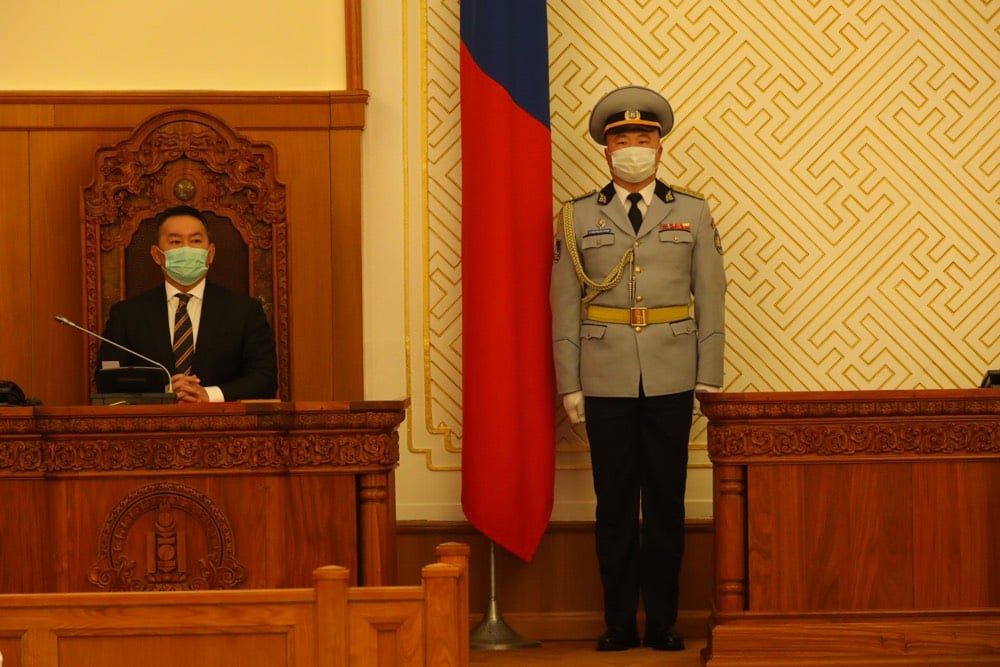
Several countries have had solid responses to the Covid-19 pandemic: Taiwan, South Korea, New Zealand, and Hong Kong. But Indi Samarajiva thinks we should be paying much more attention to Mongolia, a country of 3.17 million people where no one has died and no locally transmitted cases have been reported.1 Let’s have that again: 3.17 million people, 0 local cases, 0 deaths. How did they do it? They saw what was happening in Wuhan, coordinated with the WHO, and acted swiftly & decisively in January.
Imagine that you could go back in time to January 23rd with the horse race results and, I dunno, the new iPhone. People believe you. China has just shut down Hubei Province, the largest cordon sanitaire in human history. What would you scream to your leaders? What would you tell them to do?
You’d tell them that this was serious and that it’s coming for sure. You’d tell them to restrict the borders now, to socially distance now, and to get medical supplies ready, also now. You’d tell them to react right now, in January itself. That’s 20/20 hindsight.
That’s exactly what Mongolia did, and they don’t have a time machine. They just saw what was happening in Hubei, they coordinated with China and the WHO, and they got their shit together fast. That’s their secret, not the elevation. They just weren’t dumb.
When you go to World In Data’s Coronavirus Data Explorer and click on “Mongolia” to add their data to the graph, nothing happens because they have zero reported cases and zero deaths. They looked at the paradox of preparation — the idea that “when the best way to save lives is to prevent a disease rather than treat it, success often looks like an overreaction” — and said “sign us up for the overreacting!”
Throughout February, Mongolia was furiously getting ready - procuring face masks, test kits, and PPE; examining hospitals, food markets, and cleaning up the city. Still no reported cases. Still no let-up in readiness. No one was like “it’s not real!” or “burn the 5G towers!”
The country also suspended their New Year celebrations, which are a big deal in Asia. They deployed hundreds of people and restricted intercity travel to make sure, though the public seemed to broadly support the move.
Again — and I’ll keep saying this until March — there were still NO CASES. If you want to know how Mongolia ended up with no local cases, it’s because they reacted when there were no local cases. And they kept acting.
For example, when they heard of a case across the border (ie, not in Mongolia) South Gobi declared an emergency and put everyone in masks. The center also shut down coal exports — a huge economic hit, which they took proactively.
As you can see, at every turn they’re reacting like other countries only did when it was too late. This looked like an over-reaction, but in fact, Mongolia was always on time.
I have to tell you true: I got really upset reading this. Like crying and furious. The United States could have done this. Italy could have done this. Brazil could have done this. Sweden could have done this. England could have done this. Spain could have done this. Mongolia listened to the experts, acted quickly, and kept their people safe. Much of the rest of the world, especially the western world — the so-called first-world countries — failed to act quickly enough and hundreds of thousands of people have needlessly died and countless others have been left with chronic health issues, grief, and economic chaos.
After 2+ months of lockdown in most areas, a small minority of Americans want our country to go back to “normal” despite evidence and expert advice to the contrary. They want to get haircuts, not wear masks in public, go to crowded beaches, and generally go about their lives. These folks couch their desires in terms of freedom & liberty: the government has no right to infringe on the individual freedoms of its citizens.
But governments routinely do just that for all kinds of good reasons — e.g. you can’t murder someone just because you feel like it — and as Johns Hopkins’ public health historian Graham Mooney points out, there’s a precedent for a different way of thinking about freedom in the context of public health.
In response to these vehement appeals to individual freedom, public-health leaders in London, Liverpool, Manchester and elsewhere developed a powerful counterargument. They too framed their argument in terms of freedom — freedom from disease. To protect citizens’ right to be free from disease, in their view, governments and officials needed the authority to isolate those who were sick, vaccinate people, and take other steps to reduce the risk of infectious disease.
One of the most important reformers was George Buchanan, the chief medical officer for England from 1879 to 1892. He argued that cities and towns had the authority to take necessary steps to ensure the communal “sanitary welfare.” He and other reformers based their arguments on an idea developed by the 19th-century English philosopher John Stuart Mill, who is, ironically, remembered largely as a staunch defender of individual liberty. Mill articulated what he called the “harm principle,” which asserts that while individual liberty is sacrosanct, it should be limited when it will harm others: “The sole end for which mankind are warranted, individually or collectively, in interfering with the liberty and action of any of their number, is self-protection,” Mill wrote in On Liberty in 1859. Public-health reformers argued that the harm principle gave them the authority to pursue their aims.
An essay published in The Lancet in 1883 sums up this view nicely: “We cannot see that there is any undue violation of personal liberty in the sanitary authority acting for the whole community, requiring to be informed of the existence of diseases dangerous to others. A man’s liberty is not to involve risk to others,” the author wrote. “A man with smallpox has the natural liberty to travel in a cab or an omnibus; but society has a right that overrides his natural liberty, and says he shall not.”
There are a lot of different lenses you can use to look at how the United States and its government have confronted the Covid-19 pandemic. Race is a particularly useful one. As a reminder, here’s America’s current operating racial contract (from an Atlantic piece by Adam Serwer):
The implied terms of the racial contract are visible everywhere for those willing to see them. A 12-year-old with a toy gun is a dangerous threat who must be met with lethal force; armed militias drawing beads on federal agents are heroes of liberty. Struggling white farmers in Iowa taking billions in federal assistance are hardworking Americans down on their luck; struggling single parents in cities using food stamps are welfare queens. Black Americans struggling in the cocaine epidemic are a “bio-underclass” created by a pathological culture; white Americans struggling with opioid addiction are a national tragedy. Poor European immigrants who flocked to an America with virtually no immigration restrictions came “the right way”; poor Central American immigrants evading a baroque and unforgiving system are gang members and terrorists.
Serwer goes on to argue that the recently shifting American response to the pandemic, primarily in conservative circles, is due to an increasing awareness of which groups are bearing the brunt of the crisis: black and Latino Americans.
That more and more Americans were dying was less important than who was dying.
The disease is now “infecting people who cannot afford to miss work or telecommute-grocery store employees, delivery drivers and construction workers,” The Washington Post reported. Air travel has largely shut down, and many of the new clusters are in nursing homes, jails and prisons, and factories tied to essential industries. Containing the outbreak was no longer a question of social responsibility, but of personal responsibility. From the White House podium, Surgeon General Jerome Adams told “communities of color” that “we need you to step up and help stop the spread.”
This is a response that America is quite comfortable with because it fits with our racial contract, under which Jim Crow never actually ended. The US isn’t the only place this is happening btw. Early on, Singapore was praised for its response to the pandemic, but their reliance on and mistreatment of an underclass of migrant workers caused a secondary surge in cases.
Singapore is a small city-state with a population of just under 6 million inhabitants. On a per capita basis, it’s the second-richest country in Asia.
But its economy relies heavily on young men from Bangladesh, India and other countries who work jobs in construction and manufacturing. Singapore has no minimum wage for foreign or domestic employees. The foreign workers’ salaries can be as low as US$250 per month, but a typical salary is $500 to $600 a month.





Socials & More