kottke.org posts about politics
Somehow, I missed the teaser trailer for Don’t Look Up a couple months back, but the official trailer just came out yesterday. Directed by Adam McKay (The Big Short, Vice) and starring Leonardo DiCaprio & Jennifer Lawrence (and Meryl Streep, Jonah Hill, Mark Rylance, Cate Blanchett, Tyler Perry, and Timothée Chalamet), Don’t Look Up is a comedy about what happens when scientific fact (in the form of a planet-killing comet) slams into the fantasy worlds of politics and entertainment media. Just because you can’t spin Newton’s laws of motion doesn’t mean you can’t try!
Nothing, absolutely nothing whatsoever, about this movie is related to current events, nope, no sir. *sobbing intensifies* (I love disaster movies and will 100% see this even though it will probably be completely enraging.)
Others (like Timothy Snyder) have been saying this for months and years, but in a succinct 8-minute monologue, Bill Maher1 lays out what’s going to happen over the next three years that will pave the way for Donald Trump and the Republicans to take back the White House and set up the biggest political crisis in the United States since the Civil War.
A document came to light a few weeks ago called the Eastman Memo, which was basically a blueprint prepared for Trump on how he could steal the election after he lost it in November 2020. It outlined a plan for overturning the election by claiming that seven states actually had competing state slates of electors, which while not even remotely true, would have given Mike Pence the excuse to throw out those states and thus hand the election to Trump.
But of course the plan required election officials in those states to go along. Trump thought the ones who were Republican would. Most did not. And that’s what he’s been working on fixing ever since.
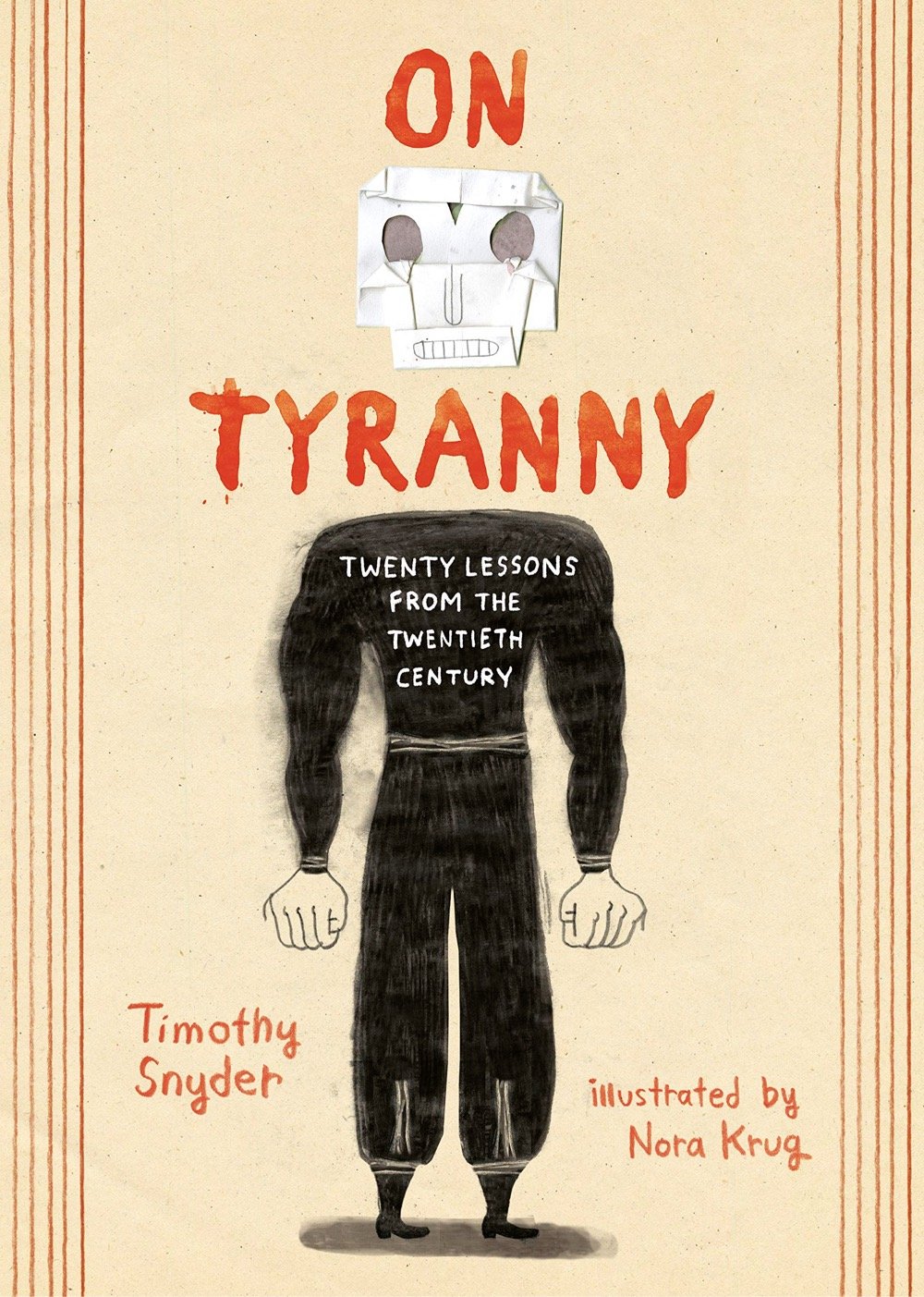
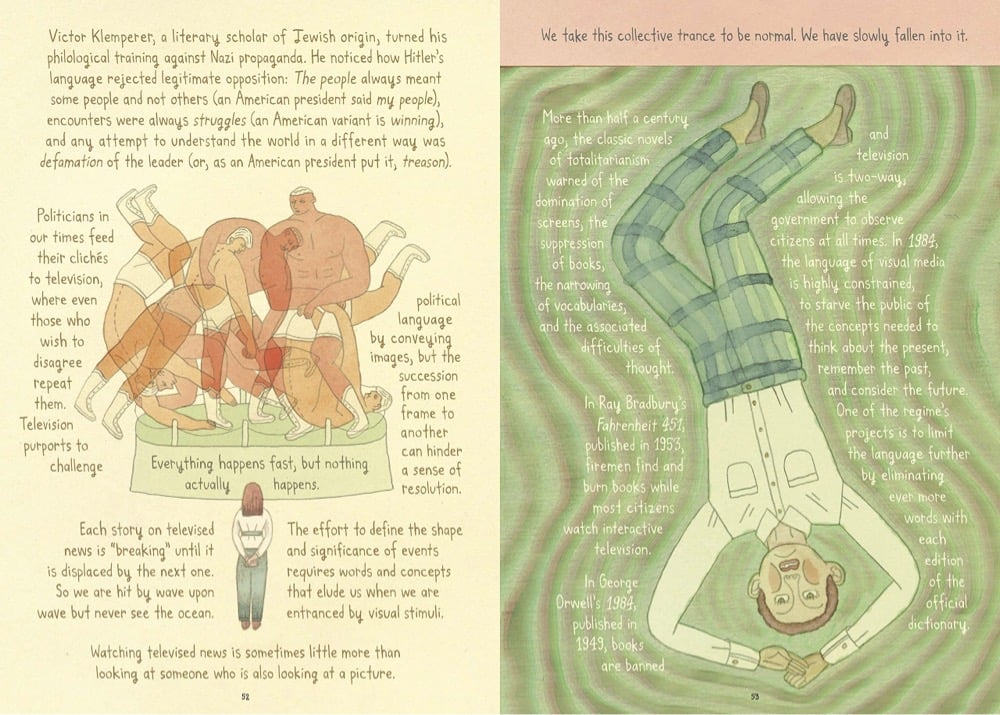
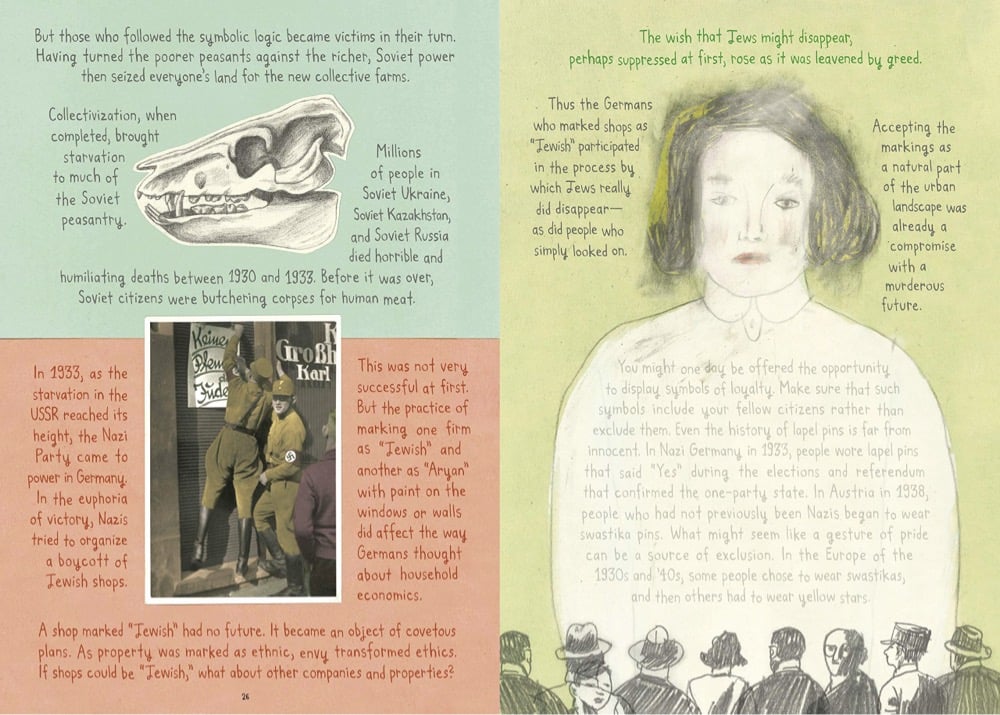
Originally written as a Facebook post in the wake of the 2016 election, Timothy Snyder’s On Tyranny: Twenty Lessons from the Twentieth Century went on to become a bestseller and a prescient warning on what was to come for America. Now, a graphic edition of On Tyranny has been released, designed and illustrated by Nora Krug. From Steven Heller’s piece on the book in Print:
Krug’s goal for this project was to use her medium to echo Snyder’s call for action. “While it was important to me to create images that would highlight the contemporary relevance of Snyder’s message,” she writes, “the use of historic images was clearly essential. At moments in the book that refer to a particular event in time — such as this one about Hitler’s annexation of Austria, when Austrian Nazis captured Jews and forced them to scrub the streets clean — I felt that rather than showing my own visual representation of that event, it was more powerful to feature a historic photograph because of the immediacy of the medium that would make that moment in history come to life.”
Combining Krug’s drawings with historic materials gave her the license to contrast the documentary with the imagined, the factual with the poetic, and to create a narrative tension that emphasizes historical relationships. “More importantly,” she explains, “this combination of mediums allows me to admit to the fact that we don’t exist in a vacuum, that we can only exist in relationship to the past, that everything we think and feel is thought and felt in reference to it, that our future is deeply rooted in our history, and that we will always be active contributors to shaping how the past is viewed and what our future will look like.”
You can order the graphic version of On Tyranny here but it seems to be backordered in most places.
Ed Yong: We’re Already Barreling Toward the Next Pandemic. The US is throwing too little money at high-tech, ultimately private sector solutions but much of the problem comes down to our underfunded public health system and “profoundly unequal society”.
“To be ready for the next pandemic, we need to make sure that there’s an even footing in our societal structures,” Seema Mohapatra, a health-law expert at Indiana University, told me. That vision of preparedness is closer to what 19th-century thinkers lobbied for, and what the 20th century swept aside. It means shifting the spotlight away from pathogens themselves and onto the living and working conditions that allow pathogens to flourish. It means measuring preparedness not just in terms of syringes, sequencers, and supply chains but also in terms of paid sick leave, safe public housing, eviction moratoriums, decarceration, food assistance, and universal health care. It means accompanying mandates for social distancing and the like with financial assistance for those who might lose work, or free accommodation where exposed people can quarantine from their family. It means rebuilding the health policies that Reagan began shredding in the 1980s and that later administrations further frayed. It means restoring trust in government and community through public services. “It’s very hard to achieve effective containment when the people you’re working with don’t think you care about them,” Arrianna Marie Planey, a medical geographer at the University of North Carolina at Chapel Hill, told me.
Within the past 50 years, the global community has solved two huge problems that had the potential to harm every person on Earth. Smallpox once killed 30% of the people who contracted the disease but through the invention of an effective, safe vaccine and an intense effort that began in the 1960s, smallpox was completely eradicated by 1980. In the 1980s, scientists discovered a hole in the ozone layer that protects the Earth from UV radiation; further depletion would have caused major problems with the world’s food supply and an epidemic of skin cancer. Forty years later, we’ve virtually eliminated the chemicals causing the depletion and ozone losses have stabilized and have recently shown improvement.
So how did we do it? The short video above talks through each of challenges, how they were met (science + politics + a bit of luck), and how we might apply these lessons to the big problems of today (climate emergency, the pandemic).
Dr. Alan Braid, a practicing OB/GYN in the state of Texas for 45 years, explains why he provided medical care in the form of an abortion to a woman in violation of the state’s absurd and dangerous new law.
A new Texas law, known as S.B. 8, virtually banned any abortion beyond about the sixth week of pregnancy. It shut down about 80 percent of the abortion services we provide. Anyone who suspects I have violated the new law can sue me for at least $10,000. They could also sue anybody who helps a person obtain an abortion past the new limit, including, apparently, the driver who brings a patient to my clinic.
For me, it is 1972 all over again.
And that is why, on the morning of Sept. 6, I provided an abortion to a woman who, though still in her first trimester, was beyond the state’s new limit. I acted because I had a duty of care to this patient, as I do for all patients, and because she has a fundamental right to receive this care.
I fully understood that there could be legal consequences — but I wanted to make sure that Texas didn’t get away with its bid to prevent this blatantly unconstitutional law from being tested.
Braid concluded his piece: “I believe abortion is an essential part of health care.” Absolutely.
I was 16 years old on the day the Berlin Wall fell. I remember coming home from school that day and watching the events unfold on television, completely shocked at how quickly it had all happened. Politics & protests had been pushing the Eastern Bloc countries toward more openness for years, but before watching this video, I’d never heard that the catalyst for that world-changing event was a short mistaken statement at the end of an otherwise boring press conference. From the BBC:
East German leaders had tried to calm mounting protests by loosening the borders, making travel easier for East Germans. They had not intended to open the border up completely.
The changes were meant to be fairly minor — but the way they were delivered had major consequences.
Notes about the new rules were handed to a spokesman, Günter Schabowski — who had no time to read them before his regular press conference. When he read the note aloud for the first time, reporters were stunned.
“Private travel outside the country can now be applied for without prerequisites,” he said. Surprised journalists clamoured for more details.
Shuffling through his notes, Mr Schabowski said that as far as he was aware, it was effective immediately.
In fact it had been planned to start the next day, with details on applying for a visa.
But the news was all over television — and East Germans flocked to the border in huge numbers.
How did the Berlin Wall fall? Two ways. Gradually, then suddenly.
Charles Gaba has been graphing the Covid-19 vaccination rates of the 50 states (and DC) against the percentage of people who voted for Donald Trump in 2020 and there is unsurprisingly a clear correlation between the two:

As one commenter noted, all of the solidly “blue” states are above the vaxxed national average and all the solidly “red” states are below it. The picture is a little more muddy when you look at the rates at the county level:
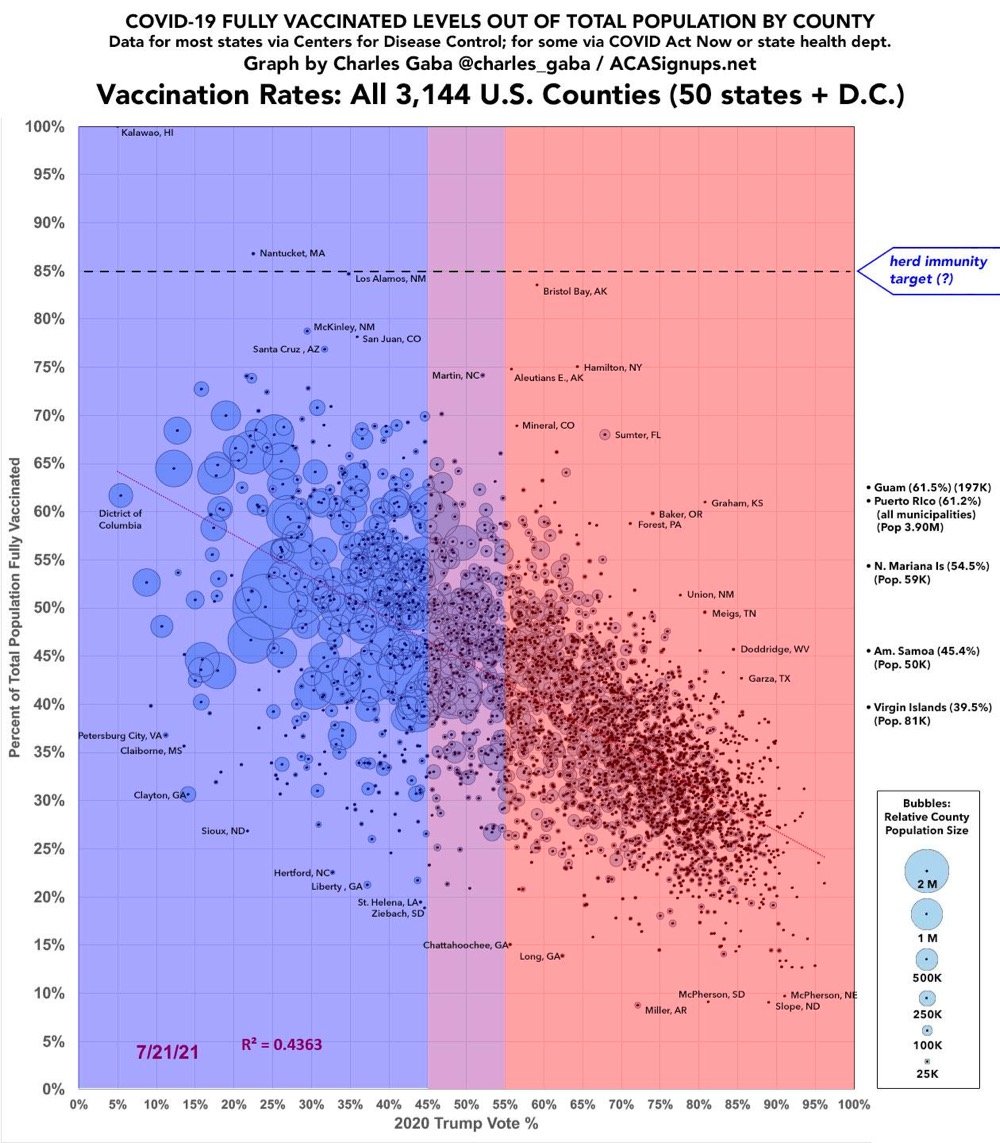
The “conservatives are unvaxxed” trend is still there, but a lack of access and education around the vaccines in counties with large Black and Latino populations also plays a large role in whether people are vaccinated or not.
This is quite a paragraph from David Bentley Hart’s Three Cheers for Socialism in Commonweal:
Americans are, of course, the most thoroughly and passively indoctrinated people on earth. They know next to nothing as a rule about their own history, or the histories of other nations, or the histories of the various social movements that have risen and fallen in the past, and they certainly know little or nothing of the complexities and contradictions comprised within words like “socialism” and “capitalism.” Chiefly, what they have been trained not to know or even suspect is that, in many ways, they enjoy far fewer freedoms, and suffer under a more intrusive centralized state, than do the citizens of countries with more vigorous social-democratic institutions. This is at once the most comic and most tragic aspect of the excitable alarm that talk of social democracy or democratic socialism can elicit on these shores. An enormous number of Americans have been persuaded to believe that they are freer in the abstract than, say, Germans or Danes precisely because they possess far fewer freedoms in the concrete. They are far more vulnerable to medical and financial crisis, far more likely to receive inadequate health coverage, far more prone to irreparable insolvency, far more unprotected against predatory creditors, far more subject to income inequality, and so forth, while effectively paying more in tax (when one figures in federal, state, local, and sales taxes, and then compounds those by all the expenditures that in this country, as almost nowhere else, their taxes do not cover). One might think that a people who once rebelled against the mightiest empire on earth on the principle of no taxation without representation would not meekly accept taxation without adequate government services. But we accept what we have become used to, I suppose. Even so, one has to ask, what state apparatus in the “free” world could be more powerful and tyrannical than the one that taxes its citizens while providing no substantial civic benefits in return, solely in order to enrich a piratically overinflated military-industrial complex and to ease the tax burdens of the immensely wealthy?
I mean, when you put it like that…
Olga Khazan writing for The Atlantic:
After an inept coronavirus response, will the United States do better when the next pandemic strikes? Experts generally agree that America learned from the past year, and that the next public-health crisis won’t be quite as bewildering. But America’s pandemic preparedness still has major gaps, some of which are too big for any one administration to fix. In recent weeks, I’ve called back many of the experts I interviewed over the past 18 months about masks, testing, contact tracing, quarantine, and more. I asked them, “Are we ready for another one?” The short answer is “Not quite.” The long answer is that being truly “ready” will be harder than anyone realizes.
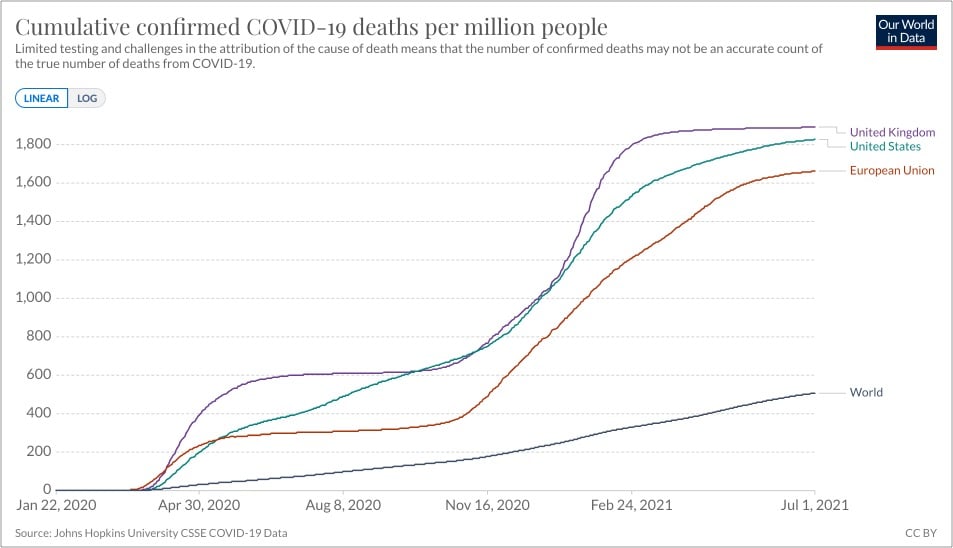
The Trump administration mishandled the American response to Covid-19 so completely that it’s tempting to pin most of the pandemic carnage on him. But the more I read about the pandemic (Michael Lewis’s The Premonition is a recent example), the more I have come to believe that the majority of the American pandemic deaths were baked in, no matter who was President. Trump was definitely a worst-case scenario, but even a more competent person in the White House in Jan 2020 (like Clinton or Sanders or Romney) would not have done so much better. Poor public health infrastructure, politicized government agencies, no mandatory paid leave, an overpriced healthcare system that only works for some, uncoordinated national response (+ federalism), years of defunding government programs, a reactive (rather than proactive) CDC, unhealthy populace, poverty, systemic racism in medicine, entitled individualism, high rate of uninsured people, growing anti-science sentiment — the pandemic was destined to race through the United States like a brush fire no matter what.
Even the European Union, whose member nations do not share many of America’s aforementioned challenges (but have other issues), did only marginally better than the US in preventing Covid deaths. The UK did worse:
This is an incredible video investigation by the NY Times of the January 6th attack on Congress by terrorists, rioters, and supporters of Donald Trump. They analyzed hundreds of videos, police bodycam footage, and police communications to reconstruct a minute-by-minute account of the Capital breach.
From the accompanying article of six takeaways from the investigation:
Most of the videos we analyzed were filmed by the rioters. By carefully listening to the unfiltered chatter within the crowd, we found a clear feedback loop between President Trump and his supporters.
As Mr. Trump spoke near the White House, supporters who had already gathered at the Capitol building hoping to disrupt the certification responded. Hearing his message to “walk down to the Capitol,” they interpreted it as the president sending reinforcements. “There’s about a million people on their way now,” we heard a man in the crowd say, as Mr. Trump’s speech played from a loudspeaker.
The call and response didn’t stop there. We found evidence of his influence once the violence was well underway. In one moment, a woman with a megaphone urged rioters to climb through a broken window by asking them to “stand up for our country and Constitution” — echoing the language in an earlier tweet from Mr. Trump. In another, as the police were pushing to clear the mob off the building, a rioter screamed at officers: “I was invited here by the president.”
It is astonishing to me how close we came to having a hostage or assassination situation with members of Congress and the Vice-President — like literal seconds and minutes away — and how is this not the only topic of conversation over the past 6 months in our country? And not only that, it’s clear that we’re not really going to do anything about it, aside from beefing up Capitol security and imprisoning some of the insurrectionists. This isn’t over — as the video’s narration states near the end: “The forces that brought them there have not gone away.”
Update: From Brian Stelter’s Reliable Sources newsletter:
But Rangappa could have also been talking about CNN’s efforts in court to obtain riot footage; or ProPublica’s recent investigation that indicated “Senior Trump Aides Knew Jan. 6 Rally Could Get Chaotic;” or Just Security’s new “clearinghouse” for riot research. Her broader point is spot on: Newsrooms have been putting the January 6 puzzle pieces together, creating a detailed rough draft of history, in spite of partisan efforts to bury that history.
For the Washington Post, Michele Norris wonders what it will take for the US to finally and fully acknowledge its history of slavery.
America experienced 246 years of slavery before it was officially ended with the passage of the 13th Amendment. That was followed by decades of legal segregation and oppression under Jim Crow, followed by a period of willful blindness and denial. A tourist from a foreign land might well conclude that the Confederacy had actually won the Civil War, based on the number of monuments, buildings and boulevards still named for heroes of its defeated army. The real truth of our shared history was a casualty of that war and, like any wound left untended, the results can be catastrophic.
A full accounting of slavery is one of terror and trauma, and for decades the natural inclination was to ask, why would anyone want to claim that history? But at a moment when the United States is dangerously divided, when we are having bitter and overdue conversations about policing, inequality and voting rights, when marauders fueled by white-nationalist rhetoric can overwhelm the Capitol, proudly waving the Confederate battle flag, the more important question is this: What happens if we don’t?
She uses Germany’s remembrance and examination of Nazism and the Holocaust as an example of a country that has properly faced up to its terrible past in order to move fully forward.
Vergangenheitsaufarbeitung refers to Germany’s efforts to interrogate the horrors of the Holocaust and the rise of Nazism. It has been a decades-long exercise, beginning in the 1960s, to examine, analyze and ultimately learn to live with an evil chapter through monuments, teachings, art, architecture, protocols and public policy. The country looks at its Nazi past by consistently, almost obsessively, memorializing the victims of that murderous era, so much so that it is now a central feature of the nation’s cultural landscape. The ethos of this campaign is “never forget.”
I visited Germany back in 2018 and its efforts to engage with past horrors were quite noticeable and stood in stark contrast to American activity along similar lines.
In particular, as a nation the US has never properly come to terms with the horrors it inflicted on African Americans and Native Americans. We build monuments to Confederate soldiers but very few to the millions enslaved and murdered. Our country committed genocide against native peoples, herded them onto reservations like cattle, and we’re still denying them the right to vote.
As Norris convincingly argues, “it is long past time to face where truth can take us”.
Yale historian Timothy Snyder has been one of the most prominent & insistent voices warning against the rise of authoritarianism & fascism in the United States in recent years — you may remember his 20 lessons from the 20th century on fighting authoritarianism from November 2016 and his more recent piece on the right’s coup attempt on January 6th.
Over the weekend, Snyder published a short piece about what he believes will happen as a result of the 1/6 insurrection and the Republicans’ ongoing effort to push their Big Lie about election fraud — basically the end of democracy in America.
I have the Cassandra feeling this spring because it is so obvious where all of this is heading. President Trump tells a big lie that elections are rigged. This authorizes him and others to seek power in extra-democratic ways. The lie is institutionalized by state legislation that suppresses voting, and that gives state legislatures themselves the right to decide how to allocate the electoral vote in presidential elections.
The scenario then goes like this. The Republicans win back the House and Senate in 2022, in part thanks to voter suppression. The Republican candidate in 2024 loses the popular vote by several million and the electoral vote by the margin of a few states. State legislatures, claiming fraud, alter the electoral count vote. The House and Senate accept that altered count. The losing candidate becomes the president. We no longer have “democratically elected government.” And people are angry.
No one is seeking to hide that this is the plan. It is right there out in the open. The prospective Republican candidates for 2024, Donald Trump, Ted Cruz, and Josh Hawley, are all running on a big lie platform. If your platform is that elections do not work, you are saying that you intend to come to power some other way. The big lie is designed not to win an election, but to discredit one. Any candidate who tells it is alienating most Americans, and preparing a minority for a scenario where fraud is claimed. This is just what Trump tried in 2020, and it led to a coup attempt in January 2021. It will be worse in January 2025.
Like he says, so obvious and out in the open. As far as I’m concerned, this is a done deal and there’s not a lot that can be done to stop it. The horse left the barn some time ago and most people can’t even tell the door is open, much less that it needs closing.
Sean Donnelly’s mother got sucked into the world of QAnon conspiracy theories, so he made a little video about it, including documenting some bets he made with her about whether or not Biden would still be in office 3 months after the inauguration or if Tom Hanks & Oprah would soon be arrested for pedophilia. Remember when Baby Boomers were all concerned that the internet was going to be harmful for their Gen X and Millennial children and grandchildren? And now all these Boomers are getting brainwashed by Facebook and Fox News? Good stuff. :|
See also QAnon, Conspiracy Theories, and the Rise of Magical Thinking, What Can You Do About QAnon?, Sacha Baron Cohen Says Tech Companies Built the “Greatest Propaganda Machine in History”, Living in a Conspiracy Nation, In Search of a Flat Earth, and My Dad, the Facebook Addict. (via waxy)
For The Atlantic, Luke Savage writes that Democrats have to put their money where their mouth is when it comes to protecting American democracy.
If you’ve followed recent Democratic messaging, you’ll have heard that American democracy is under serious attack by the Republican Party, representing an existential threat to the country. If you’ve followed Democratic lawmaking, you’d be forgiven for thinking that the threat is actually a rather piddling one. The disconnect, in this case, isn’t attributable to Democratic embellishment, but to inexcusable complacency.
Without meaningfully reforming the rules of the Senate, the Biden administration & Congressional Democratic leadership basically gets to pass one substantial bill per year (through budget reconciliation). That’s it. If Democrats lose the House in 2022, which seems likely or even certain without the passage of a federal voting rights bill, then it’s only one or two bills. And then maybe Democrats don’t see the White House, a Senate majority, and a House majority for a generation and we’ll all have to ask ourselves whether we actually like living in a de facto nationalistic one-party state.
Newer posts
Older posts





Socials & More