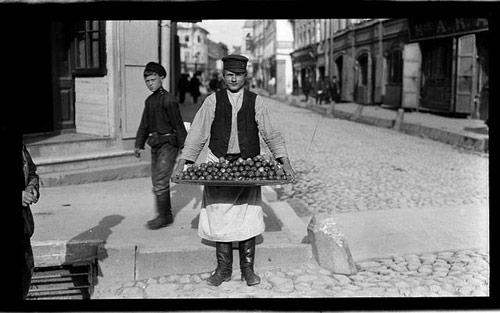
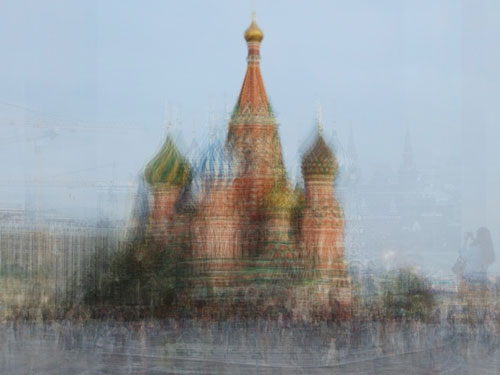
Murray Howe travelled around Europe in 1909 and these photos of Moscow uploaded to Flickr by his great grandson.
Howe was arrested and detained several times in Russia and Germany for taking unauthorized photographs but still managed to bring his entire collection of photos home with him.
Two hundred and fifty thousand troops were in formal review before the Kaiser. Suddenly a tall, sloping shouldered foreigner stepped into the open, leveled his graflex and snapped it. “Take me to the official photographer,” he suggested, when, the next instant, astounded sword bearers fell upon him from every quarter.
A few minutes later, he had the official picture maker deep in an enthusiastic conversation over some prints showing his work on another day, when foggy weather had foiled the official camera.
After that, it was merely human nature for the Kaiser’s photographer to have his Yankee friend released, and gracefully to exchange prints with him.
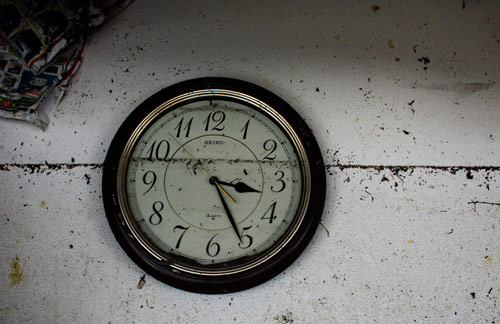
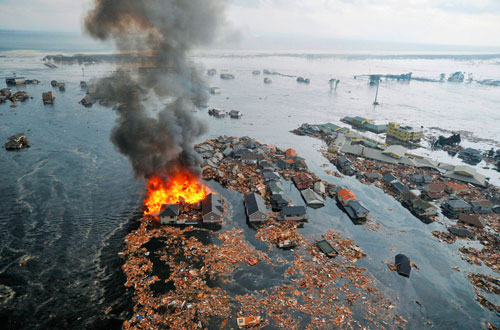
This photo was taken recently by Sergey Ponomarev in Miyagi Prefecture in northeastern Japan:
The line on the wall is the high water mark from the March 11 tsunami and the time on the clock is when the water crested (Wikipedia puts the max readings right around 15:20 local time). Each element alone is documentation of a thing…together they tell a story.
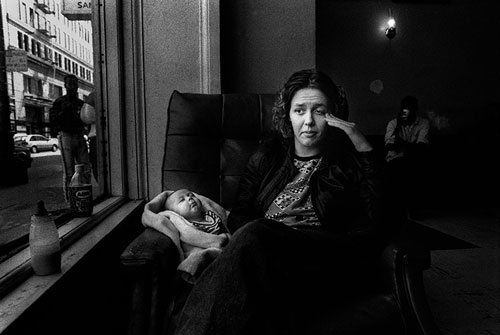
I have a soft spot for storytelling clocks in photos. Joseph Koudelka’s 1968 photo of the empty streets of Prague before the Soviet crackdown of The Prague Spring is one of my favorite photos. And obviously I love the photo taken by my wife of me holding my son Ollie when he was exactly 20 mintues old. It was the first time I’d held him and oh crap I’m crying at work again… (via in focus)
From the NY Times Lens blog, a photo essay by Diana Markosian featuring a Ukrainian town near Chernobyl where only five families remain; the rest of the 1000 original residents evacuated after the disaster 25 years ago.
But life can be grim and lonely. Twenty-five years ago, Ms. Masanovitz was a nurse. Her husband was a farmer on a collective farm. Now he spends his time drinking.
While she was photographing the couple one day, Ms. Markosian watched as Ms. Masanovitz picked up the phone in astonishment. It was the first time it had worked in a year.
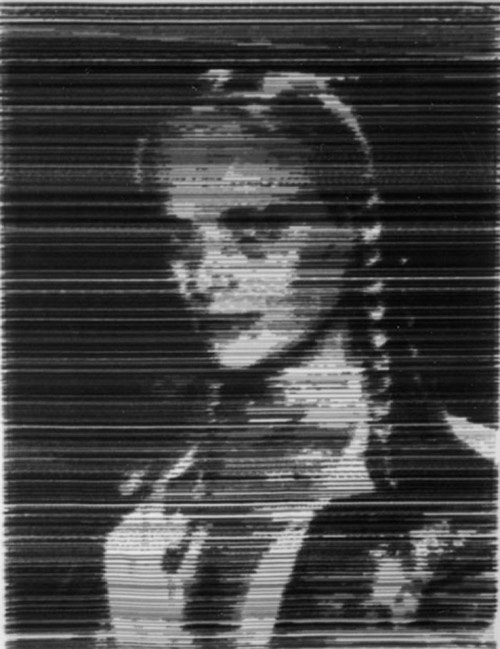
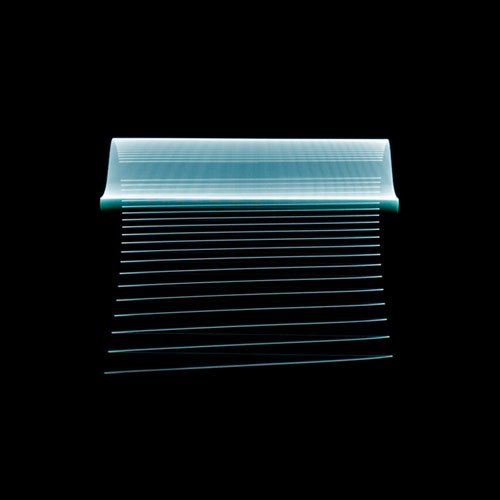
In the late 70s, Anton Perich built something resembling an inkjet printer to make large-scale paintings like this:
The photography section of Perich’s web site is also worth a look…lots of photos of the Warholish NYC scene in the 70s and 80s: Warhol, Jagger, Mapplethorpe, John Waters, etc. (via today and tomorrow)
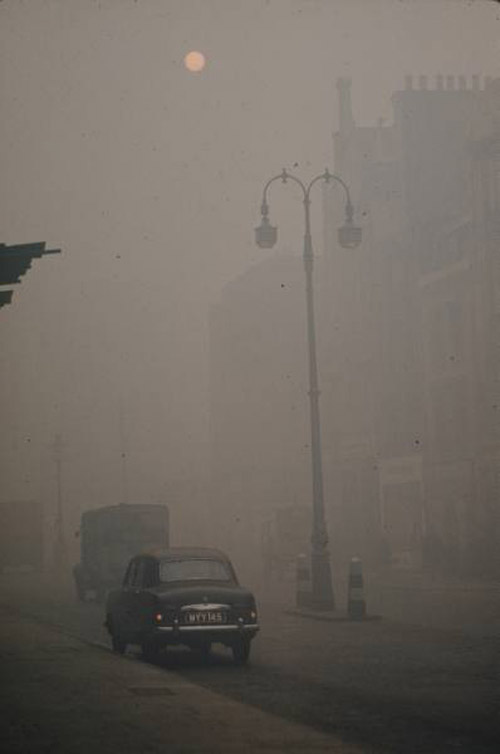
In December 1952, a thick smog settled over London for several days. This was a particularly bad episode of the London Fog, which was hardly a natural occurrence…the “fog” was mostly due to the burning of soft coal. It is now thought that the Great Smog resulted in around 12,000 deaths.
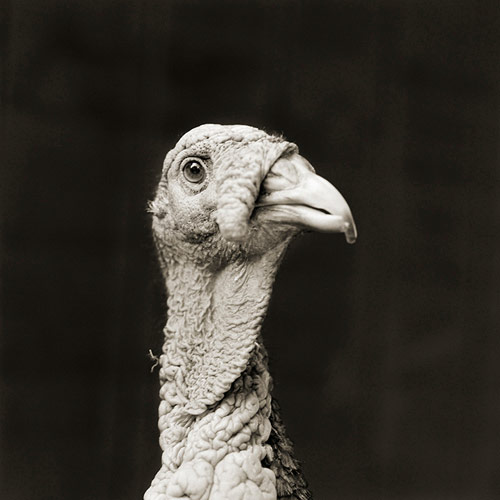
Photographer Isa Leshko is traveling to sanctuaries across the country to photograph animals that are elderly or at the end stage of their lives. “I began the series as a means of exploring my feelings about my mother’s decline due to Alzheimer’s Disease,” she says. “As I’ve worked on this project, though, I’ve come to realize that these images are a testament to survival and endurance. And they raise questions about what it means to be elderly.”
No discernible voice/tone in this writing. Rambling descriptions. I, frankly, do not care where each and every person is seated. I don’t care what shoe you’re wearing. If you take out all the unnecessary details, you’d be left with about seven words.
What a great idea…Noah Kalina, Adam Lisagor, William Wilkinson, and Oliver White made an iPhone app that helps you remember to take a daily photo of yourself inspired by Noah’s Everyday project.
I cobbled together this set up out of the desire to properly archive my design work. Next thing I knew I started getting paid for it, and it became an integral part of my work. I am simply listing my equipment and a little bit about what I know to get some designers started in figuring out the best way to shoot their own work.
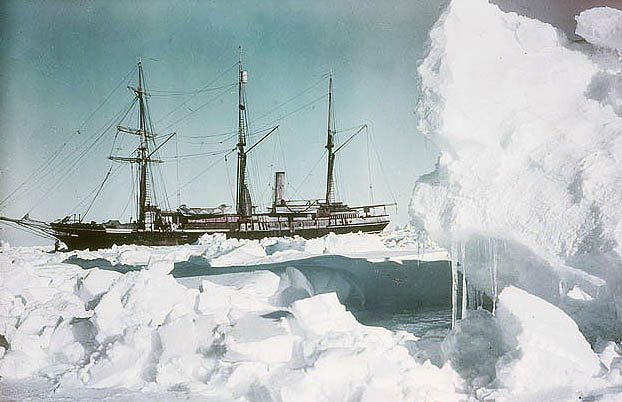
Early in 1915, their ship ‘Endurance’ became inexorably trapped in the Antarctic ice. Hurley managed to salvage the photographic plates by diving into mushy ice-water inside the sinking ship in October 1915.
The MoMA retrospective will be thematic. There will be rooms devoted to Ms. Sherman’s explorations of subjects like the grotesque, with images of mutilated bodies and abject landscapes, as well as a room with a dozen centerfolds, a takeoff of men’s magazines, in which she depicts herself in guises ranging from a sultry seductress to a vulnerable victim. There will also be a room that shows her work critiquing the fashion industry and stereotypical depictions of women.
Alan Taylor, late of The Big Picture, is up and running at The Atlantic with his new site, In Focus.
In Focus is The Atlantic’s news photography blog. Several times a week, I’ll post entries featuring collections of images that tell a story. My goal is to use photography to do the kind of high-impact journalism readers have come to expect on other pages of this site. Along the way, I’ll cover a range of subjects, from breaking news and historical topics to culture high and low. Sometimes, I’ll just showcase amazing photography.
I almost stopped reading this about halfway through because she wouldn’t stop having children, but it’s worth sticking it out until the end. (via dooce)
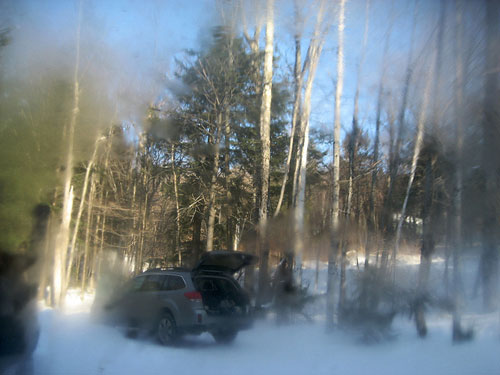
As I mentioned on Twitter, we got Ollie a camera for Christmas and set it up to post automatically to Flickr. He loves it so far, and it’s been fascinating to see how he sees the world…which is mostly low-angle and mundane. The account is private, but here are a few of my favorite shots of his:
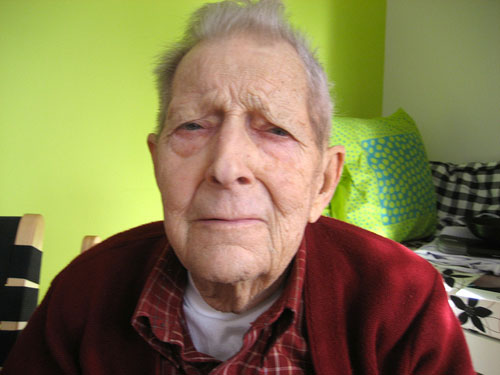
Ollie’s great grandpa
Looking out the door (note the low angle)
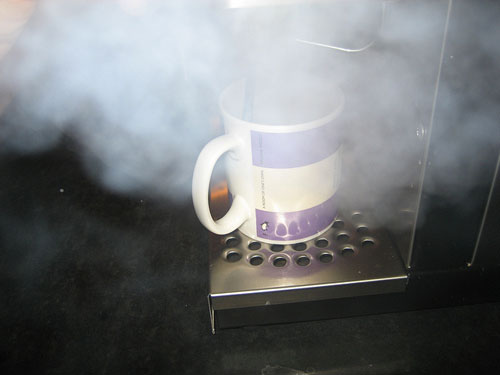
Making espresso
But often the camera is a tool for him. Yesterday morning we were trying to build a boat out of blocks…”the same as we built last week,” Ollie said to me. I couldn’t remember how we’d built the boat last week and Ollie couldn’t really describe it or duplicate it by himself. “We should have taken a picture of it. Then we would remember,” he said. And a couple of weeks ago, his toy computer (basically a glorified Speak N’ Spell) ran out of batteries and when he came running in to the kitchen to tell me, he held up his camera with a photo of the computer in question, “see Daddy, the screen’s not working”…as if I wasn’t going to take his word for it.
After I tweeted about the camera, a number of people asked what setup we were using. We had an old Powershot SD450 laying around, so we gave him that instead of buying a kids camera. Ollie’s three and a half now and pretty conscientious; he doesn’t throw stuff around or smash things so we figured we could trust him with an actual camera. And for the most part, he’s been really good with it. He puts the cord around his wrist so the camera won’t fall on the floor if it slips out of his hands. For the first few days, he was accidentially sticking his fingers in the lens area and that caused the little shutter that covers the lens when the camera is off to stick a little bit, but he stopped doing that and learned how to fix the sticky shutter himself. He sometimes gets stuck in a weird menu after pushing too many buttons, but mostly he knows how to get in and out of the menus. He knows how to use the zoom and can shoot videos. He also can tell when the battery is running out and knows how to remove the battery to recharge it. Giving an “adult” camera to a three-year-old may seem like a recipe for confusion and broken electronics, but I’m continually amazed at kids’ thirst for knowledge and empowered responsibility.
For the automatic uploading to Flickr, we put an Eye-Fi card in the camera. The Eye-Fi is a regular SD memory card with built-in wireless networking…the low-end 4GB card is only $45 on Amazon. And you can link the card to a Flickr account so that when the camera is on and in range of a trusted wifi network, the photos are automatically uploaded. Pretty simple once you get it set up.
Two and a half years ago, Alan Taylor started The Big Picture at the Boston Globe; he basically ran the site in his spare work time as a web developer for the company. Now he’s moving on to The Atlantic, where he will edit a new photo site called In Focus.
I wanted the opportunity to do this — telling news photo stories — as a fulltime job, and the Atlantic has offered that to me, for which I am grateful. I also think the Atlantic is a better overall fit for the type of international, wide-ranging storytelling I’ve practiced over the years. The Globe has been a good home and a great platform for over 425 entries since 2008 and I am truly grateful, but I’ve chosen to move on now, and really hope you’ll come along and see what I’m up to. I feel very fortunate for what I’ve been able to accomplish to date, and for the opportunity given to me now. I really can’t believe this is going to be my fulltime gig!
Smart move by The Atlantic, which is increasingly looking like one of the media properties that may make a smooth-ish transistion from print to online/app media. As for The Globe, well, I don’t think they quite knew what they had there. Eight million page views per month out of nothing with a less-than-maximal effort…that’s the kind of thing you want to encourage if you’re in the media business.
My pal Mouser has started a sand collection and is using a macro lens to take photos of each sample. This sample was collected in Hawaii.
The green grains are olivine, the black are basalt, and the white are possibly bits of shell. Green sand is reasonably rare; the southern tip of the big island of Hawai’i is the most common place to get it.
A really lovely seven-minute documentary about Scott Schuman, aka The Sartorialist.
Watching the concentration, focus, and determination in Schuman’s eyes and body as he walks around looking for photographic subjects immediately reminded me of an elite athlete; that same look was documented at length in Zidane, A 21st Century Portrait. And that’s no accident…what Schuman does is an athletic pursuit as much as anything else. The way he holds his camera while walking, down by his side, slightly behind his back, hiding it from his potential subjects until he sees an opening…he’s like a running back cradling a football, probing for an opening in the defensive line.
Note: If you are a member and tried to log in, it didn't work, and now you're stuck in a neverending login loop of death, try disabling any ad blockers or extensions. Or try logging out and then back in. Still having trouble? Email me!






Socials & More