kottke.org posts about patents
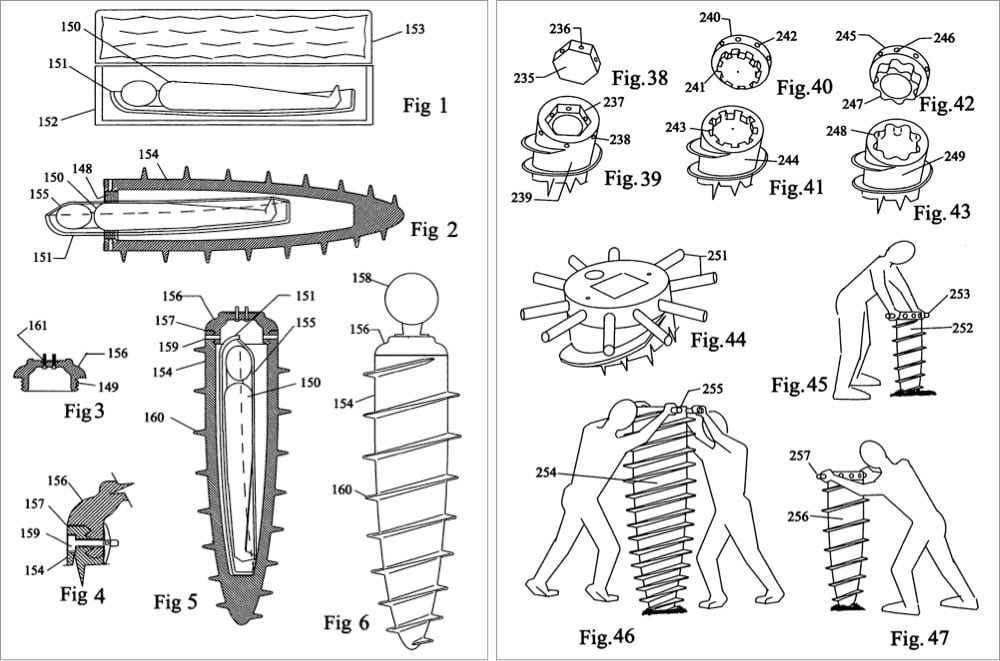
In 2009, mechanical engineer Donald Scruggs received a patent for a hermetically sealed coffin that can be screwed into the ground. David Friedman made a short documentary about Scruggs and his screw-in coffin.
I was with some friends having a couple of drinks and one of them mentioned he had to go talk to some people about an automatic grave digger, which meant a huge amount of dirt removal. And I said, “Why don’t we just make a big large carrot shaped thing with threads around it and screw it into the ground?”
Scruggs says that burying someone in his coffin is “no more trouble than putting a fencepost in”.
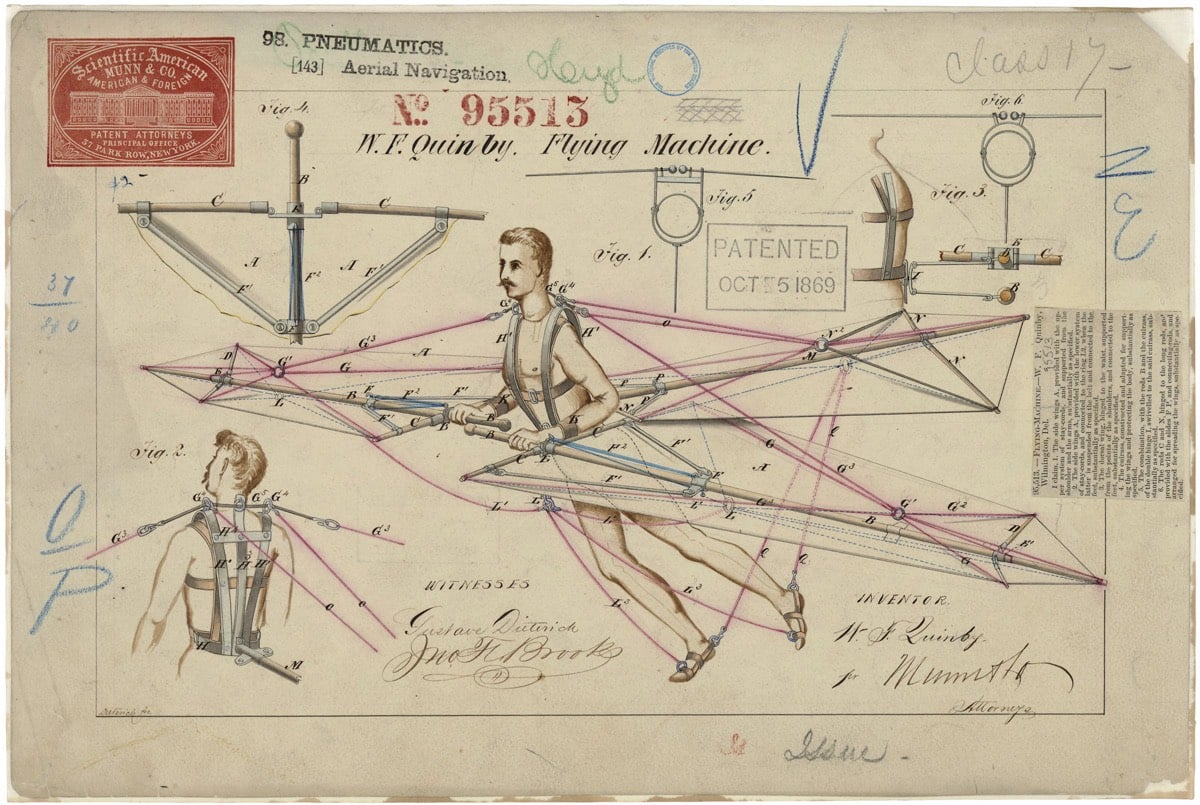
From the catalog of the National Archives, a drawing from US Patent #95513 filed by W.F. Quinby in 1869 for “Improvement in Flying-Machines”. This could easily be the cover of a lost 2003 Neutral Milk Hotel album. (via @john_overholt)
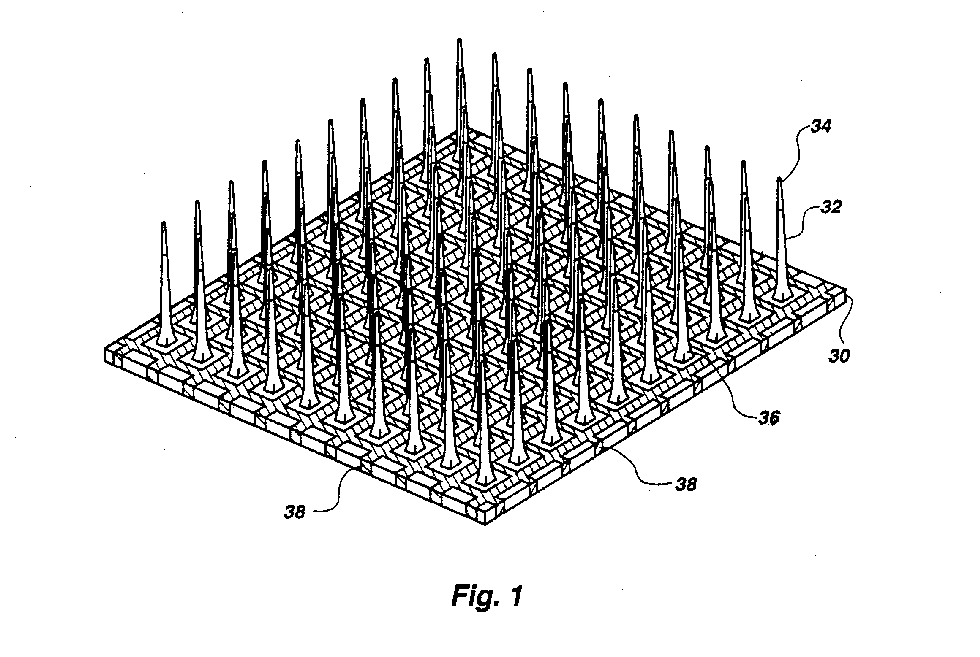
Popular Mechanics has a quick look at 15 Patents That Changed the World, including the maglev train from back in 1967, the 3d printer, a “bionic eye” retinal prosthesis from 1968, GPS, CRISPR-Cas9, and graphene. Fun to read through but I’m including it here because it was found through Chris Anderson who had this comment:
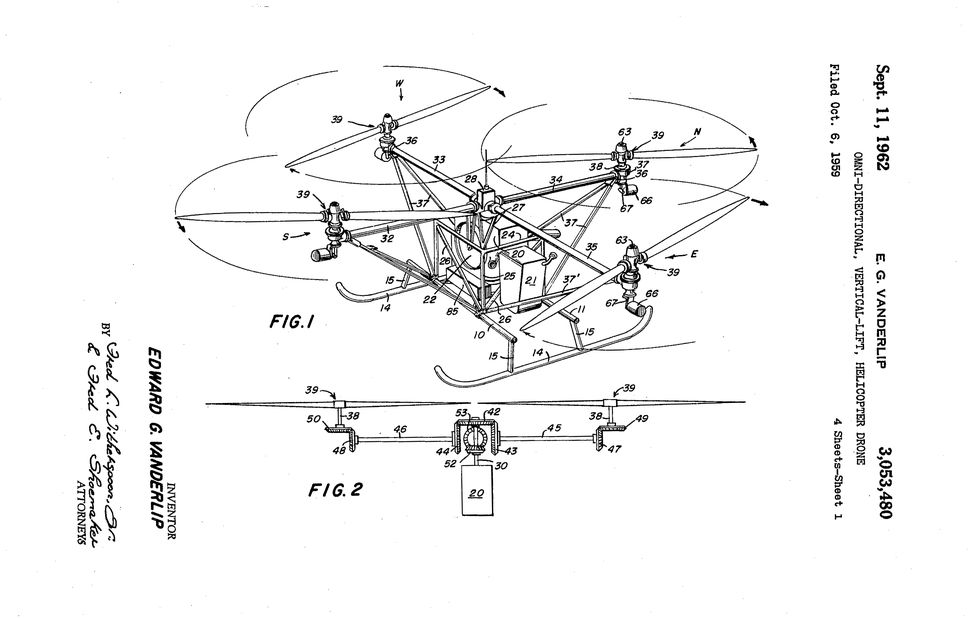
Earlier today I tweeted this Boing Boing post about the upcoming US public domain infusion, the first since 1998. In the case of both patents and copyright, it’s important to remember the innovation and creativity their release provides, not just the original work or invention it represents.
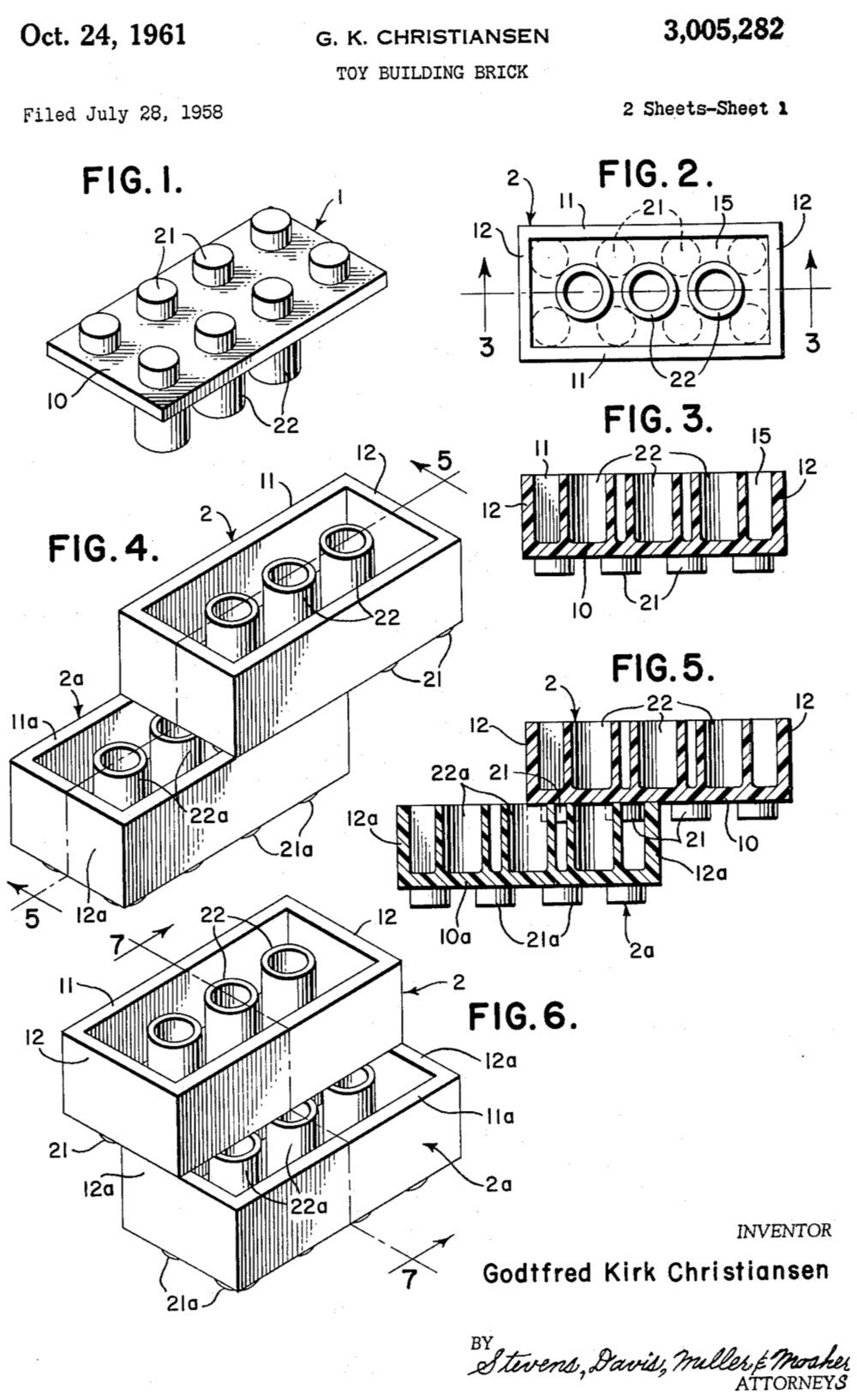
This is one of two drawings that accompanied Godtfred Kirk Christiansen’s US patent application for the Lego toy building brick. The application was submitted 60 years ago yesterday on Jan 28, 1958, an occasion that is celebrated annually as International LEGO Day. (thx, david)
Dang, Tesla just announced they’re letting anyone use their patented technology. CEO Elon Musk:
Yesterday, there was a wall of Tesla patents in the lobby of our Palo Alto headquarters. That is no longer the case. They have been removed, in the spirit of the open source movement, for the advancement of electric vehicle technology.
Tesla Motors was created to accelerate the advent of sustainable transport. If we clear a path to the creation of compelling electric vehicles, but then lay intellectual property landmines behind us to inhibit others, we are acting in a manner contrary to that goal. Tesla will not initiate patent lawsuits against anyone who, in good faith, wants to use our technology.
Damn good move for a damn good reason. It’s impressive to watch this company in action.
Update: I read that last line quoted above again and perhaps “abandoned” is too strong a word. Glenn Fleishman notes on Twitter:
They did not abandon their patents. They aren’t apparently even licensing them. They are stating they won’t sue except defensively. The devil is in the details. Twitter released a complete framework of their policy when they announced the same thing.
Hopefully Musk and co. will clarify what they mean by “in good faith”.
David Friedman profiles Martin Goetz, who received the very first software patent granted by the US Patent Office in 1968.
Goetz’s patent is here.
Twitter has developed something called the Innovator’s Patent Agreement, which is an agreement between the company and its employees that their patents won’t be used in offensive lawsuits (as opposed to defensive lawsuits).
The IPA is a new way to do patent assignment that keeps control in the hands of engineers and designers. It is a commitment from Twitter to our employees that patents can only be used for defensive purposes. We will not use the patents from employees’ inventions in offensive litigation without their permission. What’s more, this control flows with the patents, so if we sold them to others, they could only use them as the inventor intended.
This is a significant departure from the current state of affairs in the industry. Typically, engineers and designers sign an agreement with their company that irrevocably gives that company any patents filed related to the employee’s work. The company then has control over the patents and can use them however they want, which may include selling them to others who can also use them however they want. With the IPA, employees can be assured that their patents will be used only as a shield rather than as a weapon.
Red Hat has had a similar policy in place for many years.
Loren Brichter invented the “pull to refresh” interface mechanism for Tweetie, a Twitter app he eventually sold to Twitter. Apparently he patented the idea sometime before the sale, so Twitter now owns the patent.
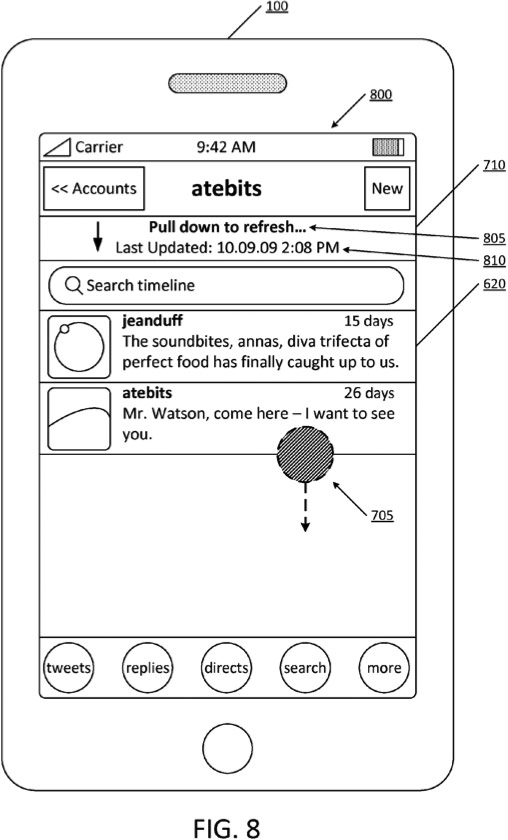
Paul Haddad of Tapbot says that Twitter won’t enforce the patent but, gosh, where have we heard that before?
Update: A reader pointed out that this is not a patent…it’s a patent application that hasn’t even been reviewed yet. But it’s clearly a novel invention and most likely will be accepted when reviewed. (thx, mike)
Finally got around to listening to the excellent episode of This American Life on patents: When Patents Attack! The episode surveys the state of the US patent system, using Nathan Myhrvold’s smarmy Intellectual Ventures as a hook to tell the story.
In polls, as many as 80 percent of software engineers say the patent system actually hinders innovation. In other words, it does exactly the opposite of what it’s supposed to do. It doesn’t encourage them to come up with new ideas and create new products, it actually gets in their way.
The Economist chimed in as well, saying that the American patent system is “a travesty which threatens the wealth and welfare of the whole world”.
At a time when our future affluence depends so heavily on innovation, we have drifted toward a patent regime that not only fails to fulfil its justifying function, to incentivise innovation, but actively impedes innovation.
Google has filed a patent that might eliminate the need for mobile phone users to choose a single network. Instead, a piece of software would poll all available networks and select the most appropriate one based on price.
Devices using the system would send networks a description of their requirements — for example, a phone call or access to the internet — and receive back bids with a per-minute cost, or flat rate, at which those needs could be met. Users can either manually accept the bid that looks best to them, or have the phone choose one automatically, based on pre-programmed criteria.
Besides being a brain-dead obvious idea — nice work once again, USPTO — if a system like this were put in place, calling Mom on Mother’s Day would get a whole lot more expensive, as would calls and data usage during other peak times or locations.
Update: I’m reminded that this is just an application, not an accepted patent, so my “nice work” comment doesn’t apply. But I would imagine that patents coming from Google have little trouble getting accepted. (thx, mike)
Did Alexander Graham Bell drink Elisha Gray’s telephone-flavored milkshake?
On May 22, 1886, The Washington Post published a shocking front-page scoop: Zenas F. Wilber, a former Washington patent examiner, swore in an affidavit that he’d been bribed by an attorney for Alexander Graham Bell to award Bell the patent for the telephone over a rival inventor, Elisha Gray, who’d filed a patent document on the same day as Bell in 1876.
Even though Bell has been legally vindicated on this issue, Seth Shulman’s new book, The Telephone Gambit, suggests that he did in fact steal a key idea from Elisha Gray. (via house next door)
According to the person who filed a re-examination request, the US Patent Office has rejected a number of broad claims related to Amazon’s one-click patent.
In its Office Action released 9 October 2007, the Patent Office found that the prior art I found and submitted completely anticipated the broadest claims of the patent, U.S. Patent No. 5,960,411.
The patent is not off the books yet…Amazon has a chance to respond before that happens. People have been waiting for this for a long time. (via marginal revolution)
A 1993 New Yorker story by John Seabook called The Flash of Genius is being made into a movie starring Greg Kinnear. The story revolves around Bob Kearns, the inventor of the intermittent windshield wiper and his struggle to get the US auto industry to pay him for infringing on his patent. “There’s no question that Dr. Kearns’ wiper circuit was interesting. He had a three-brush motor, with dynamic brake and intermittent on one speed only — his system was a concatenation of a lot of different ideas. But we figured there was just no way in the world it was patentable. An electronic timing device was an obvious thing to try next. How can you patent something that is in the natural evolution of technology?”
BTW, the phrase “flash of genius” refers to a test of patentability enacted in 1941 saying that the act of invention had to be a “flash of creative genius” on the part of the inventor and not the result of tinkering. That standard was replaced in 1952 by the non-obviousness test.
A couple of days ago, I pointed to a patent filed by the Flickr folks for the concept of interestingness. I should have poked around a bit more because there’s a related patent filed by the Flickr and Josh Schachter of del.icio.us concerning “media object metadata association and ranking”. I’m not a big fan of software patents, but even so, I can’t see the new, useful, nonobvious invention here. I also find it odd that these patents reference exactly zero prior inventions on which they are based…compare with Larry Page’s patent for PageRank.
Older posts




Socials & More